Anglès
PAU 2018 · extraordinària · sèrie 3
Examen oficial de la PAU de Catalunya amb la pauta de correcció. És d’una convocatòria anterior al model 2025: la pauta correspon a aquell examen.
Instruccions de l’examen
Part 1: Choose the best answer according to the text. Only ONE answer is correct. [3 points: 0.375 points for each correct answer. Wrong answers will be penalized by deducting 0.125 points. There is no penalty for unanswered questions.]
Part 2: Choose ONE topic. Write about number 1 or 2. Minimum length: 100 words. [4 points]
Part 3: Choose the best answer according to the recording. Only ONE answer is correct. [3 points: 0.375 points for each correct answer. Wrong answers will be penalized by deducting 0.125 points. There is no penalty for unanswered questions.]
Exercici 1
Part 1: Reading comprehension
 Toca per ampliar
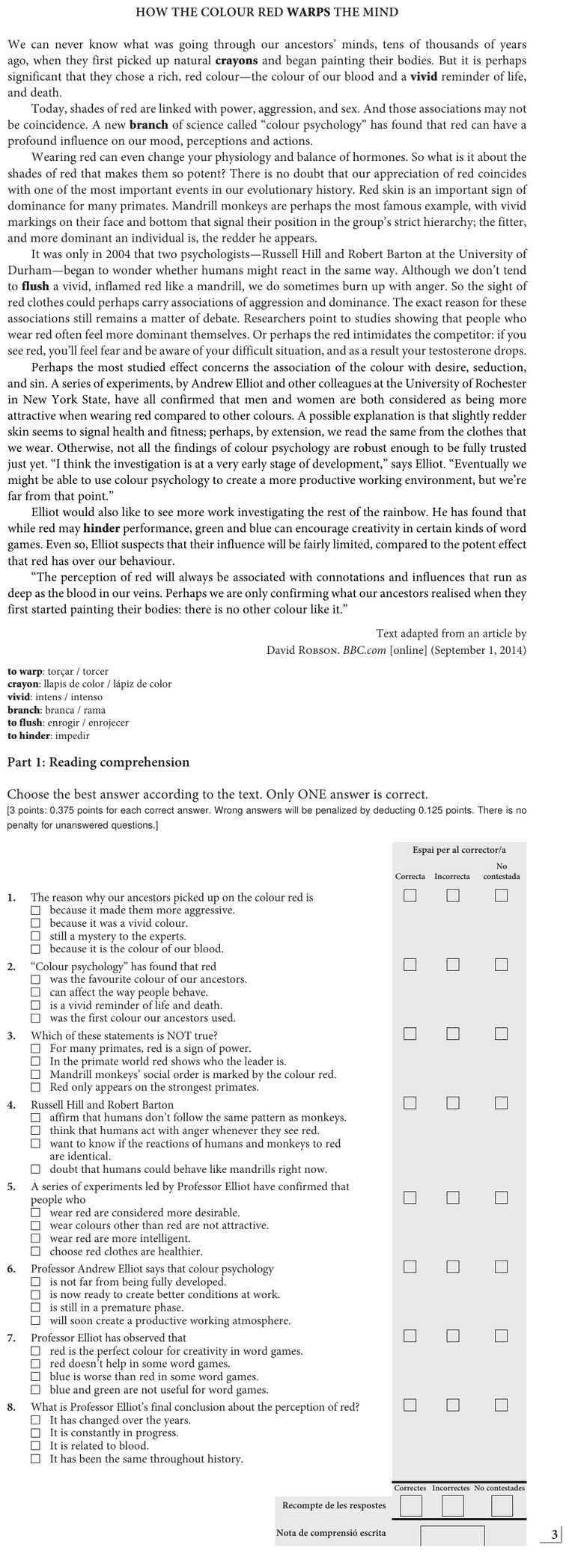
HOW THE COLOUR RED WARPS THE MIND
We can never know what was going through our ancestors’ minds, tens of thousands of years
ago, when they first picked up natural crayons and began painting their bodies. But it is perhaps
significant that they chose a rich, red colour—the colour of our blood and a vivid reminder of life,
and death.
Today, shades of red are linked with power, aggression, and sex. And those associations may not
be coincidence. A new branch of science called “colour psychology” has found that red can have a
profound influence on our mood, perceptions and actions.
Wearing red can even change your physiology and balance of hormones. So what is it about the
shades of red that makes them so potent? There is no doubt that our appreciation of red coincides
with one of the most important events in our evolutionary history. Red skin is an important sign of
dominance for many primates. Mandrill monkeys are perhaps the most famous example, with vivid
markings on their face and bottom that signal their position in the group’s strict hierarchy; the fitter,
and more dominant an individual is, the redder he appears.
It was only in 2004 that two psychologists—Russell Hill and Robert Barton at the University of
Durham—began to wonder whether humans might react in the same way. Although we don’t tend
to flush a vivid, inflamed red like a mandrill, we do sometimes burn up with anger. So the sight of
red clothes could perhaps carry associations of aggression and dominance. The exact reason for these
associations still remains a matter of debate. Researchers point to studies showing that people who
wear red often feel more dominant themselves. Or perhaps the red intimidates the competitor: if you
see red, you’ll feel fear and be aware of your difficult situation, and as a result your testosterone drops.
Perhaps the most studied effect concerns the association of the colour with desire, seduction,
and sin. A series of experiments, by Andrew Elliot and other colleagues at the University of Rochester
in New York State, have all confirmed that men and women are both considered as being more
attractive when wearing red compared to other colours. A possible explanation is that slightly redder
skin seems to signal health and fitness; perhaps, by extension, we read the same from the clothes that
we wear. Otherwise, not all the findings of colour psychology are robust enough to be fully trusted
just yet. “I think the investigation is at a very early stage of development,” says Elliot. “Eventually we
might be able to use colour psychology to create a more productive working environment, but we’re
far from that point.”
Elliot would also like to see more work investigating the rest of the rainbow. He has found that
while red may hinder performance, green and blue can encourage creativity in certain kinds of word
games. Even so, Elliot suspects that their influence will be fairly limited, compared to the potent effect
that red has over our behaviour.
“The perception of red will always be associated with connotations and influences that run as
deep as the blood in our veins. Perhaps we are only confirming what our ancestors realised when they
first started painting their bodies: there is no other colour like it.”
Text adapted from an article by
David Robson. BBC.com [online] (September 1, 2014)
to warp: torçar / torcer
crayon: llapis de color / lápiz de color
vivid: intens / intenso
branch: branca / rama
to flush: enrogir / enrojecer
to hinder: impedir
Vegeu el text de lectura de la pregunta 1 de Part 1.
1. The reason why our ancestors picked up on the colour red is
because it made them more aggressive.
because it was a vivid colour.
still a mystery to the experts.
because it is the colour of our blood.
2. “Colour psychology” has found that red
was the favourite colour of our ancestors.
can affect the way people behave.
is a vivid reminder of life and death.
was the first colour our ancestors used.
3. Which of these statements is NOT true?
For many primates, red is a sign of power.
In the primate world red shows who the leader is.
Mandrill monkeys’ social order is marked by the colour red.
Red only appears on the strongest primates.
4. Russell Hill and Robert Barton
affirm that humans don’t follow the same pattern as monkeys.
think that humans act with anger whenever they see red.
want to know if the reactions of humans and monkeys to red
are identical.
doubt that humans could behave like mandrills right now.
5. A series of experiments led by Professor Elliot have confirmed that
people who
wear red are considered more desirable.
wear colours other than red are not attractive.
wear red are more intelligent.
choose red clothes are healthier.
6. Professor Andrew Elliot says that colour psychology
is not far from being fully developed.
is now ready to create better conditions at work.
is still in a premature phase.
will soon create a productive working atmosphere.
7. Professor Elliot has observed that
red is the perfect colour for creativity in word games.
red doesn’t help in some word games.
blue is worse than red in some word games.
blue and green are not useful for word games.
8. What is Professor Elliot’s final conclusion about the perception of red?
It has changed over the years.
It is constantly in progress.
It is related to blood.
It has been the same throughout history.
 Toca per ampliar
- 0,375 pSeleccionar la resposta de la clau oficial: still a mystery to the experts.Penalització: Resposta incorrecta: −0,125 punts. Resposta en blanc: cap penalització.
Toca per ampliar- 0,375 pSeleccionar la resposta de la clau oficial: can affect the way people behave.Penalització: Resposta incorrecta: −0,125 punts. Resposta en blanc: cap penalització.
Toca per ampliar- 0,375 pSeleccionar la resposta de la clau oficial: Red only appears on the strongest primates.Penalització: Resposta incorrecta: −0,125 punts. Resposta en blanc: cap penalització.
Toca per ampliar- 0,375 pSeleccionar la resposta de la clau oficial: want to know if the reactions of humans and monkeys to red are identical.Penalització: Resposta incorrecta: −0,125 punts. Resposta en blanc: cap penalització.
Toca per ampliar- 0,375 pSeleccionar la resposta de la clau oficial: wear red are considered more desirable.Penalització: Resposta incorrecta: −0,125 punts. Resposta en blanc: cap penalització.
Toca per ampliar- 0,375 pSeleccionar la resposta de la clau oficial: is still in a premature phase.Penalització: Resposta incorrecta: −0,125 punts. Resposta en blanc: cap penalització.
Toca per ampliar- 0,375 pSeleccionar la resposta de la clau oficial: red doesn’t help in some word games.Penalització: Resposta incorrecta: −0,125 punts. Resposta en blanc: cap penalització.
Toca per ampliar- 0,375 pSeleccionar la resposta de la clau oficial: It has been the same throughout history.Penalització: Resposta incorrecta: −0,125 punts. Resposta en blanc: cap penalització.
Exercici 2 · opció A
Part 2: Writing
 Toca per ampliar
Choose ONE topic. Write about number 1 or 2. Minimum length: 100 words. [4 points]
1. Can we judge others by the way they look? Does a person’s appearance influence his or
her character? Write an opinion essay.
Toca per ampliar- 4 pSense desglossament als PDF proporcionats: redactar en anglès una resposta al tema 1 en el gènere i amb l’extensió que indica l’enunciat. El quadern assigna 4 punts a la redacció; no s’hi especifiquen descriptors ni pesos de Grammar, Vocabulary, Text o Maturity.
Exercici 2 · opció B
Part 2: Writing
Toca per ampliarChoose ONE topic. Write about number 1 or 2. Minimum length: 100 words. [4 points]
2. Next academic year you may be living in a shared flat with other students or in a
university residence, or maybe you’ll be staying in your own house with your family.
Write a ‘for and against’ essay explaining the advantages and disadvantages of living
away from home while you’re a university student. Make sure you do NOT use your own
name in your essay.
Toca per ampliar- 4 pSense desglossament als PDF proporcionats: redactar en anglès una resposta al tema 2 en el gènere i amb l’extensió que indica l’enunciat. El quadern assigna 4 punts a la redacció; no s’hi especifiquen descriptors ni pesos de Grammar, Vocabulary, Text o Maturity.
Exercici 3
Part 3: Listening comprehension
 Toca per ampliar
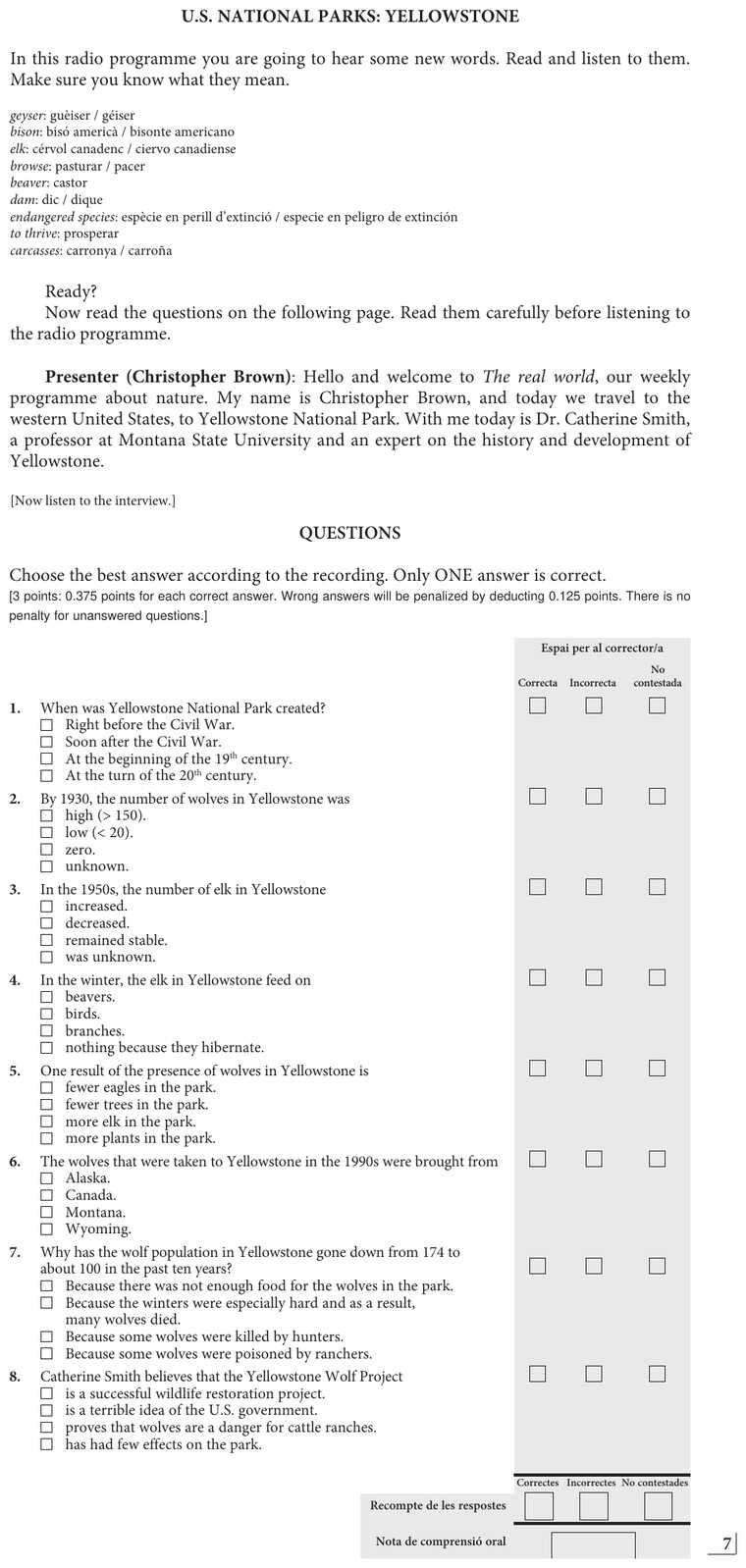
U.S. NATIONAL PARKS: YELLOWSTONE
In this radio programme you are going to hear some new words. Read and listen to them.
Make sure you know what they mean.
geyser: guèiser / géiser
bison: bisó americà / bisonte americano
elk: cérvol canadenc / ciervo canadiense
browse: pasturar / pacer
beaver: castor
dam: dic / dique
endangered species: espècie en perill d’extinció / especie en peligro de extinción
to thrive: prosperar
carcasses: carronya / carroña
Ready?
Now read the questions on the following page. Read them carefully before listening to
the radio programme.
Presenter (Christopher Brown): Hello and welcome to The real world, our weekly
programme about nature. My name is Christopher Brown, and today we travel to the
western United States, to Yellowstone National Park. With me today is Dr. Catherine Smith,
a professor at Montana State University and an expert on the history and development of
Yellowstone.
[Now listen to the interview.]
Transcripció oficial (pauangl18sp.pdf):
U.S. NATIONAL PARKS: YELLOWSTONE
In this radio programme you are going to hear some new words. Read and listen to them. Make sure you
know what they mean.
geyser: guèiser / géiser
bison: bisó americà / bisonte americano
elk: cérvol del Canadà / alce
browse: pasturar / pacer
beaver: castor
dam: dic / dique
endangered species: espècie en perill d’extinció / especie en peligro de extinción
to thrive: prosperar
carcasses: carronya / carroña
Ready? Now read the questions on the following page. Read them carefully before listening to the radio
programme.
Presenter (Christopher Brown): Hello and welcome to “The real world”, our weekly programme about
nature. My name is Christopher Brown, and today we travel to the western United States, to Yellowstone
National Park. With me today is Dr. Catherine Smith, a professor at Montana State University and an
expert on the history and development of Yellowstone.
Christopher Brown (CB): Good morning, Dr. Smith. Can you tell me a little bit about Yellowstone
National Park?
Catherine Smith (CS): Good morning, and thank you for inviting me. Yellowstone is the nation’s oldest
national park and was established shortly after the end of the Civil War, when Ulysses S. Grant was
President. The park is located in three states, Montana, Idaho, and Wyoming, and covers almost 9,000
km2. The park is probably best known for its geysers—those hot springs that eject lots of water and
steam, and its wildlife. The park has large populations of bears, bison, elk, and importantly, wolves.
CB: Why are wolves so important?
CS: Wolves are a vital part of the Yellowstone ecosystem. You know, not so long ago there were no
wolves in the park at all.
CB: None at all? How’s that? I thought wolves were all over this part of the Rocky Mountains.
CS: You’re right, wolves have always lived in this area. But by the 1920s, most had been killed by
hunters. People often think of the mass shootings of American bison because of Hollywood movies, but in
fact wolves were hunted with more determination than any other animal in American history. Officially, the
last wolves in the park were killed in 1926.
CB: And what has happened since then? How did wolves come back to the park?
CS: Well, in the 1940s and 1950s, biologists began to realize that the absence of wolves was a problem.
The elk population began to increase tremendously, because wolves are natural predators of elk and
without them, the elk multiplied.
CB: Why would an increase in the population of elk be a problem? I mean, elk are native to this area too,
aren’t they?
CS: Yes, of course, but scientists saw that there were too many elk for the habitat. Yellowstone has long,
hard winters, with lots of snow. Without the wolves, the elk did not need to move around very much to
look for food because they were not being threatened. So the elk stayed in places with lots of young trees
and branches that were above the snow, and ate them—they browsed, as we biologists say—and as a
result, certain types of trees would no longer grow in some areas because the elk had eaten all the young
ones. And this was devastating for beavers, which depended on those branches to survive during the
winter. The elk had eaten them all.
CB: There was a problem with beavers, too? I thought that the beaver population was stable after people
stopped wearing beaver coats and hats.
CS: Well, ecosystems are incredibly complex. Beavers were disappearing from Yellowstone because
their food supply was limited since the elk ate so much. Today the beaver population is growing, and
beavers are building new dams and ponds all over the park. The park is experiencing much less erosion
and plant loss. And one of the main reasons for the increase in the number of beavers and plants is the
Yellowstone Wolf Project.
CB. So in essence, are you saying that the wolves saved the beavers and trees? Could you tell us a little
more about this project?
CS: Sure. In the 1990s biologists in Yellowstone began exploring the idea of bringing Canadian wolves to
the park. In January 1995, the first eight wolves arrived from Alberta, Canada. Today we have about a
hundred wolves. About 10 years ago we had a peak of 174 wolves, but in the past ten years some
hunting has been permitted because wolves were no longer classified as an Endangered Species. The
wolf population is stable now.
CB: It sounds like an interesting project. Was everyone in favour of it? I mean, in the western part of the
United States there are a lot of ranches with cattle, and wolves are known to attack cattle. I can imagine
that the ranch owners were not too happy.
CS: In fact, this project has been called the most controversial project in the history of the U.S. National
Park Service. Depending on your point of view, the revival of wolf populations in Yellowstone is either one
of the greatest wildlife restoration projects ever undertaken, or the worst idea that the government has
ever had for ranchers and hunters. It’s a real source of debate here. A 2010 study by the U.S.
Department of Agriculture showed that only a little more than 2% of cattle deaths were caused by
predators. In fact, government studies have shown that between 1991 and 2005, coyotes, dogs and
mountain lions, not wolves, were the main killers of cattle.
CB: And how do you feel about the project? Now that you’ve been able to see and study the
consequences over twenty years, would you do it again?
CS: Absolutely, reintroducing wolves to Yellowstone has been very successful. Most scientists agree that
a wide diversity of species is a healthy thing for the larger community of animals. The return of the wolf
has helped other animals to thrive. Bears, coyotes, foxes, and even birds like eagles eat carcasses. All
those meat-eaters benefit from the protein the wolves leave on the landscape. We have more trees than
20 years ago. And the increase in beavers has helped the rivers. So in my opinion, the project has had a
very positive impact.
CB: Our time is up for today. Thank you, Dr. Smith, for joining us today on “The real world”.
CS: My pleasure.
Adapted from an article by Kate Tobin on the PBS News Hour
https://www.pbs.org/newshour/science/wolves-greenthumbs-yellowstone.
Vegeu el listening i la transcripció oficial de la pregunta 1 de Part 3.
1. When was Yellowstone National Park created?
Right before the Civil War.
Soon after the Civil War.
At the beginning of the 19th century.
At the turn of the 20th century.
2. By 1930, the number of wolves in Yellowstone was
high (> 150).
low (< 20).
zero.
unknown.
3. In the 1950s, the number of elk in Yellowstone
increased.
decreased.
remained stable.
was unknown.
4. In the winter, the elk in Yellowstone feed on
beavers.
birds.
branches.
nothing because they hibernate.
5. One result of the presence of wolves in Yellowstone is
fewer eagles in the park.
fewer trees in the park.
more elk in the park.
more plants in the park.
6. The wolves that were taken to Yellowstone in the 1990s were brought from
Alaska.
Canada.
Montana.
Wyoming.
7. Why has the wolf population in Yellowstone gone down from 174 to
about 100 in the past ten years?
Because there was not enough food for the wolves in the park.
Because the winters were especially hard and as a result,
many wolves died.
Because some wolves were killed by hunters.
Because some wolves were poisoned by ranchers.
8. Catherine Smith believes that the Yellowstone Wolf Project
is a successful wildlife restoration project.
is a terrible idea of the U.S. government.
proves that wolves are a danger for cattle ranches.
has had few effects on the park.
Toca per ampliar- 0,375 pSeleccionar la resposta de la clau oficial: Soon after the Civil War.Penalització: Resposta incorrecta: −0,125 punts. Resposta en blanc: cap penalització.
Toca per ampliar- 0,375 pSeleccionar la resposta de la clau oficial: zero.Penalització: Resposta incorrecta: −0,125 punts. Resposta en blanc: cap penalització.
Toca per ampliar- 0,375 pSeleccionar la resposta de la clau oficial: increased.Penalització: Resposta incorrecta: −0,125 punts. Resposta en blanc: cap penalització.
Toca per ampliar- 0,375 pSeleccionar la resposta de la clau oficial: branches.Penalització: Resposta incorrecta: −0,125 punts. Resposta en blanc: cap penalització.
Toca per ampliar- 0,375 pSeleccionar la resposta de la clau oficial: more plants in the park.Penalització: Resposta incorrecta: −0,125 punts. Resposta en blanc: cap penalització.
Toca per ampliar- 0,375 pSeleccionar la resposta de la clau oficial: Canada.Penalització: Resposta incorrecta: −0,125 punts. Resposta en blanc: cap penalització.
Toca per ampliar- 0,375 pSeleccionar la resposta de la clau oficial: Because some wolves were killed by hunters.Penalització: Resposta incorrecta: −0,125 punts. Resposta en blanc: cap penalització.
Toca per ampliar- 0,375 pSeleccionar la resposta de la clau oficial: a successful wildlife restoration project.Penalització: Resposta incorrecta: −0,125 punts. Resposta en blanc: cap penalització.