Anglès
PAU 2018 · ordinària · sèrie 1
Examen oficial de la PAU de Catalunya amb la pauta de correcció. És d’una convocatòria anterior al model 2025: la pauta correspon a aquell examen.
Instruccions de l’examen
Part 1: Choose the best answer according to the text. Only ONE answer is correct. [3 points: 0.375 points for each correct answer. Wrong answers will be penalized by deducting 0.125 points. There is no penalty for unanswered questions.]
Part 2: Choose ONE topic. Write about number 1 or 2. Minimum length: 100 words. [4 points]
Part 3: Choose the best answer according to the recording. Only ONE answer is correct. [3 points: 0.375 points for each correct answer. Wrong answers will be penalized by deducting 0.125 points. There is no penalty for unanswered questions.]
Exercici 1
Part 1: Reading comprehension
 Toca per ampliar
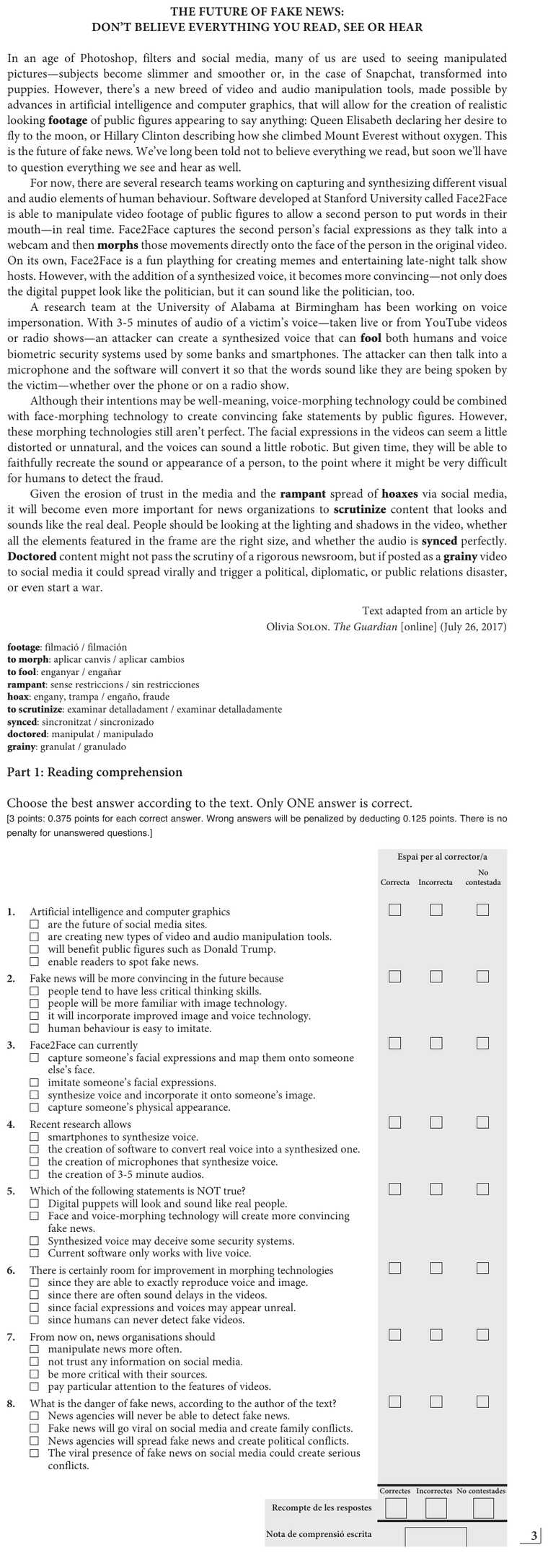
THE FUTURE OF FAKE NEWS:
DON’T BELIEVE EVERYTHING YOU READ, SEE OR HEAR
In an age of Photoshop, filters and social media, many of us are used to seeing manipulated
pictures—subjects become slimmer and smoother or, in the case of Snapchat, transformed into
puppies. However, there’s a new breed of video and audio manipulation tools, made possible by
advances in artificial intelligence and computer graphics, that will allow for the creation of realistic
looking footage of public figures appearing to say anything: Queen Elisabeth declaring her desire to
fly to the moon, or Hillary Clinton describing how she climbed Mount Everest without oxygen. This
is the future of fake news. We’ve long been told not to believe everything we read, but soon we’ll have
to question everything we see and hear as well.
For now, there are several research teams working on capturing and synthesizing different visual
and audio elements of human behaviour. Software developed at Stanford University called Face2Face
is able to manipulate video footage of public figures to allow a second person to put words in their
mouth—in real time. Face2Face captures the second person’s facial expressions as they talk into a
webcam and then morphs those movements directly onto the face of the person in the original video.
On its own, Face2Face is a fun plaything for creating memes and entertaining late-night talk show
hosts. However, with the addition of a synthesized voice, it becomes more convincing—not only does
the digital puppet look like the politician, but it can sound like the politician, too.
A research team at the University of Alabama at Birmingham has been working on voice
impersonation. With 3-5 minutes of audio of a victim’s voice—taken live or from YouTube videos
or radio shows—an attacker can create a synthesized voice that can fool both humans and voice
biometric security systems used by some banks and smartphones. The attacker can then talk into a
microphone and the software will convert it so that the words sound like they are being spoken by
the victim—whether over the phone or on a radio show.
Although their intentions may be well-meaning, voice-morphing technology could be combined
with face-morphing technology to create convincing fake statements by public figures. However,
these morphing technologies still aren’t perfect. The facial expressions in the videos can seem a little
distorted or unnatural, and the voices can sound a little robotic. But given time, they will be able to
faithfully recreate the sound or appearance of a person, to the point where it might be very difficult
for humans to detect the fraud.
Given the erosion of trust in the media and the rampant spread of hoaxes via social media,
it will become even more important for news organizations to scrutinize content that looks and
sounds like the real deal. People should be looking at the lighting and shadows in the video, whether
all the elements featured in the frame are the right size, and whether the audio is synced perfectly.
Doctored content might not pass the scrutiny of a rigorous newsroom, but if posted as a grainy video
to social media it could spread virally and trigger a political, diplomatic, or public relations disaster,
or even start a war.
Text adapted from an article by
Olivia Solon. The Guardian [online] (July 26, 2017)
footage: filmació / filmación
to morph: aplicar canvis / aplicar cambios
to fool: enganyar / engañar
rampant: sense restriccions / sin restricciones
hoax: engany, trampa / engaño, fraude
to scrutinize: examinar detalladament / examinar detalladamente
synced: sincronitzat / sincronizado
doctored: manipulat / manipulado
grainy: granulat / granulado
Vegeu el text de lectura de la pregunta 1 de Part 1.
1. Artificial intelligence and computer graphics
are the future of social media sites.
are creating new types of video and audio manipulation tools.
will benefit public figures such as Donald Trump.
enable readers to spot fake news.
2. Fake news will be more convincing in the future because
people tend to have less critical thinking skills.
people will be more familiar with image technology.
it will incorporate improved image and voice technology.
human behaviour is easy to imitate.
3. Face2Face can currently
capture someone’s facial expressions and map them onto someone
else’s face.
imitate someone’s facial expressions.
synthesize voice and incorporate it onto someone’s image.
capture someone’s physical appearance.
4. Recent research allows
smartphones to synthesize voice.
the creation of software to convert real voice into a synthesized one.
the creation of microphones that synthesize voice.
the creation of 3-5 minute audios.
5. Which of the following statements is NOT true?
Digital puppets will look and sound like real people.
Face and voice-morphing technology will create more convincing
fake news.
Synthesized voice may deceive some security systems.
Current software only works with live voice.
6. There is certainly room for improvement in morphing technologies
since they are able to exactly reproduce voice and image.
since there are often sound delays in the videos.
since facial expressions and voices may appear unreal.
since humans can never detect fake videos.
7. From now on, news organisations should
manipulate news more often.
not trust any information on social media.
be more critical with their sources.
pay particular attention to the features of videos.
8. What is the danger of fake news, according to the author of the text?
News agencies will never be able to detect fake news.
Fake news will go viral on social media and create family conflicts.
News agencies will spread fake news and create political conflicts.
The viral presence of fake news on social media could create serious
conflicts.
 Toca per ampliar
- 0,375 pSeleccionar la resposta de la clau oficial: are creating new types of video and audio manipulation tools.Penalització: Resposta incorrecta: −0,125 punts. Resposta en blanc: cap penalització.
Toca per ampliar- 0,375 pSeleccionar la resposta de la clau oficial: it will incorporate improved image and voice technology.Penalització: Resposta incorrecta: −0,125 punts. Resposta en blanc: cap penalització.
Toca per ampliar- 0,375 pSeleccionar la resposta de la clau oficial: capture someone’s facial expressions and map them onto someone else’s face.Penalització: Resposta incorrecta: −0,125 punts. Resposta en blanc: cap penalització.
Toca per ampliar- 0,375 pSeleccionar la resposta de la clau oficial: the creation of software to convert real voice into a synthesized one.Penalització: Resposta incorrecta: −0,125 punts. Resposta en blanc: cap penalització.
Toca per ampliar- 0,375 pSeleccionar la resposta de la clau oficial: Current software only works with live voice.Penalització: Resposta incorrecta: −0,125 punts. Resposta en blanc: cap penalització.
Toca per ampliar- 0,375 pSeleccionar la resposta de la clau oficial: since facial expressions and voices may appear unreal.Penalització: Resposta incorrecta: −0,125 punts. Resposta en blanc: cap penalització.
Toca per ampliar- 0,375 pSeleccionar la resposta de la clau oficial: be more critical with their sources. / OR / pay particular attention to the features of videos.Penalització: Resposta incorrecta: −0,125 punts. Resposta en blanc: cap penalització.
Toca per ampliar- 0,375 pSeleccionar la resposta de la clau oficial: The viral presence of fake news on social media could create serious conflicts.Penalització: Resposta incorrecta: −0,125 punts. Resposta en blanc: cap penalització.
Exercici 2 · opció A
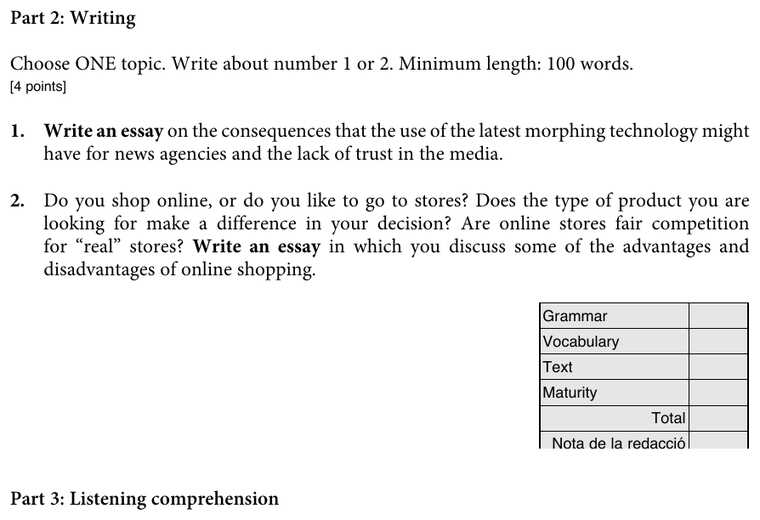
Part 2: Writing
 Toca per ampliar
Choose ONE topic. Write about number 1 or 2. Minimum length: 100 words. [4 points]
1. Write an essay on the consequences that the use of the latest morphing technology might
have for news agencies and the lack of trust in the media.
Toca per ampliar- 4 pSense desglossament als PDF proporcionats: redactar en anglès una resposta al tema 1 en el gènere i amb l’extensió que indica l’enunciat. El quadern assigna 4 punts a la redacció; no s’hi especifiquen descriptors ni pesos de Grammar, Vocabulary, Text o Maturity.
Exercici 2 · opció B
Part 2: Writing
Toca per ampliarChoose ONE topic. Write about number 1 or 2. Minimum length: 100 words. [4 points]
2. Do you shop online, or do you like to go to stores? Does the type of product you are
looking for make a difference in your decision? Are online stores fair competition
for “real” stores? Write an essay in which you discuss some of the advantages and
disadvantages of online shopping.
Toca per ampliar- 4 pSense desglossament als PDF proporcionats: redactar en anglès una resposta al tema 2 en el gènere i amb l’extensió que indica l’enunciat. El quadern assigna 4 punts a la redacció; no s’hi especifiquen descriptors ni pesos de Grammar, Vocabulary, Text o Maturity.
Exercici 3
Part 3: Listening comprehension
 Toca per ampliar
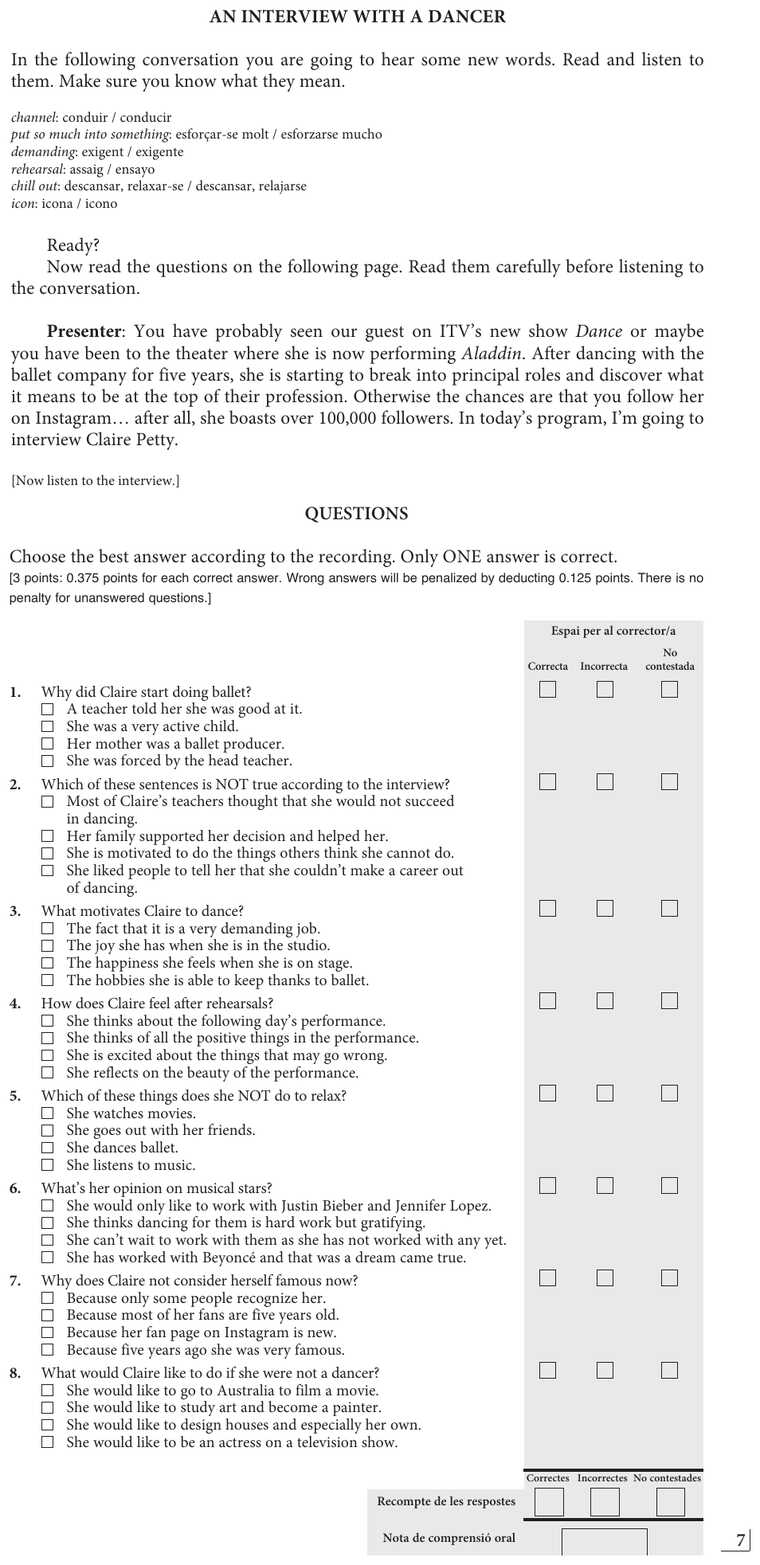
AN INTERVIEW WITH A DANCER
In the following conversation you are going to hear some new words. Read and listen to
them. Make sure you know what they mean.
channel: conduir / conducir
put so much into something: esforçar-se molt / esforzarse mucho
demanding: exigent / exigente
rehearsal: assaig / ensayo
chill out: descansar, relaxar-se / descansar, relajarse
icon: icona / icono
Ready?
Now read the questions on the following page. Read them carefully before listening to
the conversation.
Presenter: You have probably seen our guest on ITV’s new show Dance or maybe
you have been to the theater where she is now performing Aladdin. After dancing with the
ballet company for five years, she is starting to break into principal roles and discover what
it means to be at the top of their profession. Otherwise the chances are that you follow her
on Instagram… after all, she boasts over 100,000 followers. In today’s program, I’m going to
interview Claire Petty.
[Now listen to the interview.]
Transcripció oficial (pauangl18jp.pdf):
An Interview with a Dancer
In the following conversation you are going to hear some new words. Read and listen
to them. Make sure you know what they mean.
channel: conduir / conducir
put so much into something: esforçar-se molt / esforzarse mucho
demanding: exigent / exigente
rehearsal: assaig / ensayo
chill out: descansar, relaxar-se / descansar, relajarse
icon: icona / icono
Ready?
Now read the questions on the following page. Read them carefully before listening to
the conversation.
_______________________________________________________________
PRESENTER (REPORTER): You have probably seen our guest on ITV’s new show
“Dance” or maybe you have been to the theater where she is now performing ‘Aladdin’.
After dancing with the ballet company for five years, she is starting to break into
principal roles and discover what it means to be at the top of their profession.
Otherwise the chances are that you follow her on Instagram… after all, she boasts over
100,000 followers. In today’s program, I’m going to interview Claire Petty.
REPORTER: Hi, Anne. Welcome to our programme.
CLAIRE: My pleasure.
REPORTER: To start, tell us a little about yourself.
CLAIRE: I started dancing at the age of four, doing ballet, because I had a lot of energy
and my mum needed to channel it into something productive! I was very lucky
that at the age of 12 I had a teacher that guided me more towards the classical
route, and I joined the School of American Ballet in New York when I was 14. I
worked with the New York City Ballet my last year at school, and we performed
‘Nutcracker’ that year, which was an amazing experience. I went back to school
that January and on the first day back my head teacher told me I had a job at
the Boston Ballet and that I started work the next day—I literally re-packed all
my things and hopped on the plane straightaway!
REPORTER: What advice do you wish someone had given you at 15?
CLAIRE: I wish someone had told me not to let people tell me that I can’t do
something. At school most of my teachers told me dance was a waste of time
and that I couldn’t make a career out of it. That really upset me because I had
put so much into it and my family made a lot of sacrifices. But as I got older, I
realised that those people motivated me to prove them wrong and I guess they
will always motivate me, because now when people tell me I can’t do
something, I make sure I DO do it.
REPORTER: Ballet is a pretty demanding profession: there are long hours, it’s very
physical, you have to travel a lot. What motivates you?
CLAIRE: It’s just those times on stage where you’re either doing a role you love, or
you’re in a really beautiful theatre, and sometimes you just realise how lucky
you are to be doing a job where you absolutely love it, and you’re doing your
hobby as a career. Those moments push you through. You’ve done all that hard
work in the studio, you’ve tried to get your technique to the highest standard it
can be, and then you just need to enjoy that moment on stage.
REPORTER: There must be a fine balance between relaxing after a long day of
rehearsals and thinking over the work you’ve done that day. How do you
manage that?
CLAIRE: Immediately after rehearsal, I like to reflect a little bit on the positive things.
There’s always going to be something that’s gone wrong—I don’t think you ever
walk away thinking ‘well, that was perfect’—but that’s the beauty of performing
a character role because every day can be different. The way we perform
‘Aladdin’ in our first show will be different from the way we play it in our second
show. That’s what’s exciting – the growth, and the change, and responding to
each other.
REPORTER: You’re super busy! What do you do to relax and chill out?
CLAIRE: Ha ha. I have very little free time, which is how I like it—I hate being bored. I
go to the movies, hang out with my dance friends, watch TV, listen to music, do
all those normal things. It’s good to chill out and remind yourself that, as brilliant
as ballet is, there’s a big world out there.
REPORTER: You’ve already danced with Justin Bieber and Jennifer Lopez. What has
been your career highlight so far?
CLAIRE: Dancing for Justin Bieber and definitely Jennifer Lopez have been major
highlights but I’m excited about working with Lady Gaga on her dancing videos
for her new album. That’s been really cool, and I can’t wait for everyone to see
what she’s been working on!
REPORTER: Which musical icons do you dream about working or dancing with one
day?
CLAIRE: I’ve always wanted to dance for Beyoncé. She’s a very talented dancer
herself, with so much energy. It’s definitely something I would love to do. Being
involved with Lady Gaga’s music clips and seeing what is involved in the
process has opened my eyes to professional dancing outside ballet and I’ve
loved it, so I hope dancing for other musical icons is just as fun. It’s lot of hard
work but rewarding for sure.
REPORTER: I was following you on Instagram earlier and there’s a fan page for you!
What’s it like going from living a normal life to dealing with the fame that comes
with your profile now?
CLAIRE: Ha ha. It’s no different, to be honest! Most of the fans are from overseas, so
my life here hasn’t changed all that much in the past five years. When I go out,
a few people recognize me and it’s nice, but I’m not that famous.
REPORTER: What’s next for you?
CLAIRE: I’m going to the Dominican Republic in August for the World Latin Dance
Championship to perform in Jennifer Lopez’s show there – I’m very excited
about that! We also have stuff happening in Australia after and possibly
Switzerland. Then I’m filming the rest of the episodes for “Dance”, which I’m
looking forward to.
REPORTER: Finally, if you weren’t a dancer, what would you be doing?
CLAIRE: I’d quite like to learn something about architecture and interior design
because I’ve always liked drawing, but I’ve never had time to work on it
properly. I’ve always loved walking into a stylish home. It’s my dream to build
my own house and decorate it with things from all around the world .
REPORTER: Well, Claire, it’s been a pleasure having you here tonight.
CLAIRE: Thank you for inviting me.
Adapted from: https://www.fq.co.nz/missfq/celeb/entertainment/dancer-kaea-pearce-
interview-grid [30th November 2017]
Vegeu el listening i la transcripció oficial de la pregunta 1 de Part 3.
1. Why did Claire start doing ballet?
A teacher told her she was good at it.
She was a very active child.
Her mother was a ballet producer.
She was forced by the head teacher.
2. Which of these sentences is NOT true according to the interview?
Most of Claire’s teachers thought that she would not succeed
in dancing.
Her family supported her decision and helped her.
She is motivated to do the things others think she cannot do.
She liked people to tell her that she couldn’t make a career out
of dancing.
3. What motivates Claire to dance?
The fact that it is a very demanding job.
The joy she has when she is in the studio.
The happiness she feels when she is on stage.
The hobbies she is able to keep thanks to ballet.
4. How does Claire feel after rehearsals?
She thinks about the following day’s performance.
She thinks of all the positive things in the performance.
She is excited about the things that may go wrong.
She reflects on the beauty of the performance.
5. Which of these things does she NOT do to relax?
She watches movies.
She goes out with her friends.
She dances ballet.
She listens to music.
6. What’s her opinion on musical stars?
She would only like to work with Justin Bieber and Jennifer Lopez.
She thinks dancing for them is hard work but gratifying.
She can’t wait to work with them as she has not worked with any yet.
She has worked with Beyoncé and that was a dream came true.
7. Why does Claire not consider herself famous now?
Because only some people recognize her.
Because most of her fans are five years old.
Because her fan page on Instagram is new.
Because five years ago she was very famous.
8. What would Claire like to do if she were not a dancer?
She would like to go to Australia to film a movie.
She would like to study art and become a painter.
She would like to design houses and especially her own.
She would like to be an actress on a television show.
Toca per ampliar- 0,375 pSeleccionar la resposta de la clau oficial: She was a very active child.Penalització: Resposta incorrecta: −0,125 punts. Resposta en blanc: cap penalització.
Toca per ampliar- 0,375 pSeleccionar la resposta de la clau oficial: She liked people to tell her that she couldn’t make a career out of dancing.Penalització: Resposta incorrecta: −0,125 punts. Resposta en blanc: cap penalització.
Toca per ampliar- 0,375 pSeleccionar la resposta de la clau oficial: The happiness she feels when she is on stage.Penalització: Resposta incorrecta: −0,125 punts. Resposta en blanc: cap penalització.
Toca per ampliar- 0,375 pSeleccionar la resposta de la clau oficial: She thinks of all the positive things in the performance.Penalització: Resposta incorrecta: −0,125 punts. Resposta en blanc: cap penalització.
Toca per ampliar- 0,375 pSeleccionar la resposta de la clau oficial: She dances ballet.Penalització: Resposta incorrecta: −0,125 punts. Resposta en blanc: cap penalització.
Toca per ampliar- 0,375 pSeleccionar la resposta de la clau oficial: She thinks dancing for them is hard work but gratifying.Penalització: Resposta incorrecta: −0,125 punts. Resposta en blanc: cap penalització.
Toca per ampliar- 0,375 pSeleccionar la resposta de la clau oficial: Because only some people recognize her.Penalització: Resposta incorrecta: −0,125 punts. Resposta en blanc: cap penalització.
Toca per ampliar- 0,375 pSeleccionar la resposta de la clau oficial: She would like to design houses and especially her own.Penalització: Resposta incorrecta: −0,125 punts. Resposta en blanc: cap penalització.