Anglès
PAU 2019 · extraordinària · sèrie 5
Examen oficial de la PAU de Catalunya amb la pauta de correcció. És d’una convocatòria anterior al model 2025: la pauta correspon a aquell examen.
Instruccions de l’examen
Part 1: Choose the best answer according to the text. Only ONE answer is correct. [3 points: 0.375 points for each correct answer. Wrong answers will be penalized by deducting 0.125 points. There is no penalty for unanswered questions.]
Part 2: Choose ONE topic. Your answer should be 125-150 words in length. There is no specific penalty for exceeding 150 words in length. Extra points are not given for exceeding 150 words. [4 points]
Part 3: Choose the best answer according to the recording. Only ONE answer is correct. [3 points: 0.375 points for each correct answer. Wrong answers will be penalized by deducting 0.125 points. There is no penalty for unanswered questions.]
Exercici 1
Part 1: Reading comprehension
 Toca per ampliar
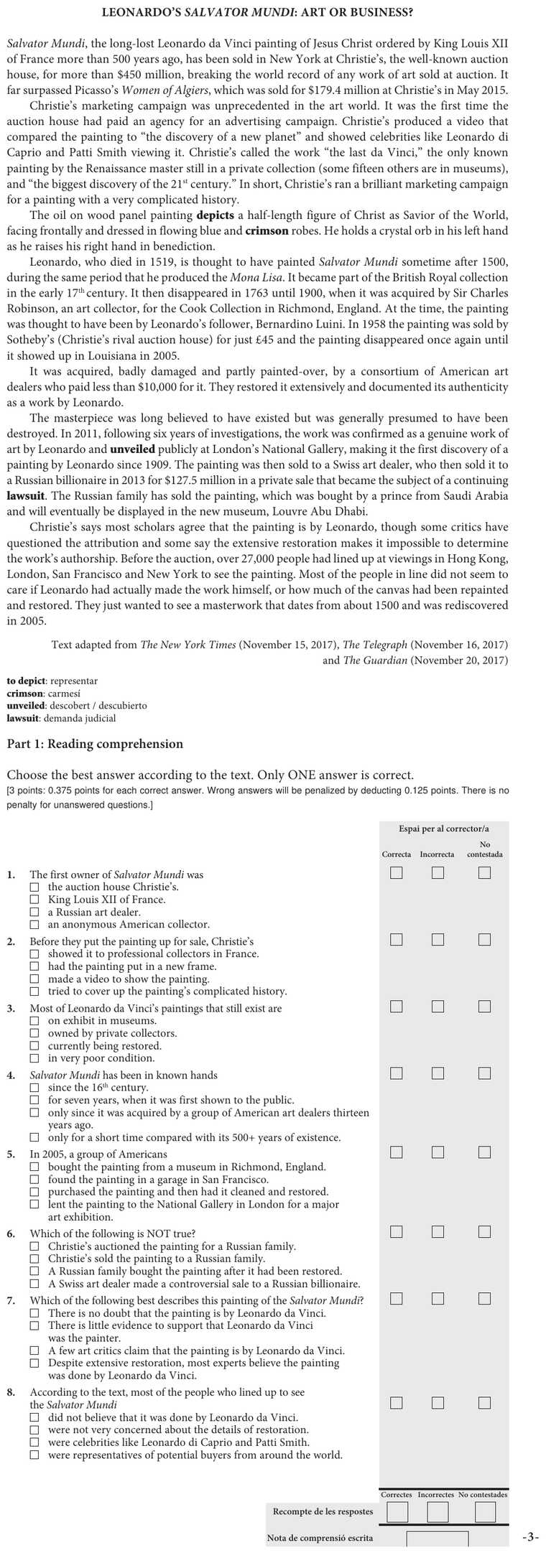
LEONARDO’S SALVATOR MUNDI: ART OR BUSINESS?
Salvator Mundi, the long-lost Leonardo da Vinci painting of Jesus Christ ordered by King Louis XII
of France more than 500 years ago, has been sold in New York at Christie’s, the well-known auction
house, for more than $450 million, breaking the world record of any work of art sold at auction. It
far surpassed Picasso’s Women of Algiers, which was sold for $179.4 million at Christie’s in May 2015.
Christie’s marketing campaign was unprecedented in the art world. It was the first time the
auction house had paid an agency for an advertising campaign. Christie’s produced a video that
compared the painting to “the discovery of a new planet” and showed celebrities like Leonardo di
Caprio and Patti Smith viewing it. Christie’s called the work “the last da Vinci,” the only known
painting by the Renaissance master still in a private collection (some fifteen others are in museums),
and “the biggest discovery of the 21st century.” In short, Christie’s ran a brilliant marketing campaign
for a painting with a very complicated history.
The oil on wood panel painting depicts a half-length figure of Christ as Savior of the World,
facing frontally and dressed in flowing blue and crimson robes. He holds a crystal orb in his left hand
as he raises his right hand in benediction.
Leonardo, who died in 1519, is thought to have painted Salvator Mundi sometime after 1500,
during the same period that he produced the Mona Lisa. It became part of the British Royal collection
in the early 17th century. It then disappeared in 1763 until 1900, when it was acquired by Sir Charles
Robinson, an art collector, for the Cook Collection in Richmond, England. At the time, the painting
was thought to have been by Leonardo’s follower, Bernardino Luini. In 1958 the painting was sold by
Sotheby’s (Christie’s rival auction house) for just £45 and the painting disappeared once again until
it showed up in Louisiana in 2005.
It was acquired, badly damaged and partly painted-over, by a consortium of American art
dealers who paid less than $10,000 for it. They restored it extensively and documented its authenticity
as a work by Leonardo.
The masterpiece was long believed to have existed but was generally presumed to have been
destroyed. In 2011, following six years of investigations, the work was confirmed as a genuine work of
art by Leonardo and unveiled publicly at London’s National Gallery, making it the first discovery of a
painting by Leonardo since 1909. The painting was then sold to a Swiss art dealer, who then sold it to
a Russian billionaire in 2013 for $127.5 million in a private sale that became the subject of a continuing
lawsuit. The Russian family has sold the painting, which was bought by a prince from Saudi Arabia
and will eventually be displayed in the new museum, Louvre Abu Dhabi.
Christie’s says most scholars agree that the painting is by Leonardo, though some critics have
questioned the attribution and some say the extensive restoration makes it impossible to determine
the work’s authorship. Before the auction, over 27,000 people had lined up at viewings in Hong Kong,
London, San Francisco and New York to see the painting. Most of the people in line did not seem to
care if Leonardo had actually made the work himself, or how much of the canvas had been repainted
and restored. They just wanted to see a masterwork that dates from about 1500 and was rediscovered
in 2005.
Text adapted from The New York Times (November 15, 2017), The Telegraph (November 16, 2017)
and The Guardian (November 20, 2017)
to depict: representar
crimson: carmesí
unveiled: descobert / descubierto
lawsuit: demanda judicial
Vegeu el text de lectura de la pregunta 1 de Part 1.
1. The first owner of Salvator Mundi was
the auction house Christie’s.
King Louis XII of France.
a Russian art dealer.
an anonymous American collector.
2. Before they put the painting up for sale, Christie’s
showed it to professional collectors in France.
had the painting put in a new frame.
made a video to show the painting.
tried to cover up the painting’s complicated history.
3. Most of Leonardo da Vinci’s paintings that still exist are
on exhibit in museums.
owned by private collectors.
currently being restored.
in very poor condition.
4. Salvator Mundi has been in known hands
since the 16th century.
for seven years, when it was first shown to the public.
only since it was acquired by a group of American art dealers thirteen
years ago.
only for a short time compared with its 500+ years of existence.
5. In 2005, a group of Americans
bought the painting from a museum in Richmond, England.
found the painting in a garage in San Francisco.
purchased the painting and then had it cleaned and restored.
lent the painting to the National Gallery in London for a major
art exhibition.
6. Which of the following is NOT true?
Christie’s auctioned the painting for a Russian family.
Christie’s sold the painting to a Russian family.
A Russian family bought the painting after it had been restored.
A Swiss art dealer made a controversial sale to a Russian billionaire.
7. Which of the following best describes this painting of the Salvator Mundi?
There is no doubt that the painting is by Leonardo da Vinci.
There is little evidence to support that Leonardo da Vinci
was the painter.
A few art critics claim that the painting is by Leonardo da Vinci.
Despite extensive restoration, most experts believe the painting
was done by Leonardo da Vinci.
8. According to the text, most of the people who lined up to see
the Salvator Mundi
did not believe that it was done by Leonardo da Vinci.
were not very concerned about the details of restoration.
were celebrities like Leonardo di Caprio and Patti Smith.
were representatives of potential buyers from around the world.
 Toca per ampliar
- 0,375 pSeleccionar la resposta de la clau oficial: King Louis XII of France.Penalització: Resposta incorrecta: −0,125 punts. Resposta en blanc: cap penalització.
Toca per ampliar- 0,375 pSeleccionar la resposta de la clau oficial: made a video to show the painting.Penalització: Resposta incorrecta: −0,125 punts. Resposta en blanc: cap penalització.
Toca per ampliar- 0,375 pSeleccionar la resposta de la clau oficial: on exhibit in museums.Penalització: Resposta incorrecta: −0,125 punts. Resposta en blanc: cap penalització.
Toca per ampliar- 0,375 pSeleccionar la resposta de la clau oficial: only for a short time compared with its 500+ years of existence.Penalització: Resposta incorrecta: −0,125 punts. Resposta en blanc: cap penalització.
Toca per ampliar- 0,375 pSeleccionar la resposta de la clau oficial: purchased the painting and then had it cleaned and restored.Penalització: Resposta incorrecta: −0,125 punts. Resposta en blanc: cap penalització.
Toca per ampliar- 0,375 pSeleccionar la resposta de la clau oficial: Christie’s sold the painting to a Russian family.Penalització: Resposta incorrecta: −0,125 punts. Resposta en blanc: cap penalització.
Toca per ampliar- 0,375 pSeleccionar la resposta de la clau oficial: Despite extensive restoration, most experts believe the painting was done by Leonardo da Vinci.Penalització: Resposta incorrecta: −0,125 punts. Resposta en blanc: cap penalització.
Toca per ampliar- 0,375 pSeleccionar la resposta de la clau oficial: were not very concerned about the details of restoration.Penalització: Resposta incorrecta: −0,125 punts. Resposta en blanc: cap penalització.
Exercici 2 · opció A
Part 2: Writing
 Toca per ampliar
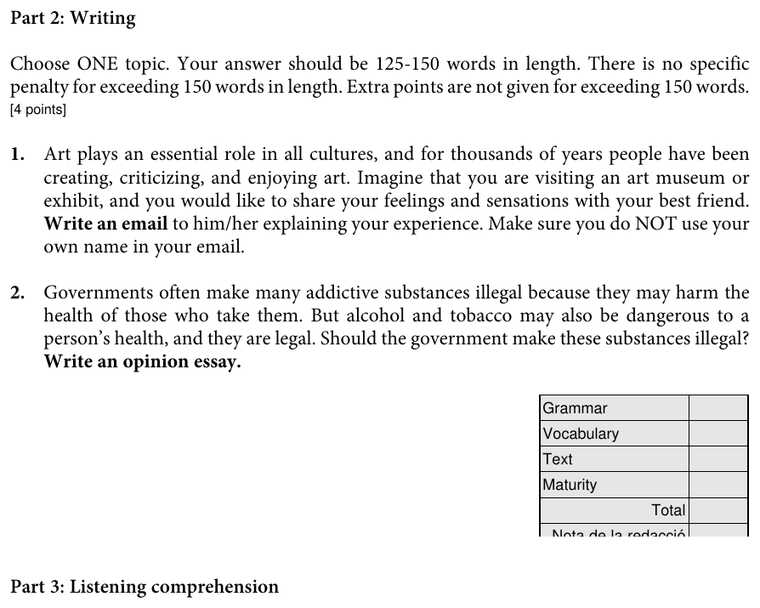
Choose ONE topic. Your answer should be 125-150 words in length. There is no specific penalty for exceeding 150 words in length. Extra points are not given for exceeding 150 words. [4 points]
1. Art plays an essential role in all cultures, and for thousands of years people have been
creating, criticizing, and enjoying art. Imagine that you are visiting an art museum or
exhibit, and you would like to share your feelings and sensations with your best friend.
Write an email to him/her explaining your experience. Make sure you do NOT use your
own name in your email.
Toca per ampliar- 4 pSense desglossament als PDF proporcionats: redactar en anglès una resposta al tema 1 en el gènere i amb l’extensió que indica l’enunciat. El quadern assigna 4 punts a la redacció; no s’hi especifiquen descriptors ni pesos de Grammar, Vocabulary, Text o Maturity.
Exercici 2 · opció B
Part 2: Writing
Toca per ampliarChoose ONE topic. Your answer should be 125-150 words in length. There is no specific penalty for exceeding 150 words in length. Extra points are not given for exceeding 150 words. [4 points]
2. Governments often make many addictive substances illegal because they may harm the
health of those who take them. But alcohol and tobacco may also be dangerous to a
person’s health, and they are legal. Should the government make these substances illegal?
Write an opinion essay.
Toca per ampliar- 4 pSense desglossament als PDF proporcionats: redactar en anglès una resposta al tema 2 en el gènere i amb l’extensió que indica l’enunciat. El quadern assigna 4 punts a la redacció; no s’hi especifiquen descriptors ni pesos de Grammar, Vocabulary, Text o Maturity.
Exercici 3
Part 3: Listening comprehension
 Toca per ampliar
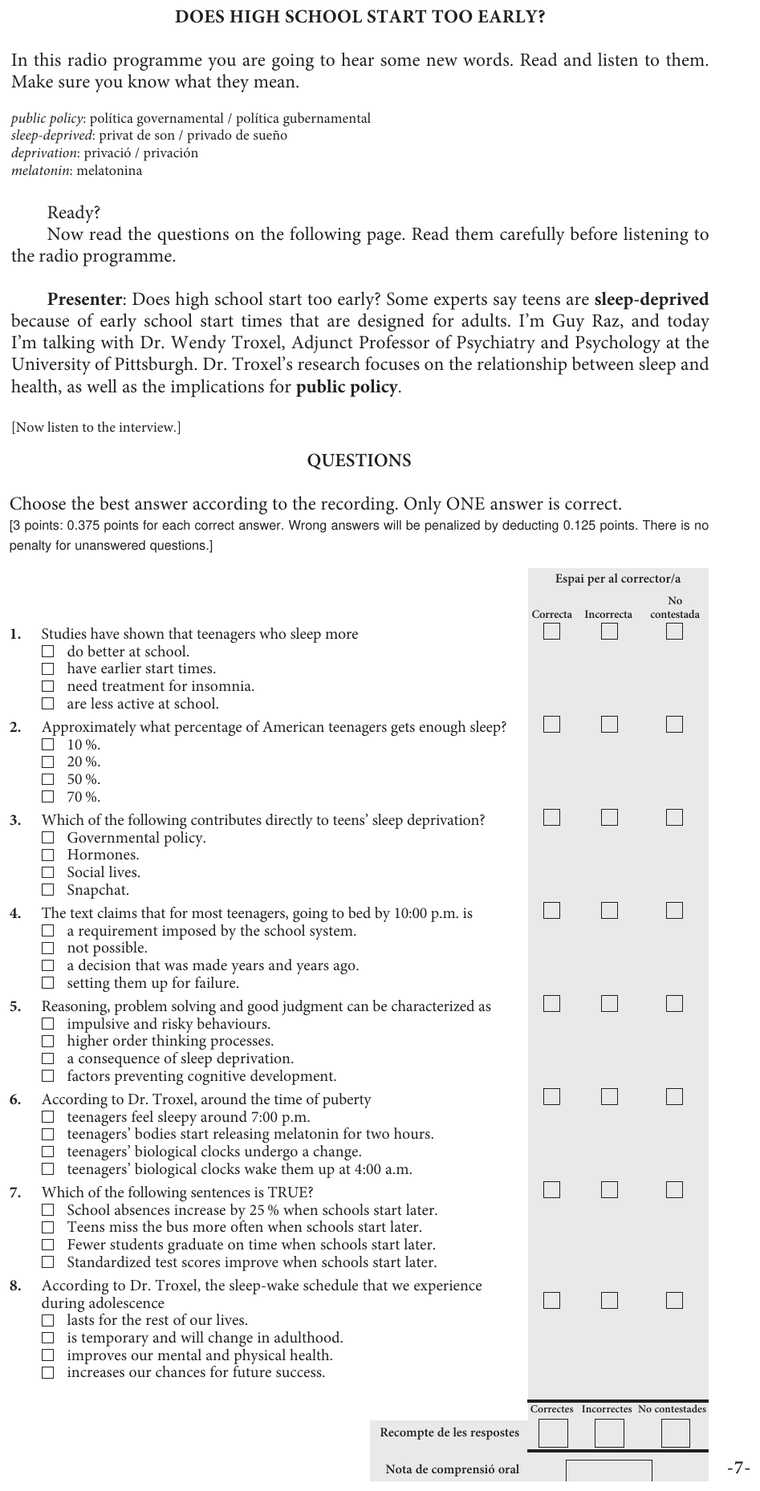
DOES HIGH SCHOOL START TOO EARLY?
In this radio programme you are going to hear some new words. Read and listen to them.
Make sure you know what they mean.
public policy: política governamental / política gubernamental
sleep-deprived: privat de son / privado de sueño
deprivation: privació / privación
melatonin: melatonina
Ready?
Now read the questions on the following page. Read them carefully before listening to
the radio programme.
Presenter: Does high school start too early? Some experts say teens are sleep-deprived
because of early school start times that are designed for adults. I’m Guy Raz, and today
I’m talking with Dr. Wendy Troxel, Adjunct Professor of Psychiatry and Psychology at the
University of Pittsburgh. Dr. Troxel’s research focuses on the relationship between sleep and
health, as well as the implications for public policy.
[Now listen to the interview.]
Transcripció oficial (pauangl19sp.pdf):
Does High School Start Too Early?
In this radio programme you are going to hear some new words. Read and listen to
them. Make sure you know what they mean.
public policy: política governamental / política gubernamental
sleep deprived: privat de son / privado de sueño
deprivation: privació / privación
melatonin: melatonina
Presenter (Guy Raz): Does high school start too early? Some experts say teens are
sleep-deprived because of early school start times that are designed for adults. I’m
Guy Raz, and today I’m talking with Dr. Wendy Troxel, Adjunct Professor of Psychiatry
and Psycology at the University of Pittsburgh. Dr. Troxel’s research focusses on the
relationship between sleep and health, as well as the implications for public policy.
GUY RAZ (GR): Welcome to the show, Dr. Troxel. If I were to ask you to give me one
idea about something that could have a huge impact on kids in schools, what would it
be?
WENDY TROXEL (WT): More sleep.
GR: More sleep—that could actually have measurable impact on how well students do
at school?
WT: Absolutely, and we have evidence.
GR: Your research focusses on teenagers, so high school-age kids.
WT: Yes. That’s right. Kids who get adequate amounts of sleep perform better in
school. They’re more likely to show up for school on time, have better graduation rates.
They’re able to think and perform better. Their attention is better. Kids who are sleeping
sufficient amounts also have better mental health and physical health, all of which we
know goes into the factors that contribute to a whole, healthy child who’s able to
perform and succeed in school.
GR: This may sound obvious, right? Kids need more sleep.
WT: Yes, but it’s not that easy. Sleep deprivation among American teenagers is an
epidemic. Only about 1 in 10 gets the 8 to 10 hours of sleep per night recommended by
sleep scientists and paediatricians. And remember, 8 hours is the minimum
recommendation.
GR: And what do you think are the main factors contributing to sleep deprivation?
WT: There are several, but a major factor preventing teens from getting the sleep they
actually need is public policy, not hormones, social lives or Snapchat.
GR: Public policy?
WT: Yes. Across the country, many schools are starting around 7:30 a.m. or earlier,
despite the fact that major medical organizations recommend that middle and high
schools start no earlier than 8:30 a.m. These timetables have a direct effect on HOW
MUCH or, in fact, HOW LITTLE sleep American teenagers really get.
GR: Basically what you’re saying is that since school starts so early for teens, and
obviously they have to wake up much earlier than that to get ready and reach the
school before 7:30, they’re not going to sleep enough.
WT: Exactly. It’s a simple math problem. If you have a school that starts at 7:35 a.m.,
like my own child’s, that means that they’re getting on a bus between 6:30 and 6:45
a.m. So if you simply count backwards from the clock, your child has to be going to bed
by 10:00 p.m. at the latest. And that’s simply not realistic for most teenagers. But the
truth of the matter is all this is a decision that was made years and years ago before we
knew the consequences of sleep deprivation.
GR: So, according to your research, we’re setting teenagers up for failure—failure in
their ability to sleep and failure in their ability to perform well at school.
WT: That’s exactly right. Adolescence is a period of dramatic brain development,
particularly in the parts of the brain that are responsible for those higher order thinking
processes, including reasoning, problem solving and good judgment—in other words,
the very type of brain activity that’s responsible for those impulsive and often risky
behaviours that are so characteristic of adolescents.
GR: So, many of the unpleasant characteristics of teenagers, like abrupt changes in
mood, irritability, laziness, depression, could actually be a product of chronic sleep
deprivation?
WT: Right. Around the time of puberty, teenagers experience a delay in their biological
clock, which determines when we feel most awake and when we feel most sleepy. This
is caused in part by a shift in the release of the hormone melatonin. Teenager’s bodies
wait to start releasing melatonin until around 11 p.m., which is two hours later than
what we see in adults or younger children. This means that waking a teenager up a 6
a.m. is the biological equivalent of waking up an adult at 4 a.m.
GR: But this seems like an easy problem to solve. You just change the start time of
schools.
WT: I wish it were that easy. But first let me tell you about some other benefits of later
start times.
GR: Sure, please go on.
WT: What we know is that when schools start later, one school district found a 25%
reduction in school absences. When we delay start times, children are actually more
likely to get the bus. So we see an increase in class attendance, and as a result, an
increase in graduation rates.
GR: This must eventually have a direct impact on their lifetime earnings.
WT: Of course. Teens from districts with later start times get more sleep, and not
surprisingly, they do better academically. Standardized test scores in math and reading
go up by 2 to 3 percentage points. Their health improves, and even their families are
happier.
GR: So in essence what you’re saying is the teenage period in our lives is when our
biology requires a specific schedule, and that specific schedule involves waking up
later.
WT: Exactly. This is a developmental issue. People don’t have these shifted sleep-
wake schedules for the rest of their lives. It’s only during adolescence. Sleep science
has clearly shown that there is a change in sleep-wake cycles and teenagers naturally
go to bed later and sleep in later. So by depriving them of sleep in adolescence, we’re
hurting their health and their chances for success.
GR: Thank you, Dr. Troxel. Unfortunately, we’re out of time. I’m Guy Raz, and you’ve
been listening to our show about how simple solutions can be the answer to some of
our most complex problems.
Adapted from
https://www.npr.org/2017/11/17/564608245/wendy-troxel-does-high-school-start-too-
early [November 17, 2017]
Vegeu el listening i la transcripció oficial de la pregunta 1 de Part 3.
1. Studies have shown that teenagers who sleep more
do better at school.
have earlier start times.
need treatment for insomnia.
are less active at school.
2. Approximately what percentage of American teenagers gets enough sleep?
10 %.
20 %.
50 %.
70 %.
3. Which of the following contributes directly to teens’ sleep deprivation?
Governmental policy.
Hormones.
Social lives.
Snapchat.
4. The text claims that for most teenagers, going to bed by 10:00 p.m. is
a requirement imposed by the school system.
not possible.
a decision that was made years and years ago.
setting them up for failure.
5. Reasoning, problem solving and good judgment can be characterized as
impulsive and risky behaviours.
higher order thinking processes.
a consequence of sleep deprivation.
factors preventing cognitive development.
6. According to Dr. Troxel, around the time of puberty
teenagers feel sleepy around 7:00 p.m.
teenagers’ bodies start releasing melatonin for two hours.
teenagers’ biological clocks undergo a change.
teenagers’ biological clocks wake them up at 4:00 a.m.
7. Which of the following sentences is TRUE?
School absences increase by 25 % when schools start later.
Teens miss the bus more often when schools start later.
Fewer students graduate on time when schools start later.
Standardized test scores improve when schools start later.
8. According to Dr. Troxel, the sleep-wake schedule that we experience
during adolescence
lasts for the rest of our lives.
is temporary and will change in adulthood.
improves our mental and physical health.
increases our chances for future success.
Toca per ampliar- 0,375 pSeleccionar la resposta de la clau oficial: do better at school.Penalització: Resposta incorrecta: −0,125 punts. Resposta en blanc: cap penalització.
Toca per ampliar- 0,375 pSeleccionar la resposta de la clau oficial: 10%Penalització: Resposta incorrecta: −0,125 punts. Resposta en blanc: cap penalització.
Toca per ampliar- 0,375 pSeleccionar la resposta de la clau oficial: Governmental policy.Penalització: Resposta incorrecta: −0,125 punts. Resposta en blanc: cap penalització.
Toca per ampliar- 0,375 pSeleccionar la resposta de la clau oficial: not possible.Penalització: Resposta incorrecta: −0,125 punts. Resposta en blanc: cap penalització.
Toca per ampliar- 0,375 pSeleccionar la resposta de la clau oficial: higher order thinking processes.Penalització: Resposta incorrecta: −0,125 punts. Resposta en blanc: cap penalització.
Toca per ampliar- 0,375 pSeleccionar la resposta de la clau oficial: teenagers’ biological clocks undergo a change.Penalització: Resposta incorrecta: −0,125 punts. Resposta en blanc: cap penalització.
Toca per ampliar- 0,375 pSeleccionar la resposta de la clau oficial: standardized test scores improve.Penalització: Resposta incorrecta: −0,125 punts. Resposta en blanc: cap penalització.
Toca per ampliar- 0,375 pSeleccionar la resposta de la clau oficial: is temporary and will change in adulthood.Penalització: Resposta incorrecta: −0,125 punts. Resposta en blanc: cap penalització.