Anglès
PAU 2019 · ordinària · sèrie 1
Examen oficial de la PAU de Catalunya amb la pauta de correcció. És d’una convocatòria anterior al model 2025: la pauta correspon a aquell examen.
Instruccions de l’examen
Part 1: Choose the best answer according to the text. Only ONE answer is correct. [3 points: 0.375 points for each correct answer. Wrong answers will be penalized by deducting 0.125 points. There is no penalty for unanswered questions.]
Part 2: Choose ONE topic. Your answer should be 125-150 words in length. There is no specific penalty for exceeding 150 words in length. Extra points are not given for exceeding 150 words. [4 points]
Part 3: Choose the best answer according to the recording. Only ONE answer is correct. [3 points: 0.375 points for each correct answer. Wrong answers will be penalized by deducting 0.125 points. There is no penalty for unanswered questions.]
Exercici 1
Part 1: Reading comprehension
 Toca per ampliar
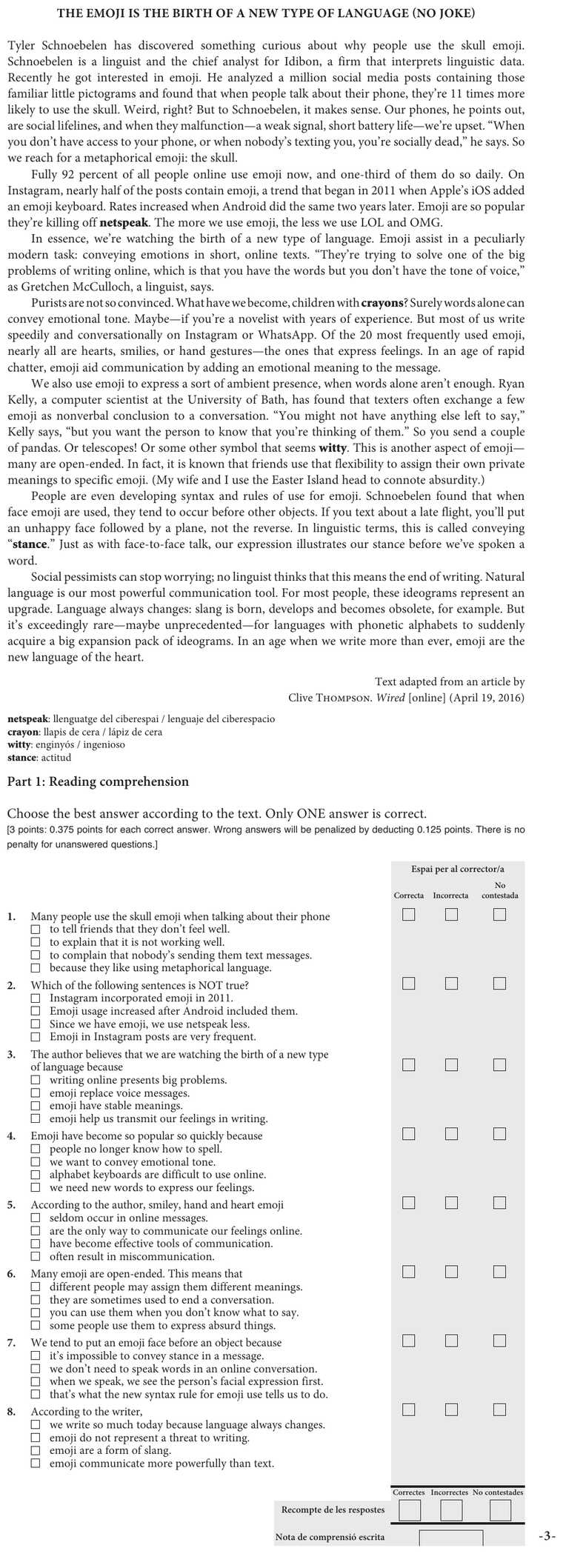
THE EMOJI IS THE BIRTH OF A NEW TYPE OF LANGUAGE (NO JOKE)
Tyler Schnoebelen has discovered something curious about why people use the skull emoji.
Schnoebelen is a linguist and the chief analyst for Idibon, a firm that interprets linguistic data.
Recently he got interested in emoji. He analyzed a million social media posts containing those
familiar little pictograms and found that when people talk about their phone, they’re 11 times more
likely to use the skull. Weird, right? But to Schnoebelen, it makes sense. Our phones, he points out,
are social lifelines, and when they malfunction—a weak signal, short battery life—we’re upset. “When
you don’t have access to your phone, or when nobody’s texting you, you’re socially dead,” he says. So
we reach for a metaphorical emoji: the skull.
Fully 92 percent of all people online use emoji now, and one-third of them do so daily. On
Instagram, nearly half of the posts contain emoji, a trend that began in 2011 when Apple’s iOS added
an emoji keyboard. Rates increased when Android did the same two years later. Emoji are so popular
they’re killing off netspeak. The more we use emoji, the less we use LOL and OMG.
In essence, we’re watching the birth of a new type of language. Emoji assist in a peculiarly
modern task: conveying emotions in short, online texts. “They’re trying to solve one of the big
problems of writing online, which is that you have the words but you don’t have the tone of voice,”
as Gretchen McCulloch, a linguist, says.
Purists are not so convinced. What have we become, children with crayons? Surely words alone can
convey emotional tone. Maybe—if you’re a novelist with years of experience. But most of us write
speedily and conversationally on Instagram or WhatsApp. Of the 20 most frequently used emoji,
nearly all are hearts, smilies, or hand gestures—the ones that express feelings. In an age of rapid
chatter, emoji aid communication by adding an emotional meaning to the message.
We also use emoji to express a sort of ambient presence, when words alone aren’t enough. Ryan
Kelly, a computer scientist at the University of Bath, has found that texters often exchange a few
emoji as nonverbal conclusion to a conversation. “You might not have anything else left to say,”
Kelly says, “but you want the person to know that you’re thinking of them.” So you send a couple
of pandas. Or telescopes! Or some other symbol that seems witty. This is another aspect of emoji—
many are open-ended. In fact, it is known that friends use that flexibility to assign their own private
meanings to specific emoji. (My wife and I use the Easter Island head to connote absurdity.)
People are even developing syntax and rules of use for emoji. Schnoebelen found that when
face emoji are used, they tend to occur before other objects. If you text about a late flight, you’ll put
an unhappy face followed by a plane, not the reverse. In linguistic terms, this is called conveying
“stance.” Just as with face-to-face talk, our expression illustrates our stance before we’ve spoken a
word.
Social pessimists can stop worrying; no linguist thinks that this means the end of writing. Natural
language is our most powerful communication tool. For most people, these ideograms represent an
upgrade. Language always changes: slang is born, develops and becomes obsolete, for example. But
it’s exceedingly rare—maybe unprecedented—for languages with phonetic alphabets to suddenly
acquire a big expansion pack of ideograms. In an age when we write more than ever, emoji are the
new language of the heart.
Text adapted from an article by
Clive Thompson. Wired [online] (April 19, 2016)
netspeak: llenguatge del ciberespai / lenguaje del ciberespacio
crayon: llapis de cera / lápiz de cera
witty: enginyós / ingenioso
stance: actitud
Vegeu el text de lectura de la pregunta 1 de Part 1.
1. Many people use the skull emoji when talking about their phone
to tell friends that they don’t feel well.
to explain that it is not working well.
to complain that nobody’s sending them text messages.
because they like using metaphorical language.
2. Which of the following sentences is NOT true?
Instagram incorporated emoji in 2011.
Emoji usage increased after Android included them.
Since we have emoji, we use netspeak less.
Emoji in Instagram posts are very frequent.
3. The author believes that we are watching the birth of a new type
of language because
writing online presents big problems.
emoji replace voice messages.
emoji have stable meanings.
emoji help us transmit our feelings in writing.
4. Emoji have become so popular so quickly because
people no longer know how to spell.
we want to convey emotional tone.
alphabet keyboards are difficult to use online.
we need new words to express our feelings.
5. According to the author, smiley, hand and heart emoji
seldom occur in online messages.
are the only way to communicate our feelings online.
have become effective tools of communication.
often result in miscommunication.
6. Many emoji are open-ended. This means that
different people may assign them different meanings.
they are sometimes used to end a conversation.
you can use them when you don’t know what to say.
some people use them to express absurd things.
7. We tend to put an emoji face before an object because
it’s impossible to convey stance in a message.
we don’t need to speak words in an online conversation.
when we speak, we see the person’s facial expression first.
that’s what the new syntax rule for emoji use tells us to do.
8. According to the writer,
we write so much today because language always changes.
emoji do not represent a threat to writing.
emoji are a form of slang.
emoji communicate more powerfully than text.
 Toca per ampliar
- 0,375 pSeleccionar la resposta de la clau oficial: to explain that it is not working well.Penalització: Resposta incorrecta: −0,125 punts. Resposta en blanc: cap penalització.
Toca per ampliar- 0,375 pSeleccionar la resposta de la clau oficial: Instagram incorporated emoji in 2011.Penalització: Resposta incorrecta: −0,125 punts. Resposta en blanc: cap penalització.
Toca per ampliar- 0,375 pSeleccionar la resposta de la clau oficial: emoji help us transmit our feelings in writing.Penalització: Resposta incorrecta: −0,125 punts. Resposta en blanc: cap penalització.
Toca per ampliar- 0,375 pSeleccionar la resposta de la clau oficial: we want to convey emotional tone.Penalització: Resposta incorrecta: −0,125 punts. Resposta en blanc: cap penalització.
Toca per ampliar- 0,375 pSeleccionar la resposta de la clau oficial: have become effective tools of communication.Penalització: Resposta incorrecta: −0,125 punts. Resposta en blanc: cap penalització.
Toca per ampliar- 0,375 pSeleccionar la resposta de la clau oficial: different people may assign them different meanings.Penalització: Resposta incorrecta: −0,125 punts. Resposta en blanc: cap penalització.
Toca per ampliar- 0,375 pSeleccionar la resposta de la clau oficial: when we speak, we see the person’s facial expression first.Penalització: Resposta incorrecta: −0,125 punts. Resposta en blanc: cap penalització.
Toca per ampliar- 0,375 pSeleccionar la resposta de la clau oficial: emoji do not represent a threat to writing.Penalització: Resposta incorrecta: −0,125 punts. Resposta en blanc: cap penalització.
Exercici 2 · opció A
Part 2: Writing
 Toca per ampliar
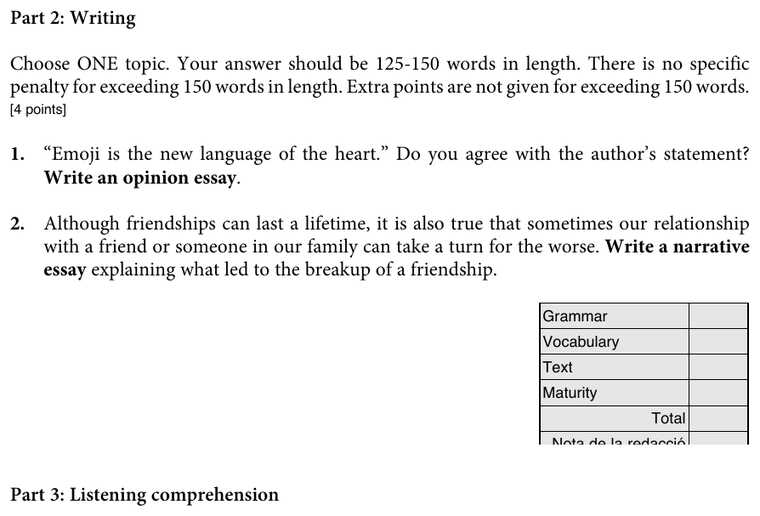
Choose ONE topic. Your answer should be 125-150 words in length. There is no specific penalty for exceeding 150 words in length. Extra points are not given for exceeding 150 words. [4 points]
1. “Emoji is the new language of the heart.” Do you agree with the author’s statement?
Write an opinion essay.
Toca per ampliar- 4 pSense desglossament als PDF proporcionats: redactar en anglès una resposta al tema 1 en el gènere i amb l’extensió que indica l’enunciat. El quadern assigna 4 punts a la redacció; no s’hi especifiquen descriptors ni pesos de Grammar, Vocabulary, Text o Maturity.
Exercici 2 · opció B
Part 2: Writing
 Toca per ampliar
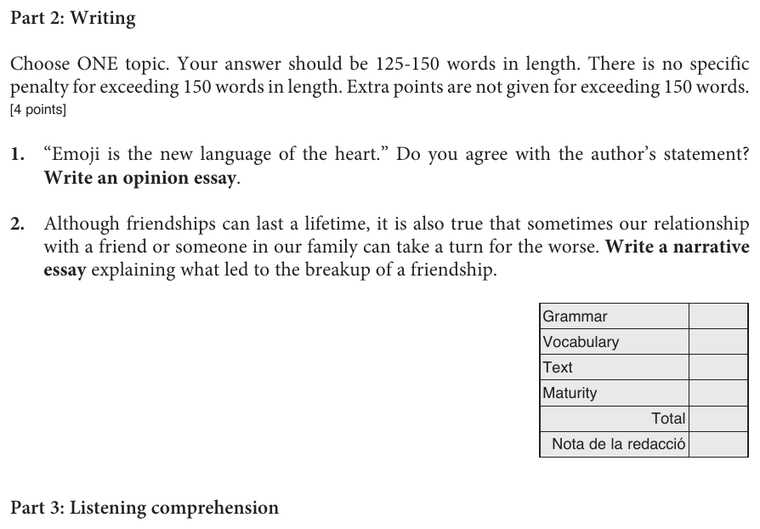
Choose ONE topic. Your answer should be 125-150 words in length. There is no specific penalty for exceeding 150 words in length. Extra points are not given for exceeding 150 words. [4 points]
2. Although friendships can last a lifetime, it is also true that sometimes our relationship
with a friend or someone in our family can take a turn for the worse. Write a narrative
essay explaining what led to the breakup of a friendship.
Toca per ampliar- 4 pSense desglossament als PDF proporcionats: redactar en anglès una resposta al tema 2 en el gènere i amb l’extensió que indica l’enunciat. El quadern assigna 4 punts a la redacció; no s’hi especifiquen descriptors ni pesos de Grammar, Vocabulary, Text o Maturity.
Exercici 3
Part 3: Listening comprehension
 Toca per ampliar
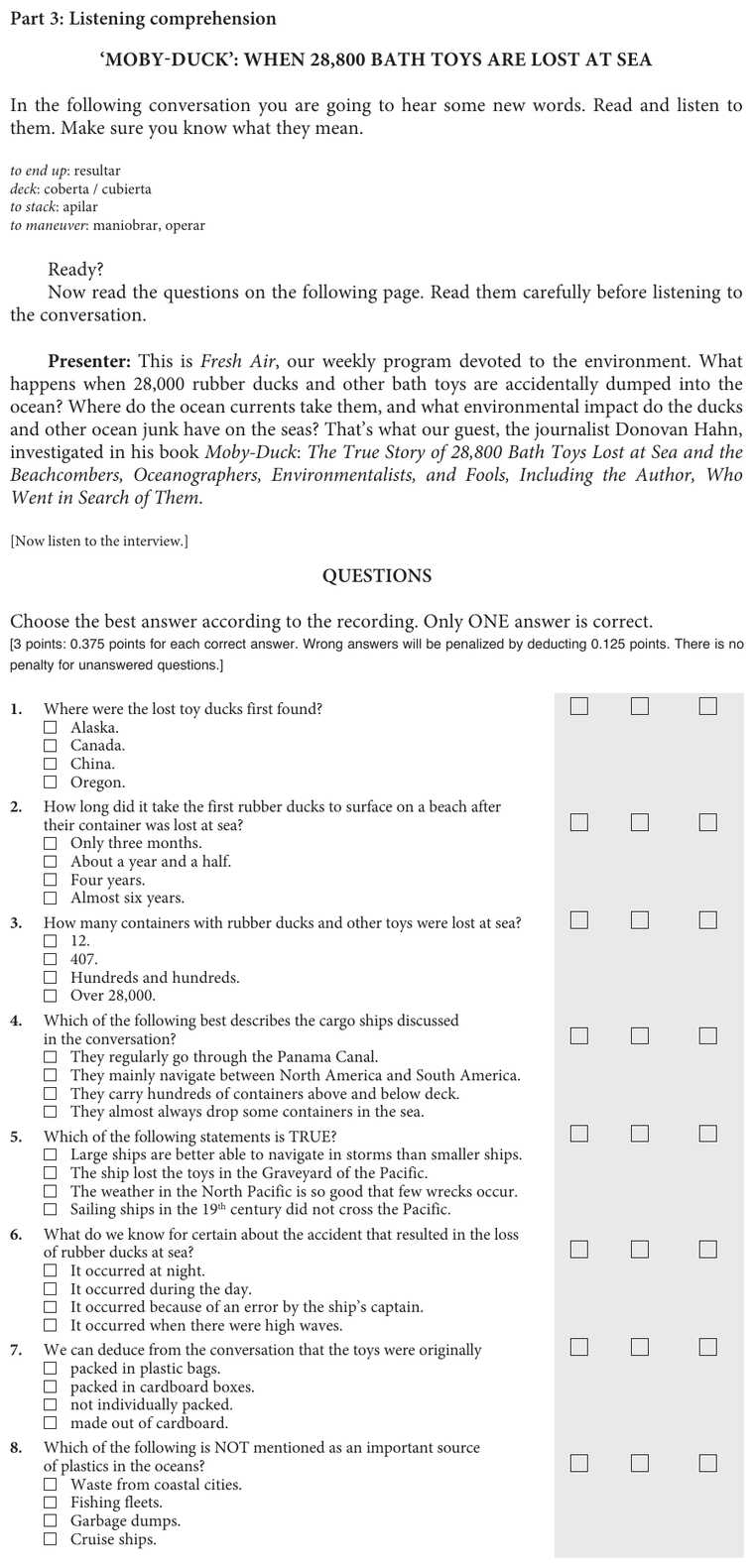
‘MOBY-DUCK’: WHEN 28,800 BATH TOYS ARE LOST AT SEA
In the following conversation you are going to hear some new words. Read and listen to
them. Make sure you know what they mean.
to end up: resultar
deck: coberta / cubierta
to stack: apilar
to maneuver: maniobrar, operar
Ready?
Now read the questions on the following page. Read them carefully before listening to
the conversation.
Presenter: This is Fresh Air, our weekly program devoted to the environment. What
happens when 28,000 rubber ducks and other bath toys are accidentally dumped into the
ocean? Where do the ocean currents take them, and what environmental impact do the ducks
and other ocean junk have on the seas? That’s what our guest, the journalist Donovan Hahn,
investigated in his book Moby-Duck: The True Story of 28,800 Bath Toys Lost at Sea and the
Beachcombers, Oceanographers, Environmentalists, and Fools, Including the Author, Who
Went in Search of Them.
[Now listen to the interview.]
Transcripció oficial (pauangl19jp.pdf):
'Moby-Duck': When 28,800 Bath Toys Are Lost At Sea
In the following conversation you are going to hear some new words. Read and listen to them.
Make sure you know what they mean.
to end up resultar
deck coberta / cubierta
to stack apilar
to maneuver maniobrar, operar
Ready?
Now read the questions on the following page. Read them carefully before listening to the
conversation.
_______________________________________________________________
This is FRESH AIR, our weekly program devoted to the environment. What happens when 28,000
rubber ducks and other bath toys are accidentally dumped in the ocean? Where do the ocean
currents take them, and what environmental impact do the ducks and other ocean junk have on
the seas? That’s what our guest, the journalist Donovan Hahn, investigated in his book “Moby-
Duck: The True Story of 28,800 Bath Toys Lost at Sea and the Beachcombers, Oceanographers,
Environmentalists, and Fools, Including the Author, Who Went in Search of Them”.
REPORTER: Welcome, Mr. Hahn, to FRESH AIR.
Donovan Hahn: Thank you. Happy to be here.
REPORTER: Let’s begin at the beginning. These 28,000 toys end up in the North Pacific in
January, 1992, when a container falls off a cargo vessel. When and where do people begin finding
them?
DH: The following year, in the autumn of 1993, people started finding hundreds of rubber ducks
in Sitka, Alaska.
REPORTER: So the ducks were in a container that fell into the ocean. Does that happen often?
I mean, millions of containers are shipped around the world every year, so I would imagine that
this was a pretty rare event.
DH: In fact, the loss of containers at sea is not so uncommon. But the shipping companies don’t
particularly like to talk about this problem because of issues with insurance policies. In the
accident that is the subject of my book, 12 containers were lost at sea, and that is considered a
small spill. In 1998, there was a major disaster in which a ship traveling from China to Seattle,
Washington lost 407 containers. That was one of the most expensive shipping disasters in history.
REPORTER: Could you tell us a little more about the kind of ship this container was on, so we
can understand how these containers are lost?
DH: Sure. These cargo ships are huge, they’re hundreds of meters long. Many are too big to go
through the Panama Canal, which explains the importance of the shipping routes between China
and the west coast of the U.S. They carry hundreds and hundreds of containers. Even though
some containers are carried below deck, most are stacked on top of each other on the main
deck. Typically, the containers are placed into stacks of six, so you can see how easy it would be
for some to fall off.
REPORTER: With so many stacked containers, how do they NOT fall off the ships?
DH: The shipping companies study how to best stack the containers in order to balance their
weight without affecting the ship’s ability to maneuver.
REPORTER: It must be a complex calculation.
DH: It is. And, of course, insurance companies require the shipping companies to take every
measure to get the calculations right.
REPORTER: It must be hard, with the size of these ships. And they also have to take into account
the weather, which can be very bad in the North Pacific.
DH: Absolutely. The shipping companies believe that the huge ships today will survive almost any
storm, and for the most part, they do. The fact that these ships are so huge explains why they are
more likely to try to sail through bad weather than ships in the past, which tried hard to avoid
storms. In fact, part of the route taken by the large cargo ship that lost the toys off the coast of
Oregon is known as the Graveyard of the Pacific because of all the shipwrecks recorded there,
especially during the time of sailing ships in the 19th century. Given the number of ships today,
significant accidents are quite rare.
REPORTER: Let’s go back to the lost rubber ducks. Can you tell us a little bit about what would
have happened that day? I mean, what was in this container, and what would’ve happened as it
tumbled into the sea?
DH: We know where the cargo ship was—it was very near the International Date Line, just south
of the Aleutian Islands in Alaska. We don’t know if it was day or night. We know that a ship in the
same area sent a weather report to the National Weather Service describing waves over 10
meters high, which means the seas were rough. We don’t know exactly how, but 12 containers
went overboard. And the container with the toys would have burst open during the fall, and initially
a bunch of cardboard boxes were sent into the sea.
REPORTER: And then I suppose the cardboard dissolved, so what we have left are the toys.
DH: Exactly.
REPORTER: How can you be so sure that the toys found in Alaska are the ones that were lost at
sea in this container?
DH: That part of the investigation was actually easy. First, these toys are no longer being made,
so the design is different and not difficult to recognize. They are hollow plastic and sort of strange-
looking. Second, the ducks have the manufacturer’s mark on the wing. Third, we know from other
merchandise lost at sea what plastic looks like after crossing the ocean. The ducks became thin
and lost their color, becoming almost white. And finally, the toys were found by the dozens exactly
where the sea currents would have taken them.
REPORTER: One of the things you mention in your book is the harm that plastics are causing in
the ocean. But you say that most of the harm isn’t from container ships but rather from other
sources, is that right?
DH: Yes, although container ships are responsible for some of the plastic waste in the oceans, in
fact most of the plastics are from coastlines with urban waste and garbage dumps, and even
fishing fleets. Merchandise from containers lost at sea is just a small portion of the problem.
REPORTER: That’s all we have time for today on FRESH AIR. Thank you, Mr. Hohn, for your
interesting story.
DH: My pleasure.
Adapted from an interview heard on National Public Radio’s programme Fresh Air, March 29,
2011.
Vegeu el listening i la transcripció oficial de la pregunta 1 de Part 3.
1. Where were the lost toy ducks first found?
Alaska.
Canada.
China.
Oregon.
2. How long did it take the first rubber ducks to surface on a beach after
their container was lost at sea?
Only three months.
About a year and a half.
Four years.
Almost six years.
3. How many containers with rubber ducks and other toys were lost at sea?
12.
407.
Hundreds and hundreds.
Over 28,000.
4. Which of the following best describes the cargo ships discussed
in the conversation?
They regularly go through the Panama Canal.
They mainly navigate between North America and South America.
They carry hundreds of containers above and below deck.
They almost always drop some containers in the sea.
5. Which of the following statements is TRUE?
Large ships are better able to navigate in storms than smaller ships.
The ship lost the toys in the Graveyard of the Pacific.
The weather in the North Pacific is so good that few wrecks occur.
Sailing ships in the 19th century did not cross the Pacific.
6. What do we know for certain about the accident that resulted in the loss
of rubber ducks at sea?
It occurred at night.
It occurred during the day.
It occurred because of an error by the ship’s captain.
It occurred when there were high waves.
7. We can deduce from the conversation that the toys were originally
packed in plastic bags.
packed in cardboard boxes.
not individually packed.
made out of cardboard.
8. Which of the following is NOT mentioned as an important source
of plastics in the oceans?
Waste from coastal cities.
Fishing fleets.
Garbage dumps.
Cruise ships.
Toca per ampliar- 0,375 pSeleccionar la resposta de la clau oficial: Alaska.Penalització: Resposta incorrecta: −0,125 punts. Resposta en blanc: cap penalització.
Toca per ampliar- 0,375 pSeleccionar la resposta de la clau oficial: About a year and a half.Penalització: Resposta incorrecta: −0,125 punts. Resposta en blanc: cap penalització.
Toca per ampliar- 0,375 pSeleccionar la resposta de la clau oficial: 12.Penalització: Resposta incorrecta: −0,125 punts. Resposta en blanc: cap penalització.
Toca per ampliar- 0,375 pSeleccionar la resposta de la clau oficial: They carry hundreds of containers above and below deck.Penalització: Resposta incorrecta: −0,125 punts. Resposta en blanc: cap penalització.
Toca per ampliar- 0,375 pSeleccionar la resposta de la clau oficial: Large ships are better able to navigate in storms than smaller ships.Penalització: Resposta incorrecta: −0,125 punts. Resposta en blanc: cap penalització.
Toca per ampliar- 0,375 pSeleccionar la resposta de la clau oficial: It occurred when there were high waves.Penalització: Resposta incorrecta: −0,125 punts. Resposta en blanc: cap penalització.
Toca per ampliar- 0,375 pSeleccionar la resposta de la clau oficial: packed in cardboard boxes.Penalització: Resposta incorrecta: −0,125 punts. Resposta en blanc: cap penalització.
Toca per ampliar- 0,375 pSeleccionar la resposta de la clau oficial: Cruise ships.Penalització: Resposta incorrecta: −0,125 punts. Resposta en blanc: cap penalització.