Anglès
PAU 2019 · ordinària · sèrie 4
Examen oficial de la PAU de Catalunya amb la pauta de correcció. És d’una convocatòria anterior al model 2025: la pauta correspon a aquell examen.
Instruccions de l’examen
Part 1: Choose the best answer according to the text. Only ONE answer is correct. [3 points: 0.375 points for each correct answer. Wrong answers will be penalized by deducting 0.125 points. There is no penalty for unanswered questions.]
Part 2: Choose ONE topic. Your answer should be 125-150 words in length. There is no specific penalty for exceeding 150 words in length. Extra points are not given for exceeding 150 words. [4 points]
Part 3: Choose the best answer according to the recording. Only ONE answer is correct. [3 points: 0.375 points for each correct answer. Wrong answers will be penalized by deducting 0.125 points. There is no penalty for unanswered questions.]
Exercici 1
Part 1: Reading comprehension
 Toca per ampliar
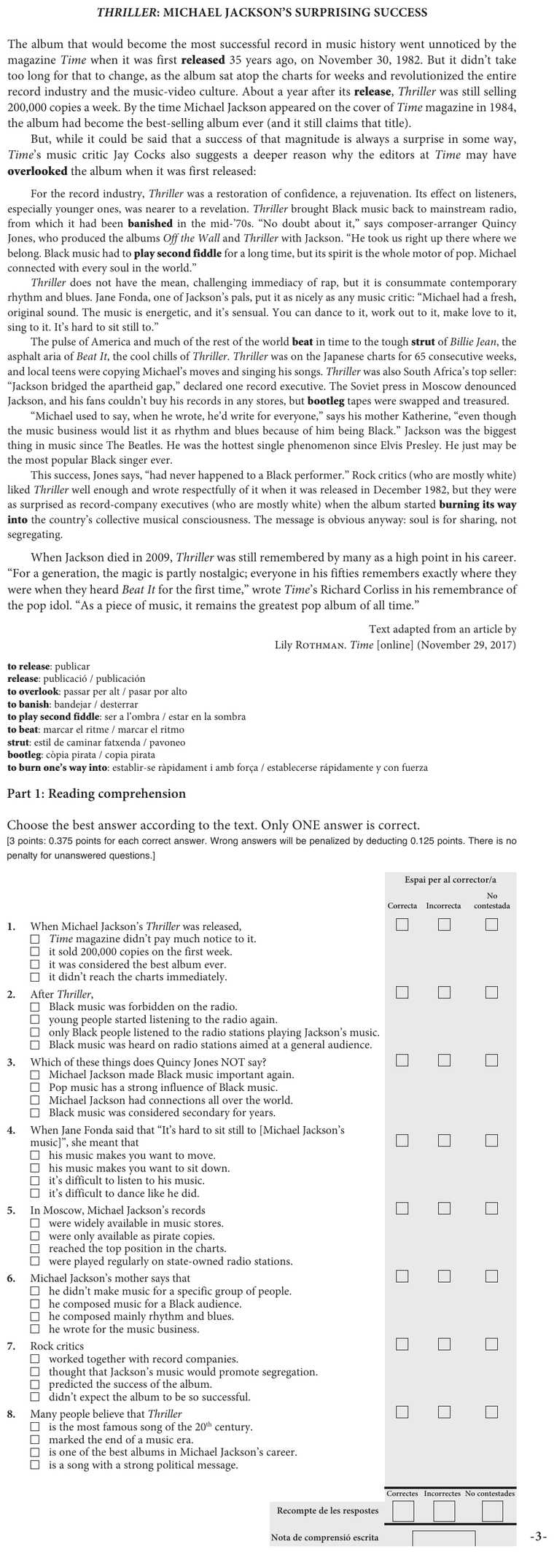
THRILLER: MICHAEL JACKSON’S SURPRISING SUCCESS
The album that would become the most successful record in music history went unnoticed by the
magazine Time when it was first released 35 years ago, on November 30, 1982. But it didn’t take
too long for that to change, as the album sat atop the charts for weeks and revolutionized the entire
record industry and the music-video culture. About a year after its release, Thriller was still selling
200,000 copies a week. By the time Michael Jackson appeared on the cover of Time magazine in 1984,
the album had become the best-selling album ever (and it still claims that title).
But, while it could be said that a success of that magnitude is always a surprise in some way,
Time’s music critic Jay Cocks also suggests a deeper reason why the editors at Time may have
overlooked the album when it was first released:
For the record industry, Thriller was a restoration of confidence, a rejuvenation. Its effect on listeners,
especially younger ones, was nearer to a revelation. Thriller brought Black music back to mainstream radio,
from which it had been banished in the mid-’70s. “No doubt about it,” says composer-arranger Quincy
Jones, who produced the albums Off the Wall and Thriller with Jackson. “He took us right up there where we
belong. Black music had to play second fiddle for a long time, but its spirit is the whole motor of pop. Michael
connected with every soul in the world.”
Thriller does not have the mean, challenging immediacy of rap, but it is consummate contemporary
rhythm and blues. Jane Fonda, one of Jackson’s pals, put it as nicely as any music critic: “Michael had a fresh,
original sound. The music is energetic, and it’s sensual. You can dance to it, work out to it, make love to it,
sing to it. It’s hard to sit still to.”
The pulse of America and much of the rest of the world beat in time to the tough strut of Billie Jean, the
asphalt aria of Beat It, the cool chills of Thriller. Thriller was on the Japanese charts for 65 consecutive weeks,
and local teens were copying Michael’s moves and singing his songs. Thriller was also South Africa’s top seller:
“Jackson bridged the apartheid gap,” declared one record executive. The Soviet press in Moscow denounced
Jackson, and his fans couldn’t buy his records in any stores, but bootleg tapes were swapped and treasured.
“Michael used to say, when he wrote, he’d write for everyone,” says his mother Katherine, “even though
the music business would list it as rhythm and blues because of him being Black.” Jackson was the biggest
thing in music since The Beatles. He was the hottest single phenomenon since Elvis Presley. He just may be
the most popular Black singer ever.
This success, Jones says, “had never happened to a Black performer.” Rock critics (who are mostly white)
liked Thriller well enough and wrote respectfully of it when it was released in December 1982, but they were
as surprised as record-company executives (who are mostly white) when the album started burning its way
into the country’s collective musical consciousness. The message is obvious anyway: soul is for sharing, not
segregating.
When Jackson died in 2009, Thriller was still remembered by many as a high point in his career.
“For a generation, the magic is partly nostalgic; everyone in his fifties remembers exactly where they
were when they heard Beat It for the first time,” wrote Time’s Richard Corliss in his remembrance of
the pop idol. “As a piece of music, it remains the greatest pop album of all time.”
Text adapted from an article by
Lily Rothman. Time [online] (November 29, 2017)
to release: publicar
release: publicació / publicación
to overlook: passar per alt / pasar por alto
to banish: bandejar / desterrar
to play second fiddle: ser a l’ombra / estar en la sombra
to beat: marcar el ritme / marcar el ritmo
strut: estil de caminar fatxenda / pavoneo
bootleg: còpia pirata / copia pirata
to burn one’s way into: establir-se ràpidament i amb força / establecerse rápidamente y con fuerza
Vegeu el text de lectura de la pregunta 1 de Part 1.
1. When Michael Jackson’s Thriller was released,
Time magazine didn’t pay much notice to it.
it sold 200,000 copies on the first week.
it was considered the best album ever.
it didn’t reach the charts immediately.
2. After Thriller,
Black music was forbidden on the radio.
young people started listening to the radio again.
only Black people listened to the radio stations playing Jackson’s music.
Black music was heard on radio stations aimed at a general audience.
3. Which of these things does Quincy Jones NOT say?
Michael Jackson made Black music important again.
Pop music has a strong influence of Black music.
Michael Jackson had connections all over the world.
Black music was considered secondary for years.
4. When Jane Fonda said that “It’s hard to sit still to [Michael Jackson’s
music]”, she meant that
his music makes you want to move.
his music makes you want to sit down.
it’s difficult to listen to his music.
it’s difficult to dance like he did.
5. In Moscow, Michael Jackson’s records
were widely available in music stores.
were only available as pirate copies.
reached the top position in the charts.
were played regularly on state-owned radio stations.
6. Michael Jackson’s mother says that
he didn’t make music for a specific group of people.
he composed music for a Black audience.
he composed mainly rhythm and blues.
he wrote for the music business.
7. Rock critics
worked together with record companies.
thought that Jackson’s music would promote segregation.
predicted the success of the album.
didn’t expect the album to be so successful.
8. Many people believe that Thriller
is the most famous song of the 20th century.
marked the end of a music era.
is one of the best albums in Michael Jackson’s career.
is a song with a strong political message.
 Toca per ampliar
- 0,375 pSeleccionar la resposta de la clau oficial: Time magazine didn’t pay much notice to it.Penalització: Resposta incorrecta: −0,125 punts. Resposta en blanc: cap penalització.
Toca per ampliar- 0,375 pSeleccionar la resposta de la clau oficial: Black music was heard on radio stations aimed at a general audience.Penalització: Resposta incorrecta: −0,125 punts. Resposta en blanc: cap penalització.
Toca per ampliar- 0,375 pSeleccionar la resposta de la clau oficial: Michael Jackson had connections all over the world.Penalització: Resposta incorrecta: −0,125 punts. Resposta en blanc: cap penalització.
Toca per ampliar- 0,375 pSeleccionar la resposta de la clau oficial: his music makes you want to move.Penalització: Resposta incorrecta: −0,125 punts. Resposta en blanc: cap penalització.
Toca per ampliar- 0,375 pSeleccionar la resposta de la clau oficial: were only available as pirate copies.Penalització: Resposta incorrecta: −0,125 punts. Resposta en blanc: cap penalització.
Toca per ampliar- 0,375 pSeleccionar la resposta de la clau oficial: he didn’t make music for a specific group of people.Penalització: Resposta incorrecta: −0,125 punts. Resposta en blanc: cap penalització.
Toca per ampliar- 0,375 pSeleccionar la resposta de la clau oficial: didn’t expect the album to be so successful.Penalització: Resposta incorrecta: −0,125 punts. Resposta en blanc: cap penalització.
Toca per ampliar- 0,375 pSeleccionar la resposta de la clau oficial: is one of the best albums in Michael Jackson’s career.Penalització: Resposta incorrecta: −0,125 punts. Resposta en blanc: cap penalització.
Exercici 2 · opció A
Part 2: Writing
 Toca per ampliar
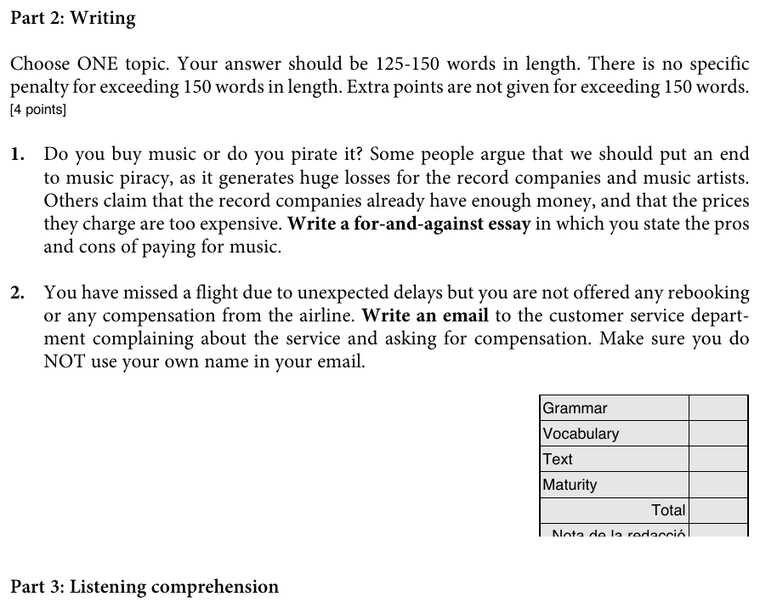
Choose ONE topic. Your answer should be 125-150 words in length. There is no specific penalty for exceeding 150 words in length. Extra points are not given for exceeding 150 words. [4 points]
1. Do you buy music or do you pirate it? Some people argue that we should put an end
to music piracy, as it generates huge losses for the record companies and music artists.
Others claim that the record companies already have enough money, and that the prices
they charge are too expensive. Write a for-and-against essay in which you state the pros
and cons of paying for music.
Toca per ampliar- 4 pSense desglossament als PDF proporcionats: redactar en anglès una resposta al tema 1 en el gènere i amb l’extensió que indica l’enunciat. El quadern assigna 4 punts a la redacció; no s’hi especifiquen descriptors ni pesos de Grammar, Vocabulary, Text o Maturity.
Exercici 2 · opció B
Part 2: Writing
Toca per ampliarChoose ONE topic. Your answer should be 125-150 words in length. There is no specific penalty for exceeding 150 words in length. Extra points are not given for exceeding 150 words. [4 points]
2. You have missed a flight due to unexpected delays but you are not offered any rebooking
or any compensation from the airline. Write an email to the customer service depart-
ment complaining about the service and asking for compensation. Make sure you do
NOT use your own name in your email.
Toca per ampliar- 4 pSense desglossament als PDF proporcionats: redactar en anglès una resposta al tema 2 en el gènere i amb l’extensió que indica l’enunciat. El quadern assigna 4 punts a la redacció; no s’hi especifiquen descriptors ni pesos de Grammar, Vocabulary, Text o Maturity.
Exercici 3
Part 3: Listening comprehension
 Toca per ampliar
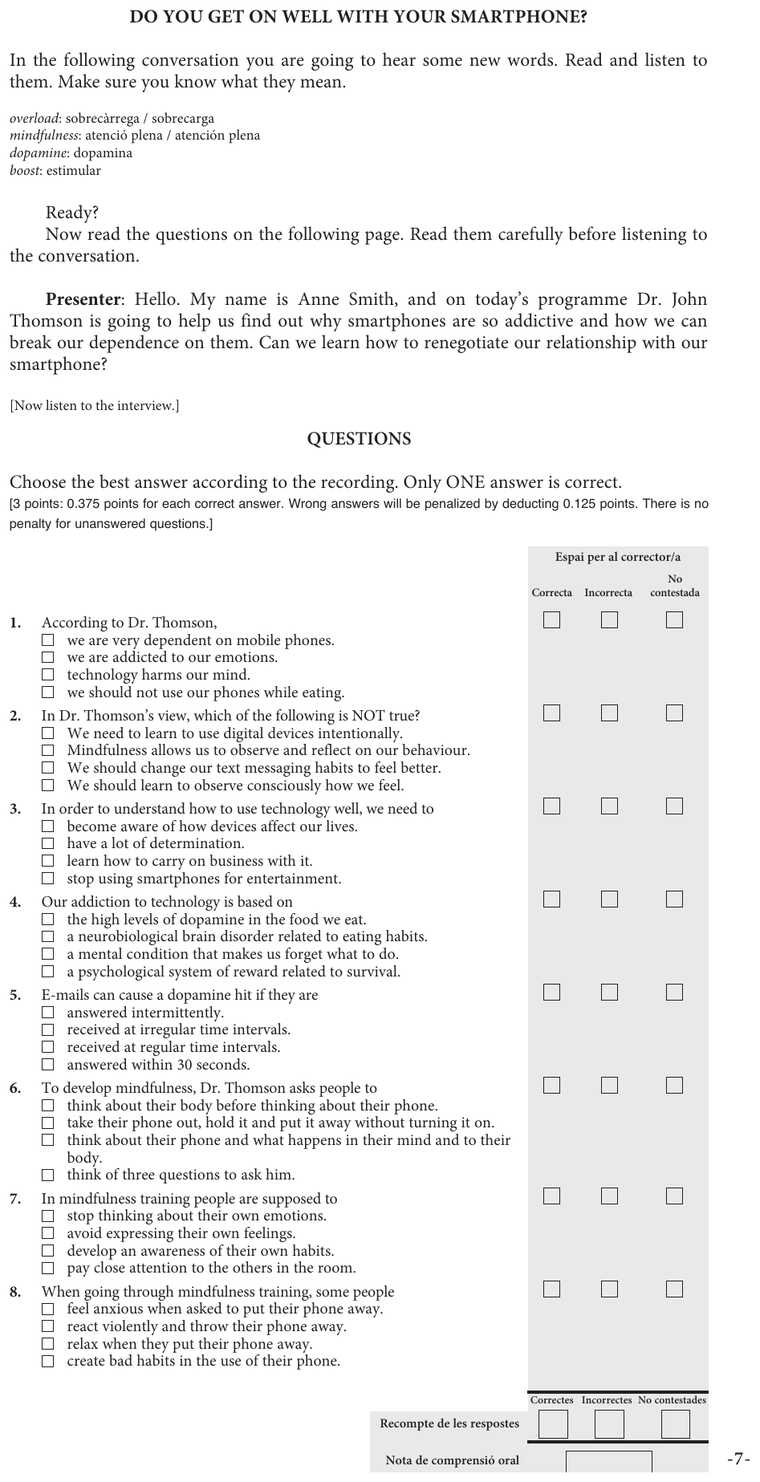
DO YOU GET ON WELL WITH YOUR SMARTPHONE?
In the following conversation you are going to hear some new words. Read and listen to
them. Make sure you know what they mean.
overload: sobrecàrrega / sobrecarga
mindfulness: atenció plena / atención plena
dopamine: dopamina
boost: estimular
Ready?
Now read the questions on the following page. Read them carefully before listening to
the conversation.
Presenter: Hello. My name is Anne Smith, and on today’s programme Dr. John
Thomson is going to help us find out why smartphones are so addictive and how we can
break our dependence on them. Can we learn how to renegotiate our relationship with our
smartphone?
[Now listen to the interview.]
Transcripció oficial (pauangl19jp.pdf):
DO YOU GET ON WELL WITH YOUR SMART PHONE?
In the following conversation you are going to hear some new words. Read and listen to them.
Make sure you know what they mean
overload: sobrecàrrega / sobrecarga
mindfulness: atenció plena / atención plena
dopamine: dopamina
boost: estimular
Ready?
Now read the questions on the following page. Read them carefully before listening to the
conversation.
Anne Smith: Hello. My name is Anne Smith, and on today’s programme Dr John Thomson is
going to help us find out why smart phones are so addictive and how can we break our
dependence on them. Can we learn how to renegotiate our relationship with our smart phone?
Anne Smith: Throw your mobile phone hard against a brick wall. Just imagine it. How does it
feel for you? What emotions come up in your mind and in your body? What about when you
realize you've left your mobile device at home, or in a taxi? Dr Thomson, have we become
addicted to our mobile phones?
John Thomson: Well... to a certain extent we are. The well-known example of people sitting
around the dinner table, each of them on their phones, is a terrible example of it. But we make a
lot of assumptions about technology that aren't quite right.
Anne Smith: What do you mean by that?
John Thomson: Well, one of the assumptions we are making is that this is an inevitable
process. We assume that these technologies do a lot of wonderful things for us. For example,
they allow us to be in touch with people and get information from all over the globe. But then we
also have to become aware that they are related to problems of distraction and information
overload. I think there are things that we can do about it.
Anne Smith: Can you give us some examples?
John Thomson: Well, we need to observe our behaviour when using technology. Almost
everything that human beings do now uses digital technology, whether it's business,
entertainment, or socialising. Smart phones have entered all those areas and have become
essential. We need to learn to become aware of the effects that our devices are having on us as
the basis for figuring out how to use them well.
Anne Smith: So what do you suggest we do?
John Thomson: So really what I'm suggesting is that there is a lot of power in bringing
mindfulness to our use of these devices to use them in more intentional ways. For example,
take the time to observe what we are feeling when we get a text message. We need to learn to
change our habits by conscious observation and reflection.
Anne Smith: How can we use our digital devices in ways that are healthier?
John Thomson: Our habits are based on a reward system. We humans have developed such a
system as a way to help us find where food is. So on a very simple level, we have to remember
where to get food, and before there were grocery stores, our brains had to have mechanisms to
learn to remember where food was. From a neurobiological standpoint, reward comes in the
form of dopamine. So if food is rich in calories, then our stomach sends a signal off to our brain
through dopamine that says, hey, remember what you ate and where you found it. This is the
way actions become habits.
Anne Smith: And so this same reward mechanism applies to everything?
John Thomson: That’s right. Let's take a simple example; stress may make us eat cupcakes or
chocolate, and then we feel better, that's the reward, so that becomes a habit. Well, the same
thing is true with technology. If we get stressed out and then we go and distract ourselves by
surfing the internet on our phone, that temporary distraction gives that same type of temporary
reward.
Anne Smith: So we are still being rewarded by that dopamine hit.
John Thomson: Yes, and some of the technologies, for example, email or texting, maximise
that type of hit. If we knew that we were going to get an email every 30 seconds, then our brain
would start expecting that and would not get the big dopamine hit that it gets with random
emails. So this technology basically boosts our dopamine system and trains us to develop
expectations.
Anne Smith: What can mindfulness training, then, do for us? And how do we develop
mindfulness?
John Thomson: For example, I would just say to people “Think about your phone. Don't even
take it out yet. Just bring it to mind. What happens when you think about your phone, what
happens to your breathing? Does your body posture change? What emotions come up when
you think about your phone? And what does it do to the quality of your attention?” So these are
the first questions I ask.
Anne Smith: Right, I see...
John Thomson: Then I would say “Now I want you take your phone out, I want you to hold it in
your hand. I don't want you to turn it on yet. Notice what's going on with your emotions”. Then I
ask people to turn on their phone and to open their email inbox, and I tell them to open a
message and respond. But I want them to notice what's happening in their mind and body all
the time. And finally, I tell them to turn off their phone and put it away and ask them how they
feel.
Anne Smith: What are the responses that you usually get from the people who go through this
exercise?
John Thomson: Everybody has somewhat different reactions. Some people notice that as soon
as they think about their phone, they start to get anxious and then they feel more relaxed when
they put the phone away, whereas others feel bad when they have to put it away. By doing this
exercise they begin to become aware of their own habits.
Anne Smith: Dr Thomson, many thanks for being with us today and for explaining how
mindfulness can help us have a healthier relationship with our mobile phones.
Sources:
Adapted from:
http://www.abc.net.au/radionational/programs/scienceshow/biomechanics-of-movement-
improves-animation-and-animal-rehabili/6805750
ABC Radio National (Australian Broadcasting Corporation)
Vegeu el listening i la transcripció oficial de la pregunta 1 de Part 3.
1. According to Dr. Thomson,
we are very dependent on mobile phones.
we are addicted to our emotions.
technology harms our mind.
we should not use our phones while eating.
2. In Dr. Thomson’s view, which of the following is NOT true?
We need to learn to use digital devices intentionally.
Mindfulness allows us to observe and reflect on our behaviour.
We should change our text messaging habits to feel better.
We should learn to observe consciously how we feel.
3. In order to understand how to use technology well, we need to
become aware of how devices affect our lives.
have a lot of determination.
learn how to carry on business with it.
stop using smartphones for entertainment.
4. Our addiction to technology is based on
the high levels of dopamine in the food we eat.
a neurobiological brain disorder related to eating habits.
a mental condition that makes us forget what to do.
a psychological system of reward related to survival.
5. E-mails can cause a dopamine hit if they are
answered intermittently.
received at irregular time intervals.
received at regular time intervals.
answered within 30 seconds.
6. To develop mindfulness, Dr. Thomson asks people to
think about their body before thinking about their phone.
take their phone out, hold it and put it away without turning it on.
think about their phone and what happens in their mind and to their
body.
think of three questions to ask him.
7. In mindfulness training people are supposed to
stop thinking about their own emotions.
avoid expressing their own feelings.
develop an awareness of their own habits.
pay close attention to the others in the room.
8. When going through mindfulness training, some people
feel anxious when asked to put their phone away.
react violently and throw their phone away.
relax when they put their phone away.
create bad habits in the use of their phone.
Toca per ampliar- 0,375 pSeleccionar la resposta de la clau oficial: we are very dependent on mobile phones.Penalització: Resposta incorrecta: −0,125 punts. Resposta en blanc: cap penalització.
Toca per ampliar- 0,375 pSeleccionar la resposta de la clau oficial: We should change our text messaging habits to feel better.Penalització: Resposta incorrecta: −0,125 punts. Resposta en blanc: cap penalització.
Toca per ampliar- 0,375 pSeleccionar la resposta de la clau oficial: become aware of how devices affect our lives.Penalització: Resposta incorrecta: −0,125 punts. Resposta en blanc: cap penalització.
Toca per ampliar- 0,375 pSeleccionar la resposta de la clau oficial: a psychological system of reward related to survival.Penalització: Resposta incorrecta: −0,125 punts. Resposta en blanc: cap penalització.
Toca per ampliar- 0,375 pSeleccionar la resposta de la clau oficial: received at irregular time intervals.Penalització: Resposta incorrecta: −0,125 punts. Resposta en blanc: cap penalització.
Toca per ampliar- 0,375 pSeleccionar la resposta de la clau oficial: think about their phone and what happens in their mind and to their body.Penalització: Resposta incorrecta: −0,125 punts. Resposta en blanc: cap penalització.
Toca per ampliar- 0,375 pSeleccionar la resposta de la clau oficial: develop an awareness of their own habits.Penalització: Resposta incorrecta: −0,125 punts. Resposta en blanc: cap penalització.
Toca per ampliar- 0,375 pSeleccionar la resposta de la clau oficial: relax when they put phone away.Penalització: Resposta incorrecta: −0,125 punts. Resposta en blanc: cap penalització.