Anglès
PAU 2020 · extraordinària · sèrie 4
Examen oficial de la PAU de Catalunya amb la pauta de correcció. És d’una convocatòria anterior al model 2025: la pauta correspon a aquell examen.
Instruccions de l’examen
Part 1: Choose the best answer according to the recording. Only ONE answer is correct. [3 points: 0.375 points for each correct answer. Wrong answers will be penalized by deducting 0.125 points. There is no penalty for unanswered questions.]
Part 2: Choose the best answer according to the text. Only ONE answer is correct. [3 points: 0.375 points for each correct answer. Wrong answers will be penalized by deducting 0.125 points. There is no penalty for unanswered questions.]
Part 3: Choose ONE topic. Your answer should be 125-150 words in length. There is no specific penalty for exceeding 150 words in length. Extra points are not given for exceeding 150 words. [4 points]
Exercici 1
Part 1: Listening comprehension
 Toca per ampliar
COUNTING THE BUGS AND BACTERIA, YOU’RE ‘NEVER HOME ALONE’
In this radio programme you are going to hear some new words. Read and listen to them.
Make sure you know what they mean.
microbe: microbi / microbio
showerhead: ruixador de la dutxa / alcachofa de ducha
moist: humit / húmedo
to breed: criar
Ready?
Now read the questions on the following page. Read them carefully before listening to
the radio programme.
[Now listen to the interview.]
Transcripció oficial (pauangl20sp.pdf):
Counting The Bugs And Bacteria, You're 'Never Home Alone'
In this radio programme you are going to hear some new words. Read and listen to them.
Make sure you know what they mean.
microbe: microbi/microbio
showerhead: carxofa de dutxa / alcachofa de ducha
moist: humid / húmedo
to breed: criar/criar
Ready? Now read the questions on the following page. Read them carefully before listening to
the radio programme.
_______________________________________________________________________
Presenter
You may be shocked to learn what's living in your home. The bacteria, the fungi, viruses, parasites
and insects - probably many more than you imagined. My guest Rob Dunn says the real goal is
to create a healthy balance of all the microorganisms and insects that co-habit with us. Dunn and
the team of scientists he works with analyze the populations of microorganisms living on floors,
in basements, on water faucets, the surfaces of TVs, etcetera. He's a professor in the Department
of Applied Ecology at North Carolina State University and author of the new book "Never Home
Alone" about the microbes, insects, some of them quite exotic, that live in our homes.
[Now listen to the interview]
REPORTER: So, let's start with just an overview of what's going on in our homes.
DUNN: Every surface, every bit of air, every bit of water in your home is alive. And every house,
every building we've ever studied, is alive. When we study homes, different homes have different
kinds of life in those different places. And so your house has habitats. Each of those habitats is a
little bit different. And there are, across houses, hundreds of thousands of species.
REPORTER: How did you get interested in this?
DUNN: So I started off studying rainforests. I was fascinated by the fact that you could turn over
a leaf, and every leaf seemed to have something new. And then I eventually found myself in
homes with the realization that a lot of what I'd done in jungles we could do under the bed and in
showers. And we were making the same kinds of discoveries I'd make in Bolivia or Ghana or
Australia or anywhere else.
REPORTER: One of the things you've learned in studying the microecosystem of homes is that
there are microbes that live in the extreme environments outdoors - in very cold temperatures or
very hot temperatures - that could live indoors because our homes reproduce the extremes of the
outdoors through things like the freezer and the hot water heater. So can you elaborate on that a
little bit?
DUNN: Certainly. So if you look at a traditional home from a couple of hundred years ago, it would
have been relatively open to the outdoor environment, and the conditions in it would have been
very much like the conditions outdoors. But in our modern, complex homes, we've built a whole
bunch of little structures in the home that replicate really extreme environments from elsewhere
on Earth. You know, our freezers are kind of like the Arctic. Our ovens are like really, really hot
deserts. And so when we do that, we're creating habitat for species that like those conditions.
REPORTER: Last year, you were in Iceland filming a documentary near a geyser. People
studying the microbes of hot water taps and heaters in homes found similar microbes to the ones
in this geyser. So what are they, and what are they doing in our homes?
DUNN: These are really amazing microbes and their environment has to be really hot, close to
boiling temperature of water, to grow. And then, if you go to houses, hot water heaters are full of
them, too. And they live in that superhot water and they love it. They pour on to you when you
take a shower. And they're fascinating little bugs.
REPORTER: Are they harmful to us?
DUNN: No, they're not harmful in any way.
REPORTER: Another study that's been done is on the bacteria in showerheads. Can you assure
us that it's OK to take a shower, please?
DUNN: It's OK to take a shower. It's far less risky than shaking hands with your neighbour.
REPORTER: Should we stop doing that?
DUNN: No, you should do that, too. We live in a world that's full of life, and we're always making
decisions about how to avoid the very most dangerous things while still keeping contact with the
rest of life. And, you know, I think we just have to acknowledge that we're surrounded by life.
REPORTER: A lot of people now use antibacterial soaps and hand sanitizers. Having studied all
these microbes, what are they doing to the microecology of our homes?
DUNN: Well - so first of all, we know that soap and water - good old-fashioned soap and water -
works great to kill pathogens that show up on your hands because you shook somebody's hand
who was sick or, you know, after you go to the bathroom. And soap and water saves millions and
millions of lives a year. Antibacterial soaps don't work any better than good old-fashioned soaps.
We get scared by the idea that there's life around us. We try to kill all of it, and in doing so, we're
more likely to make ourselves sick.
REPORTER: Heat and air conditioning systems, which are moist, can breed a lot of stuff. What
are some of the surprises that you and other scientists have found growing in heat and air
conditioning systems?
DUNN: Well, we often work with dust. If you have a heat and air conditioning system, there's a
set of microbes that those systems seem to favour. And they're not species we know much about,
but we know that we can predictably find them in houses that use their heat and air conditioning
system a lot.
REPORTER: You know how a lot of people take probiotics so that you create in yourself a good
bacterial environment instead of an imbalance? Do you think someday there's going to be
something similar to that for homes, something that will allow us to create a good microbial
ecology in our homes?
DUNN: Yeah, I hope so. It's not there now. But I look forward to a time when we can essentially
garden our homes, fill them with species that benefit us and push out the species that don't.
REPORTER: Well, Rob Dunn, thank you so much for talking with us.
DUNN: Oh, it's been an absolute pleasure. Thank you so much.
Adapted from
https://www.npr.org/sections/health-shots/2018/11/12/666933600/counting-the-bugs-and-
bacteria-youre-never-home-alone-and-thats-ok
[November 12, 2018]
Vegeu el listening i la transcripció oficial de la pregunta 1 de Part 1.
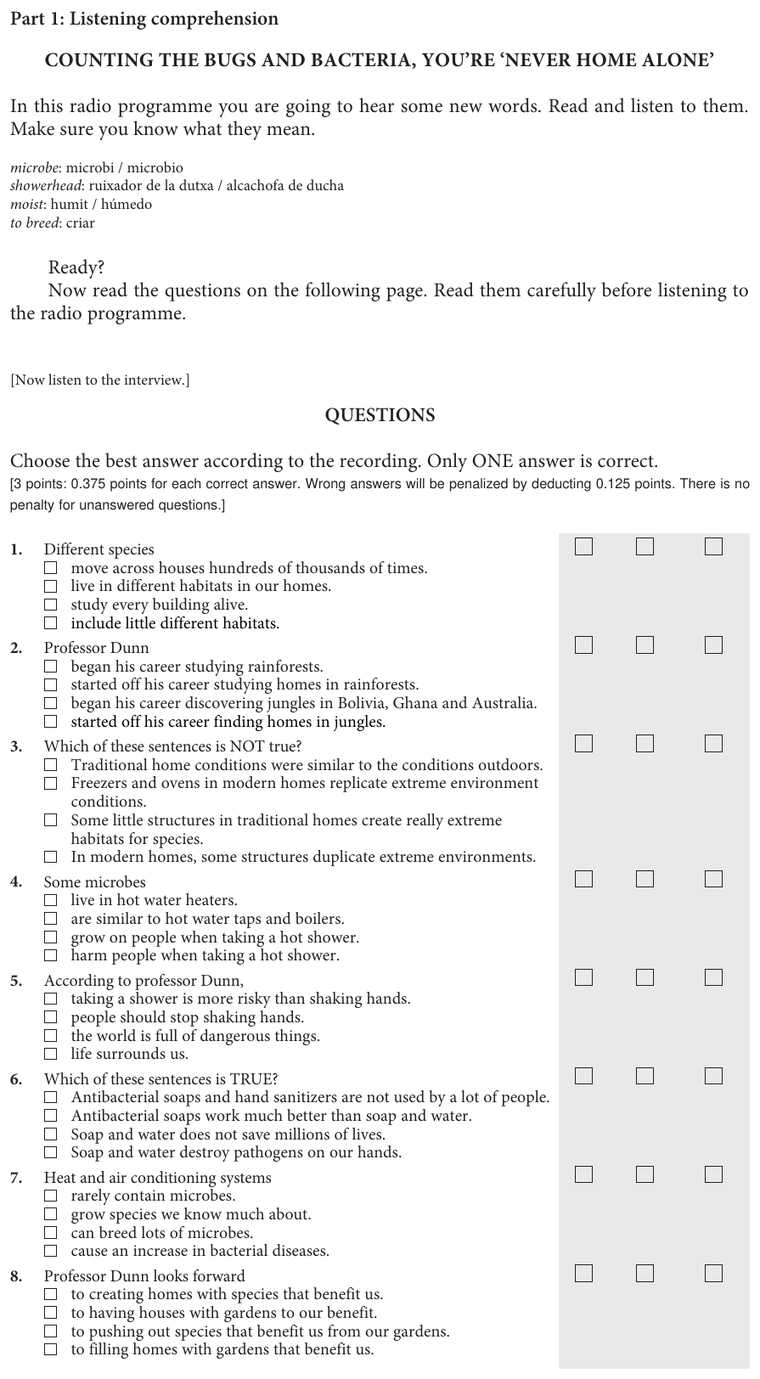
1. Different species
move across houses hundreds of thousands of times.
live in different habitats in our homes.
study every building alive.
include little different habitats.
2. Professor Dunn
began his career studying rainforests.
started off his career studying homes in rainforests.
began his career discovering jungles in Bolivia, Ghana and Australia.
started off his career finding homes in jungles.
3. Which of these sentences is NOT true?
Traditional home conditions were similar to the conditions outdoors.
Freezers and ovens in modern homes replicate extreme environment
conditions.
Some little structures in traditional homes create really extreme
habitats for species.
In modern homes, some structures duplicate extreme environments.
4. Some microbes
live in hot water heaters.
are similar to hot water taps and boilers.
grow on people when taking a hot shower.
harm people when taking a hot shower.
5. According to professor Dunn,
taking a shower is more risky than shaking hands.
people should stop shaking hands.
the world is full of dangerous things.
life surrounds us.
6. Which of these sentences is TRUE?
Antibacterial soaps and hand sanitizers are not used by a lot of people.
Antibacterial soaps work much better than soap and water.
Soap and water does not save millions of lives.
Soap and water destroy pathogens on our hands.
7. Heat and air conditioning systems
rarely contain microbes.
grow species we know much about.
can breed lots of microbes.
cause an increase in bacterial diseases.
8. Professor Dunn looks forward
to creating homes with species that benefit us.
to having houses with gardens to our benefit.
to pushing out species that benefit us from our gardens.
to filling homes with gardens that benefit us.
 Toca per ampliar
- 0,375 pSeleccionar la resposta de la clau oficial: live in different habitats in our homes.Penalització: Resposta incorrecta: −0,125 punts. Resposta en blanc: cap penalització.
Toca per ampliar- 0,375 pSeleccionar la resposta de la clau oficial: began his career studying rainforests.Penalització: Resposta incorrecta: −0,125 punts. Resposta en blanc: cap penalització.
Toca per ampliar- 0,375 pSeleccionar la resposta de la clau oficial: Some little structures in traditional homes create really extreme habitats for species.Penalització: Resposta incorrecta: −0,125 punts. Resposta en blanc: cap penalització.
Toca per ampliar- 0,375 pSeleccionar la resposta de la clau oficial: live in hot water heaters.Penalització: Resposta incorrecta: −0,125 punts. Resposta en blanc: cap penalització.
Toca per ampliar- 0,375 pSeleccionar la resposta de la clau oficial: life surrounds us.Penalització: Resposta incorrecta: −0,125 punts. Resposta en blanc: cap penalització.
Toca per ampliar- 0,375 pSeleccionar la resposta de la clau oficial: Soap and water destroy pathogens on our hands.Penalització: Resposta incorrecta: −0,125 punts. Resposta en blanc: cap penalització.
Toca per ampliar- 0,375 pSeleccionar la resposta de la clau oficial: can breed lots of microbes.Penalització: Resposta incorrecta: −0,125 punts. Resposta en blanc: cap penalització.
Toca per ampliar- 0,375 pSeleccionar la resposta de la clau oficial: to creating homes with species that benefit us.Penalització: Resposta incorrecta: −0,125 punts. Resposta en blanc: cap penalització.
Exercici 2
Part 2: Reading comprehension
 Toca per ampliar
HUGE REDUCTIONS IN MEAT-EATING ‘ESSENTIAL’ TO AVOID
CLIMATE BREAKDOWN
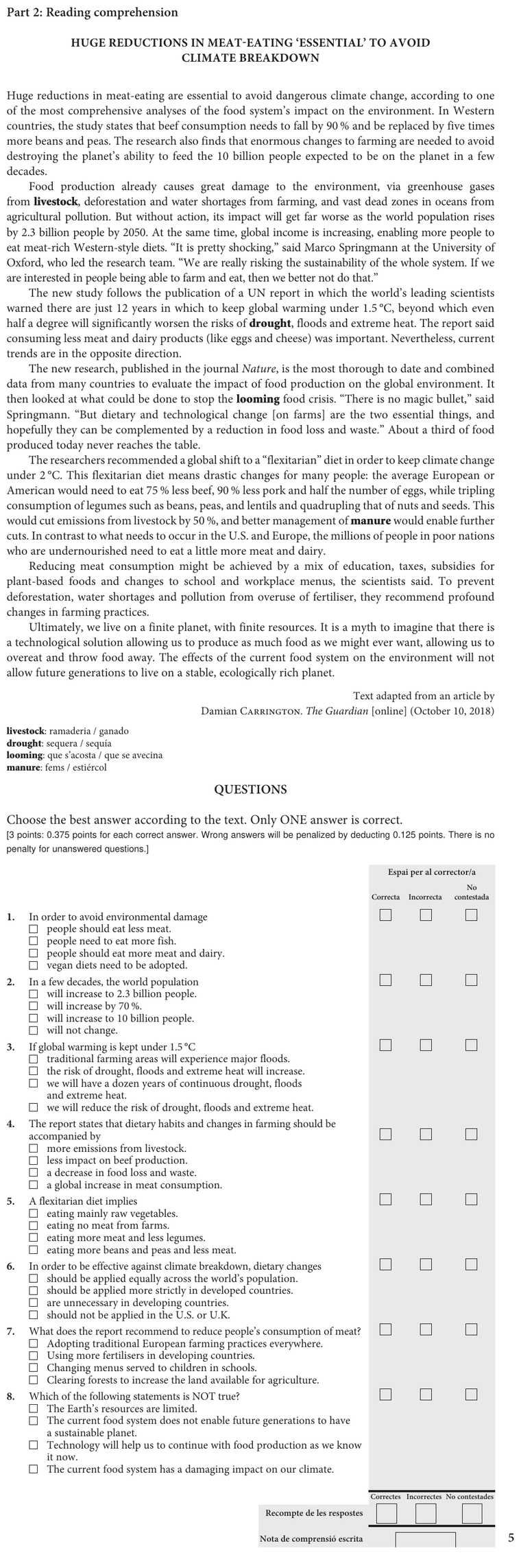
Huge reductions in meat-eating are essential to avoid dangerous climate change, according to one
of the most comprehensive analyses of the food system’s impact on the environment. In Western
countries, the study states that beef consumption needs to fall by 90 % and be replaced by five times
more beans and peas. The research also finds that enormous changes to farming are needed to avoid
destroying the planet’s ability to feed the 10 billion people expected to be on the planet in a few
decades.
Food production already causes great damage to the environment, via greenhouse gases
from livestock, deforestation and water shortages from farming, and vast dead zones in oceans from
agricultural pollution. But without action, its impact will get far worse as the world population rises
by 2.3 billion people by 2050. At the same time, global income is increasing, enabling more people to
eat meat-rich Western-style diets. “It is pretty shocking,” said Marco Springmann at the University of
Oxford, who led the research team. “We are really risking the sustainability of the whole system. If we
are interested in people being able to farm and eat, then we better not do that.”
The new study follows the publication of a UN report in which the world’s leading scientists
warned there are just 12 years in which to keep global warming under 1.5 °C, beyond which even
half a degree will significantly worsen the risks of drought, floods and extreme heat. The report said
consuming less meat and dairy products (like eggs and cheese) was important. Nevertheless, current
trends are in the opposite direction.
The new research, published in the journal Nature, is the most thorough to date and combined
data from many countries to evaluate the impact of food production on the global environment. It
then looked at what could be done to stop the looming food crisis. “There is no magic bullet,” said
Springmann. “But dietary and technological change [on farms] are the two essential things, and
hopefully they can be complemented by a reduction in food loss and waste.” About a third of food
produced today never reaches the table.
The researchers recommended a global shift to a “flexitarian” diet in order to keep climate change
under 2 °C. This flexitarian diet means drastic changes for many people: the average European or
American would need to eat 75 % less beef, 90 % less pork and half the number of eggs, while tripling
consumption of legumes such as beans, peas, and lentils and quadrupling that of nuts and seeds. This
would cut emissions from livestock by 50 %, and better management of manure would enable further
cuts. In contrast to what needs to occur in the U.S. and Europe, the millions of people in poor nations
who are undernourished need to eat a little more meat and dairy.
Reducing meat consumption might be achieved by a mix of education, taxes, subsidies for
plant-based foods and changes to school and workplace menus, the scientists said. To prevent
deforestation, water shortages and pollution from overuse of fertiliser, they recommend profound
changes in farming practices.
Ultimately, we live on a finite planet, with finite resources. It is a myth to imagine that there is
a technological solution allowing us to produce as much food as we might ever want, allowing us to
overeat and throw food away. The effects of the current food system on the environment will not
allow future generations to live on a stable, ecologically rich planet.
Text adapted from an article by
Damian Carrington. The Guardian [online] (October 10, 2018)
livestock: ramaderia / ganado
drought: sequera / sequía
looming: que s’acosta / que se avecina
manure: fems / estiércol
Vegeu el text de lectura de la pregunta 1 de Part 2.
1. In order to avoid environmental damage
people should eat less meat.
people need to eat more fish.
people should eat more meat and dairy.
vegan diets need to be adopted.
2. In a few decades, the world population
will increase to 2.3 billion people.
will increase by 70 %.
will increase to 10 billion people.
will not change.
3. If global warming is kept under 1.5 °C
traditional farming areas will experience major floods.
the risk of drought, floods and extreme heat will increase.
we will have a dozen years of continuous drought, floods
and extreme heat.
we will reduce the risk of drought, floods and extreme heat.
4. The report states that dietary habits and changes in farming should be
accompanied by
more emissions from livestock.
less impact on beef production.
a decrease in food loss and waste.
a global increase in meat consumption.
5. A flexitarian diet implies
eating mainly raw vegetables.
eating no meat from farms.
eating more meat and less legumes.
eating more beans and peas and less meat.
6. In order to be effective against climate breakdown, dietary changes
should be applied equally across the world’s population.
should be applied more strictly in developed countries.
are unnecessary in developing countries.
should not be applied in the U.S. or U.K.
7. What does the report recommend to reduce people’s consumption of meat?
Adopting traditional European farming practices everywhere.
Using more fertilisers in developing countries.
Changing menus served to children in schools.
Clearing forests to increase the land available for agriculture.
8. Which of the following statements is NOT true?
The Earth’s resources are limited.
The current food system does not enable future generations to have
a sustainable planet.
Technology will help us to continue with food production as we know
it now.
The current food system has a damaging impact on our climate.
Toca per ampliar- 0,375 pSeleccionar la resposta de la clau oficial: people should eat less meat.Penalització: Resposta incorrecta: −0,125 punts. Resposta en blanc: cap penalització.
Toca per ampliar- 0,375 pSeleccionar la resposta de la clau oficial: will increase to 10 billion people.Penalització: Resposta incorrecta: −0,125 punts. Resposta en blanc: cap penalització.
Toca per ampliar- 0,375 pSeleccionar la resposta de la clau oficial: we will reduce the risk of drought, floods and extreme heat.Penalització: Resposta incorrecta: −0,125 punts. Resposta en blanc: cap penalització.
Toca per ampliar- 0,375 pSeleccionar la resposta de la clau oficial: a decrease in food loss and waste.Penalització: Resposta incorrecta: −0,125 punts. Resposta en blanc: cap penalització.
Toca per ampliar- 0,375 pSeleccionar la resposta de la clau oficial: eating more beans and peas and less meat.Penalització: Resposta incorrecta: −0,125 punts. Resposta en blanc: cap penalització.
Toca per ampliar- 0,375 pSeleccionar la resposta de la clau oficial: should be applied more strictly in developed countries.Penalització: Resposta incorrecta: −0,125 punts. Resposta en blanc: cap penalització.
Toca per ampliar- 0,375 pSeleccionar la resposta de la clau oficial: Changing menus served to children in schools.Penalització: Resposta incorrecta: −0,125 punts. Resposta en blanc: cap penalització.
Toca per ampliar- 0,375 pSeleccionar la resposta de la clau oficial: Technology will help us to continue with food production as we know it now.Penalització: Resposta incorrecta: −0,125 punts. Resposta en blanc: cap penalització.
Exercici 3 · opció A
Part 3: Writing
 Toca per ampliar
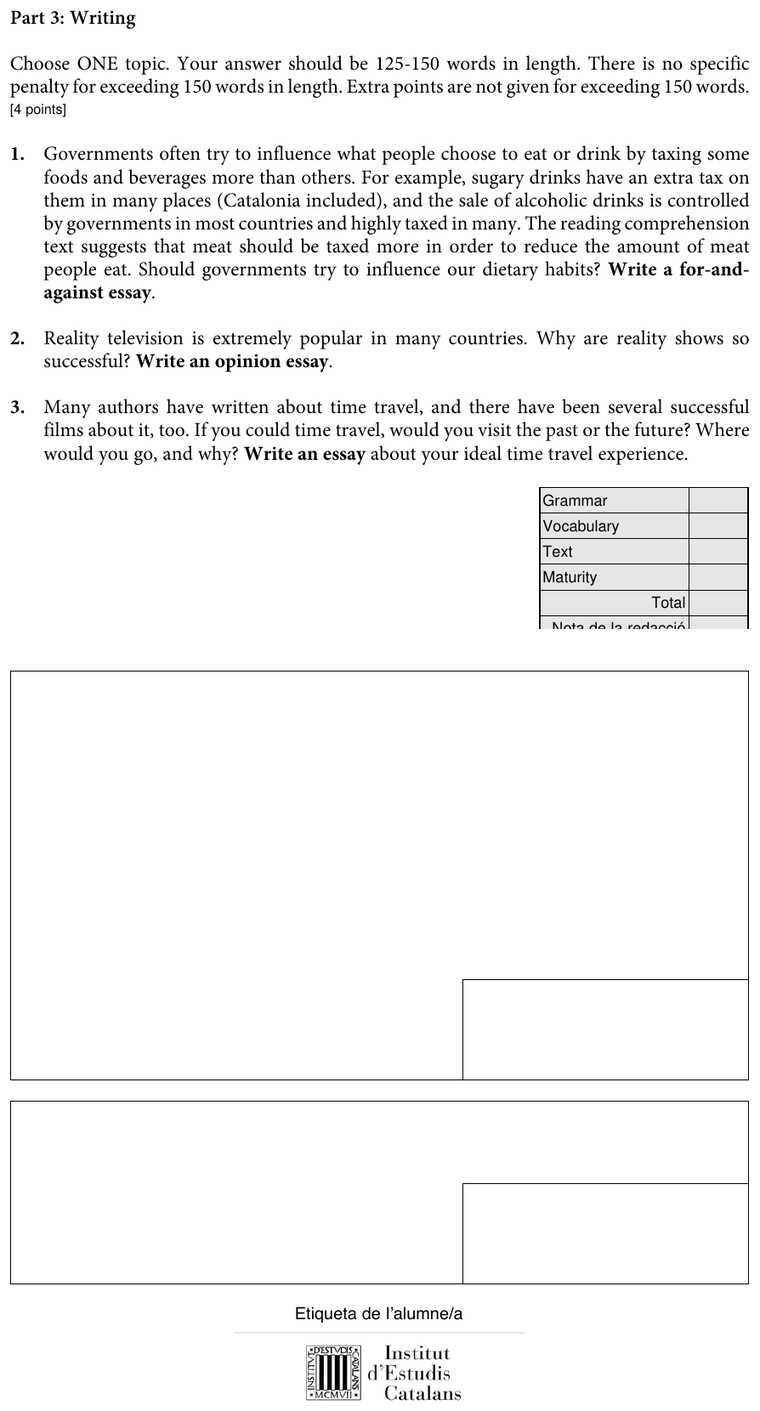
Choose ONE topic. Your answer should be 125-150 words in length. There is no specific penalty for exceeding 150 words in length. Extra points are not given for exceeding 150 words. [4 points]
1. Governments often try to influence what people choose to eat or drink by taxing some
foods and beverages more than others. For example, sugary drinks have an extra tax on
them in many places (Catalonia included), and the sale of alcoholic drinks is controlled
by governments in most countries and highly taxed in many. The reading comprehension
text suggests that meat should be taxed more in order to reduce the amount of meat
people eat. Should governments try to influence our dietary habits? Write a for-and-
against essay.
Toca per ampliar- 4 pSense desglossament als PDF proporcionats: redactar en anglès una resposta al tema 1 en el gènere i amb l’extensió que indica l’enunciat. El quadern assigna 4 punts a la redacció; no s’hi especifiquen descriptors ni pesos de Grammar, Vocabulary, Text o Maturity.
Exercici 3 · opció B
Part 3: Writing
Toca per ampliarChoose ONE topic. Your answer should be 125-150 words in length. There is no specific penalty for exceeding 150 words in length. Extra points are not given for exceeding 150 words. [4 points]
2. Reality television is extremely popular in many countries. Why are reality shows so
successful? Write an opinion essay.
Toca per ampliar- 4 pSense desglossament als PDF proporcionats: redactar en anglès una resposta al tema 2 en el gènere i amb l’extensió que indica l’enunciat. El quadern assigna 4 punts a la redacció; no s’hi especifiquen descriptors ni pesos de Grammar, Vocabulary, Text o Maturity.
Exercici 3 · opció C
Part 3: Writing
Toca per ampliarChoose ONE topic. Your answer should be 125-150 words in length. There is no specific penalty for exceeding 150 words in length. Extra points are not given for exceeding 150 words. [4 points]
3. Many authors have written about time travel, and there have been several successful
films about it, too. If you could time travel, would you visit the past or the future? Where
would you go, and why? Write an essay about your ideal time travel experience.
Toca per ampliar- 4 pSense desglossament als PDF proporcionats: redactar en anglès una resposta al tema 3 en el gènere i amb l’extensió que indica l’enunciat. El quadern assigna 4 punts a la redacció; no s’hi especifiquen descriptors ni pesos de Grammar, Vocabulary, Text o Maturity.