Anglès
PAU 2020 · ordinària · sèrie 1
Examen oficial de la PAU de Catalunya amb la pauta de correcció. És d’una convocatòria anterior al model 2025: la pauta correspon a aquell examen.
Instruccions de l’examen
Part 1: Choose the best answer according to the recording. Only ONE answer is correct. [3 points: 0.375 points for each correct answer. Wrong answers will be penalized by deducting 0.125 points. There is no penalty for unanswered questions.]
Part 2: Choose the best answer according to the text. Only ONE answer is correct. [3 points: 0.375 points for each correct answer. Wrong answers will be penalized by deducting 0.125 points. There is no penalty for unanswered questions.]
Part 3: Choose ONE topic. Your answer should be 125-150 words in length. There is no specific penalty for exceeding 150 words in length. Extra points are not given for exceeding 150 words. [4 points]
Exercici 1
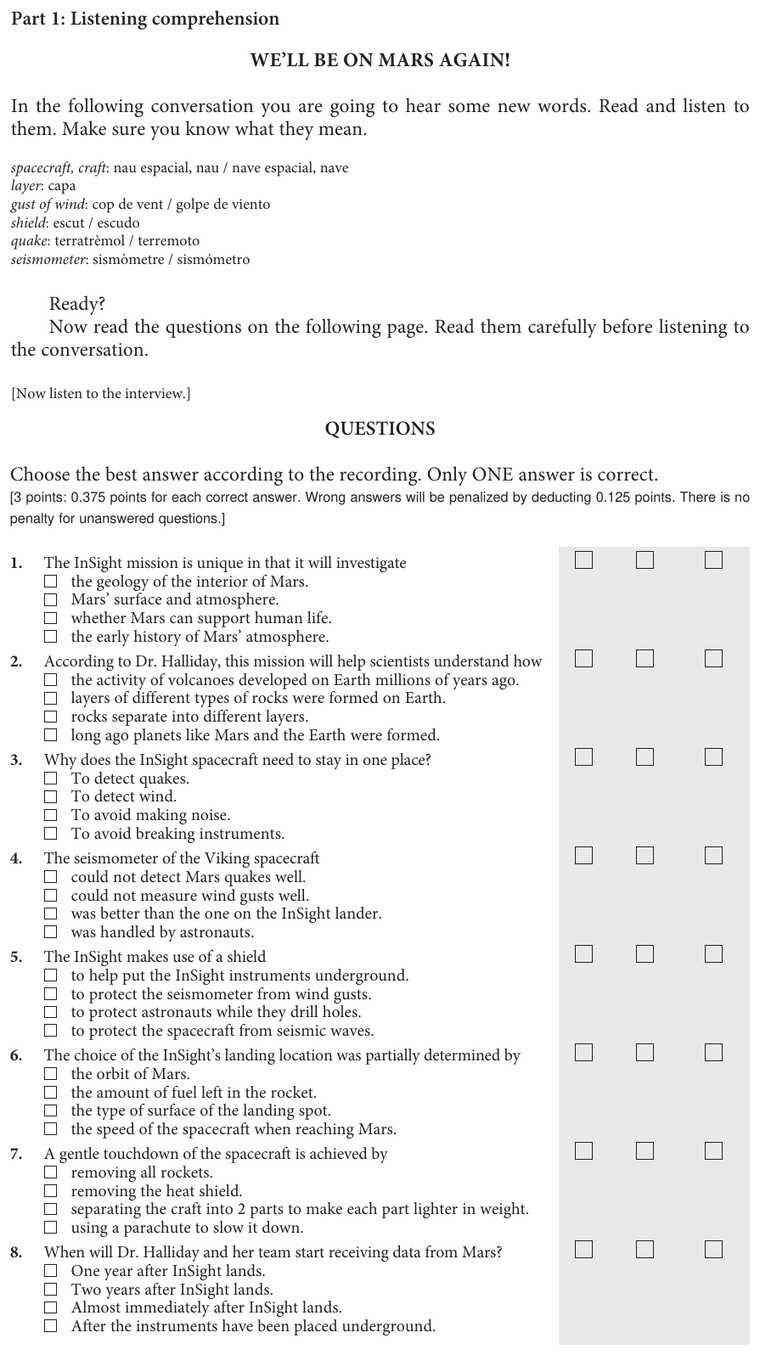
Part 1: Listening comprehension
 Toca per ampliar
WE’LL BE ON MARS AGAIN!
In the following conversation you are going to hear some new words. Read and listen to
them. Make sure you know what they mean.
spacecraft, craft: nau espacial, nau / nave espacial, nave
layer: capa
gust of wind: cop de vent / golpe de viento
shield: escut / escudo
quake: terratrèmol / terremoto
seismometer: sismòmetre / sismómetro
Ready?
Now read the questions on the following page. Read them carefully before listening to
the conversation.
[Now listen to the interview.]
Transcripció oficial (pauangl20jp.pdf):
We’ll be on Mars again!
In the following conversation you are going to hear some new words. Read and listen to
them. Make sure you know what they mean.
spacecraft, craft: nau espaial, nau / nave espacial, nave
layer: capa
gust of wind: cop de vent / golpe de viento
shield: escut / escudo
quake: terratrèmol / terremoto
seismometer: sismòmetre/sismómetro
Ready?
Now read the questions on the following page. Read them carefully before listening to
the conversation.
_____________________________________________________________________
Paul Smith: This is Science Today. Welcome! The spacecraft InSight successfully
landed on the surface of Mars a few weeks ago, just as other spacecraft had done in
previous missions, but it is different this time. Today, Dr Susan Halliday, a scientist
working for the InSight mission for NASA is with us and will help us find out why this
mission is different from previous ones.
Paul: We've had a lot of spacecraft go to Mars. What's unique about this mission?
Dr Halliday: We have had many missions that have looked at the surface of Mars, but
we are the first one that is really going to tell us about the interior of Mars and its
several layers, how all those layers got there. We will learn about the geologic activity
that could have created a habitat that may have supported life early in Mars's history.
Paul: And why do we want to know that?
Dr Halliday: Well, what we are really aiming for, our big-picture scientific question is
what happens in the first tens of millions of years after a planet forms. We know from
investigations of volcanoes on Earth that all the rocky bodies go through this process of
separating into different layers, but we don’t know much about how that process really
works. Our mission will help us gain a better understanding of this process.
Paul: Can you tell me a little bit about the craft?
Dr Halliday: Sure, it's the InSight Lander. Lander crafts don’t have wheels. We actually
need to stay in one place and be as quiet as possible so that we can use our
instruments to detect Mars quakes. In fact, we put those instruments underground. This
is extremely important to us. The first mission that landed on Mars, Viking, actually had
a seismometer that stayed on the craft. So it detected the gusts of wind that made the
craft shake, but it could not detect quakes precisely at all.
Paul: I see, so the InSight also has a seismometer?
Dr Halliday: Yes, that’s right, but for the first time we're going to place it on the ground.
The only other place where this has been done besides Earth is on the Moon. The
Apollo astronauts actually drilled holes into the Moon to place some instruments
underground. But now we are going to do all those things robotically. We use a robotic
arm to put the seismometer in the ground and then place a wind shield on top of the
seismometer to protect it from wind gusts that could be mistaken for seismic waves.
Paul: And how do you decide on the landing location? Can you determine a location
precisely?
Dr Halliday: Yes, we can be very precise about the location. In fact, we chose a
specific area where there is a certain elevation for safety reasons. The atmosphere of
Mars is very thin, so we need to have enough atmosphere to slow us down so that we
can land. And because the InSight is powered by solar energy, we need to be near the
equator. And then, lastly, we don't want our spacecraft to land on rocks or to have
rocks under the surface we want to drill. We went for the flattest, safest, most boring
landing site ever on Mars, we were not interested in exploring the geology of various
areas, as previous missions had done.
Paul: When the Curiosity spacecraft landed on Mars about six years ago, the landing
was described as the seven minutes of terror. Is it less risky now?
Dr Halliday: Well, not really. Every time you land on Mars it's always very risky. When
it works, it looks smooth and easy, but, in fact, at least a third of the missions that have
been sent to Mars have failed.
Paul: And how is the landing achieved?
Dr Halliday: Well, first we need a heat shield, because we are going at 12,300 miles
per hour when we hit the atmosphere of Mars. This slows down the craft quite a bit.
Then, when it is pretty near the surface, the parachute is released. This makes the craft
go quite slowly, and finally, in the last one hundred meters or so we remove the
parachute and we come down on landing rockets. And so if everything goes well, it's
quite a gentle touchdown.
Paul: But it's still a precision landing really, isn't it?
Susan: It is, and it's all automated. Because of the one-way flight time to Mars, we
can't command anything when this is happening, we just have to rely on getting the
sequence of commands correct in advance and we just sit in the control room and wait
to hear back.
Paul: So, now that the landing was successful, what happens next?
Dr Halliday: Our initial mission lasts one Mars year, that is, two Earth years. The first
thing we are going to do is spend a few months choosing the right place to put our
instruments down in the ground. So it will be a while before we actually start acquiring
data.
Paul: I am sure that data must be very interesting and revealing.
Dr Halliday: We hope so.
Paul: I’m afraid we’ve run out of time. Many thanks for talking to us about the InSight
mission.
Dr Halliday: My pleasure.
Sources:
Adapted from:
https://www.abc.net.au/radionational/programs/scienceshow/mars-insight-lander-to-
monitor-mars-interior/10548156#
ABC Radio National (Australian Broadcasting Corporation)
Vegeu el listening i la transcripció oficial de la pregunta 1 de Part 1.
1. The InSight mission is unique in that it will investigate
the geology of the interior of Mars.
Mars’ surface and atmosphere.
whether Mars can support human life.
the early history of Mars’ atmosphere.
2. According to Dr. Halliday, this mission will help scientists understand how
the activity of volcanoes developed on Earth millions of years ago.
layers of different types of rocks were formed on Earth.
rocks separate into different layers.
long ago planets like Mars and the Earth were formed.
3. Why does the InSight spacecraft need to stay in one place?
To detect quakes.
To detect wind.
To avoid making noise.
To avoid breaking instruments.
4. The seismometer of the Viking spacecraft
could not detect Mars quakes well.
could not measure wind gusts well.
was better than the one on the InSight lander.
was handled by astronauts.
5. The InSight makes use of a shield
to help put the InSight instruments underground.
to protect the seismometer from wind gusts.
to protect astronauts while they drill holes.
to protect the spacecraft from seismic waves.
6. The choice of the InSight’s landing location was partially determined by
the orbit of Mars.
the amount of fuel left in the rocket.
the type of surface of the landing spot.
the speed of the spacecraft when reaching Mars.
7. A gentle touchdown of the spacecraft is achieved by
removing all rockets.
removing the heat shield.
separating the craft into 2 parts to make each part lighter in weight.
using a parachute to slow it down.
8. When will Dr. Halliday and her team start receiving data from Mars?
One year after InSight lands.
Two years after InSight lands.
Almost immediately after InSight lands.
After the instruments have been placed underground.
 Toca per ampliar
- 0,375 pSeleccionar la resposta de la clau oficial: the geology of the interior of Mars.Penalització: Resposta incorrecta: −0,125 punts. Resposta en blanc: cap penalització.
Toca per ampliar- 0,375 pSeleccionar la resposta de la clau oficial: rocks separate into different layers.Penalització: Resposta incorrecta: −0,125 punts. Resposta en blanc: cap penalització.
Toca per ampliar- 0,375 pSeleccionar la resposta de la clau oficial: To detect quakes.Penalització: Resposta incorrecta: −0,125 punts. Resposta en blanc: cap penalització.
Toca per ampliar- 0,375 pSeleccionar la resposta de la clau oficial: could not detect Mars quakes well.Penalització: Resposta incorrecta: −0,125 punts. Resposta en blanc: cap penalització.
Toca per ampliar- 0,375 pSeleccionar la resposta de la clau oficial: to protect the seismometer from wind gusts.Penalització: Resposta incorrecta: −0,125 punts. Resposta en blanc: cap penalització.
Toca per ampliar- 0,375 pSeleccionar la resposta de la clau oficial: the type of surface of the landing spot.Penalització: Resposta incorrecta: −0,125 punts. Resposta en blanc: cap penalització.
Toca per ampliar- 0,375 pSeleccionar la resposta de la clau oficial: using a parachute to slow it down.Penalització: Resposta incorrecta: −0,125 punts. Resposta en blanc: cap penalització.
Toca per ampliar- 0,375 pSeleccionar la resposta de la clau oficial: After the instruments have been placed underground.Penalització: Resposta incorrecta: −0,125 punts. Resposta en blanc: cap penalització.
Exercici 2
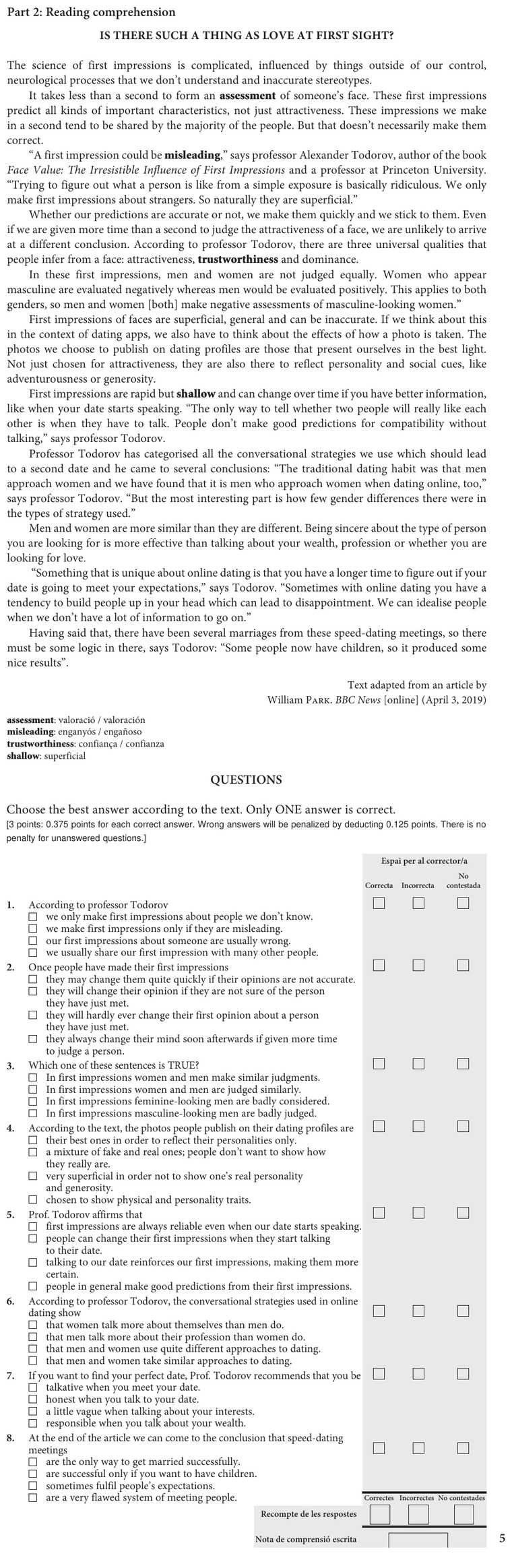
Part 2: Reading comprehension
 Toca per ampliar
IS THERE SUCH A THING AS LOVE AT FIRST SIGHT?
The science of first impressions is complicated, influenced by things outside of our control,
neurological processes that we don’t understand and inaccurate stereotypes.
It takes less than a second to form an assessment of someone’s face. These first impressions
predict all kinds of important characteristics, not just attractiveness. These impressions we make
in a second tend to be shared by the majority of the people. But that doesn’t necessarily make them
correct.
“A first impression could be misleading,” says professor Alexander Todorov, author of the book
Face Value: The Irresistible Influence of First Impressions and a professor at Princeton University.
“Trying to figure out what a person is like from a simple exposure is basically ridiculous. We only
make first impressions about strangers. So naturally they are superficial.”
Whether our predictions are accurate or not, we make them quickly and we stick to them. Even
if we are given more time than a second to judge the attractiveness of a face, we are unlikely to arrive
at a different conclusion. According to professor Todorov, there are three universal qualities that
people infer from a face: attractiveness, trustworthiness and dominance.
In these first impressions, men and women are not judged equally. Women who appear
masculine are evaluated negatively whereas men would be evaluated positively. This applies to both
genders, so men and women [both] make negative assessments of masculine-looking women.”
First impressions of faces are superficial, general and can be inaccurate. If we think about this
in the context of dating apps, we also have to think about the effects of how a photo is taken. The
photos we choose to publish on dating profiles are those that present ourselves in the best light.
Not just chosen for attractiveness, they are also there to reflect personality and social cues, like
adventurousness or generosity.
First impressions are rapid but shallow and can change over time if you have better information,
like when your date starts speaking. “The only way to tell whether two people will really like each
other is when they have to talk. People don’t make good predictions for compatibility without
talking,” says professor Todorov.
Professor Todorov has categorised all the conversational strategies we use which should lead
to a second date and he came to several conclusions: “The traditional dating habit was that men
approach women and we have found that it is men who approach women when dating online, too,”
says professor Todorov. “But the most interesting part is how few gender differences there were in
the types of strategy used.”
Men and women are more similar than they are different. Being sincere about the type of person
you are looking for is more effective than talking about your wealth, profession or whether you are
looking for love.
“Something that is unique about online dating is that you have a longer time to figure out if your
date is going to meet your expectations,” says Todorov. “Sometimes with online dating you have a
tendency to build people up in your head which can lead to disappointment. We can idealise people
when we don’t have a lot of information to go on.”
Having said that, there have been several marriages from these speed-dating meetings, so there
must be some logic in there, says Todorov: “Some people now have children, so it produced some
nice results”.
Text adapted from an article by
William Park. BBC News [online] (April 3, 2019)
assessment: valoració / valoración
misleading: enganyós / engañoso
trustworthiness: confiança / confianza
shallow: superficial
Vegeu el text de lectura de la pregunta 1 de Part 2.
1. According to professor Todorov
we only make first impressions about people we don’t know.
we make first impressions only if they are misleading.
our first impressions about someone are usually wrong.
we usually share our first impression with many other people.
2. Once people have made their first impressions
they may change them quite quickly if their opinions are not accurate.
they will change their opinion if they are not sure of the person
they have just met.
they will hardly ever change their first opinion about a person
they have just met.
they always change their mind soon afterwards if given more time
to judge a person.
3. Which one of these sentences is TRUE?
In first impressions women and men make similar judgments.
In first impressions women and men are judged similarly.
In first impressions feminine-looking men are badly considered.
In first impressions masculine-looking men are badly judged.
4. According to the text, the photos people publish on their dating profiles are
their best ones in order to reflect their personalities only.
a mixture of fake and real ones; people don’t want to show how
they really are.
very superficial in order not to show one’s real personality
and generosity.
chosen to show physical and personality traits.
5. Prof. Todorov affirms that
first impressions are always reliable even when our date starts speaking.
people can change their first impressions when they start talking
to their date.
talking to our date reinforces our first impressions, making them more
certain.
people in general make good predictions from their first impressions.
6. According to professor Todorov, the conversational strategies used in online
dating show
that women talk more about themselves than men do.
that men talk more about their profession than women do.
that men and women use quite different approaches to dating.
that men and women take similar approaches to dating.
7. If you want to find your perfect date, Prof. Todorov recommends that you be
talkative when you meet your date.
honest when you talk to your date.
a little vague when talking about your interests.
responsible when you talk about your wealth.
8. At the end of the article we can come to the conclusion that speed-dating
meetings
are the only way to get married successfully.
are successful only if you want to have children.
sometimes fulfil people’s expectations.
are a very flawed system of meeting people.
Toca per ampliar- 0,375 pSeleccionar la resposta de la clau oficial: we only make first impressions about people we don't know.Penalització: Resposta incorrecta: −0,125 punts. Resposta en blanc: cap penalització.
Toca per ampliar- 0,375 pSeleccionar la resposta de la clau oficial: they will hardly ever change their first opinion about a person they have just met.Penalització: Resposta incorrecta: −0,125 punts. Resposta en blanc: cap penalització.
Toca per ampliar- 0,375 pSeleccionar la resposta de la clau oficial: In first impressions women and men make similar judgments.Penalització: Resposta incorrecta: −0,125 punts. Resposta en blanc: cap penalització.
Toca per ampliar- 0,375 pSeleccionar la resposta de la clau oficial: chosen to show physical and personality traits.Penalització: Resposta incorrecta: −0,125 punts. Resposta en blanc: cap penalització.
Toca per ampliar- 0,375 pSeleccionar la resposta de la clau oficial: people can change their first impressions when they start talking to their date.Penalització: Resposta incorrecta: −0,125 punts. Resposta en blanc: cap penalització.
Toca per ampliar- 0,375 pSeleccionar la resposta de la clau oficial: that men and women take similar approaches to dating.Penalització: Resposta incorrecta: −0,125 punts. Resposta en blanc: cap penalització.
Toca per ampliar- 0,375 pSeleccionar la resposta de la clau oficial: honest when you talk to your date.Penalització: Resposta incorrecta: −0,125 punts. Resposta en blanc: cap penalització.
Toca per ampliar- 0,375 pSeleccionar la resposta de la clau oficial: sometimes fulfil people's expectations.Penalització: Resposta incorrecta: −0,125 punts. Resposta en blanc: cap penalització.
Exercici 3 · opció A
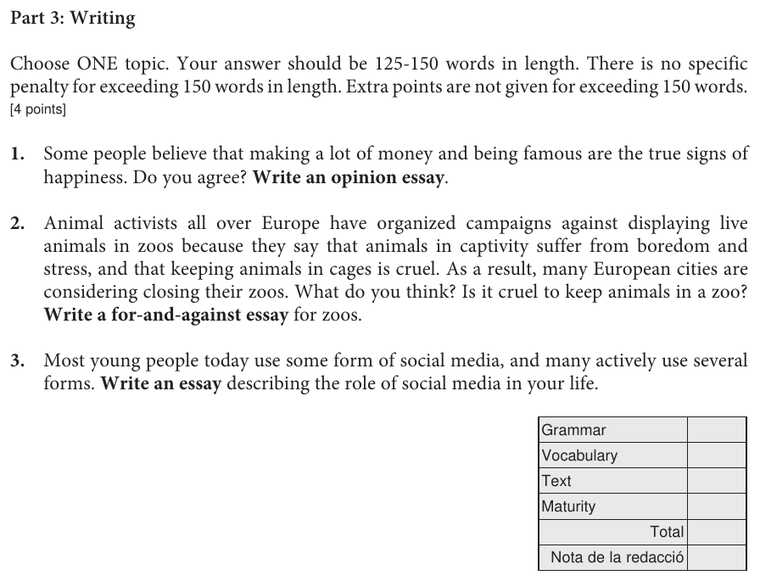
Part 3: Writing
 Toca per ampliar
Choose ONE topic. Your answer should be 125-150 words in length. There is no specific penalty for exceeding 150 words in length. Extra points are not given for exceeding 150 words. [4 points]
1. Some people believe that making a lot of money and being famous are the true signs of
happiness. Do you agree? Write an opinion essay.
Toca per ampliar- 4 pSense desglossament als PDF proporcionats: redactar en anglès una resposta al tema 1 en el gènere i amb l’extensió que indica l’enunciat. El quadern assigna 4 punts a la redacció; no s’hi especifiquen descriptors ni pesos de Grammar, Vocabulary, Text o Maturity.
Exercici 3 · opció B
Part 3: Writing
Toca per ampliarChoose ONE topic. Your answer should be 125-150 words in length. There is no specific penalty for exceeding 150 words in length. Extra points are not given for exceeding 150 words. [4 points]
2. Animal activists all over Europe have organized campaigns against displaying live
animals in zoos because they say that animals in captivity suffer from boredom and
stress, and that keeping animals in cages is cruel. As a result, many European cities are
considering closing their zoos. What do you think? Is it cruel to keep animals in a zoo?
Write a for-and-against essay for zoos.
Toca per ampliar- 4 pSense desglossament als PDF proporcionats: redactar en anglès una resposta al tema 2 en el gènere i amb l’extensió que indica l’enunciat. El quadern assigna 4 punts a la redacció; no s’hi especifiquen descriptors ni pesos de Grammar, Vocabulary, Text o Maturity.
Exercici 3 · opció C
Part 3: Writing
Toca per ampliarChoose ONE topic. Your answer should be 125-150 words in length. There is no specific penalty for exceeding 150 words in length. Extra points are not given for exceeding 150 words. [4 points]
3. Most young people today use some form of social media, and many actively use several
forms. Write an essay describing the role of social media in your life.
Toca per ampliar- 4 pSense desglossament als PDF proporcionats: redactar en anglès una resposta al tema 3 en el gènere i amb l’extensió que indica l’enunciat. El quadern assigna 4 punts a la redacció; no s’hi especifiquen descriptors ni pesos de Grammar, Vocabulary, Text o Maturity.