Anglès
PAU 2020 · ordinària · sèrie 3
Examen oficial de la PAU de Catalunya amb la pauta de correcció. És d’una convocatòria anterior al model 2025: la pauta correspon a aquell examen.
Instruccions de l’examen
Part 1: Choose the best answer according to the recording. Only ONE answer is correct. [3 points: 0.375 points for each correct answer. Wrong answers will be penalized by deducting 0.125 points. There is no penalty for unanswered questions.]
Part 2: Choose the best answer according to the text. Only ONE answer is correct. [3 points: 0.375 points for each correct answer. Wrong answers will be penalized by deducting 0.125 points. There is no penalty for unanswered questions.]
Part 3: Choose ONE topic. Your answer should be 125-150 words in length. There is no specific penalty for exceeding 150 words in length. Extra points are not given for exceeding 150 words. [4 points]
Exercici 1
Part 1: Listening comprehension
 Toca per ampliar
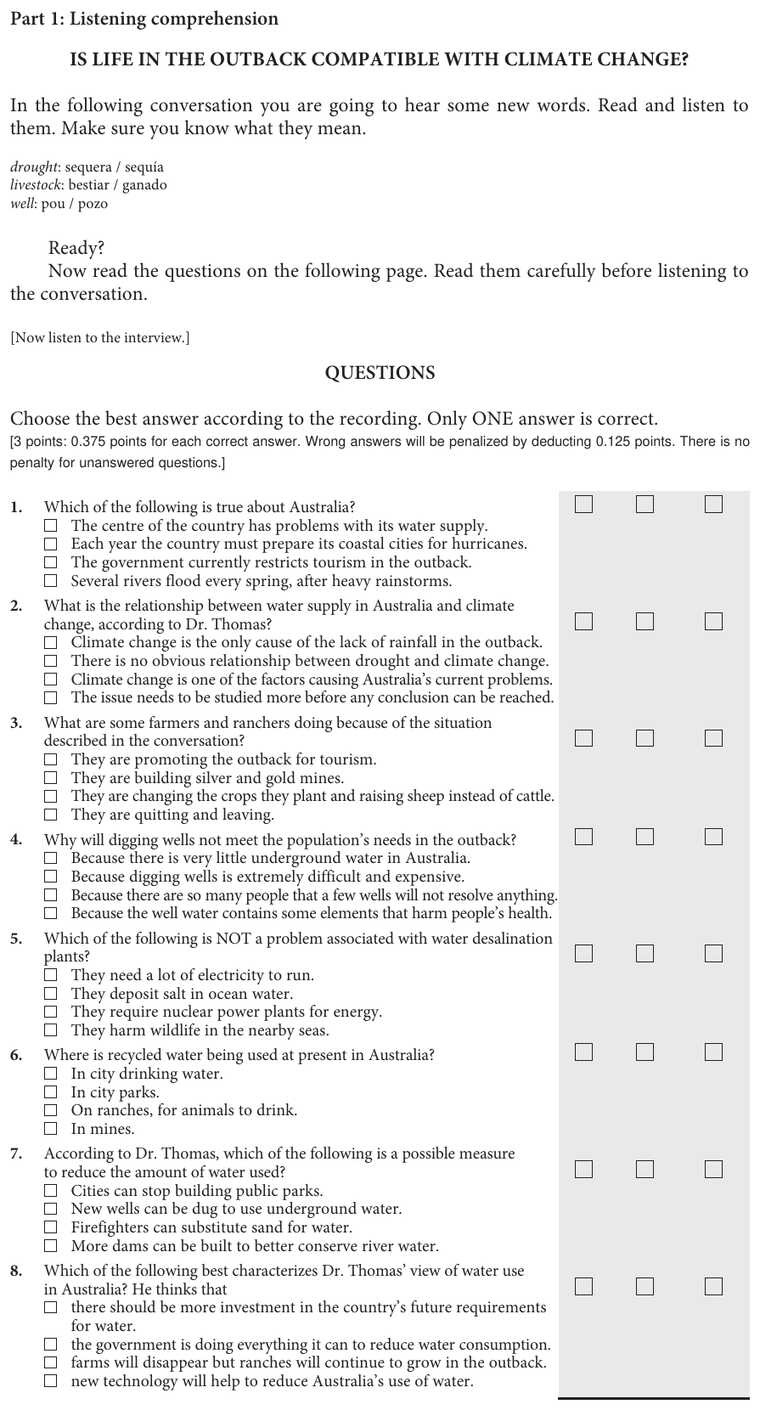
IS LIFE IN THE OUTBACK COMPATIBLE WITH CLIMATE CHANGE?
In the following conversation you are going to hear some new words. Read and listen to
them. Make sure you know what they mean.
drought: sequera / sequía
livestock: bestiar / ganado
well: pou / pozo
Ready?
Now read the questions on the following page. Read them carefully before listening to
the conversation.
[Now listen to the interview.]
Transcripció oficial (pauangl20jp.pdf):
IS LIFE IN THE OUTBACK COMPATIBLE WITH CLIMATE CHANGE?
In the following conversation you are going to hear some new words. Read and listen
to them. Make sure you know what they mean.
drought sequera / sequía
livestock bestià / Ganado
well pou/pozo
Ready?
Now read the questions on the following page. Read them carefully before listening to
the conversation.
Journalist: Today everyone is talking about climate change and its negative effects on
our planet. In recent years, natural events such as huge forest fires, severe droughts
and major hurricanes have made people around the world more aware of the
importance of our environment. To talk about these and other issues, today we’ve
invited Dr. Robert Thomas from Australian National University to our program.
Welcome, Dr. Thomas.
Dr. Thomas: Thank you. Happy to be here.
Journalist: What can you tell us about the effects of climate change in Australia, Dr.
Thomas?
Dr. Thomas: Climate change is affecting the amount of rain in the country. Simply put,
it rains less. Right now one of the major issues in Australia is the shortage of water in
the outback, the central part of the country that is quite a distance from the coastline
cities where most Australians live. In the outback, there are more than a dozen towns
without a reliable source of water.
Journalist: Oh, I didn’t know that.
Dr. Thomas: In the past few years, there has been a severe drought in Australia. Most
people don’t realize that Australia is the world’s most arid continent. Rivers and lakes
are disappearing, so people are beginning to fear that many of the rural areas in the
middle of the country may have to be abandoned.
Journalist: Is the lack of water only a result of climate change?
Dr. Thomas: Not exactly. In addition to severe drought in recent years that IS related to
climate change, the government approved mining projects that depended on an
intensive use of water. Tourism in the outback has been promoted for years, and the
population there is growing. More mining and more people mean more pressure on
water resources.
Journalist: So there has been a combination of factors involved.
Dr. Thomas: That’s right. Besides the new mines and the growing number of people,
the country has not invested enough money to prepare for its future water needs.
Australia is behind countries like the United States and China in preparing for the
future. And the sad part is, the future is now. It rains less in Australia than it did before,
so the rivers are drying up. And every year there are huge forest fires that are
uncontrollable.
Journalist: What are people going to do?
Dr. Thomas: Well, actually a lot of the farmers in the outback are giving up. Many have
decided not to plant any crops on their land and are selling all their livestock. They are
moving away. And the towns that developed to serve the farmers and ranchers will
probably be abandoned. Those towns depend on the business created by the farmers,
and the farmers depend on access to water. With no water, whole towns will probably
disappear.
Journalist: It’s surprising that nothing can be done. Can’t they dig wells? I know that
some deserts do have underground water.
Dr. Thomas: In some places, wells already supply part of the drinking water. Many
towns want to dig new wells. But digging wells is not a permanent solution to the
problem.
Journalist: Why not?
Dr. Thomas: Because the water underground is not high quality water for drinking. It
often has a metallic taste, and there have been some studies to suggest that it is
responsible for some long-term health problems like high blood pressure. This water
has to be treated, and water treatment plants in the outback are expensive and harmful
to the environment.
Journalist: Is the situation as bad in Australia’s big cities, like Sydney and Melbourne?
Dr. Thomas: No, the situation in coastal areas like Sydney and Melbourne is better but
not without problems. Both cities restrict the amount of water people can use. In
Sydney the government has hired “water officers” to educate the public and enforce
water restrictions.
Journalist: How about using sea water, like they do in other parts of the world?
Australia obviously has easy access to oceans.
Dr. Thomas: We do use ocean water. The coastal areas have desalination plants,
which are crucial to Australia’s water supply. Desalination plants, however, also create
some environmental problems because they require a lot of energy to operate and the
salt they remove from the water is dumped back into the oceans, which is not good for
fish and other sea-living creatures. But the fact is these plants are necessary for
Australia.
Journalist: Can water be recycled? I know that in some places in the U.S. recycled
water is used to clean streets, for example.
Dr. Thomas: Yes, recycling water is important now and will become even more
important in the future. Recycled water is often used to water parks in cities. There are
other things that can be done, too. For example, fire stations are studying how to use
sand, instead of water, to put out fires. Gardens can have artificial lawns, as opposed
to grass. We still don’t know the long-term results of climate change, but it is clear that
no matter what, Australia must plan for its future water needs.
Journalist: That’s all we have time for today. Thank you, Dr. Thomas, for joining us
today.
Dr. Thomas: My pleasure.
(adapted from an article by Livia Albeck-Ripka published in The New York Times, Dec.
8, 2019)
Vegeu el listening i la transcripció oficial de la pregunta 1 de Part 1.
1. Which of the following is true about Australia?
The centre of the country has problems with its water supply.
Each year the country must prepare its coastal cities for hurricanes.
The government currently restricts tourism in the outback.
Several rivers flood every spring, after heavy rainstorms.
2. What is the relationship between water supply in Australia and climate
change, according to Dr. Thomas?
Climate change is the only cause of the lack of rainfall in the outback.
There is no obvious relationship between drought and climate change.
Climate change is one of the factors causing Australia’s current problems.
The issue needs to be studied more before any conclusion can be reached.
3. What are some farmers and ranchers doing because of the situation
described in the conversation?
They are promoting the outback for tourism.
They are building silver and gold mines.
They are changing the crops they plant and raising sheep instead of cattle.
They are quitting and leaving.
4. Why will digging wells not meet the population’s needs in the outback?
Because there is very little underground water in Australia.
Because digging wells is extremely difficult and expensive.
Because there are so many people that a few wells will not resolve anything.
Because the well water contains some elements that harm people’s health.
5. Which of the following is NOT a problem associated with water desalination
plants?
They need a lot of electricity to run.
They deposit salt in ocean water.
They require nuclear power plants for energy.
They harm wildlife in the nearby seas.
6. Where is recycled water being used at present in Australia?
In city drinking water.
In city parks.
On ranches, for animals to drink.
In mines.
7. According to Dr. Thomas, which of the following is a possible measure
to reduce the amount of water used?
Cities can stop building public parks.
New wells can be dug to use underground water.
Firefighters can substitute sand for water.
More dams can be built to better conserve river water.
8. Which of the following best characterizes Dr. Thomas’ view of water use
in Australia? He thinks that
there should be more investment in the country’s future requirements
for water.
the government is doing everything it can to reduce water consumption.
farms will disappear but ranches will continue to grow in the outback.
new technology will help to reduce Australia’s use of water.
 Toca per ampliar
- 0,375 pSeleccionar la resposta de la clau oficial: The centre of the country has problems with its water supply.Penalització: Resposta incorrecta: −0,125 punts. Resposta en blanc: cap penalització.
Toca per ampliar- 0,375 pSeleccionar la resposta de la clau oficial: Climate change is one of the factors causing Australia’s current problems.Penalització: Resposta incorrecta: −0,125 punts. Resposta en blanc: cap penalització.
Toca per ampliar- 0,375 pSeleccionar la resposta de la clau oficial: They are quitting and leaving.Penalització: Resposta incorrecta: −0,125 punts. Resposta en blanc: cap penalització.
Toca per ampliar- 0,375 pSeleccionar la resposta de la clau oficial: Because the well water contains some elements that harm people’s health.Penalització: Resposta incorrecta: −0,125 punts. Resposta en blanc: cap penalització.
Toca per ampliar- 0,375 pSeleccionar la resposta de la clau oficial: They require nuclear power plants for energy.Penalització: Resposta incorrecta: −0,125 punts. Resposta en blanc: cap penalització.
Toca per ampliar- 0,375 pSeleccionar la resposta de la clau oficial: In city parks.Penalització: Resposta incorrecta: −0,125 punts. Resposta en blanc: cap penalització.
Toca per ampliar- 0,375 pSeleccionar la resposta de la clau oficial: Firefighters can substitute sand for water.Penalització: Resposta incorrecta: −0,125 punts. Resposta en blanc: cap penalització.
Toca per ampliar- 0,375 pSeleccionar la resposta de la clau oficial: there should be more investment in the country’s future requirements for water.Penalització: Resposta incorrecta: −0,125 punts. Resposta en blanc: cap penalització.
Exercici 2
Part 2: Reading comprehension
 Toca per ampliar
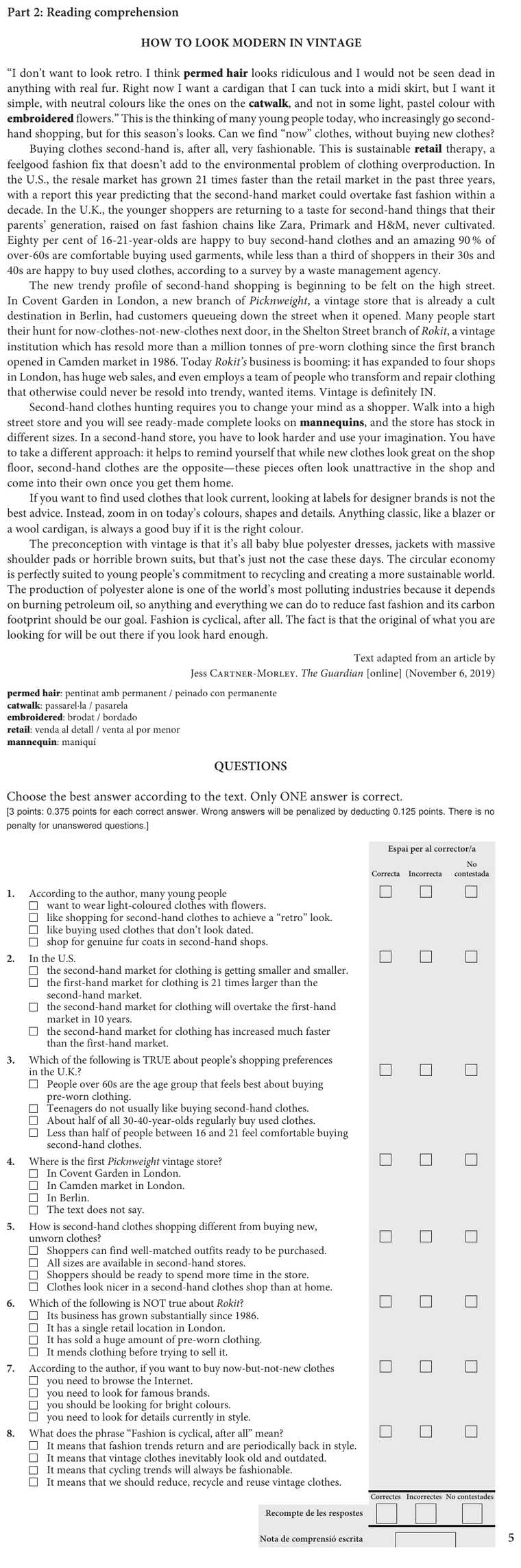
HOW TO LOOK MODERN IN VINTAGE
“I don’t want to look retro. I think permed hair looks ridiculous and I would not be seen dead in
anything with real fur. Right now I want a cardigan that I can tuck into a midi skirt, but I want it
simple, with neutral colours like the ones on the catwalk, and not in some light, pastel colour with
embroidered flowers.” This is the thinking of many young people today, who increasingly go second-
hand shopping, but for this season’s looks. Can we find “now” clothes, without buying new clothes?
Buying clothes second-hand is, after all, very fashionable. This is sustainable retail therapy, a
feelgood fashion fix that doesn’t add to the environmental problem of clothing overproduction. In
the U.S., the resale market has grown 21 times faster than the retail market in the past three years,
with a report this year predicting that the second-hand market could overtake fast fashion within a
decade. In the U.K., the younger shoppers are returning to a taste for second-hand things that their
parents’ generation, raised on fast fashion chains like Zara, Primark and H&M, never cultivated.
Eighty per cent of 16-21-year-olds are happy to buy second-hand clothes and an amazing 90 % of
over-60s are comfortable buying used garments, while less than a third of shoppers in their 30s and
40s are happy to buy used clothes, according to a survey by a waste management agency.
The new trendy profile of second-hand shopping is beginning to be felt on the high street.
In Covent Garden in London, a new branch of Picknweight, a vintage store that is already a cult
destination in Berlin, had customers queueing down the street when it opened. Many people start
their hunt for now-clothes-not-new-clothes next door, in the Shelton Street branch of Rokit, a vintage
institution which has resold more than a million tonnes of pre-worn clothing since the first branch
opened in Camden market in 1986. Today Rokit’s business is booming: it has expanded to four shops
in London, has huge web sales, and even employs a team of people who transform and repair clothing
that otherwise could never be resold into trendy, wanted items. Vintage is definitely IN.
Second-hand clothes hunting requires you to change your mind as a shopper. Walk into a high
street store and you will see ready-made complete looks on mannequins, and the store has stock in
different sizes. In a second-hand store, you have to look harder and use your imagination. You have
to take a different approach: it helps to remind yourself that while new clothes look great on the shop
floor, second-hand clothes are the opposite—these pieces often look unattractive in the shop and
come into their own once you get them home.
If you want to find used clothes that look current, looking at labels for designer brands is not the
best advice. Instead, zoom in on today’s colours, shapes and details. Anything classic, like a blazer or
a wool cardigan, is always a good buy if it is the right colour.
The preconception with vintage is that it’s all baby blue polyester dresses, jackets with massive
shoulder pads or horrible brown suits, but that’s just not the case these days. The circular economy
is perfectly suited to young people’s commitment to recycling and creating a more sustainable world.
The production of polyester alone is one of the world’s most polluting industries because it depends
on burning petroleum oil, so anything and everything we can do to reduce fast fashion and its carbon
footprint should be our goal. Fashion is cyclical, after all. The fact is that the original of what you are
looking for will be out there if you look hard enough.
Text adapted from an article by
Jess Cartner-Morley. The Guardian [online] (November 6, 2019)
permed hair: pentinat amb permanent / peinado con permanente
catwalk: passarel·la / pasarela
embroidered: brodat / bordado
retail: venda al detall / venta al por menor
mannequin: maniquí
Vegeu el text de lectura de la pregunta 1 de Part 2.
1. According to the author, many young people
want to wear light-coloured clothes with flowers.
like shopping for second-hand clothes to achieve a “retro” look.
like buying used clothes that don’t look dated.
shop for genuine fur coats in second-hand shops.
2. In the U.S.
the second-hand market for clothing is getting smaller and smaller.
the first-hand market for clothing is 21 times larger than the
second-hand market.
the second-hand market for clothing will overtake the first-hand
market in 10 years.
the second-hand market for clothing has increased much faster
than the first-hand market.
3. Which of the following is TRUE about people’s shopping preferences
in the U.K.?
People over 60s are the age group that feels best about buying
pre-worn clothing.
Teenagers do not usually like buying second-hand clothes.
About half of all 30-40-year-olds regularly buy used clothes.
Less than half of people between 16 and 21 feel comfortable buying
second-hand clothes.
4. Where is the first Picknweight vintage store?
In Covent Garden in London.
In Camden market in London.
In Berlin.
The text does not say.
5. How is second-hand clothes shopping different from buying new,
unworn clothes?
Shoppers can find well-matched outfits ready to be purchased.
All sizes are available in second-hand stores.
Shoppers should be ready to spend more time in the store.
Clothes look nicer in a second-hand clothes shop than at home.
6. Which of the following is NOT true about Rokit?
Its business has grown substantially since 1986.
It has a single retail location in London.
It has sold a huge amount of pre-worn clothing.
It mends clothing before trying to sell it.
7. According to the author, if you want to buy now-but-not-new clothes
you need to browse the Internet.
you need to look for famous brands.
you should be looking for bright colours.
you need to look for details currently in style.
8. What does the phrase “Fashion is cyclical, after all” mean?
It means that fashion trends return and are periodically back in style.
It means that vintage clothes inevitably look old and outdated.
It means that cycling trends will always be fashionable.
It means that we should reduce, recycle and reuse vintage clothes.
Toca per ampliar- 0,375 pSeleccionar la resposta de la clau oficial: like buying used clothes that don’t look dated.Penalització: Resposta incorrecta: −0,125 punts. Resposta en blanc: cap penalització.
Toca per ampliar- 0,375 pSeleccionar la resposta de la clau oficial: the second-hand market for clothing has increased much faster than the first-hand market.Penalització: Resposta incorrecta: −0,125 punts. Resposta en blanc: cap penalització.
Toca per ampliar- 0,375 pSeleccionar la resposta de la clau oficial: People over 60 are the age group that feels best about buying pre-worn clothing.Penalització: Resposta incorrecta: −0,125 punts. Resposta en blanc: cap penalització.
Toca per ampliar- 0,375 pSeleccionar la resposta de la clau oficial: In Berlin.Penalització: Resposta incorrecta: −0,125 punts. Resposta en blanc: cap penalització.
Toca per ampliar- 0,375 pSeleccionar la resposta de la clau oficial: Shoppers should be ready to spend more time in the store.Penalització: Resposta incorrecta: −0,125 punts. Resposta en blanc: cap penalització.
Toca per ampliar- 0,375 pSeleccionar la resposta de la clau oficial: It has a single retail location in London.Penalització: Resposta incorrecta: −0,125 punts. Resposta en blanc: cap penalització.
Toca per ampliar- 0,375 pSeleccionar la resposta de la clau oficial: you need to look for details currently in style.Penalització: Resposta incorrecta: −0,125 punts. Resposta en blanc: cap penalització.
Toca per ampliar- 0,375 pSeleccionar la resposta de la clau oficial: It means that fashion trends return and are periodically back in style.Penalització: Resposta incorrecta: −0,125 punts. Resposta en blanc: cap penalització.
Exercici 3 · opció A
Part 3: Writing
 Toca per ampliar
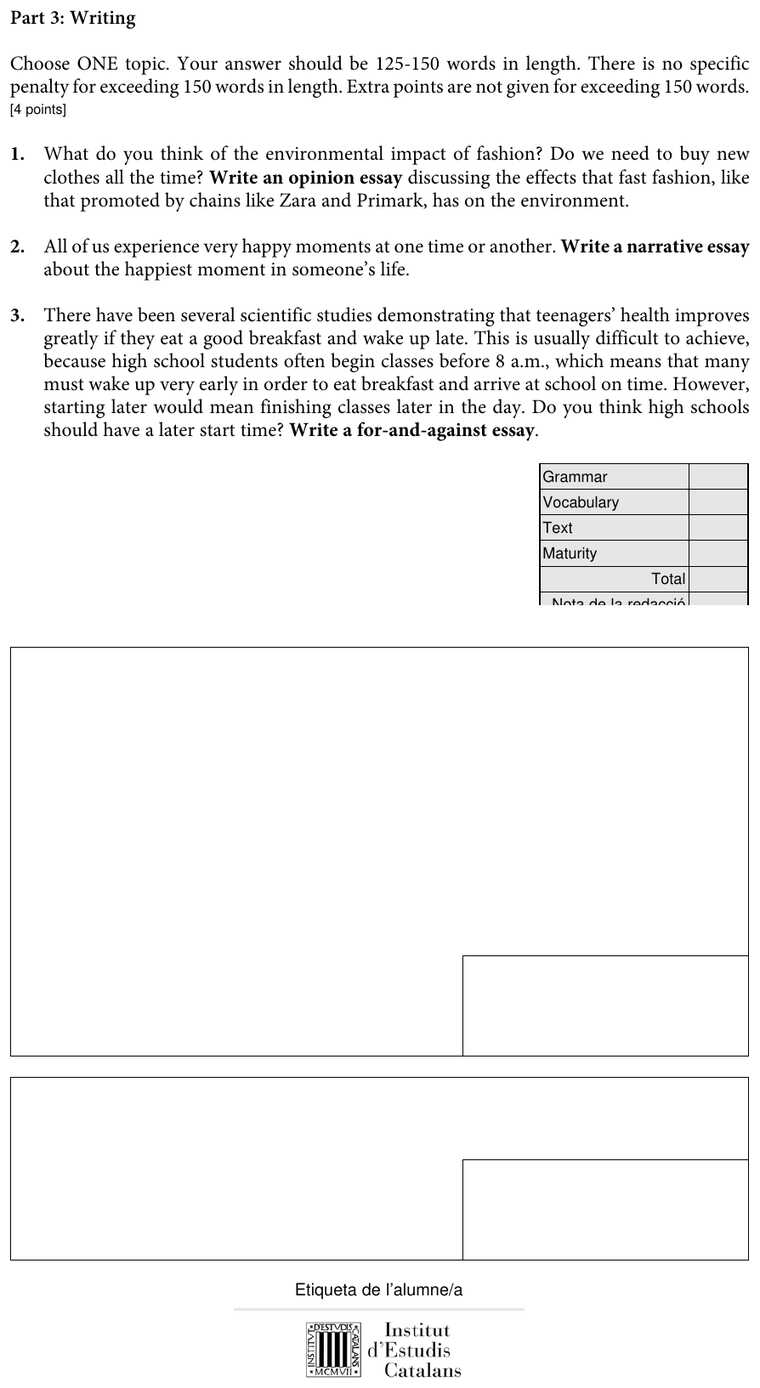
Choose ONE topic. Your answer should be 125-150 words in length. There is no specific penalty for exceeding 150 words in length. Extra points are not given for exceeding 150 words. [4 points]
1. What do you think of the environmental impact of fashion? Do we need to buy new
clothes all the time? Write an opinion essay discussing the effects that fast fashion, like
that promoted by chains like Zara and Primark, has on the environment.
Toca per ampliar- 4 pSense desglossament als PDF proporcionats: redactar en anglès una resposta al tema 1 en el gènere i amb l’extensió que indica l’enunciat. El quadern assigna 4 punts a la redacció; no s’hi especifiquen descriptors ni pesos de Grammar, Vocabulary, Text o Maturity.
Exercici 3 · opció B
Part 3: Writing
Toca per ampliarChoose ONE topic. Your answer should be 125-150 words in length. There is no specific penalty for exceeding 150 words in length. Extra points are not given for exceeding 150 words. [4 points]
2. All of us experience very happy moments at one time or another. Write a narrative essay
about the happiest moment in someone’s life.
Toca per ampliar- 4 pSense desglossament als PDF proporcionats: redactar en anglès una resposta al tema 2 en el gènere i amb l’extensió que indica l’enunciat. El quadern assigna 4 punts a la redacció; no s’hi especifiquen descriptors ni pesos de Grammar, Vocabulary, Text o Maturity.
Exercici 3 · opció C
Part 3: Writing
Toca per ampliarChoose ONE topic. Your answer should be 125-150 words in length. There is no specific penalty for exceeding 150 words in length. Extra points are not given for exceeding 150 words. [4 points]
3. There have been several scientific studies demonstrating that teenagers’ health improves
greatly if they eat a good breakfast and wake up late. This is usually difficult to achieve,
because high school students often begin classes before 8 a.m., which means that many
must wake up very early in order to eat breakfast and arrive at school on time. However,
starting later would mean finishing classes later in the day. Do you think high schools
should have a later start time? Write a for-and-against essay.
Toca per ampliar- 4 pSense desglossament als PDF proporcionats: redactar en anglès una resposta al tema 3 en el gènere i amb l’extensió que indica l’enunciat. El quadern assigna 4 punts a la redacció; no s’hi especifiquen descriptors ni pesos de Grammar, Vocabulary, Text o Maturity.