Anglès
PAU 2021 · extraordinària · sèrie 1
Examen oficial de la PAU de Catalunya amb la pauta de correcció. És d’una convocatòria anterior al model 2025: la pauta correspon a aquell examen.
Instruccions de l’examen
Part 1: Choose the best answer according to the recording. Only ONE answer is correct. [3 points: 0.375 points for each correct answer. Wrong answers will be penalized by deducting 0.125 points. There is no penalty for unanswered questions.]
Part 2: Choose the best answer according to the text. Only ONE answer is correct. [3 points: 0.375 points for each correct answer. Wrong answers will be penalized by deducting 0.125 points. There is no penalty for unanswered questions.]
Part 3: Choose ONE topic. Your answer should be 125-150 words in length. There is no specific penalty for exceeding 150 words in length. Extra points are not given for exceeding 150 words. [4 points]
Exercici 1
Part 1: Listening comprehension
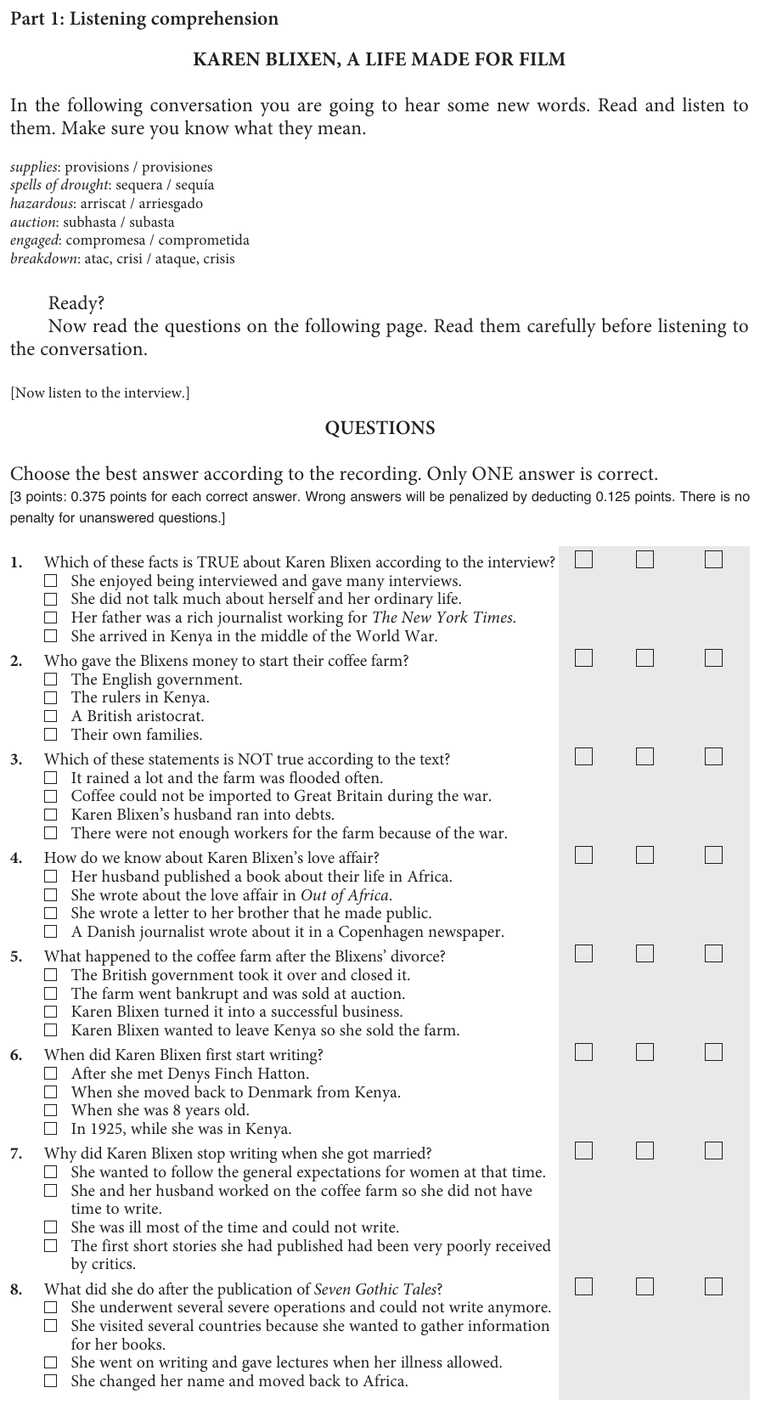 Toca per ampliar
KAREN BLIXEN, A LIFE MADE FOR FILM
In the following conversation you are going to hear some new words. Read and listen to
them. Make sure you know what they mean.
supplies: provisions / provisiones
spells of drought: sequera / sequía
hazardous: arriscat / arriesgado
auction: subhasta / subasta
engaged: compromesa / comprometida
breakdown: atac, crisi / ataque, crisis
Ready?
Now read the questions on the following page. Read them carefully before listening to
the conversation.
[Now listen to the interview.]
Transcripció oficial (pauangl21sp.pdf):
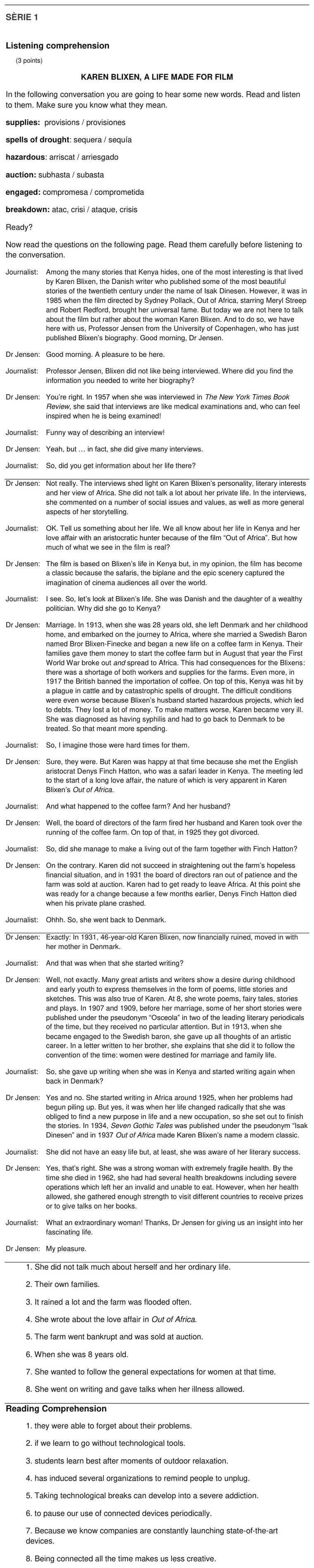
KAREN BLIXEN, A LIFE MADE FOR FILM
In the following conversation you are going to hear some new words. Read and listen
to them. Make sure you know what they mean.
supplies: provisions / provisiones
spells of drought: sequera / sequía
hazardous: arriscat / arriesgado
auction: subhasta / subasta
engaged: compromesa / comprometida
breakdown: atac, crisi / ataque, crisis
Ready?
Now read the questions on the following page. Read them carefully before listening to
the conversation.
Journalist: Among the many stories that Kenya hides, one of the most interesting is that lived
by Karen Blixen, the Danish writer who published some of the most beautiful
stories of the twentieth century under the name of Isak Dinesen. However, it was in
1985 when the film directed by Sydney Pollack, Out of Africa, starring Meryl Streep
and Robert Redford, brought her universal fame. But today we are not here to talk
about the film but rather about the woman Karen Blixen. And to do so, we have
here with us, Professor Jensen from the University of Copenhagen, who has just
published Blixen’s biography. Good morning, Dr Jensen.
Dr Jensen: Good morning. A pleasure to be here.
Journalist: Professor Jensen, Blixen did not like being interviewed. Where did you find the
information you needed to write her biography?
Dr Jensen: You’re right. In 1957 when she was interviewed in The New York Times Book
Review, she said that interviews are like medical examinations and, who can feel
inspired when he is being examined!
Journalist: Funny way of describing an interview!
Dr Jensen: Yeah, but … in fact, she did give many interviews.
Journalist: So, did you get information about her life there?
Dr Jensen: Not really. The interviews shed light on Karen Blixen’s personality, literary interests
and her view of Africa. She did not talk a lot about her private life. In the interviews,
she commented on a number of social issues and values, as well as more general
aspects of her storytelling.
Journalist: OK. Tell us something about her life. We all know about her life in Kenya and her
love affair with an aristocratic hunter because of the film “Out of Africa”. But how
much of what we see in the film is real?
Dr Jensen: The film is based on Blixen’s life in Kenya but, in my opinion, the film has become
a classic because the safaris, the biplane and the epic scenery captured the
imagination of cinema audiences all over the world.
Journalist: I see. So, let’s look at Blixen’s life. She was Danish and the daughter of a wealthy
politician. Why did she go to Kenya?
Dr Jensen: Marriage. In 1913, when she was 28 years old, she left Denmark and her childhood
home, and embarked on the journey to Africa, where she married a Swedish Baron
named Bror Blixen-Finecke and began a new life on a coffee farm in Kenya. Their
families gave them money to start the coffee farm but in August that year the First
World War broke out and spread to Africa. This had consequences for the Blixens:
there was a shortage of both workers and supplies for the farms. Even more, in
1917 the British banned the importation of coffee. On top of this, Kenya was hit by
a plague in cattle and by catastrophic spells of drought. The difficult conditions
were even worse because Blixen’s husband started hazardous projects, which led
to debts. They lost a lot of money. To make matters worse, Karen became very ill.
She was diagnosed as having syphilis and had to go back to Denmark to be
treated. So that meant more spending.
Journalist: So, I imagine those were hard times for them.
Dr Jensen: Sure, they were. But Karen was happy at that time because she met the English
aristocrat Denys Finch Hatton, who was a safari leader in Kenya. The meeting led
to the start of a long love affair, the nature of which is very apparent in Karen
Blixen’s Out of Africa.
Journalist: And what happened to the coffee farm? And her husband?
Dr Jensen: Well, the board of directors of the farm fired her husband and Karen took over the
running of the coffee farm. On top of that, in 1925 they got divorced.
Journalist: So, did she manage to make a living out of the farm together with Finch Hatton?
Dr Jensen: On the contrary. Karen did not succeed in straightening out the farm’s hopeless
financial situation, and in 1931 the board of directors ran out of patience and the
farm was sold at auction. Karen had to get ready to leave Africa. At this point she
was ready for a change because a few months earlier, Denys Finch Hatton died
when his private plane crashed.
Journalist: Ohhh. So, she went back to Denmark.
Dr Jensen: Exactly: In 1931, 46-year-old Karen Blixen, now financially ruined, moved in with
her mother in Denmark.
Journalist: And that was when that she started writing?
Dr Jensen: Well, not exactly. Many great artists and writers show a desire during childhood
and early youth to express themselves in the form of poems, little stories and
sketches. This was also true of Karen. At 8, she wrote poems, fairy tales, stories
and plays. In 1907 and 1909, before her marriage, some of her short stories were
published under the pseudonym “Osceola” in two of the leading literary periodicals
of the time, but they received no particular attention. But in 1913, when she
became engaged to the Swedish baron, she gave up all thoughts of an artistic
career. In a letter written to her brother, she explains that she did it to follow the
convention of the time: women were destined for marriage and family life.
Journalist: So, she gave up writing when she was in Kenya and started writing again when
back in Denmark?
Dr Jensen: Yes and no. She started writing in Africa around 1925, when her problems had
begun piling up. But yes, it was when her life changed radically that she was
obliged to find a new purpose in life and a new occupation, so she set out to finish
the stories. In 1934, Seven Gothic Tales was published under the pseudonym “Isak
Dinesen” and in 1937 Out of Africa made Karen Blixen’s name a modern classic.
Journalist: She did not have an easy life but, at least, she was aware of her literary success.
Dr Jensen: Yes, that’s right. She was a strong woman with extremely fragile health. By the
time she died in 1962, she had had several health breakdowns including severe
operations which left her an invalid and unable to eat. However, when her health
allowed, she gathered enough strength to visit different countries to receive prizes
or to give talks on her books.
Journalist: What an extraordinary woman! Thanks, Dr Jensen for giving us an insight into her
fascinating life.
Dr Jensen: My pleasure.
Vegeu el listening i la transcripció oficial de la pregunta 1 de Part 1.
1. Which of these facts is TRUE about Karen Blixen according to the interview?
She enjoyed being interviewed and gave many interviews.
She did not talk much about herself and her ordinary life.
Her father was a rich journalist working for The New York Times.
She arrived in Kenya in the middle of the World War.
2. Who gave the Blixens money to start their coffee farm?
The English government.
The rulers in Kenya.
A British aristocrat.
Their own families.
3. Which of these statements is NOT true according to the text?
It rained a lot and the farm was flooded often.
Coffee could not be imported to Great Britain during the war.
Karen Blixen’s husband ran into debts.
There were not enough workers for the farm because of the war.
4. How do we know about Karen Blixen’s love affair?
Her husband published a book about their life in Africa.
She wrote about the love affair in Out of Africa.
She wrote a letter to her brother that he made public.
A Danish journalist wrote about it in a Copenhagen newspaper.
5. What happened to the coffee farm after the Blixens’ divorce?
The British government took it over and closed it.
The farm went bankrupt and was sold at auction.
Karen Blixen turned it into a successful business.
Karen Blixen wanted to leave Kenya so she sold the farm.
6. When did Karen Blixen first start writing?
After she met Denys Finch Hatton.
When she moved back to Denmark from Kenya.
When she was 8 years old.
In 1925, while she was in Kenya.
7. Why did Karen Blixen stop writing when she got married?
She wanted to follow the general expectations for women at that time.
She and her husband worked on the coffee farm so she did not have
time to write.
She was ill most of the time and could not write.
The first short stories she had published had been very poorly received
by critics.
8. What did she do after the publication of Seven Gothic Tales?
She underwent several severe operations and could not write anymore.
She visited several countries because she wanted to gather information
for her books.
She went on writing and gave lectures when her illness allowed.
She changed her name and moved back to Africa.
 Toca per ampliar
- 0,375 pSeleccionar la resposta de la clau oficial: She did not talk much about herself and her ordinary life.Penalització: Resposta incorrecta: −0,125 punts. Resposta en blanc: cap penalització.
Toca per ampliar- 0,375 pSeleccionar la resposta de la clau oficial: Their own families.Penalització: Resposta incorrecta: −0,125 punts. Resposta en blanc: cap penalització.
Toca per ampliar- 0,375 pSeleccionar la resposta de la clau oficial: It rained a lot and the farm was flooded often.Penalització: Resposta incorrecta: −0,125 punts. Resposta en blanc: cap penalització.
Toca per ampliar- 0,375 pSeleccionar la resposta de la clau oficial: She wrote about the love affair in Out of Africa.Penalització: Resposta incorrecta: −0,125 punts. Resposta en blanc: cap penalització.
Toca per ampliar- 0,375 pSeleccionar la resposta de la clau oficial: The farm went bankrupt and was sold at auction.Penalització: Resposta incorrecta: −0,125 punts. Resposta en blanc: cap penalització.
Toca per ampliar- 0,375 pSeleccionar la resposta de la clau oficial: When she was 8 years old.Penalització: Resposta incorrecta: −0,125 punts. Resposta en blanc: cap penalització.
Toca per ampliar- 0,375 pSeleccionar la resposta de la clau oficial: She wanted to follow the general expectations for women at that time.Penalització: Resposta incorrecta: −0,125 punts. Resposta en blanc: cap penalització.
Toca per ampliar- 0,375 pSeleccionar la resposta de la clau oficial: She went on writing and gave talks when her illness allowed.Penalització: Resposta incorrecta: −0,125 punts. Resposta en blanc: cap penalització.
Exercici 2
Part 2: Reading comprehension
 Toca per ampliar
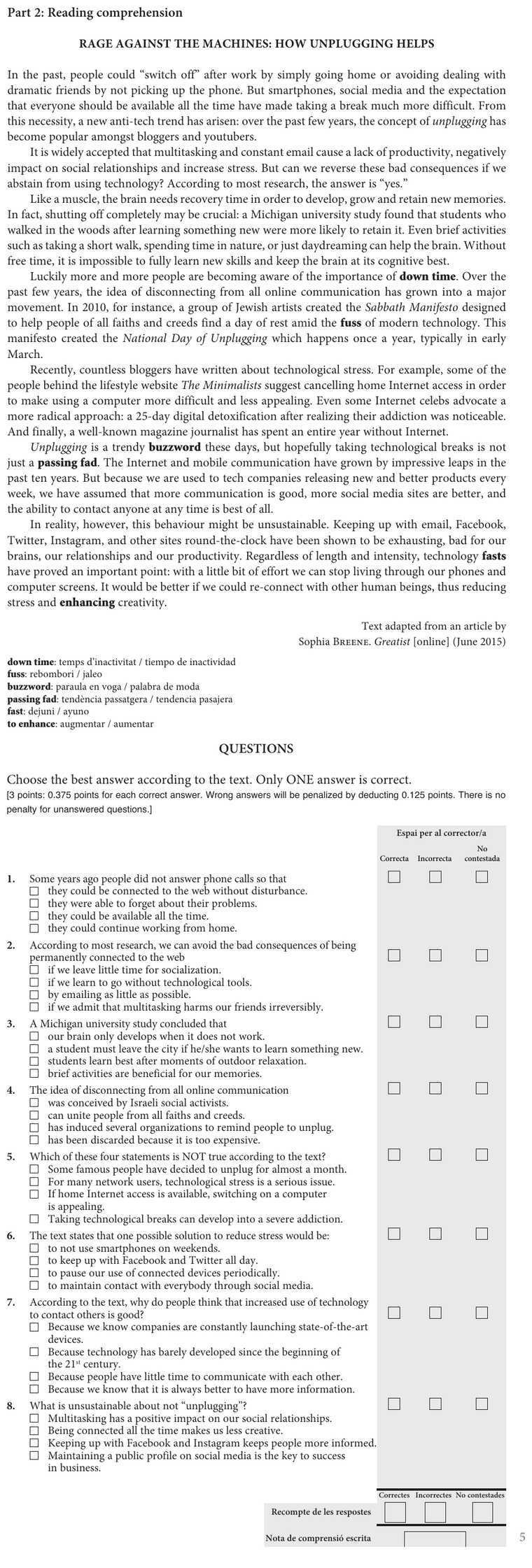
RAGE AGAINST THE MACHINES: HOW UNPLUGGING HELPS
In the past, people could “switch off” after work by simply going home or avoiding dealing with
dramatic friends by not picking up the phone. But smartphones, social media and the expectation
that everyone should be available all the time have made taking a break much more difficult. From
this necessity, a new anti-tech trend has arisen: over the past few years, the concept of unplugging has
become popular amongst bloggers and youtubers.
It is widely accepted that multitasking and constant email cause a lack of productivity, negatively
impact on social relationships and increase stress. But can we reverse these bad consequences if we
abstain from using technology? According to most research, the answer is “yes.”
Like a muscle, the brain needs recovery time in order to develop, grow and retain new memories.
In fact, shutting off completely may be crucial: a Michigan university study found that students who
walked in the woods after learning something new were more likely to retain it. Even brief activities
such as taking a short walk, spending time in nature, or just daydreaming can help the brain. Without
free time, it is impossible to fully learn new skills and keep the brain at its cognitive best.
Luckily more and more people are becoming aware of the importance of down time. Over the
past few years, the idea of disconnecting from all online communication has grown into a major
movement. In 2010, for instance, a group of Jewish artists created the Sabbath Manifesto designed
to help people of all faiths and creeds find a day of rest amid the fuss of modern technology. This
manifesto created the National Day of Unplugging which happens once a year, typically in early
March.
Recently, countless bloggers have written about technological stress. For example, some of the
people behind the lifestyle website The Minimalists suggest cancelling home Internet access in order
to make using a computer more difficult and less appealing. Even some Internet celebs advocate a
more radical approach: a 25-day digital detoxification after realizing their addiction was noticeable.
And finally, a well-known magazine journalist has spent an entire year without Internet.
Unplugging is a trendy buzzword these days, but hopefully taking technological breaks is not
just a passing fad. The Internet and mobile communication have grown by impressive leaps in the
past ten years. But because we are used to tech companies releasing new and better products every
week, we have assumed that more communication is good, more social media sites are better, and
the ability to contact anyone at any time is best of all.
In reality, however, this behaviour might be unsustainable. Keeping up with email, Facebook,
Twitter, Instagram, and other sites round-the-clock have been shown to be exhausting, bad for our
brains, our relationships and our productivity. Regardless of length and intensity, technology fasts
have proved an important point: with a little bit of effort we can stop living through our phones and
computer screens. It would be better if we could re-connect with other human beings, thus reducing
stress and enhancing creativity.
Text adapted from an article by
Sophia Breene. Greatist [online] (June 2015)
down time: temps d’inactivitat / tiempo de inactividad
fuss: rebombori / jaleo
buzzword: paraula en voga / palabra de moda
passing fad: tendència passatgera / tendencia pasajera
fast: dejuni / ayuno
to enhance: augmentar / aumentar
Vegeu el text de lectura de la pregunta 1 de Part 2.
1. Some years ago people did not answer phone calls so that
they could be connected to the web without disturbance.
they were able to forget about their problems.
they could be available all the time.
they could continue working from home.
2. According to most research, we can avoid the bad consequences of being
permanently connected to the web
if we leave little time for socialization.
if we learn to go without technological tools.
by emailing as little as possible.
if we admit that multitasking harms our friends irreversibly.
3. A Michigan university study concluded that
our brain only develops when it does not work.
a student must leave the city if he/she wants to learn something new.
students learn best after moments of outdoor relaxation.
brief activities are beneficial for our memories.
4. The idea of disconnecting from all online communication
was conceived by Israeli social activists.
can unite people from all faiths and creeds.
has induced several organizations to remind people to unplug.
has been discarded because it is too expensive.
5. Which of these four statements is NOT true according to the text?
Some famous people have decided to unplug for almost a month.
For many network users, technological stress is a serious issue.
If home Internet access is available, switching on a computer
is appealing.
Taking technological breaks can develop into a severe addiction.
6. The text states that one possible solution to reduce stress would be:
to not use smartphones on weekends.
to keep up with Facebook and Twitter all day.
to pause our use of connected devices periodically.
to maintain contact with everybody through social media.
7. According to the text, why do people think that increased use of technology
to contact others is good?
Because we know companies are constantly launching state-of-the-art
devices.
Because technology has barely developed since the beginning of
the 21st century.
Because people have little time to communicate with each other.
Because we know that it is always better to have more information.
8. What is unsustainable about not “unplugging”?
Multitasking has a positive impact on our social relationships.
Being connected all the time makes us less creative.
Keeping up with Facebook and Instagram keeps people more informed.
Maintaining a public profile on social media is the key to success
in business.
Toca per ampliar- 0,375 pSeleccionar la resposta de la clau oficial: they were able to forget about their problems.Penalització: Resposta incorrecta: −0,125 punts. Resposta en blanc: cap penalització.
Toca per ampliar- 0,375 pSeleccionar la resposta de la clau oficial: if we learn to go without technological tools.Penalització: Resposta incorrecta: −0,125 punts. Resposta en blanc: cap penalització.
Toca per ampliar- 0,375 pSeleccionar la resposta de la clau oficial: students learn best after moments of outdoor relaxation.Penalització: Resposta incorrecta: −0,125 punts. Resposta en blanc: cap penalització.
Toca per ampliar- 0,375 pSeleccionar la resposta de la clau oficial: has induced several organizations to remind people to unplug.Penalització: Resposta incorrecta: −0,125 punts. Resposta en blanc: cap penalització.
Toca per ampliar- 0,375 pSeleccionar la resposta de la clau oficial: Taking technological breaks can develop into a severe addiction.Penalització: Resposta incorrecta: −0,125 punts. Resposta en blanc: cap penalització.
Toca per ampliar- 0,375 pSeleccionar la resposta de la clau oficial: to pause our use of connected devices periodically.Penalització: Resposta incorrecta: −0,125 punts. Resposta en blanc: cap penalització.
Toca per ampliar- 0,375 pSeleccionar la resposta de la clau oficial: Because we know companies are constantly launching state-of-the-art devices.Penalització: Resposta incorrecta: −0,125 punts. Resposta en blanc: cap penalització.
Toca per ampliar- 0,375 pSeleccionar la resposta de la clau oficial: Being connected all the time makes us less creative.Penalització: Resposta incorrecta: −0,125 punts. Resposta en blanc: cap penalització.
Exercici 3 · opció A
Part 3: Writing
 Toca per ampliar
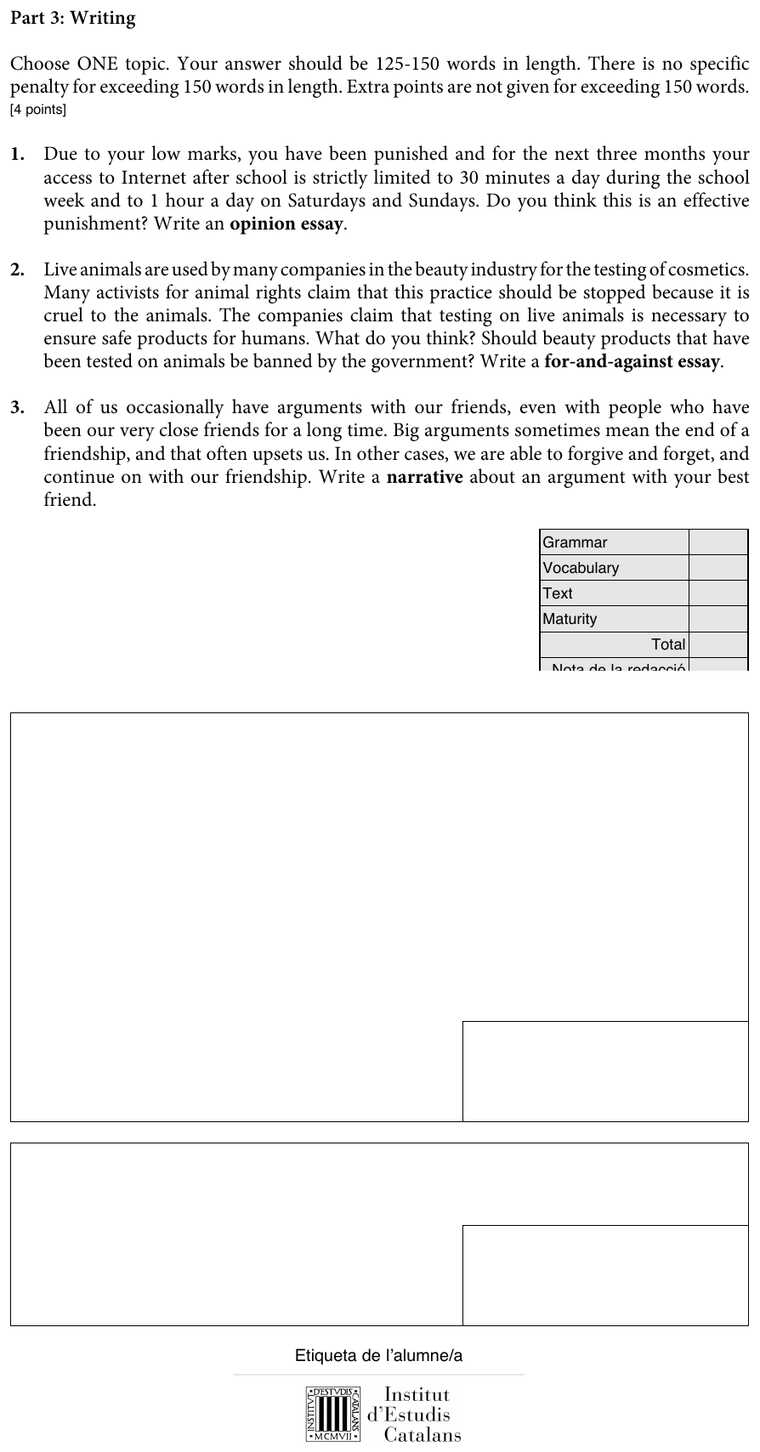
Choose ONE topic. Your answer should be 125-150 words in length. There is no specific penalty for exceeding 150 words in length. Extra points are not given for exceeding 150 words. [4 points]
1. Due to your low marks, you have been punished and for the next three months your
access to Internet after school is strictly limited to 30 minutes a day during the school
week and to 1 hour a day on Saturdays and Sundays. Do you think this is an effective
punishment? Write an opinion essay.
Toca per ampliar- 4 pSense desglossament als PDF proporcionats: redactar en anglès una resposta al tema 1 en el gènere i amb l’extensió que indica l’enunciat. El quadern assigna 4 punts a la redacció; no s’hi especifiquen descriptors ni pesos de Grammar, Vocabulary, Text o Maturity.
Exercici 3 · opció B
Part 3: Writing
Toca per ampliarChoose ONE topic. Your answer should be 125-150 words in length. There is no specific penalty for exceeding 150 words in length. Extra points are not given for exceeding 150 words. [4 points]
2. Live animals are used by many companies in the beauty industry for the testing of cosmetics.
Many activists for animal rights claim that this practice should be stopped because it is
cruel to the animals. The companies claim that testing on live animals is necessary to
ensure safe products for humans. What do you think? Should beauty products that have
been tested on animals be banned by the government? Write a for-and-against essay.
Toca per ampliar- 4 pSense desglossament als PDF proporcionats: redactar en anglès una resposta al tema 2 en el gènere i amb l’extensió que indica l’enunciat. El quadern assigna 4 punts a la redacció; no s’hi especifiquen descriptors ni pesos de Grammar, Vocabulary, Text o Maturity.
Exercici 3 · opció C
Part 3: Writing
Toca per ampliarChoose ONE topic. Your answer should be 125-150 words in length. There is no specific penalty for exceeding 150 words in length. Extra points are not given for exceeding 150 words. [4 points]
3. All of us occasionally have arguments with our friends, even with people who have
been our very close friends for a long time. Big arguments sometimes mean the end of a
friendship, and that often upsets us. In other cases, we are able to forgive and forget, and
continue on with our friendship. Write a narrative about an argument with your best
friend.
Toca per ampliar- 4 pSense desglossament als PDF proporcionats: redactar en anglès una resposta al tema 3 en el gènere i amb l’extensió que indica l’enunciat. El quadern assigna 4 punts a la redacció; no s’hi especifiquen descriptors ni pesos de Grammar, Vocabulary, Text o Maturity.