Anglès
PAU 2021 · ordinària · sèrie 2
Examen oficial de la PAU de Catalunya amb la pauta de correcció. És d’una convocatòria anterior al model 2025: la pauta correspon a aquell examen.
Instruccions de l’examen
Part 1: Choose the best answer according to the recording. Only ONE answer is correct. [3 points: 0.375 points for each correct answer. Wrong answers will be penalized by deducting 0.125 points. There is no penalty for unanswered questions.]
Part 2: Choose the best answer according to the text. Only ONE answer is correct. [3 points: 0.375 points for each correct answer. Wrong answers will be penalized by deducting 0.125 points. There is no penalty for unanswered questions.]
Part 3: Choose ONE topic. Your answer should be 125-150 words in length. There is no specific penalty for exceeding 150 words in length. Extra points are not given for exceeding 150 words. [4 points]
Exercici 1
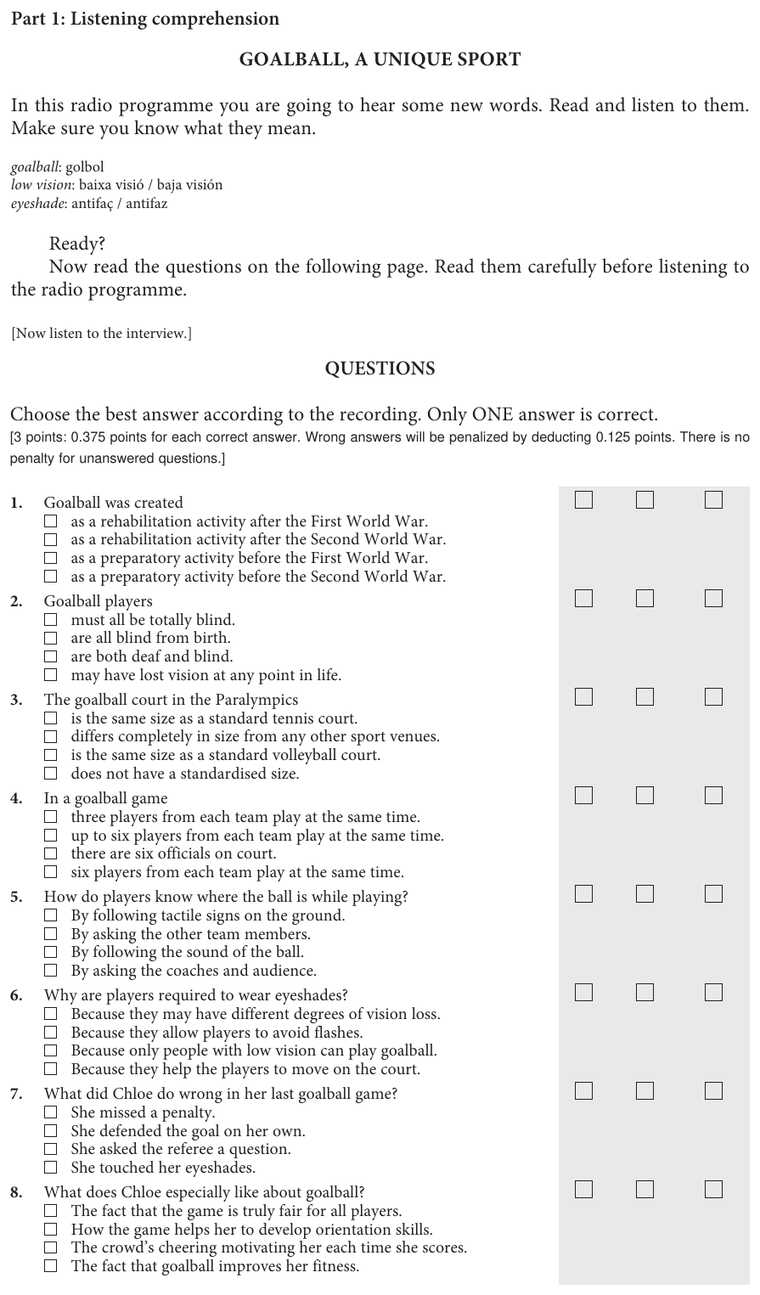
Part 1: Listening comprehension
 Toca per ampliar
GOALBALL, A UNIQUE SPORT
In this radio programme you are going to hear some new words. Read and listen to them.
Make sure you know what they mean.
goalball: golbol
low vision: baixa visió / baja visión
eyeshade: antifaç / antifaz
Ready?
Now read the questions on the following page. Read them carefully before listening to
the radio programme.
[Now listen to the interview.]
Transcripció oficial (pauangl21jp.pdf):
Goalball, a Unique Sport
In this radio programme you are going to hear some new words. Read and listen to
them. Make sure you know what they mean.
goalball: golbol / gólbol
low vision: baixa visió / baja visión
eyeshade: antifaç / antifaz
Ready? Now read the questions on the following page. Read them carefully before
listening to the radio programme. [Now listen to the interview.]
Interviewer: The Paralympic Games are a series of international multi-sport
events involving athletes with different disabilities. What you may not know is that there
is one sport played in the Paralympics which does not have an Olympics counterpart:
goalball. My guest today is Chloe Thompson, and she is here to tell us what makes
goalball unique. She is a goalball player on the American team.
Welcome to our programme, Chloe. I must say I’ve never heard of goalball. Can you
tell us a little bit about this sport, and what makes it unique?
Chloe: Sure, and thank you for inviting me to your programme. Goalball is the only
sport played in the Paralympics that has not been adapted from another sport. It was
created on its own, specifically for people who have low vision or who are blind. It was
invented in the 1940s by two doctors to help with the rehabilitation of soldiers who had
been blinded in the Second World War, and developed as a competitive sport in the
1950s and 1960s. Today goalball is played in over 100 countries around the world. The
game has a large following in these countries and is played both for enjoyment as well
as a rehabilitation technique for children who are born blind and for anyone who loses
their sight later in life. It was first played in the Paralympics unofficially in 1972, and in
1976 it became an official Paralympic sport.
Interviewer: What kind of court is it played on?
Chloe: Goalball is played on a court that is the same size as a volleyball court. It is 18
meters long by 9 meters wide and all of the lines that are on the floor are both painted
and tactile so that the players can feel them with their hands and feet as they play.
Interviewer: Why do the lines on the floor have to be painted, if all the players rely on
their sense of touch to feel them?
Chloe: Goalball has referees, like other competitive sports, and they need to see the
lines. In fact, there are nine officials on court during official competitions.
Interviewer: Of course. Could you tell us a bit about the game itself? How long does a
game take, and how do you score points?
Chloe: A goalball game consists of two 12-minute halves with a 3-minute halftime in
which the players switch ends of the court, so each game lasts about half an hour.
There are two teams, and there is a maximum of six players on each team, and there
are three players from each team on the court at any single time. Players try to defend
their goal from throws of a ball from the other end of the court. So, the object of the
game is to score goals by getting the ball past the opposing team and across the goal
line, and to do this you either throw the ball or roll it on the ground. The ball is about the
size of a basketball and it weighs just under three pounds.
Interviewer: So you either throw or roll the ball. Can you also kick it?
Chloe: No, players are not allowed to kick the ball.
Interviewer: This may sound like a silly question, but how do you know where the ball is
if you can't see it?
Chloe: The ball has bells inside of it so that it can be heard when it's being thrown or
when it’s rolling. So for the players it's very important for the crowd to keep quiet while
the ball is in play because otherwise we can’t hear it. The coaches must also stay silent
during gameplay. In fact, silence is so important that if players on the offense make too
much noise while they are throwing or rolling the ball, they can be penalized because
the team defending its goal might not be able to hear the ball.
Interviewer: Is this sport only for people who are totally blind?
Chloe: No. Some players are totally blind and some have low vision. Because of the
varying degrees of visual impairment of the athletes, we are all required to wear
eyeshades that completely black out our vision, so that everybody on court, in effect,
plays blind.
Interviewer: Tell us a little bit about your last goalball game.
Chloe: It was great! We played in San Francisco. One of the referees punished me with
a penalty because I touched my eyeshades, which is not allowed, so I had to defend
the entire goal on my own. I was nervous and could feel the tense atmosphere in the
audience. But in the end, we won!
Interviewer: I can tell you’re very enthusiastic about goalball Why do you like playing so
much?
Chloe: To me, my team is like a family. I love the unity that we have. We are really
good friends and rely on each other. Apart from that, this sport improves my orientation
skills and builds confidence, which helps me in lots of ways. I also like the
competitiveness of the game. It's really great fun!
Interviewer: Thank you, Chloe, for such a lovely introduction to this sport. We hope to
see you on court very soon, although now we know we won't be allowed to shout each
time you touch the ball. I’m looking forward to seeing your next match!
Chloe: Thank you!
Text adapted from United States Association of Blind Athletes /
https://www.youtube.com/watch?v=du5doesduIw; Goalball New Zealand /
http://www.goalball.org.nz/home/what-is-goalball; and Goalfix USA /
https://goalfixsportsusa.com/news/goalball/.
Vegeu el listening i la transcripció oficial de la pregunta 1 de Part 1.
1. Goalball was created
as a rehabilitation activity after the First World War.
as a rehabilitation activity after the Second World War.
as a preparatory activity before the First World War.
as a preparatory activity before the Second World War.
2. Goalball players
must all be totally blind.
are all blind from birth.
are both deaf and blind.
may have lost vision at any point in life.
3. The goalball court in the Paralympics
is the same size as a standard tennis court.
differs completely in size from any other sport venues.
is the same size as a standard volleyball court.
does not have a standardised size.
4. In a goalball game
three players from each team play at the same time.
up to six players from each team play at the same time.
there are six officials on court.
six players from each team play at the same time.
5. How do players know where the ball is while playing?
By following tactile signs on the ground.
By asking the other team members.
By following the sound of the ball.
By asking the coaches and audience.
6. Why are players required to wear eyeshades?
Because they may have different degrees of vision loss.
Because they allow players to avoid flashes.
Because only people with low vision can play goalball.
Because they help the players to move on the court.
7. What did Chloe do wrong in her last goalball game?
She missed a penalty.
She defended the goal on her own.
She asked the referee a question.
She touched her eyeshades.
8. What does Chloe especially like about goalball?
The fact that the game is truly fair for all players.
How the game helps her to develop orientation skills.
The crowd’s cheering motivating her each time she scores.
The fact that goalball improves her fitness.
 Toca per ampliar
- 0,375 pSeleccionar la resposta de la clau oficial: as a rehabilitation activity after the Second World War.Penalització: Resposta incorrecta: −0,125 punts. Resposta en blanc: cap penalització.
Toca per ampliar- 0,375 pSeleccionar la resposta de la clau oficial: may have lost vision at any point in life.Penalització: Resposta incorrecta: −0,125 punts. Resposta en blanc: cap penalització.
Toca per ampliar- 0,375 pSeleccionar la resposta de la clau oficial: is the same size as a standard volleyball court.Penalització: Resposta incorrecta: −0,125 punts. Resposta en blanc: cap penalització.
Toca per ampliar- 0,375 pSeleccionar la resposta de la clau oficial: three players from each team play at the same time.Penalització: Resposta incorrecta: −0,125 punts. Resposta en blanc: cap penalització.
Toca per ampliar- 0,375 pSeleccionar la resposta de la clau oficial: By following the sound of the ball.Penalització: Resposta incorrecta: −0,125 punts. Resposta en blanc: cap penalització.
Toca per ampliar- 0,375 pSeleccionar la resposta de la clau oficial: Because they may have different degrees of vision loss.Penalització: Resposta incorrecta: −0,125 punts. Resposta en blanc: cap penalització.
Toca per ampliar- 0,375 pSeleccionar la resposta de la clau oficial: She touched her eyeshades.Penalització: Resposta incorrecta: −0,125 punts. Resposta en blanc: cap penalització.
Toca per ampliar- 0,375 pSeleccionar la resposta de la clau oficial: How the game helps her to develop orientation skills.Penalització: Resposta incorrecta: −0,125 punts. Resposta en blanc: cap penalització.
Exercici 2
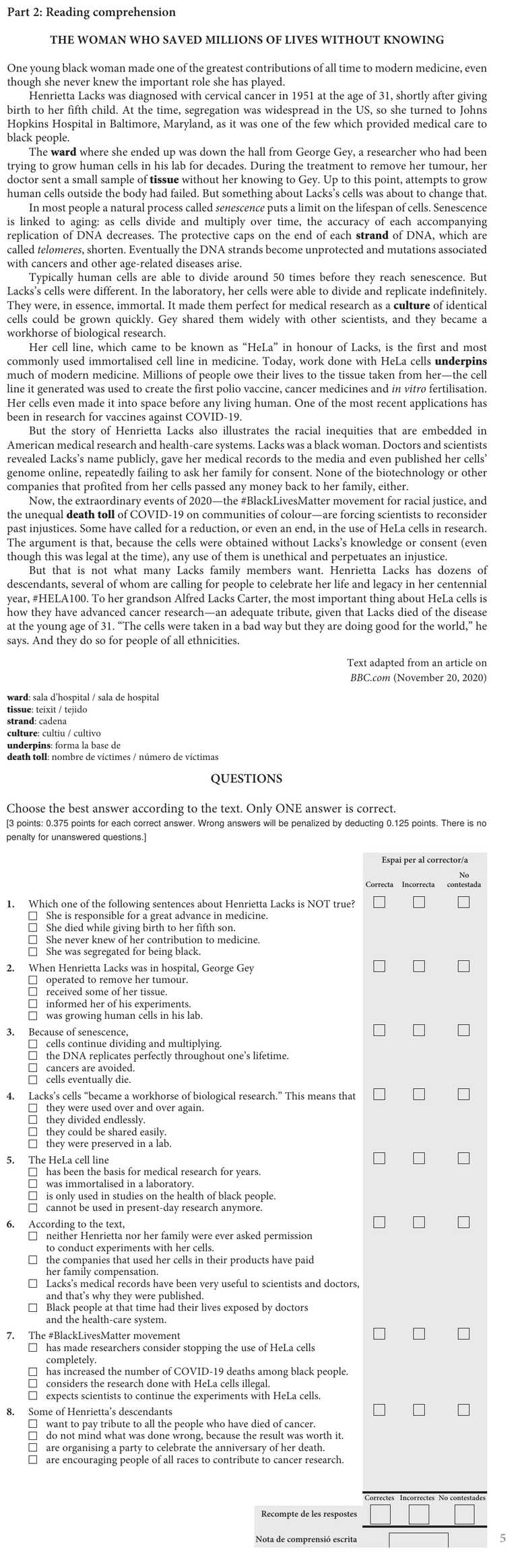
Part 2: Reading comprehension
 Toca per ampliar
THE WOMAN WHO SAVED MILLIONS OF LIVES WITHOUT KNOWING
One young black woman made one of the greatest contributions of all time to modern medicine, even
though she never knew the important role she has played.
Henrietta Lacks was diagnosed with cervical cancer in 1951 at the age of 31, shortly after giving
birth to her fifth child. At the time, segregation was widespread in the US, so she turned to Johns
Hopkins Hospital in Baltimore, Maryland, as it was one of the few which provided medical care to
black people.
The ward where she ended up was down the hall from George Gey, a researcher who had been
trying to grow human cells in his lab for decades. During the treatment to remove her tumour, her
doctor sent a small sample of tissue without her knowing to Gey. Up to this point, attempts to grow
human cells outside the body had failed. But something about Lacks’s cells was about to change that.
In most people a natural process called senescence puts a limit on the lifespan of cells. Senescence
is linked to aging: as cells divide and multiply over time, the accuracy of each accompanying
replication of DNA decreases. The protective caps on the end of each strand of DNA, which are
called telomeres, shorten. Eventually the DNA strands become unprotected and mutations associated
with cancers and other age-related diseases arise.
Typically human cells are able to divide around 50 times before they reach senescence. But
Lacks’s cells were different. In the laboratory, her cells were able to divide and replicate indefinitely.
They were, in essence, immortal. It made them perfect for medical research as a culture of identical
cells could be grown quickly. Gey shared them widely with other scientists, and they became a
workhorse of biological research.
Her cell line, which came to be known as “HeLa” in honour of Lacks, is the first and most
commonly used immortalised cell line in medicine. Today, work done with HeLa cells underpins
much of modern medicine. Millions of people owe their lives to the tissue taken from her—the cell
line it generated was used to create the first polio vaccine, cancer medicines and in vitro fertilisation.
Her cells even made it into space before any living human. One of the most recent applications has
been in research for vaccines against COVID-19.
But the story of Henrietta Lacks also illustrates the racial inequities that are embedded in
American medical research and health-care systems. Lacks was a black woman. Doctors and scientists
revealed Lacks’s name publicly, gave her medical records to the media and even published her cells’
genome online, repeatedly failing to ask her family for consent. None of the biotechnology or other
companies that profited from her cells passed any money back to her family, either.
Now, the extraordinary events of 2020—the #BlackLivesMatter movement for racial justice, and
the unequal death toll of COVID-19 on communities of colour—are forcing scientists to reconsider
past injustices. Some have called for a reduction, or even an end, in the use of HeLa cells in research.
The argument is that, because the cells were obtained without Lacks’s knowledge or consent (even
though this was legal at the time), any use of them is unethical and perpetuates an injustice.
But that is not what many Lacks family members want. Henrietta Lacks has dozens of
descendants, several of whom are calling for people to celebrate her life and legacy in her centennial
year, #HELA100. To her grandson Alfred Lacks Carter, the most important thing about HeLa cells is
how they have advanced cancer research—an adequate tribute, given that Lacks died of the disease
at the young age of 31. “The cells were taken in a bad way but they are doing good for the world,” he
says. And they do so for people of all ethnicities.
Text adapted from an article on
BBC.com (November 20, 2020)
ward: sala d’hospital / sala de hospital
tissue: teixit / tejido
strand: cadena
culture: cultiu / cultivo
underpins: forma la base de
death toll: nombre de víctimes / número de víctimas
Vegeu el text de lectura de la pregunta 1 de Part 2.
1. Which one of the following sentences about Henrietta Lacks is NOT true?
She is responsible for a great advance in medicine.
She died while giving birth to her fifth son.
She never knew of her contribution to medicine.
She was segregated for being black.
2. When Henrietta Lacks was in hospital, George Gey
operated to remove her tumour.
received some of her tissue.
informed her of his experiments.
was growing human cells in his lab.
3. Because of senescence,
cells continue dividing and multiplying.
the DNA replicates perfectly throughout one’s lifetime.
cancers are avoided.
cells eventually die.
4. Lacks’s cells “became a workhorse of biological research.” This means that
they were used over and over again.
they divided endlessly.
they could be shared easily.
they were preserved in a lab.
5. The HeLa cell line
has been the basis for medical research for years.
was immortalised in a laboratory.
is only used in studies on the health of black people.
cannot be used in present-day research anymore.
6. According to the text,
neither Henrietta nor her family were ever asked permission
to conduct experiments with her cells.
the companies that used her cells in their products have paid
her family compensation.
Lacks’s medical records have been very useful to scientists and doctors,
and that’s why they were published.
Black people at that time had their lives exposed by doctors
and the health-care system.
7. The #BlackLivesMatter movement
has made researchers consider stopping the use of HeLa cells
completely.
has increased the number of COVID-19 deaths among black people.
considers the research done with HeLa cells illegal.
expects scientists to continue the experiments with HeLa cells.
8. Some of Henrietta’s descendants
want to pay tribute to all the people who have died of cancer.
do not mind what was done wrong, because the result was worth it.
are organising a party to celebrate the anniversary of her death.
are encouraging people of all races to contribute to cancer research.
Toca per ampliar- 0,375 pSeleccionar la resposta de la clau oficial: She died while giving birth to her fifth son.Penalització: Resposta incorrecta: −0,125 punts. Resposta en blanc: cap penalització.
Toca per ampliar- 0,375 pSeleccionar la resposta de la clau oficial: received some of her tissue.Penalització: Resposta incorrecta: −0,125 punts. Resposta en blanc: cap penalització.
Toca per ampliar- 0,375 pSeleccionar la resposta de la clau oficial: cells eventually die.Penalització: Resposta incorrecta: −0,125 punts. Resposta en blanc: cap penalització.
Toca per ampliar- 0,375 pSeleccionar la resposta de la clau oficial: they were used over and over again.Penalització: Resposta incorrecta: −0,125 punts. Resposta en blanc: cap penalització.
Toca per ampliar- 0,375 pSeleccionar la resposta de la clau oficial: has been the basis for medical research for years.Penalització: Resposta incorrecta: −0,125 punts. Resposta en blanc: cap penalització.
Toca per ampliar- 0,375 pSeleccionar la resposta de la clau oficial: neither Henrietta nor her family were ever asked permission to conduct experiments with her cells.Penalització: Resposta incorrecta: −0,125 punts. Resposta en blanc: cap penalització.
Toca per ampliar- 0,375 pSeleccionar la resposta de la clau oficial: has made researchers consider stopping the use of HeLa cells completely.Penalització: Resposta incorrecta: −0,125 punts. Resposta en blanc: cap penalització.
Toca per ampliar- 0,375 pSeleccionar la resposta de la clau oficial: do not mind what was done wrong, because the result was worth it.Penalització: Resposta incorrecta: −0,125 punts. Resposta en blanc: cap penalització.
Exercici 3 · opció A
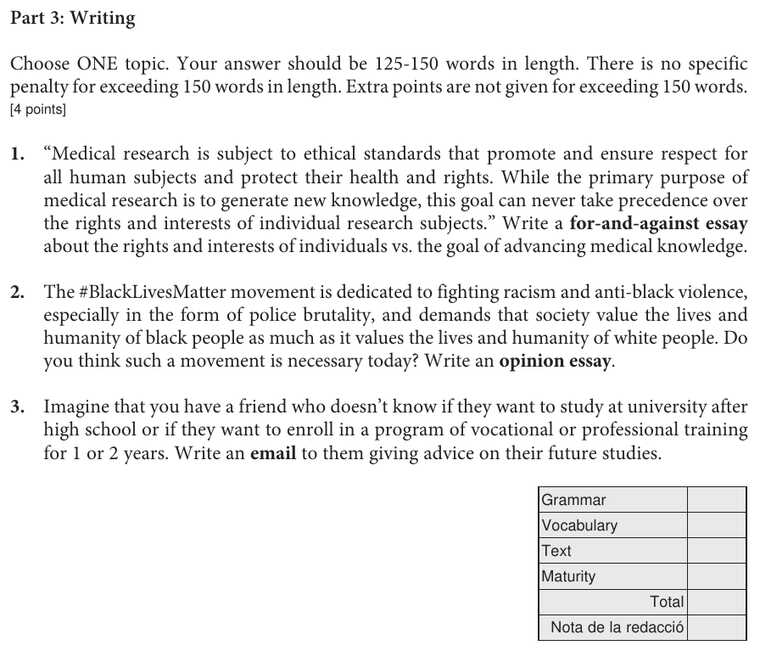
Part 3: Writing
 Toca per ampliar
Choose ONE topic. Your answer should be 125-150 words in length. There is no specific penalty for exceeding 150 words in length. Extra points are not given for exceeding 150 words. [4 points]
1. “Medical research is subject to ethical standards that promote and ensure respect for
all human subjects and protect their health and rights. While the primary purpose of
medical research is to generate new knowledge, this goal can never take precedence over
the rights and interests of individual research subjects.” Write a for-and-against essay
about the rights and interests of individuals vs. the goal of advancing medical knowledge.
Toca per ampliar- 4 pSense desglossament als PDF proporcionats: redactar en anglès una resposta al tema 1 en el gènere i amb l’extensió que indica l’enunciat. El quadern assigna 4 punts a la redacció; no s’hi especifiquen descriptors ni pesos de Grammar, Vocabulary, Text o Maturity.
Exercici 3 · opció B
Part 3: Writing
Toca per ampliarChoose ONE topic. Your answer should be 125-150 words in length. There is no specific penalty for exceeding 150 words in length. Extra points are not given for exceeding 150 words. [4 points]
2. The #BlackLivesMatter movement is dedicated to fighting racism and anti-black violence,
especially in the form of police brutality, and demands that society value the lives and
humanity of black people as much as it values the lives and humanity of white people. Do
you think such a movement is necessary today? Write an opinion essay.
Toca per ampliar- 4 pSense desglossament als PDF proporcionats: redactar en anglès una resposta al tema 2 en el gènere i amb l’extensió que indica l’enunciat. El quadern assigna 4 punts a la redacció; no s’hi especifiquen descriptors ni pesos de Grammar, Vocabulary, Text o Maturity.
Exercici 3 · opció C
Part 3: Writing
Toca per ampliarChoose ONE topic. Your answer should be 125-150 words in length. There is no specific penalty for exceeding 150 words in length. Extra points are not given for exceeding 150 words. [4 points]
3. Imagine that you have a friend who doesn’t know if they want to study at university after
high school or if they want to enroll in a program of vocational or professional training
for 1 or 2 years. Write an email to them giving advice on their future studies.
Toca per ampliar- 4 pSense desglossament als PDF proporcionats: redactar en anglès una resposta al tema 3 en el gènere i amb l’extensió que indica l’enunciat. El quadern assigna 4 punts a la redacció; no s’hi especifiquen descriptors ni pesos de Grammar, Vocabulary, Text o Maturity.