Anglès
PAU 2021 · ordinària · sèrie 5
Examen oficial de la PAU de Catalunya amb la pauta de correcció. És d’una convocatòria anterior al model 2025: la pauta correspon a aquell examen.
Instruccions de l’examen
Part 1: Choose the best answer according to the recording. Only ONE answer is correct. [3 points: 0.375 points for each correct answer. Wrong answers will be penalized by deducting 0.125 points. There is no penalty for unanswered questions.]
Part 2: Choose the best answer according to the text. Only ONE answer is correct. [3 points: 0.375 points for each correct answer. Wrong answers will be penalized by deducting 0.125 points. There is no penalty for unanswered questions.]
Part 3: Choose ONE topic. Your answer should be 125-150 words in length. There is no specific penalty for exceeding 150 words in length. Extra points are not given for exceeding 150 words. [4 points]
Exercici 1
Part 1: Listening comprehension
 Toca per ampliar
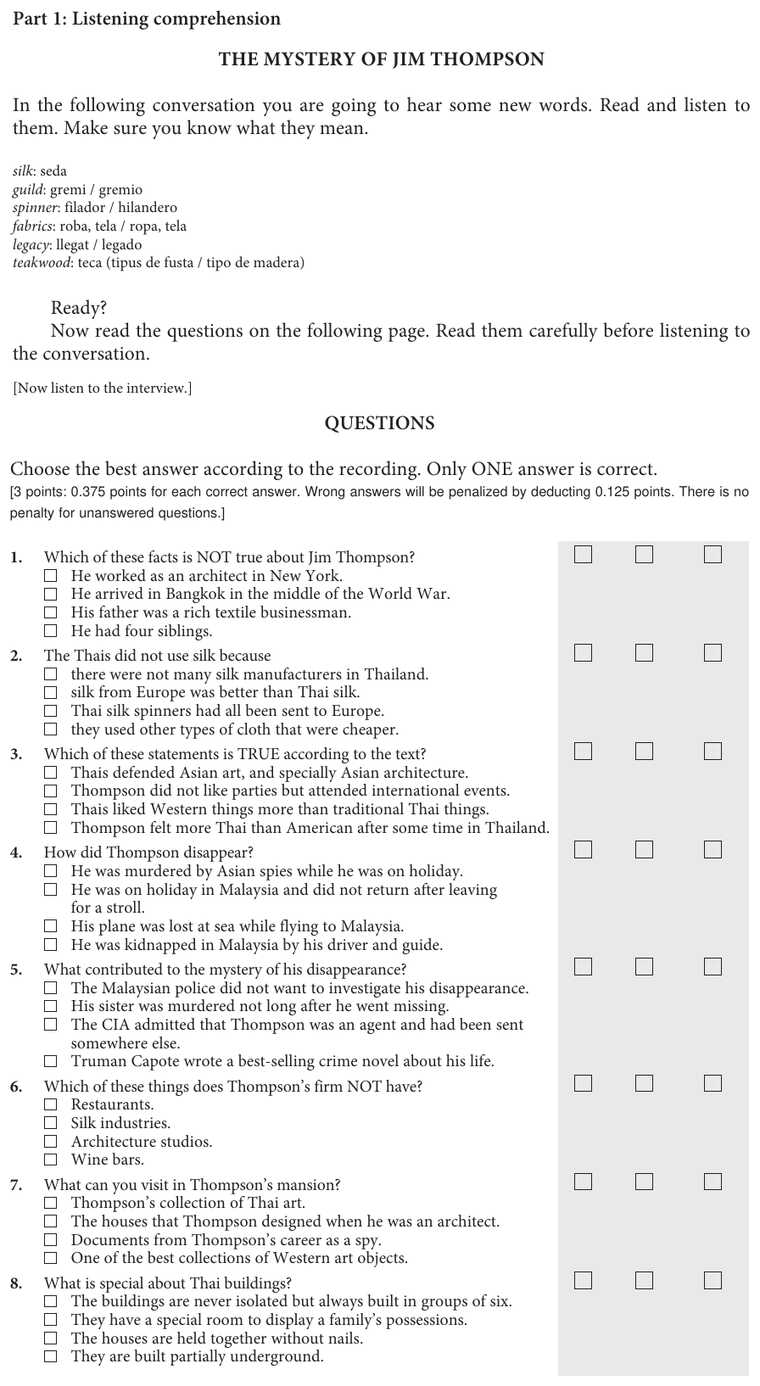
THE MYSTERY OF JIM THOMPSON
In the following conversation you are going to hear some new words. Read and listen to
them. Make sure you know what they mean.
silk: seda
guild: gremi / gremio
spinner: filador / hilandero
fabrics: roba, tela / ropa, tela
legacy: llegat / legado
teakwood: teca (tipus de fusta / tipo de madera)
Ready?
Now read the questions on the following page. Read them carefully before listening to
the conversation.
[Now listen to the interview.]
Transcripció oficial (pauangl21jp.pdf):
The Mystery of Jim Thompson
In the following conversation, you are going to hear some new words. Read and listen
to them. Make sure you know what they mean.
silk: seda
guild: gremi / gremio
spinner: filador / hilandero
fabrics: roba, tela / ropa, tela
legacy: llegat / legado
teakwood: teca (tipus de fusta / tipo de madera)
Ready?
Now read the questions on the following page. Read them carefully before listening to
the conversation.
More than forty years after the supposed death of Jim Thompson, he remains the most
important and beloved farang (‘foreigner’) in Thailand. His name is related to the silk
business in Thailand, but he led a life full of adventures and his death, if he is dead, is
still a mystery. In today’s program, our reporter interviews Mark Biles, who has just
published a biography of Jim Thompson.
REPORTER: Hi, Mark. Welcome to our programme.
MARK: My pleasure.
REPORTER: To start, tell us why you are so interested in Jim Thompson.
MARK: Well, learning about someone from a different era, a different background or a
totally different set of life experiences gives you a new perspective. It allows you to see
the world in new ways. Two years ago, I was in Thailand on holidays, and someone told
me about this man. Everything about him seemed taken out of a movie. So, I started to
investigate. I was able to find out many things about his life but much remained, and will
remain, a secret forever.
REPORTER: He was American, wasn’t he? So how come he is so famous in Thailand?
Tell us a bit about his life.
MARK: Jim Thompson was born in Delaware, in the United States. He was the
youngest of five children His father was a wealthy textile manufacturer. He studied
architecture at Princeton. He lived and worked in New York and had a comfortable life
there. But in 1944 he quit his job and enlisted with the Delaware National Guard. In
1949, he joined the Department of Strategic Services of the United States, what today
we know as the CIA, to participate in different operations in the Far East. He arrived in
Thailand shortly after the victory over Japan in World War II. After a series of
"missions", he was finally assigned to Bangkok as head of American secret services,
thus beginning the fabulous legend that emerges from his no less fabulous life.
REPORTER: So, let me see if I got it right. He was a spy!!
MARK: Exactly, notice we are referring to the 1940s. The Second World War had just
ended. It’s the time of the Cold War. The United States needed information, so Thailand
seemed like a great place to get it. However, oddly enough he is not remembered for his
deeds as a member of CIA. He was a benefactor for Thai society and that is why he is
well remembered.
REPORTER: Right. He is linked to the silk industry, isn’t he? How did this relationship
start?
MARK: In Bangkok Thompson bought a part of the Oriental Hotel, but his great
opportunity came with the guild of silk spinners. The guild was in decline because silk
had been relegated by the Thais themselves in favour of other, cheaper fabrics.
Thompson was a visionary and relaunched the silk business thanks to his contacts with
Europe. In 1948, he founded the Silk Company of Thailand.
REPORTER: But wasn’t being a foreigner a huge inconvenience for him? I mean, did the
Thais trust him? He may not have known many of their customs and ways of doing
business.
MARK: Well, at a time when the Thais preferred everything Western, Thompson was a
revolutionary who recovered traditions and craftsmanship. He defended Thai art and
architecture at all costs, but without losing his own Western roots. In fact, there was no
party or social event of any kind that Thompson did not attend. His presence was
fundamental at any and every event, and both the Thais and the international
community in Bangkok adored him.
REPORTER: So, he was kind of a star!
MARK: Yes, in fact, all the personalities that passed through the Bangkok of those
years sat at his table, among them his friend Truman Capote.
REPORTER: I see. But tell us a bit about his mysterious disappearance. What happened?
MARK: In fact, his mysterious disappearance accelerated his legend. In 1967, during a
vacation in Malaysia with some friends, he went for a walk and simply disappeared.
This gave rise to speculations of all kinds: kidnapping, murder, all sorts of things.
REPORTER: But people do not just disappear. I’m sure the police looked into the
disappearance.
MARK: Yes, of course. But the fact is that he was never found, which only served to
forge his legend. And to put more salt on the wound, his only sister was killed in her
home in the United States soon after his disappearance and their driver and guide in
Malaysia dropped out of sight and was never heard from again. You can see how all of
this seems to be part of a crime novel as opposed to real life. Some people say that, in
reality, he never stopped working for the CIA and that's why he left as suddenly as he
had arrived.
REPORTER: Spy or not, the truth is that he left a magnificent legacy.
MARK: Definitely. Today the silk business that Thompson created is one of the main
sources of income in the country, a thriving industry that exports silk to the whole world.
In addition, the firm has diversified and has entered the restaurant business, opening
restaurants and wine bars with all the glamour that always characterized this man of
exquisite tastes.
REPORTER: We are running out of time, so a last question. Is there a place in
Thailand where we can see his legacy?
MARK: Yes, absolutely. Currently you can visit his magnificent mansion, which has
been converted into a museum in Bangkok. In 1958, he began what was to be his most
important architectural achievement—the construction of a new home to display his art
objects. The house is a combination of six independent Thai-style teakwood houses
that have been reassembled in traditional Thai fashion—not even a single nail was
used. And the museum also houses an excellent collection of Thai art that includes one
of the best collections of traditional art from around the world.
REPORTER: Well, Mark, it’s been a pleasure to have you here tonight.
MARK: Thank you for inviting me.
Adapted from: http://www.turismotailandes.com/el-misterio-de-jim-thompson-y-el-negocio-de-
la-seda-en-tailandia/ and https://www.youtube.com/watch?v=e1yq9gCKnEE [30th November
2018]
Vegeu el listening i la transcripció oficial de la pregunta 1 de Part 1.
1. Which of these facts is NOT true about Jim Thompson?
He worked as an architect in New York.
He arrived in Bangkok in the middle of the World War.
His father was a rich textile businessman.
He had four siblings.
2. The Thais did not use silk because
there were not many silk manufacturers in Thailand.
silk from Europe was better than Thai silk.
Thai silk spinners had all been sent to Europe.
they used other types of cloth that were cheaper.
3. Which of these statements is TRUE according to the text?
Thais defended Asian art, and specially Asian architecture.
Thompson did not like parties but attended international events.
Thais liked Western things more than traditional Thai things.
Thompson felt more Thai than American after some time in Thailand.
4. How did Thompson disappear?
He was murdered by Asian spies while he was on holiday.
He was on holiday in Malaysia and did not return after leaving
for a stroll.
His plane was lost at sea while flying to Malaysia.
He was kidnapped in Malaysia by his driver and guide.
5. What contributed to the mystery of his disappearance?
The Malaysian police did not want to investigate his disappearance.
His sister was murdered not long after he went missing.
The CIA admitted that Thompson was an agent and had been sent
somewhere else.
Truman Capote wrote a best-selling crime novel about his life.
6. Which of these things does Thompson’s firm NOT have?
Restaurants.
Silk industries.
Architecture studios.
Wine bars.
7. What can you visit in Thompson’s mansion?
Thompson’s collection of Thai art.
The houses that Thompson designed when he was an architect.
Documents from Thompson’s career as a spy.
One of the best collections of Western art objects.
8. What is special about Thai buildings?
The buildings are never isolated but always built in groups of six.
They have a special room to display a family’s possessions.
The houses are held together without nails.
They are built partially underground.
 Toca per ampliar
- 0,375 pSeleccionar la resposta de la clau oficial: He arrived in Bangkok in the middle of the World War.Penalització: Resposta incorrecta: −0,125 punts. Resposta en blanc: cap penalització.
Toca per ampliar- 0,375 pSeleccionar la resposta de la clau oficial: They used other types of cloth that were cheaper.Penalització: Resposta incorrecta: −0,125 punts. Resposta en blanc: cap penalització.
Toca per ampliar- 0,375 pSeleccionar la resposta de la clau oficial: Thais liked Western things more than traditional Thai things.Penalització: Resposta incorrecta: −0,125 punts. Resposta en blanc: cap penalització.
Toca per ampliar- 0,375 pSeleccionar la resposta de la clau oficial: He was on holiday in Malaysia and did not return after leaving for a stroll.Penalització: Resposta incorrecta: −0,125 punts. Resposta en blanc: cap penalització.
Toca per ampliar- 0,375 pSeleccionar la resposta de la clau oficial: His sister was murdered not long after he went missing.Penalització: Resposta incorrecta: −0,125 punts. Resposta en blanc: cap penalització.
Toca per ampliar- 0,375 pSeleccionar la resposta de la clau oficial: Architecture studiosPenalització: Resposta incorrecta: −0,125 punts. Resposta en blanc: cap penalització.
Toca per ampliar- 0,375 pSeleccionar la resposta de la clau oficial: Thompson’s collection of Thai art.Penalització: Resposta incorrecta: −0,125 punts. Resposta en blanc: cap penalització.
Toca per ampliar- 0,375 pSeleccionar la resposta de la clau oficial: The houses are held together without nails.Penalització: Resposta incorrecta: −0,125 punts. Resposta en blanc: cap penalització.
Exercici 2
Part 2: Reading comprehension
 Toca per ampliar
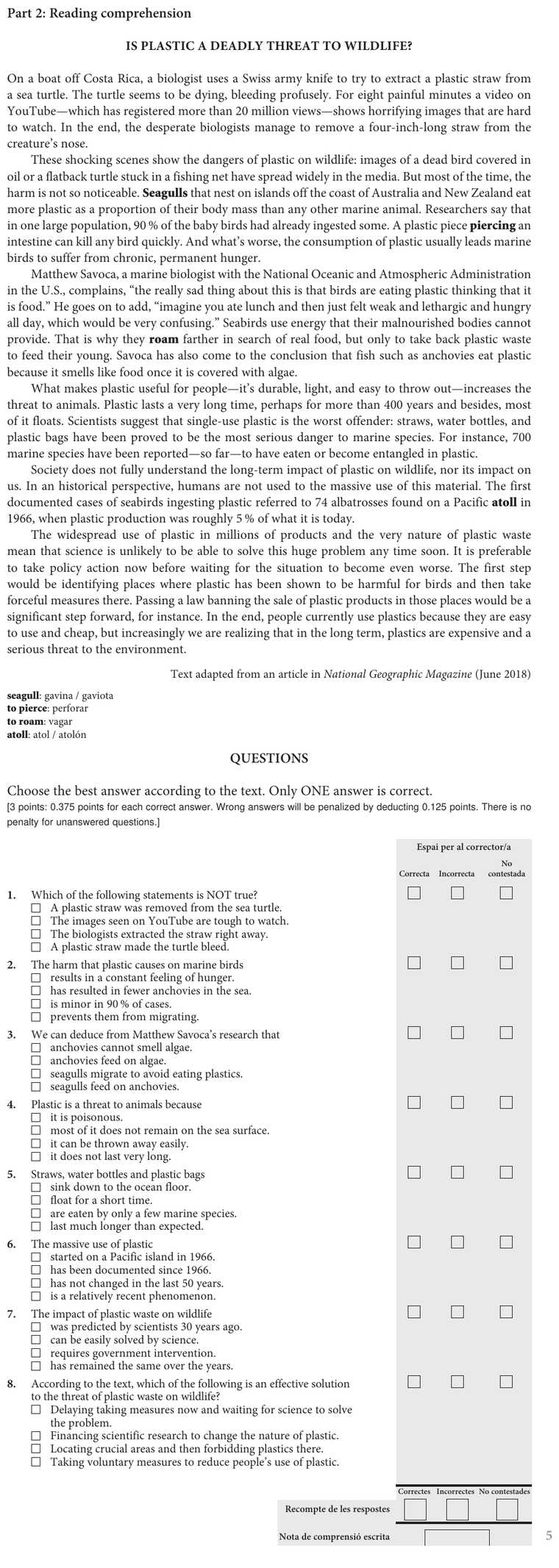
IS PLASTIC A DEADLY THREAT TO WILDLIFE?
On a boat off Costa Rica, a biologist uses a Swiss army knife to try to extract a plastic straw from
a sea turtle. The turtle seems to be dying, bleeding profusely. For eight painful minutes a video on
YouTube—which has registered more than 20 million views—shows horrifying images that are hard
to watch. In the end, the desperate biologists manage to remove a four-inch-long straw from the
creature’s nose.
These shocking scenes show the dangers of plastic on wildlife: images of a dead bird covered in
oil or a flatback turtle stuck in a fishing net have spread widely in the media. But most of the time, the
harm is not so noticeable. Seagulls that nest on islands off the coast of Australia and New Zealand eat
more plastic as a proportion of their body mass than any other marine animal. Researchers say that
in one large population, 90 % of the baby birds had already ingested some. A plastic piece piercing an
intestine can kill any bird quickly. And what’s worse, the consumption of plastic usually leads marine
birds to suffer from chronic, permanent hunger.
Matthew Savoca, a marine biologist with the National Oceanic and Atmospheric Administration
in the U.S., complains, “the really sad thing about this is that birds are eating plastic thinking that it
is food.” He goes on to add, “imagine you ate lunch and then just felt weak and lethargic and hungry
all day, which would be very confusing.” Seabirds use energy that their malnourished bodies cannot
provide. That is why they roam farther in search of real food, but only to take back plastic waste
to feed their young. Savoca has also come to the conclusion that fish such as anchovies eat plastic
because it smells like food once it is covered with algae.
What makes plastic useful for people—it’s durable, light, and easy to throw out—increases the
threat to animals. Plastic lasts a very long time, perhaps for more than 400 years and besides, most
of it floats. Scientists suggest that single-use plastic is the worst offender: straws, water bottles, and
plastic bags have been proved to be the most serious danger to marine species. For instance, 700
marine species have been reported—so far—to have eaten or become entangled in plastic.
Society does not fully understand the long-term impact of plastic on wildlife, nor its impact on
us. In an historical perspective, humans are not used to the massive use of this material. The first
documented cases of seabirds ingesting plastic referred to 74 albatrosses found on a Pacific atoll in
1966, when plastic production was roughly 5 % of what it is today.
The widespread use of plastic in millions of products and the very nature of plastic waste
mean that science is unlikely to be able to solve this huge problem any time soon. It is preferable
to take policy action now before waiting for the situation to become even worse. The first step
would be identifying places where plastic has been shown to be harmful for birds and then take
forceful measures there. Passing a law banning the sale of plastic products in those places would be a
significant step forward, for instance. In the end, people currently use plastics because they are easy
to use and cheap, but increasingly we are realizing that in the long term, plastics are expensive and a
serious threat to the environment.
Text adapted from an article in National Geographic Magazine (June 2018)
seagull: gavina / gaviota
to pierce: perforar
to roam: vagar
atoll: atol / atolón
Vegeu el text de lectura de la pregunta 1 de Part 2.
1. Which of the following statements is NOT true?
A plastic straw was removed from the sea turtle.
The images seen on YouTube are tough to watch.
The biologists extracted the straw right away.
A plastic straw made the turtle bleed.
2. The harm that plastic causes on marine birds
results in a constant feeling of hunger.
has resulted in fewer anchovies in the sea.
is minor in 90 % of cases.
prevents them from migrating.
3. We can deduce from Matthew Savoca’s research that
anchovies cannot smell algae.
anchovies feed on algae.
seagulls migrate to avoid eating plastics.
seagulls feed on anchovies.
4. Plastic is a threat to animals because
it is poisonous.
most of it does not remain on the sea surface.
it can be thrown away easily.
it does not last very long.
5. Straws, water bottles and plastic bags
sink down to the ocean floor.
float for a short time.
are eaten by only a few marine species.
last much longer than expected.
6. The massive use of plastic
started on a Pacific island in 1966.
has been documented since 1966.
has not changed in the last 50 years.
is a relatively recent phenomenon.
7. The impact of plastic waste on wildlife
was predicted by scientists 30 years ago.
can be easily solved by science.
requires government intervention.
has remained the same over the years.
8. According to the text, which of the following is an effective solution
to the threat of plastic waste on wildlife?
Delaying taking measures now and waiting for science to solve
the problem.
Financing scientific research to change the nature of plastic.
Locating crucial areas and then forbidding plastics there.
Taking voluntary measures to reduce people’s use of plastic.
Toca per ampliar- 0,375 pSeleccionar la resposta de la clau oficial: The biologists extracted the straw right away.Penalització: Resposta incorrecta: −0,125 punts. Resposta en blanc: cap penalització.
Toca per ampliar- 0,375 pSeleccionar la resposta de la clau oficial: results in a constant feeling of hunger.Penalització: Resposta incorrecta: −0,125 punts. Resposta en blanc: cap penalització.
Toca per ampliar- 0,375 pSeleccionar la resposta de la clau oficial: anchovies feed on algae.Penalització: Resposta incorrecta: −0,125 punts. Resposta en blanc: cap penalització.
Toca per ampliar- 0,375 pSeleccionar la resposta de la clau oficial: it can be thrown away easily.Penalització: Resposta incorrecta: −0,125 punts. Resposta en blanc: cap penalització.
Toca per ampliar- 0,375 pSeleccionar la resposta de la clau oficial: last much longer than expected.Penalització: Resposta incorrecta: −0,125 punts. Resposta en blanc: cap penalització.
Toca per ampliar- 0,375 pSeleccionar la resposta de la clau oficial: is a relatively recent phenomenon.Penalització: Resposta incorrecta: −0,125 punts. Resposta en blanc: cap penalització.
Toca per ampliar- 0,375 pSeleccionar la resposta de la clau oficial: requires government intervention.Penalització: Resposta incorrecta: −0,125 punts. Resposta en blanc: cap penalització.
Toca per ampliar- 0,375 pSeleccionar la resposta de la clau oficial: Locating crucial areas and then forbidding plastics there.Penalització: Resposta incorrecta: −0,125 punts. Resposta en blanc: cap penalització.
Exercici 3 · opció A
Part 3: Writing
 Toca per ampliar
Choose ONE topic. Your answer should be 125-150 words in length. There is no specific penalty for exceeding 150 words in length. Extra points are not given for exceeding 150 words. [4 points]
1. Last summer you went rock climbing in the Pyrenees and realized that all the surroundings
were full of plastic waste. Write an informal letter to a friend of yours describing your
feelings.
Toca per ampliar- 4 pSense desglossament als PDF proporcionats: redactar en anglès una resposta al tema 1 en el gènere i amb l’extensió que indica l’enunciat. El quadern assigna 4 punts a la redacció; no s’hi especifiquen descriptors ni pesos de Grammar, Vocabulary, Text o Maturity.
Exercici 3 · opció B
Part 3: Writing
Toca per ampliarChoose ONE topic. Your answer should be 125-150 words in length. There is no specific penalty for exceeding 150 words in length. Extra points are not given for exceeding 150 words. [4 points]
2. Imagine that you are the chief editor of an important newspaper and you decide to write
an editorial about the environment and global warming. Write a formal essay arguing
for strong, efficient measures to protect the environment.
Toca per ampliar- 4 pSense desglossament als PDF proporcionats: redactar en anglès una resposta al tema 2 en el gènere i amb l’extensió que indica l’enunciat. El quadern assigna 4 punts a la redacció; no s’hi especifiquen descriptors ni pesos de Grammar, Vocabulary, Text o Maturity.
Exercici 3 · opció C
Part 3: Writing
Toca per ampliarChoose ONE topic. Your answer should be 125-150 words in length. There is no specific penalty for exceeding 150 words in length. Extra points are not given for exceeding 150 words. [4 points]
3. You have recently finished high school. A few years from now, when you look back on
your time in high school, what part will you remember fondly? And which part will you
wish you could forget? Write an essay describing how you think you will view your high
school experience.
Toca per ampliar- 4 pSense desglossament als PDF proporcionats: redactar en anglès una resposta al tema 3 en el gènere i amb l’extensió que indica l’enunciat. El quadern assigna 4 punts a la redacció; no s’hi especifiquen descriptors ni pesos de Grammar, Vocabulary, Text o Maturity.