Anglès
PAU 2022 · extraordinària · sèrie 3
Examen oficial de la PAU de Catalunya amb la pauta de correcció. És d’una convocatòria anterior al model 2025: la pauta correspon a aquell examen.
Listening
PAU 2022 · extraordinària · sèrie 3Instruccions de l’examen
Part 1: Listening comprehension
Choose the best answer according to the recording. Only ONE answer is correct. [3 points: 0.375 points for each correct answer. Wrong answers will be penalized by deducting 0.125 points. There is no penalty for unanswered questions.]
Part 2: Reading comprehension
Choose the best answer according to the text. Only ONE answer is correct. [3 points: 0.375 points for each correct answer. Wrong answers will be penalized by deducting 0.125 points. There is no penalty for unanswered questions.]
Part 3: Writing
Choose ONE topic. Your answer should be 125-150 words in length. There is no specific penalty for exceeding 150 words in length. Extra points are not given for exceeding 150 words. [4 points]
Exercici 1
Listening comprehension
 Toca per ampliar
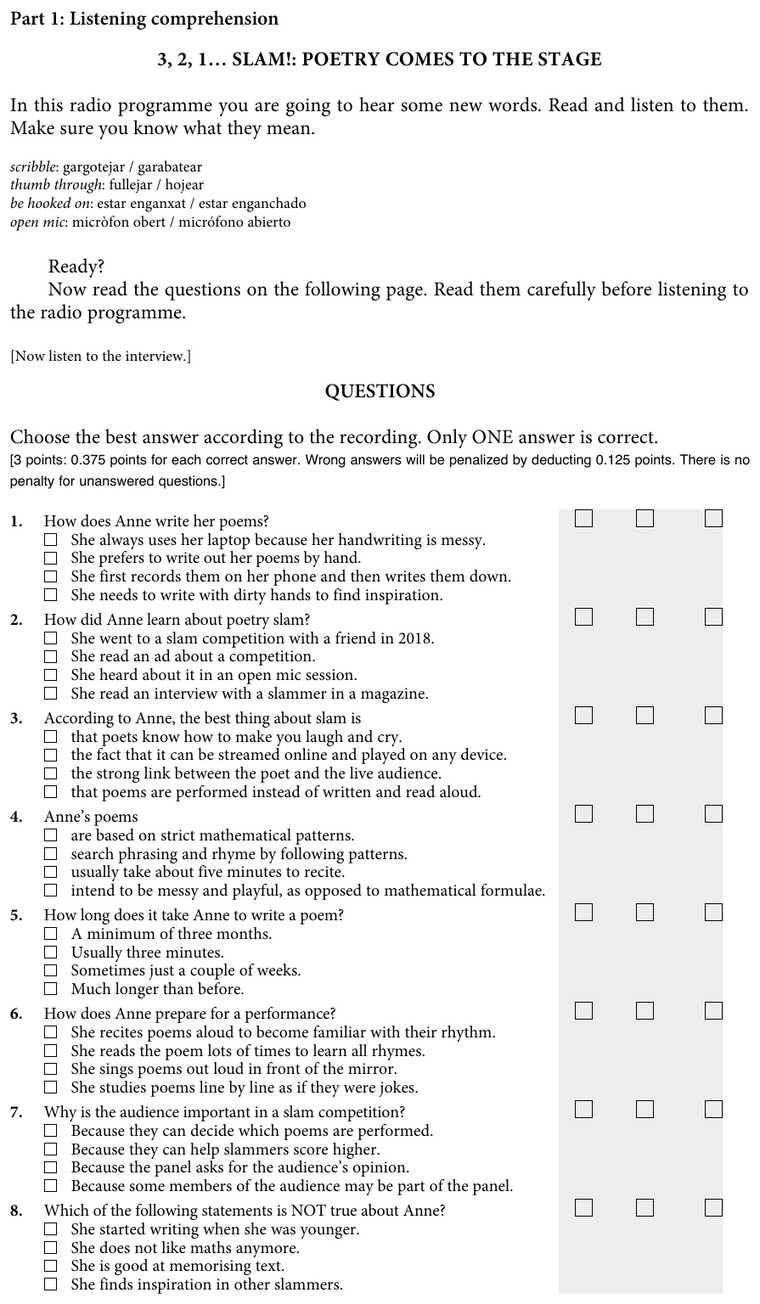
3, 2, 1… Slam!: Poetry comes to the stage
In this radio programme you are going to hear some new words. Read and listen to them. Make sure you know what they mean.
scribble: gargotejar/garabatear
thumb through: fullejar/hojear
be hooked on: estar enganxat/estar enganchado
open mic: micròfon obert/micrófono abierto
Ready? Now read the questions on the following page. Read them carefully before listening to the radio programme.
Interviewer: Welcome to our weekly programme on literature. Today we’re going to discuss a relatively recent development in literature, a poetry slam. A poetry slam is a competition arts event in which poets perform before a live audience and a panel of judges. Slams have become increasingly popular all around the world, with events welcoming a large number of attendees. My guest Anne is here with us today to tell us about her experience as a slammer.
Hi, Anne! Could you tell us about yourself? Would you define yourself as a poet?
Anne: What a nice question! I had never been asked that! The truth is that I have always loved writing. I’ve got my notebook with me all the time —whether it’s by the side of my bed or on trains, I always scribble things down, although I don’t type that often. In fact, there’s a suitcase full of poems beneath my bed. I don’t remember how most of them got there. Sometimes I’ll thumb through them and see my messy little-kid handwriting. There may be over a hundred pages stained with dirty hands and the remains of more than a few grilled cheese sandwiches.
Interviewer: When did performance jump in? Why did you start taking part in poetry slam competitions?
Anne: I first saw a live slam competition in 2018. I’d never heard of this kind of event, but I saw it was advertised in a magazine. After attending a few sessions, I got completely hooked on it and decided to give it a try from stage. I think what I liked about it was that emphasis on connection. Whether it’s a performer making you laugh or making you cry, there’s a certain live element to that. You know, I’ve got videos online and you can see me perform from any device, but it’s different when it’s live. In a live context you can immediately get what the performer’s trying to say and there’s an added level of accessibility, because the person who’s written the poem is in front of you, saying it, and it gives it so much more context.
Interviewer: You have a degree in Maths, if I’m not wrong. Has that helped you with your poetry?
Anne: Yeah! For ages I told myself that the two were just separate worlds, but then I realised that when I’m writing my poems or searching for a particular way of phrasing something or a rhyme, there is definitely a technicality to it. It’s not as rigid as a formula that I have to follow, but I think I’ve really embraced the idea of patterns and playfulness that I learnt through maths. I try to bring that to my poetry.
Interviewer: Tell us about slam poems. What are they like and how do you prepare for them?
Anne: There is a time limit in poem performances –we typically have a maximum of three minutes. I used to just write my poems as a hobby in my free time, so from start to finish it would be a couple of months, maybe, waiting for inspiration to come. Now I
think that I do it full time, I’m a bit more disciplined with that, so it’s anything from a couple of weeks to much longer. It’ll often start with a playful bit of language, whether that’s a rhyme or a one-liner, and then it just comes out.
Interviewer: And you need to memorise the whole poem for live performances?
Anne: Yes, but that’s something I’ve always done. I was always good at remembering the lyrics to songs or specific jokes that I heard. As part of my writing process, I’ll speak poems out loud to feel their rhythm. The first time I perform, I’ll still have it in my book in front of me just in case, but I think once I’ve learnt a poem, I enjoy the performance aspect of it and I find that easier if I can do it without worrying about what the next line’s going to be.
Interviewer: And then in the event a panel of three to five judges gives each slammer a score, is that right? What is your secret to score high?
Anne: Yes, that’s right. Usually, the panel is selected randomly from the audience in the room. A good idea to score higher is to read the room to choose the poem you’re going to perform, because it’s a live thing, you know, so it’s dependent on who’s in the room. It’s also helpful to have enough poems so that you can pick and choose among them.
Interviewer: Are there any tips you’d like to give people who perhaps want to get into spoken word poetry?
Anne: Don’t get too nervous if you decide to try. The audience at these events is usually very supportive. Sometimes it can be difficult to feel confident, but it’s really worth it. Try open mic nights first if you think that could be helpful before getting into a competition. Watch videos online of some of the best slammers worldwide to prepare yourself, like Harry Baker’s, Dani Orviz’s, or Emi Mahmoud’s –they are a true source of inspiration!
Interviewer: Wow! I’m looking forward to watching those videos myself! Thank you, Anne, for your time and for letting us know about poetry slam. We hope to see you on stage very soon!
Anne: My pleasure.
Adapted from ‘An interview with our favourite World Poetry Slam Champion: Harry Baker’, The Temple Times, 13th March 2020.
See the official listening transcript in Part 1, question 1 (item 1.1).
How does Anne write her poems?
She always uses her laptop because her handwriting is messy.
She prefers to write out her poems by hand.
She first records them on her phone and then writes them down.
She needs to write with dirty hands to find inspiration.
How did Anne learn about poetry slam?
She went to a slam competition with a friend in 2018.
She read an ad about a competition.
She heard about it in an open mic session.
She read an interview with a slammer in a magazine.
According to Anne, the best thing about slam is
that poets know how to make you laugh and cry.
the fact that it can be streamed online and played on any device.
the strong link between the poet and the live audience.
that poems are performed instead of written and read aloud.
Anne’s poems
are based on strict mathematical patterns.
search phrasing and rhyme by following patterns.
usually take about five minutes to recite.
intend to be messy and playful, as opposed to mathematical formulae.
How long does it take Anne to write a poem?
A minimum of three months.
Usually three minutes.
Sometimes just a couple of weeks.
Much longer than before.
How does Anne prepare for a performance?
She recites poems aloud to become familiar with their rhythm.
She reads the poem lots of times to learn all rhymes.
She sings poems out loud in front of the mirror.
She studies poems line by line as if they were jokes.
Why is the audience important in a slam competition?
Because they can decide which poems are performed.
Because they can help slammers score higher.
Because the panel asks for the audience’s opinion.
Because some members of the audience may be part of the panel.
Which of the following statements is NOT true about Anne?
She started writing when she was younger.
She does not like maths anymore.
She is good at memorising text.
She finds inspiration in other slammers.
 Toca per ampliar
- 0,375 pSeleccionar la resposta de la clau oficial: She prefers to write out her poems by hand.Penalització: Resposta incorrecta: −0.125 punts; pregunta no contestada: sense penalització.
Toca per ampliar- 0,375 pSeleccionar la resposta de la clau oficial: She read an ad about a competition.Penalització: Resposta incorrecta: −0.125 punts; pregunta no contestada: sense penalització.
Toca per ampliar- 0,375 pSeleccionar la resposta de la clau oficial: the strong link between the poet and the live audience.Penalització: Resposta incorrecta: −0.125 punts; pregunta no contestada: sense penalització.
Toca per ampliar- 0,375 pSeleccionar la resposta de la clau oficial: search phrasing and rhyme by following patterns.Penalització: Resposta incorrecta: −0.125 punts; pregunta no contestada: sense penalització.
Toca per ampliar- 0,375 pSeleccionar la resposta de la clau oficial: Sometimes just a couple of weeks.Penalització: Resposta incorrecta: −0.125 punts; pregunta no contestada: sense penalització.
Toca per ampliar- 0,375 pSeleccionar la resposta de la clau oficial: She recites poems aloud to become familiar with their rhythm.Penalització: Resposta incorrecta: −0.125 punts; pregunta no contestada: sense penalització.
Toca per ampliar- 0,375 pSeleccionar la resposta de la clau oficial: Because some members of the audience may be part of the panel.Penalització: Resposta incorrecta: −0.125 punts; pregunta no contestada: sense penalització.
Toca per ampliar- 0,375 pSeleccionar la resposta de la clau oficial: She does not like maths anymore.Penalització: Resposta incorrecta: −0.125 punts; pregunta no contestada: sense penalització.
Exercici 2
Reading comprehension
 Toca per ampliar
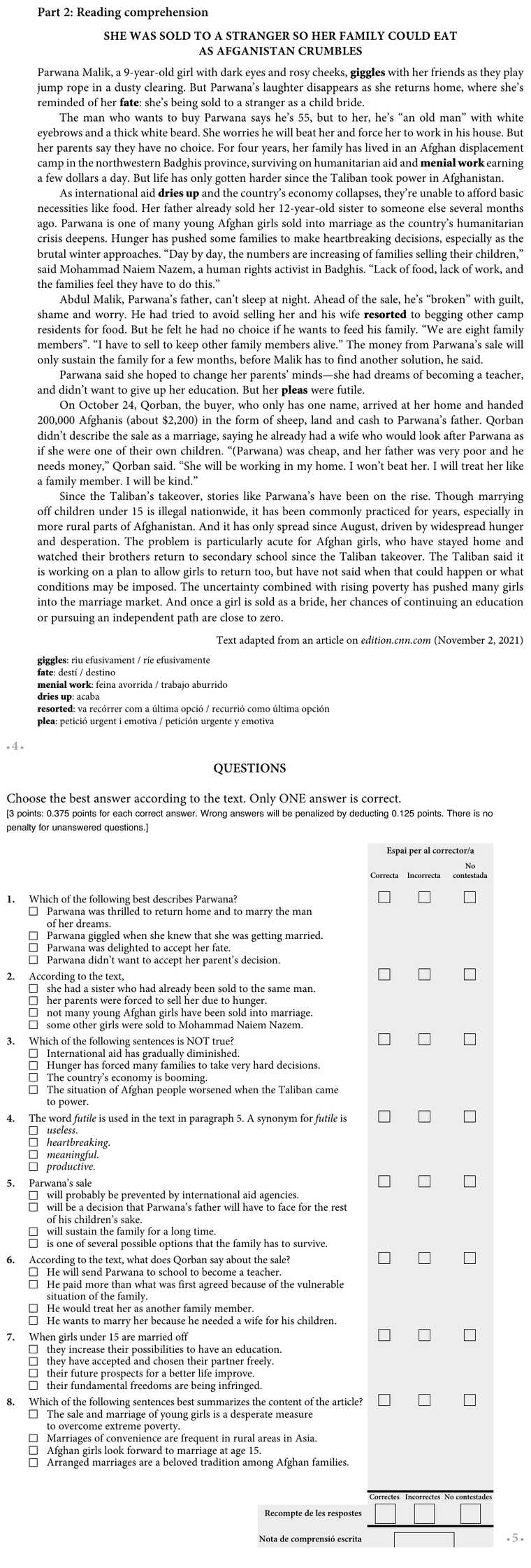
SHE WAS SOLD TO A STRANGER SO HER FAMILY COULD EAT AS AFGANISTAN CRUMBLES Parwana Malik, a 9-year-old girl with dark eyes and rosy cheeks, giggles with her friends as they play jump rope in a dusty clearing. But Parwana’s laughter disappears as she returns home, where she’s reminded of her fate: she’s being sold to a stranger as a child bride. The man who wants to buy Parwana says he’s 55, but to her, he’s “an old man” with white eyebrows and a thick white beard. She worries he will beat her and force her to work in his house. But her parents say they have no choice. For four years, her family has lived in an Afghan displacement camp in the northwestern Badghis province, surviving on humanitarian aid and menial work earning a few dollars a day. But life has only gotten harder since the Taliban took power in Afghanistan. As international aid dries up and the country’s economy collapses, they’re unable to afford basic necessities like food. Her father already sold her 12-year-old sister to someone else several months ago. Parwana is one of many young Afghan girls sold into marriage as the country’s humanitarian crisis deepens. Hunger has pushed some families to make heartbreaking decisions, especially as the brutal winter approaches. “Day by day, the numbers are increasing of families selling their children,” said Mohammad Naiem Nazem, a human rights activist in Badghis. “Lack of food, lack of work, and the families feel they have to do this.” Abdul Malik, Parwana’s father, can’t sleep at night. Ahead of the sale, he’s “broken” with guilt, shame and worry. He had tried to avoid selling her and his wife resorted to begging other camp residents for food. But he felt he had no choice if he wants to feed his family. “We are eight family members”. “I have to sell to keep other family members alive.” The money from Parwana’s sale will only sustain the family for a few months, before Malik has to find another solution, he said. Parwana said she hoped to change her parents’ minds—she had dreams of becoming a teacher, and didn’t want to give up her education. But her pleas were futile. On October 24, Qorban, the buyer, who only has one name, arrived at her home and handed 200,000 Afghanis (about $2,200) in the form of sheep, land and cash to Parwana’s father. Qorban didn’t describe the sale as a marriage, saying he already had a wife who would look after Parwana as if she were one of their own children. “(Parwana) was cheap, and her father was very poor and he needs money,” Qorban said. “She will be working in my home. I won’t beat her. I will treat her like a family member. I will be kind.” Since the Taliban’s takeover, stories like Parwana’s have been on the rise. Though marrying off children under 15 is illegal nationwide, it has been commonly practiced for years, especially in more rural parts of Afghanistan. And it has only spread since August, driven by widespread hunger and desperation. The problem is particularly acute for Afghan girls, who have stayed home and watched their brothers return to secondary school since the Taliban takeover. The Taliban said it is working on a plan to allow girls to return too, but have not said when that could happen or what conditions may be imposed. The uncertainty combined with rising poverty has pushed many girls into the marriage market. And once a girl is sold as a bride, her chances of continuing an education or pursuing an independent path are close to zero. Text adapted from an article on edition.cnn.com (November 2, 2021) giggles: riu efusivament / ríe efusivamente fate: destí / destino menial work: feina avorrida / trabajo aburrido dries up: acaba resorted: va recórrer com a última opció / recurrió como última opción plea: petició urgent i emotiva / petición urgente y emotiva
See the shared reading text and glossary in Part 2, question 1 (item 2.1).
Which of the following best describes Parwana?
Parwana was thrilled to return home and to marry the man
of her dreams.
Parwana giggled when she knew that she was getting married.
Parwana was delighted to accept her fate.
Parwana didn’t want to accept her parent’s decision.
According to the text,
she had a sister who had already been sold to the same man.
her parents were forced to sell her due to hunger.
not many young Afghan girls have been sold into marriage.
some other girls were sold to Mohammad Naiem Nazem.
Which of the following sentences is NOT true?
International aid has gradually diminished.
Hunger has forced many families to take very hard decisions.
The country’s economy is booming.
The situation of Afghan people worsened when the Taliban came
to power.
The word futile is used in the text in paragraph 5. A synonym for futile is
useless.
heartbreaking.
meaningful.
productive.
Parwana’s sale
will probably be prevented by international aid agencies.
will be a decision that Parwana’s father will have to face for the rest
of his children’s sake.
will sustain the family for a long time.
is one of several possible options that the family has to survive.
According to the text, what does Qorban say about the sale?
He will send Parwana to school to become a teacher.
He paid more than what was first agreed because of the vulnerable
situation of the family.
He would treat her as another family member.
He wants to marry her because he needed a wife for his children.
When girls under 15 are married off
they increase their possibilities to have an education.
they have accepted and chosen their partner freely.
their future prospects for a better life improve.
their fundamental freedoms are being infringed.
Which of the following sentences best summarizes the content of the article?
The sale and marriage of young girls is a desperate measure
to overcome extreme poverty.
Marriages of convenience are frequent in rural areas in Asia.
Afghan girls look forward to marriage at age 15.
Arranged marriages are a beloved tradition among Afghan families.
Toca per ampliar- 0,375 pSeleccionar la resposta de la clau oficial: Parwana didn’t want to accept her parent’s decision.Penalització: Resposta incorrecta: −0.125 punts; pregunta no contestada: sense penalització.
Toca per ampliar- 0,375 pSeleccionar la resposta de la clau oficial: her parents were forced to sell her due to hunger.Penalització: Resposta incorrecta: −0.125 punts; pregunta no contestada: sense penalització.
Toca per ampliar- 0,375 pSeleccionar la resposta de la clau oficial: The country’s economy is booming.Penalització: Resposta incorrecta: −0.125 punts; pregunta no contestada: sense penalització.
Toca per ampliar- 0,375 pSeleccionar la resposta de la clau oficial: useless.Penalització: Resposta incorrecta: −0.125 punts; pregunta no contestada: sense penalització.
Toca per ampliar- 0,375 pSeleccionar la resposta de la clau oficial: will be a decision that Parwana’s father will have to face for the rest of his children’s sake.Penalització: Resposta incorrecta: −0.125 punts; pregunta no contestada: sense penalització.
Toca per ampliar- 0,375 pSeleccionar la resposta de la clau oficial: He would treat her as another family member.Penalització: Resposta incorrecta: −0.125 punts; pregunta no contestada: sense penalització.
Toca per ampliar- 0,375 pSeleccionar la resposta de la clau oficial: their fundamental freedoms are being infringed.Penalització: Resposta incorrecta: −0.125 punts; pregunta no contestada: sense penalització.
Toca per ampliar- 0,375 pSeleccionar la resposta de la clau oficial: The sale and marriage of young girls is a desperate measure to overcome extreme poverty.Penalització: Resposta incorrecta: −0.125 punts; pregunta no contestada: sense penalització.
Exercici 3 · opció A
Writing
 Toca per ampliar
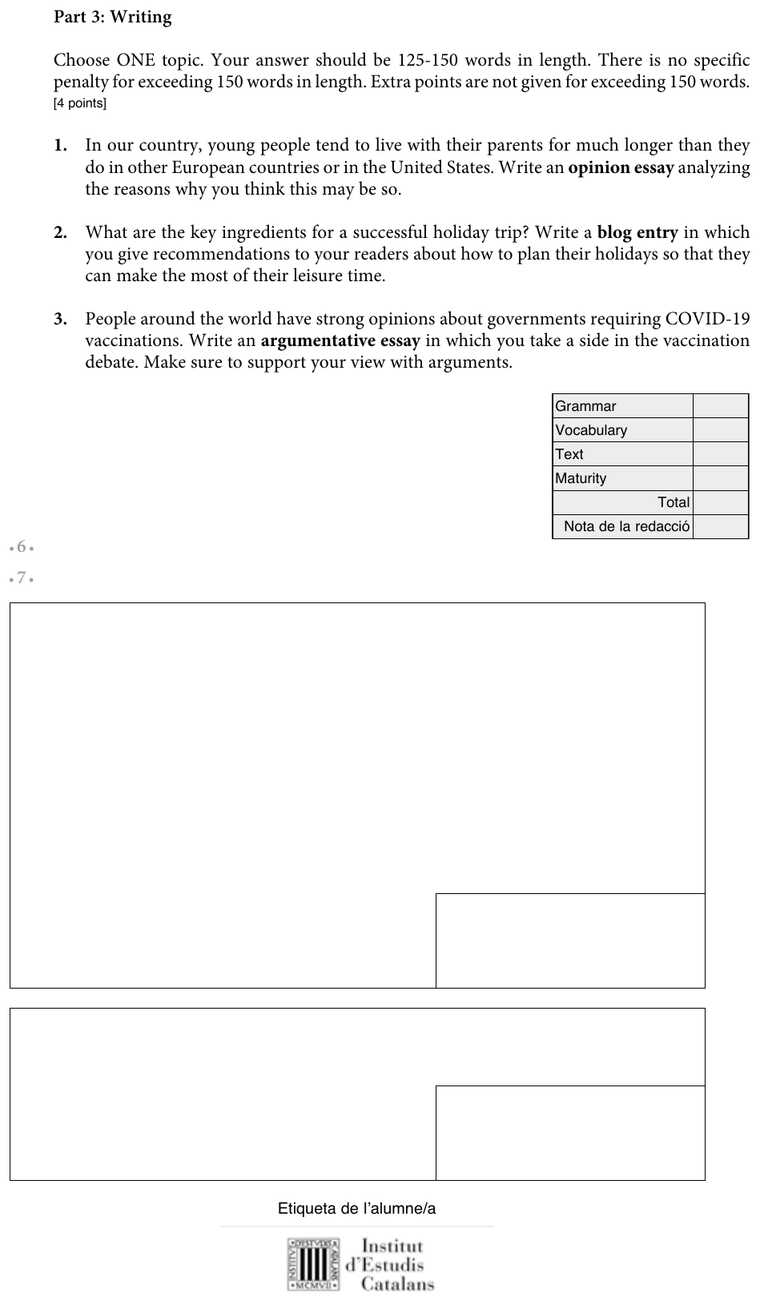
Choose ONE topic. Your answer should be 125-150 words in length. There is no specific penalty for exceeding 150 words in length. Extra points are not given for exceeding 150 words. [4 points]
In our country, young people tend to live with their parents for much longer than they do in other European countries or in the United States. Write an opinion essay analyzing the reasons why you think this may be so.
Toca per ampliar- 4 pSense desglossament: valoració global de la redacció (4 punts). La graella oficial compartida per tots els temes inclou Grammar, Vocabulary, Text i Maturity, sense pesos per categoria, descriptors de banda ni deduccions per error als PDF aportats.
Exercici 3 · opció B
Writing
Toca per ampliarChoose ONE topic. Your answer should be 125-150 words in length. There is no specific penalty for exceeding 150 words in length. Extra points are not given for exceeding 150 words. [4 points]
What are the key ingredients for a successful holiday trip? Write a blog entry in which you give recommendations to your readers about how to plan their holidays so that they can make the most of their leisure time.
Toca per ampliar- 4 pSense desglossament: valoració global de la redacció (4 punts). La graella oficial compartida per tots els temes inclou Grammar, Vocabulary, Text i Maturity, sense pesos per categoria, descriptors de banda ni deduccions per error als PDF aportats.
Exercici 3 · opció C
Writing
Toca per ampliarChoose ONE topic. Your answer should be 125-150 words in length. There is no specific penalty for exceeding 150 words in length. Extra points are not given for exceeding 150 words. [4 points]
People around the world have strong opinions about governments requiring COVID-19 vaccinations. Write an argumentative essay in which you take a side in the vaccination debate. Make sure to support your view with arguments.
Toca per ampliar- 4 pSense desglossament: valoració global de la redacció (4 punts). La graella oficial compartida per tots els temes inclou Grammar, Vocabulary, Text i Maturity, sense pesos per categoria, descriptors de banda ni deduccions per error als PDF aportats.