Anglès
PAU 2022 · ordinària · sèrie 2
Examen oficial de la PAU de Catalunya amb la pauta de correcció. És d’una convocatòria anterior al model 2025: la pauta correspon a aquell examen.
Listening
PAU 2022 · ordinària · sèrie 2Instruccions de l’examen
Part 1: Listening comprehension
Choose the best answer according to the recording. Only ONE answer is correct. [3 points: 0.375 points for each correct answer. Wrong answers will be penalized by deducting 0.125 points. There is no penalty for unanswered questions.]
Part 2: Reading comprehension
Choose the best answer according to the text. Only ONE answer is correct. [3 points: 0.375 points for each correct answer. Wrong answers will be penalized by deducting 0.125 points. There is no penalty for unanswered questions.]
Part 3: Writing
Choose ONE topic. Your answer should be 125-150 words in length. There is no specific penalty for exceeding 150 words in length. Extra points are not given for exceeding 150 words. [4 points]
Exercici 1
Listening comprehension
 Toca per ampliar
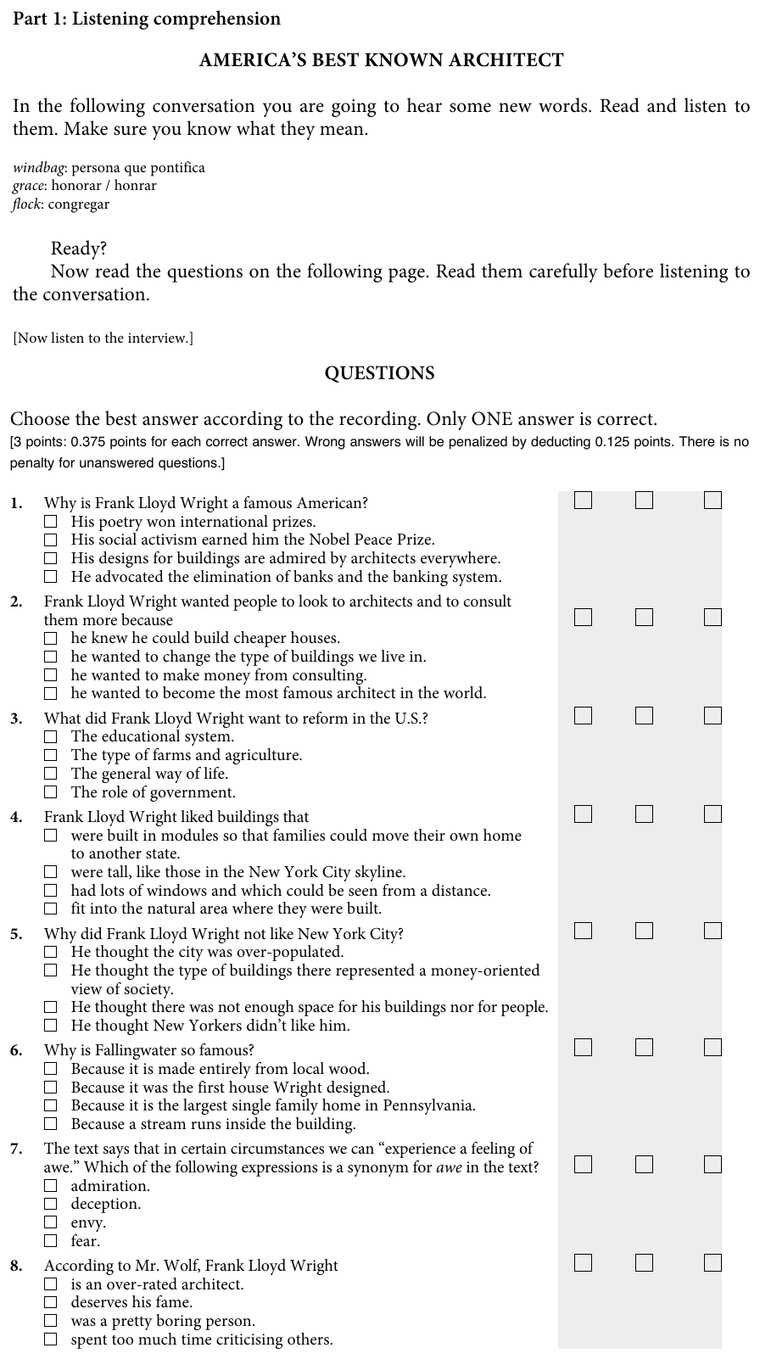
America’s Best Known Architect
In the following conversation you are going to hear some new words. Read and listen to them. Make sure you know what they mean.
windbag: persona que pontifica
grace: honorar/honrar
flock: congregar
Ready?
Now read the questions on the following page. Read them carefully before listening to the conversation.
Interviewer: Welcome to our weekly program about famous Americans. Tonight, we go after the story of one of the most extraordinary men of our time. He is Frank Lloyd Wright, perhaps the greatest architect of the twentieth century and certainly the most famous American architect ever. And in the opinion of some, America's foremost social rebel. So, let’s talk to Mr. Roger Wolf, Frank Lloyd Wright’s biographer. Mr Wolf, how would you define him?
Mr Wolf: Well, I’m not the most appropriate person to define him. According to a story in Life Magazine not many years back, fellow architects have called him everything, from a great poet to an insufferable windbag. The clergy has deplored his morals, creditors have deplored his financial habits, politicians, his opinions. Admirers of Frank Lloyd Wright consider him as a man one hundred years ahead of his time. I’m an admirer.
Interviewer: One of his most famous statements was "If I had another fifteen years to work, I could rebuild this entire country, I could change the nation." Now, would you tell me why should he, one man, want to change the way of life of millions and millions of people?
Mr Wolf: Well, he thought the way of life in which the country... to which the country is committed needs change.
Interviewer: But don’t you think these words show his ego, his self-centeredness? You're saying that practically everyone in the United States is out of step except Frank Lloyd Wright.
Mr Wolf: Not at all, I’m not saying anything of the kind. It isn't their job to build, it was his. He thought people should have a right to look to their architects for suggestions for what they should build.
Interviewer: Well, as an architect...
Mr Wolf: ...and how they should build it.
Interviewer: As an architect, how would he have liked to change the way that we live?
Mr Wolf: He wouldn't have liked to change so much the way we live, as what we live in, and how we live in it. Wright always said that we ourselves are changing in the buildings we live in. Most people don't really understand what it is to live in an organic building with organic character.
Interviewer: Well now, organic building, organic character, these are words which are difficult to understand.
Mr Wolf: Well, let's say natural, would that suit you better? For Wright, a truly organic building developed from within outwards and was thus in harmony with its time, place, and inhabitants.
Interviewer: I'm still not... I would like specifically, to know what you mean, how would he like to change the way that we live?
Mr Wolf: He meant he'd have liked to have a free architecture, an architecture that belonged where you see it standing, architecture that graced the landscape instead of being a disgrace in the landscape. His clients told him how those buildings he had built for them had changed the character of their whole lives and their whole existence. And it's different now than it was before. Well, he'd have liked to do that for the whole country.
Interviewer: But, imagine New York. When he came to New York, and he saw the skyline of New York, didn’t it excite him? After all, he did design the Guggenheim Museum in New York. Most of us think that New York is so spectacular and imposing.
Mr Wolf: In fact, it didn’t impress him at all. Because it never was planned, it was all the result of a race for rent, and it is a great monument, he thought, to the power of money and to greed. It wasn’t about ideas. He didn't see an idea in the whole thing anywhere. Do you? Where is the idea in it? What's the idea?
Interviewer: The idea is obviously, it seems to me, that a lot of people want to live together to make their livings, to make money, to... to enjoy what this large city has to offer. And I guess from time immemorial people have flocked more or less to one spot to exchange ideas as well as goods.
Mr Wolf: But there was a justification for that. When there were no other means of communication than by personal contact. That's when the plans for the cities we now live in originated. They originated back in the Middle Ages, when the only way you could have a culture, the only way you could get social distinction or any education, was by joining other people. Today, however, we cannot get modern improvements here in the city anymore.
Interviewer: Let me see if I get your point. Is Fallingwater, Frank Lloyd Wright’s most famous work, an example of good architecture? What is it that makes Fallingwater so special?
Mr Wolf: Fallingwater is Frank Lloyd Wright’s house built over a waterfall in Pennsylvania for a rich family from Pittsburgh in the 1930s, and it’s arguably the most famous house of the modern era. I think it’s Wright’s supreme example of architecture connected to nature, what he called ‘organic architecture’, because the house is integrated into the landscape. The water flows through the living room.
Interviewer: I get it now. Let’s talk about other aspects of Wright’s personality. Wright had faith in youth. However, he did not have faith in the mob, yet young people grow into adults and often turn into a mob. Or do I misunderstand?
Mr Wolf: I think you’ve got it right. He believed that many people were not properly educated and didn't have an opportunity to go right instead of left. He always said that he put a capital N on Nature, and that is where people had to go, go back to Nature. He said that when you go out into a big forest, with towering pines, and experience a feeling of awe, frequently you do connect with the presence of nature, you not only feel large, you feel enlarged and encouraged, intensified, more powerful.
Interviewer: It is clear in your biography that he was rebellious, a radical in his art and life. Do you agree?
Mr Wolf: Absolutely. But don’t forget that if you ask the average citizen to name a famous American architect, you can bet that their answer will be Frank Lloyd Wright. Wright gained such cultural primacy for good reason: he changed the way we build and live.
Interviewer: Mr. Wolf, I thank you for talking with us today.
Mr Wolf: Well, you're welcome.
Adapted from https://hrc.contentdm.oclc.org/digital/collection/p15878coll90/id/23/rec/1 .
See the official listening transcript in Part 1, question 1 (item 1.1).
Why is Frank Lloyd Wright a famous American?
His poetry won international prizes.
His social activism earned him the Nobel Peace Prize.
His designs for buildings are admired by architects everywhere.
He advocated the elimination of banks and the banking system.
Frank Lloyd Wright wanted people to look to architects and to consult
them more because
he knew he could build cheaper houses.
he wanted to change the type of buildings we live in.
he wanted to make money from consulting.
he wanted to become the most famous architect in the world.
What did Frank Lloyd Wright want to reform in the U.S.?
The educational system.
The type of farms and agriculture.
The general way of life.
The role of government.
Frank Lloyd Wright liked buildings that
were built in modules so that families could move their own home
to another state.
were tall, like those in the New York City skyline.
had lots of windows and which could be seen from a distance.
fit into the natural area where they were built.
Why did Frank Lloyd Wright not like New York City?
He thought the city was over-populated.
He thought the type of buildings there represented a money-oriented
view of society.
He thought there was not enough space for his buildings nor for people.
He thought New Yorkers didn’t like him.
Why is Fallingwater so famous?
Because it is made entirely from local wood.
Because it was the first house Wright designed.
Because it is the largest single family home in Pennsylvania.
Because a stream runs inside the building.
The text says that in certain circumstances we can “experience a feeling of
awe.” Which of the following expressions is a synonym for awe in the text?
admiration.
deception.
envy.
fear.
According to Mr. Wolf, Frank Lloyd Wright
is an over-rated architect.
deserves his fame.
was a pretty boring person.
spent too much time criticising others.
 Toca per ampliar
- 0,375 pSeleccionar la resposta de la clau oficial: His designs for buildings are admired by architects everywhere.Penalització: Resposta incorrecta: −0.125 punts; pregunta no contestada: sense penalització.
Toca per ampliar- 0,375 pSeleccionar la resposta de la clau oficial: he wanted to change the type of buildings we live in.Penalització: Resposta incorrecta: −0.125 punts; pregunta no contestada: sense penalització.
Toca per ampliar- 0,375 pSeleccionar la resposta de la clau oficial: The general way of life.Penalització: Resposta incorrecta: −0.125 punts; pregunta no contestada: sense penalització.
Toca per ampliar- 0,375 pSeleccionar la resposta de la clau oficial: fit into the natural area where they were built.Penalització: Resposta incorrecta: −0.125 punts; pregunta no contestada: sense penalització.
Toca per ampliar- 0,375 pSeleccionar la resposta de la clau oficial: He thought the type of buildings there represented a money-oriented view of society.Penalització: Resposta incorrecta: −0.125 punts; pregunta no contestada: sense penalització.
Toca per ampliar- 0,375 pSeleccionar la resposta de la clau oficial: Because a stream runs inside the building.Penalització: Resposta incorrecta: −0.125 punts; pregunta no contestada: sense penalització.
Toca per ampliar- 0,375 pSeleccionar la resposta de la clau oficial: admiration.Penalització: Resposta incorrecta: −0.125 punts; pregunta no contestada: sense penalització.
Toca per ampliar- 0,375 pSeleccionar la resposta de la clau oficial: deserves his fame.Penalització: Resposta incorrecta: −0.125 punts; pregunta no contestada: sense penalització.
Exercici 2
Reading comprehension
 Toca per ampliar
ASSATEAGUE’S WILD HORSES
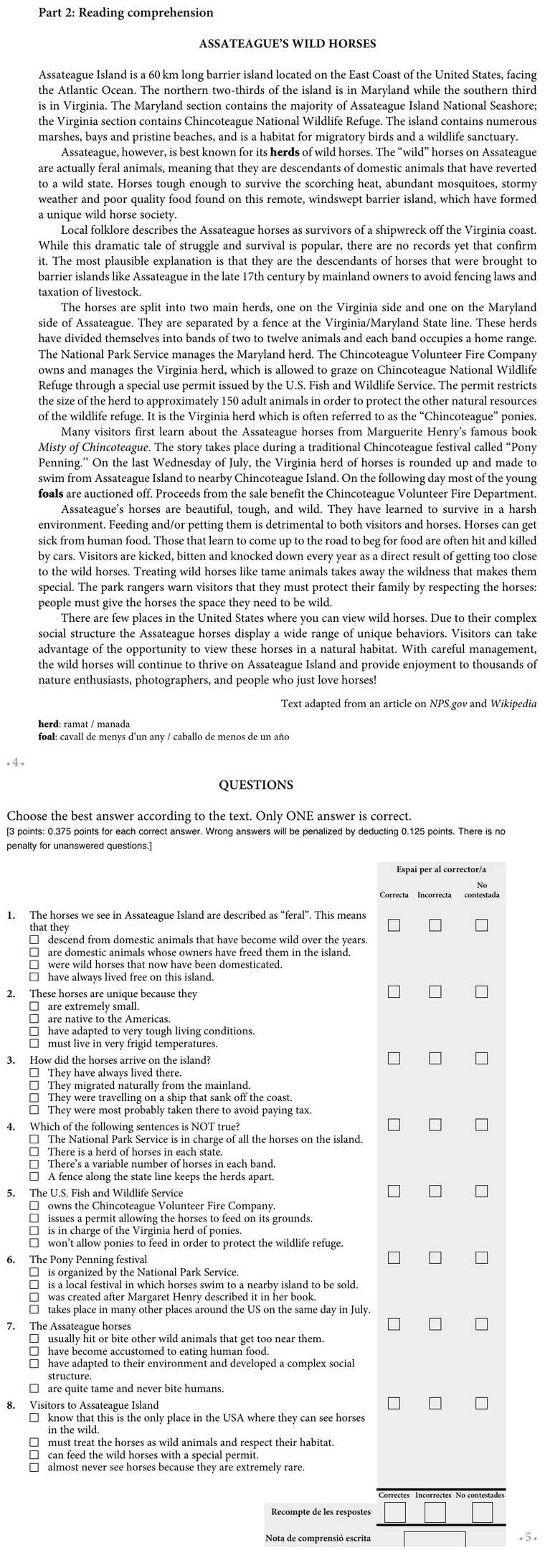
Assateague Island is a 60 km long barrier island located on the East Coast of the United States, facing the Atlantic Ocean. The northern two-thirds of the island is in Maryland while the southern third is in Virginia. The Maryland section contains the majority of Assateague Island National Seashore; the Virginia section contains Chincoteague National Wildlife Refuge. The island contains numerous marshes, bays and pristine beaches, and is a habitat for migratory birds and a wildlife sanctuary. Assateague, however, is best known for its herds of wild horses. The “wild” horses on Assateague are actually feral animals, meaning that they are descendants of domestic animals that have reverted to a wild state. Horses tough enough to survive the scorching heat, abundant mosquitoes, stormy weather and poor quality food found on this remote, windswept barrier island, which have formed a unique wild horse society. Local folklore describes the Assateague horses as survivors of a shipwreck off the Virginia coast. While this dramatic tale of struggle and survival is popular, there are no records yet that confirm it. The most plausible explanation is that they are the descendants of horses that were brought to barrier islands like Assateague in the late 17th century by mainland owners to avoid fencing laws and taxation of livestock. The horses are split into two main herds, one on the Virginia side and one on the Maryland side of Assateague. They are separated by a fence at the Virginia/Maryland State line. These herds have divided themselves into bands of two to twelve animals and each band occupies a home range. The National Park Service manages the Maryland herd. The Chincoteague Volunteer Fire Company owns and manages the Virginia herd, which is allowed to graze on Chincoteague National Wildlife Refuge through a special use permit issued by the U.S. Fish and Wildlife Service. The permit restricts the size of the herd to approximately 150 adult animals in order to protect the other natural resources of the wildlife refuge. It is the Virginia herd which is often referred to as the “Chincoteague” ponies. Many visitors first learn about the Assateague horses from Marguerite Henry’s famous book Misty of Chincoteague. The story takes place during a traditional Chincoteague festival called “Pony Penning.’’ On the last Wednesday of July, the Virginia herd of horses is rounded up and made to swim from Assateague Island to nearby Chincoteague Island. On the following day most of the young foals are auctioned off. Proceeds from the sale benefit the Chincoteague Volunteer Fire Department. Assateague’s horses are beautiful, tough, and wild. They have learned to survive in a harsh environment. Feeding and/or petting them is detrimental to both visitors and horses. Horses can get sick from human food. Those that learn to come up to the road to beg for food are often hit and killed by cars. Visitors are kicked, bitten and knocked down every year as a direct result of getting too close to the wild horses. Treating wild horses like tame animals takes away the wildness that makes them special. The park rangers warn visitors that they must protect their family by respecting the horses: people must give the horses the space they need to be wild. There are few places in the United States where you can view wild horses. Due to their complex social structure the Assateague horses display a wide range of unique behaviors. Visitors can take advantage of the opportunity to view these horses in a natural habitat. With careful management, the wild horses will continue to thrive on Assateague Island and provide enjoyment to thousands of nature enthusiasts, photographers, and people who just love horses! Text adapted from an article on NPS.gov and Wikipedia herd: ramat / manada foal: cavall de menys d’un any / caballo de menos de un año
See the shared reading text and glossary in Part 2, question 1 (item 2.1).
The horses we see in Assateague Island are described as “feral”. This means
that they
descend from domestic animals that have become wild over the years.
are domestic animals whose owners have freed them in the island.
were wild horses that now have been domesticated.
have always lived free on this island.
These horses are unique because they
are extremely small.
are native to the Americas.
have adapted to very tough living conditions.
must live in very frigid temperatures.
How did the horses arrive on the island?
They have always lived there.
They migrated naturally from the mainland.
They were travelling on a ship that sank off the coast.
They were most probably taken there to avoid paying tax.
Which of the following sentences is NOT true?
The National Park Service is in charge of all the horses on the island.
There is a herd of horses in each state.
There’s a variable number of horses in each band.
A fence along the state line keeps the herds apart.
The U.S. Fish and Wildlife Service
owns the Chincoteague Volunteer Fire Company.
issues a permit allowing the horses to feed on its grounds.
is in charge of the Virginia herd of ponies.
won’t allow ponies to feed in order to protect the wildlife refuge.
The Pony Penning festival
is organized by the National Park Service.
is a local festival in which horses swim to a nearby island to be sold.
was created after Margaret Henry described it in her book.
takes place in many other places around the US on the same day in July.
The Assateague horses
usually hit or bite other wild animals that get too near them.
have become accustomed to eating human food.
have adapted to their environment and developed a complex social
structure.
are quite tame and never bite humans.
Visitors to Assateague Island
know that this is the only place in the USA where they can see horses
in the wild.
must treat the horses as wild animals and respect their habitat.
can feed the wild horses with a special permit.
almost never see horses because they are extremely rare.
Toca per ampliar- 0,375 pSeleccionar la resposta de la clau oficial: descend from domestic animals that have become wild over the years.Penalització: Resposta incorrecta: −0.125 punts; pregunta no contestada: sense penalització.
Toca per ampliar- 0,375 pSeleccionar la resposta de la clau oficial: have adapted to very tough living conditions.Penalització: Resposta incorrecta: −0.125 punts; pregunta no contestada: sense penalització.
Toca per ampliar- 0,375 pSeleccionar la resposta de la clau oficial: They were most probably taken there to avoid paying tax.Penalització: Resposta incorrecta: −0.125 punts; pregunta no contestada: sense penalització.
Toca per ampliar- 0,375 pSeleccionar la resposta de la clau oficial: The National Park Service is in charge of all the horses on the island.Penalització: Resposta incorrecta: −0.125 punts; pregunta no contestada: sense penalització.
Toca per ampliar- 0,375 pSeleccionar la resposta de la clau oficial: issues a permit allowing the horses to feed on its grounds.Penalització: Resposta incorrecta: −0.125 punts; pregunta no contestada: sense penalització.
Toca per ampliar- 0,375 pSeleccionar la resposta de la clau oficial: is a local festival in which horses swim to a nearby island to be sold.Penalització: Resposta incorrecta: −0.125 punts; pregunta no contestada: sense penalització.
Toca per ampliar- 0,375 pSeleccionar la resposta de la clau oficial: have adapted to their environment and developed a complex social structure.Penalització: Resposta incorrecta: −0.125 punts; pregunta no contestada: sense penalització.
Toca per ampliar- 0,375 pSeleccionar la resposta de la clau oficial: must treat the horses as wild animals and respect their habitat.Penalització: Resposta incorrecta: −0.125 punts; pregunta no contestada: sense penalització.
Exercici 3 · opció A
Writing
 Toca per ampliar
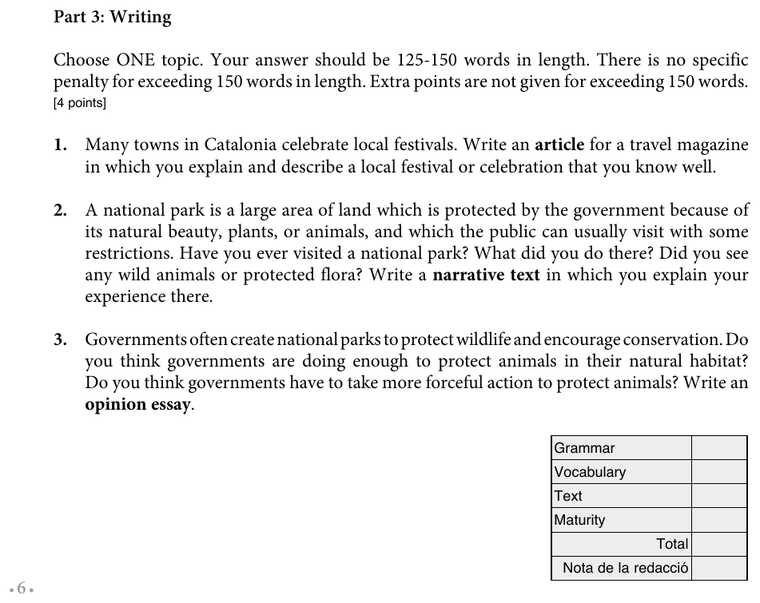
Choose ONE topic. Your answer should be 125-150 words in length. There is no specific penalty for exceeding 150 words in length. Extra points are not given for exceeding 150 words. [4 points]
Many towns in Catalonia celebrate local festivals. Write an article for a travel magazine in which you explain and describe a local festival or celebration that you know well.
Toca per ampliar- 4 pSense desglossament: valoració global de la redacció (4 punts). La graella oficial compartida per tots els temes inclou Grammar, Vocabulary, Text i Maturity, sense pesos per categoria, descriptors de banda ni deduccions per error als PDF aportats.
Exercici 3 · opció B
Writing
Toca per ampliarChoose ONE topic. Your answer should be 125-150 words in length. There is no specific penalty for exceeding 150 words in length. Extra points are not given for exceeding 150 words. [4 points]
A national park is a large area of land which is protected by the government because of its natural beauty, plants, or animals, and which the public can usually visit with some restrictions. Have you ever visited a national park? What did you do there? Did you see any wild animals or protected flora? Write a narrative text in which you explain your experience there.
Toca per ampliar- 4 pSense desglossament: valoració global de la redacció (4 punts). La graella oficial compartida per tots els temes inclou Grammar, Vocabulary, Text i Maturity, sense pesos per categoria, descriptors de banda ni deduccions per error als PDF aportats.
Exercici 3 · opció C
Writing
Toca per ampliarChoose ONE topic. Your answer should be 125-150 words in length. There is no specific penalty for exceeding 150 words in length. Extra points are not given for exceeding 150 words. [4 points]
Governments often create national parks to protect wildlife and encourage conservation. Do you think governments are doing enough to protect animals in their natural habitat? Do you think governments have to take more forceful action to protect animals? Write an opinion essay.
Toca per ampliar- 4 pSense desglossament: valoració global de la redacció (4 punts). La graella oficial compartida per tots els temes inclou Grammar, Vocabulary, Text i Maturity, sense pesos per categoria, descriptors de banda ni deduccions per error als PDF aportats.