Anglès
PAU 2022 · ordinària · sèrie 5
Examen oficial de la PAU de Catalunya amb la pauta de correcció. És d’una convocatòria anterior al model 2025: la pauta correspon a aquell examen.
Listening
PAU 2022 · ordinària · sèrie 5Instruccions de l’examen
Part 1: Listening comprehension
Choose the best answer according to the recording. Only ONE answer is correct. [3 points: 0.375 points for each correct answer. Wrong answers will be penalized by deducting 0.125 points. There is no penalty for unanswered questions.]
Part 2: Reading comprehension
Choose the best answer according to the text. Only ONE answer is correct. [3 points: 0.375 points for each correct answer. Wrong answers will be penalized by deducting 0.125 points. There is no penalty for unanswered questions.]
Part 3: Writing
Choose ONE topic. Your answer should be 125-150 words in length. There is no specific penalty for exceeding 150 words in length. Extra points are not given for exceeding 150 words. [4 points]
Exercici 1
Listening comprehension
 Toca per ampliar
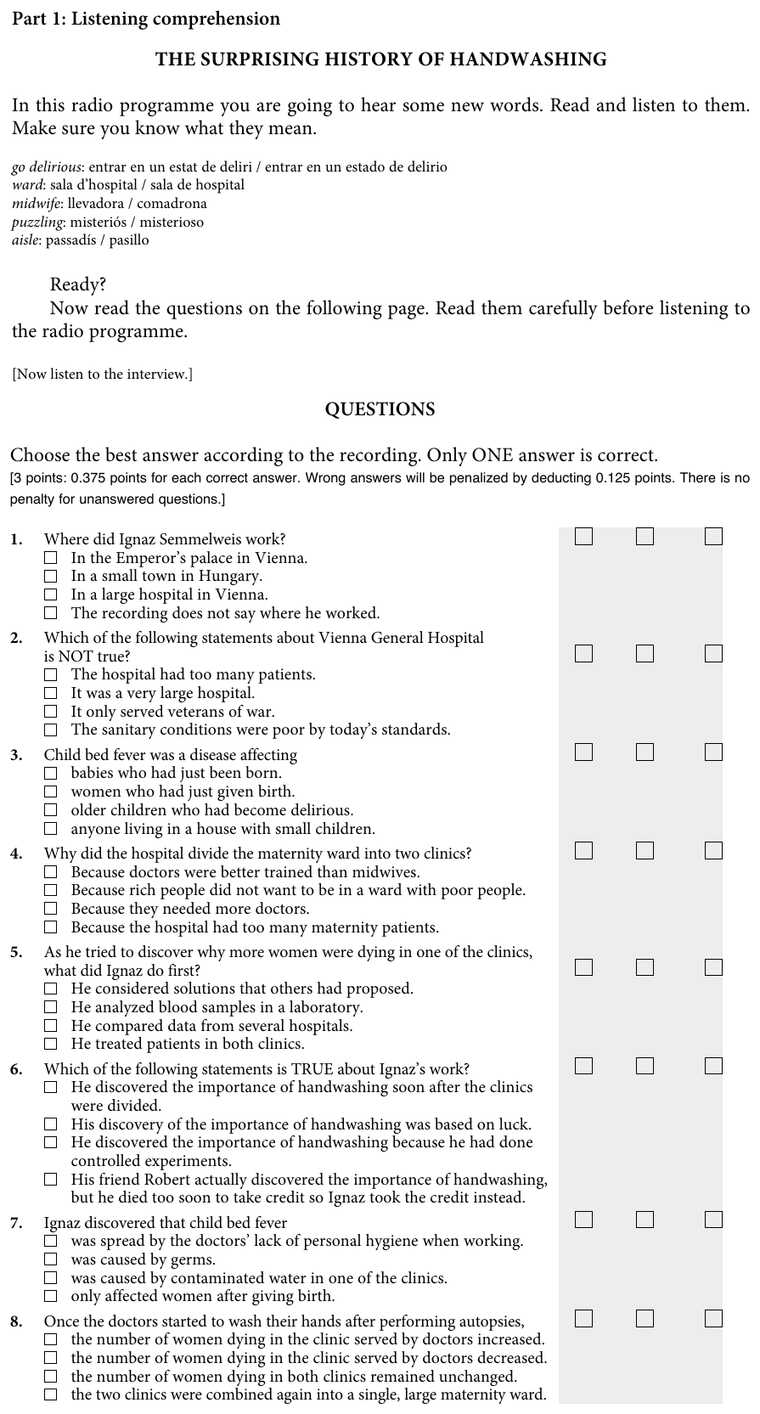
The Surprising History of Handwashing
In this radio programme you are going to hear some new words. Read and listen to them. Make sure you know what they mean.
go delirious: entrar en un estat de deliri / entrar en un estado de delirio
ward: sala d’hospital / sala de hospital
midwife: llevadora / comadrona
puzzling: misteriós / misterioso
aisle: passadís / pasillo
Ready? Now read the questions on the following page. Read them carefully before listening to the radio programme. [Now listen to the interview.]
Interviewer: We take it for granted now that washing our hands is a tool to fight disease. But somebody had to discover that, and most of the credit goes to a Hungarian doctor named Ignaz Semmelweis. How did he come to realize that handwashing was so important for our health? To answer that, we’ve invited Dr. Diana Tulane, a professor of the history of medicine at Purdue University in Indiana who has studied Ignaz Semmelweis, to our program.
Welcome and good morning, Prof. Tulane.
Prof. Tulane: Good morning, and thank you for inviting me.
Interviewer: My pleasure. How did you become interested in Ignaz? Is he famous?
Prof. Tulane: Actually, I was interested in medicine as practiced in the 19th century, and Ignaz Semmelweis became an important name in medicine from that period.
Interviewer: I’m assuming he had something to do with handwashing.
Prof. Tulane: Yes, that’s right. The history of handwashing is actually complicated, and it’s pretty amazing that someone discovered the importance of handwashing at a time when most people thought disease was caused by something like bad air.
Interviewer: How can the history of handwashing be complicated? It seems like a pretty basic thing to do.
Prof. Tulane: Now it seems basic, but that wasn’t always so. The story begins in 1844 in Vienna, Austria, where Ignaz worked in Vienna General hospital, which was the largest maternity hospital in the world. As you can imagine, hospitals at that time were very different from what we know today. They didn’t know about germs, and hospitals were so crowded that it wasn’t really that rare for there to be more than one patient in a single bed. Conditions for healing were very poor. Not surprisingly, the mortality rate in hospitals of the time was extremely high.
Interviewer: I can imagine.
Prof. Tulane: One disease that was particularly deadly at this time was child bed fever, which was responsible for the death of many, many women. Women would notice symptoms just a few days after giving birth. Child bed fever was a particularly dramatic disease because it occurred at a time when people were supposed to be very happy, as their child had just been born, but things could go very bad for the mother in a very short period of time. She would start screaming because of the pain and go delirious, and die a horrible death.
Interviewer: How terrible. What caused this disease?
Prof. Tulane: We know now that this disease is caused by a bacterial infection, but that wasn’t known at the time. Remember, they didn’t know about germs.
Interviewer: So what happened at the hospital in Vienna?
Prof. Tulane: The conditions at Vienna General hospital were so crowded that they had to divide the maternity ward into two clinics, one that was served by doctors, and the other that was served by midwives. Soon it became apparent that many more women were getting child bed fever and dying in the doctors’ clinic than in the midwives’ clinic. This was very puzzling to everyone, because doctors had more training than midwives, so everyone expected that doctors would be able to provide better care. No one understood why more women in the doctors’ clinic were dying.
Interviewer: I bet it was Ignaz who solved the puzzle. And how did he do it?
Prof. Tulane: Well, first he analyzed some of the explanations that people had already suggested. Many people thought that child bed fever was caused by overcrowded conditions, but he knew that that could not be the only factor because both the clinic served by doctors and the one served by midwives were equally crowded, so there was no difference there that would explain the difference in mortality. But he did observe some other differences between the two clinics.
Interviewer: Really? How did he do this?
Prof. Tulane: He did what any good scientist would do: he set up controlled experiments. He had the women in one clinic give birth while lying on their sides, while
those in the other clinic gave birth while lying on their backs. He then switched the positions for each group, but this had no effect. More of the doctors’ patients were still dying. Then, he noticed that in the doctors’ clinic, a priest was walking down the aisles ringing a bell. He thought that maybe psychological terror played a role because the women in the doctors’ clinic knew that they were dying once they saw the priest and heard the bell, but that he couldn’t proof that, either.
Interviewer: It sounds like this process took a long time.
Prof. Tulane: Oh yes, it took him several years. Then, in 1847, his best friend Robert, a doctor, was accidentally cut while doing an autopsy and died soon afterwards. Ignaz noticed that his dying friend shared a lot of characteristics with the women dying from child bed fever, so he hypothesized that they all had the same disease, and it obviously wasn’t only related to giving birth. He then observed that the doctors would do autopsies and afterward go directly to the maternity ward to deliver babies. He realized that the disease might be caused by the contact with dead bodies.
Interviewer: So, in effect, the doctors were spreading the disease from cadavers to mothers who had just given birth.
Prof. Tulane: Exactly. To test his hypothesis, Ignaz had the doctors wash their hands with a disinfectant after they performed an autopsy and before they entered the maternity ward. Once the doctors started doing this, the mortality rate of women in their clinic decreased to the same level as that in the midwives’ clinic.
Interviewer: So, did Ignaz become a hero? It sounds like he saved a lot of women’s lives.
Prof. Tulane: Well, yes and no. At first, the medical community was skeptical. Most of the doctors agreed to his idea of handwashing, but Ignaz was not an easy person to work with. For example, he insisted that all cases of child bed fever were caused by contamination from autopsies, even when that really wasn’t possible. In the end, he was taken to a psychiatric hospital and died alone.
Interviewer: How sad! But his realization that handwashing could prevent the spread of disease turned out to be very important.
Prof. Tulane: Yes. At about the same time as his death, scientists discovered that germs cause disease, and that would not have happened without the work of people like Ignaz Semmelweis.
Interviewer: That’s all we have time for today. Thank you, Dr. Tulane, for this very interesting history of handwashing.
Prof. Tulane. Thank you.
Text adapted from the program “The Surprise History of Handwashing” on National Public Radio, January 26, 2021.
See the official listening transcript in Part 1, question 1 (item 1.1).
Where did Ignaz Semmelweis work?
In the Emperor’s palace in Vienna.
In a small town in Hungary.
In a large hospital in Vienna.
The recording does not say where he worked.
Which of the following statements about Vienna General Hospital
is NOT true?
The hospital had too many patients.
It was a very large hospital.
It only served veterans of war.
The sanitary conditions were poor by today’s standards.
Child bed fever was a disease affecting
babies who had just been born.
women who had just given birth.
older children who had become delirious.
anyone living in a house with small children.
Why did the hospital divide the maternity ward into two clinics?
Because doctors were better trained than midwives.
Because rich people did not want to be in a ward with poor people.
Because they needed more doctors.
Because the hospital had too many maternity patients.
As he tried to discover why more women were dying in one of the clinics,
what did Ignaz do first?
He considered solutions that others had proposed.
He analyzed blood samples in a laboratory.
He compared data from several hospitals.
He treated patients in both clinics.
Which of the following statements is TRUE about Ignaz’s work?
He discovered the importance of handwashing soon after the clinics
were divided.
His discovery of the importance of handwashing was based on luck.
He discovered the importance of handwashing because he had done
controlled experiments.
His friend Robert actually discovered the importance of handwashing,
but he died too soon to take credit so Ignaz took the credit instead.
Ignaz discovered that child bed fever
was spread by the doctors’ lack of personal hygiene when working.
was caused by germs.
was caused by contaminated water in one of the clinics.
only affected women after giving birth.
Once the doctors started to wash their hands after performing autopsies,
the number of women dying in the clinic served by doctors increased.
the number of women dying in the clinic served by doctors decreased.
the number of women dying in both clinics remained unchanged.
the two clinics were combined again into a single, large maternity ward.
 Toca per ampliar
- 0,375 pSeleccionar la resposta de la clau oficial: In a large hospital in Vienna.Penalització: Resposta incorrecta: −0.125 punts; pregunta no contestada: sense penalització.
Toca per ampliar- 0,375 pSeleccionar la resposta de la clau oficial: It only served veterans of war.Penalització: Resposta incorrecta: −0.125 punts; pregunta no contestada: sense penalització.
Toca per ampliar- 0,375 pSeleccionar la resposta de la clau oficial: women who had just given birth.Penalització: Resposta incorrecta: −0.125 punts; pregunta no contestada: sense penalització.
Toca per ampliar- 0,375 pSeleccionar la resposta de la clau oficial: Because the hospital had too many maternity patients.Penalització: Resposta incorrecta: −0.125 punts; pregunta no contestada: sense penalització.
Toca per ampliar- 0,375 pSeleccionar la resposta de la clau oficial: He considered solutions that others had proposed.Penalització: Resposta incorrecta: −0.125 punts; pregunta no contestada: sense penalització.
Toca per ampliar- 0,375 pSeleccionar la resposta de la clau oficial: He discovered the importance of handwashing because he had done controlled experiments.Penalització: Resposta incorrecta: −0.125 punts; pregunta no contestada: sense penalització.
Toca per ampliar- 0,375 pSeleccionar la resposta de la clau oficial: was spread by the doctors’ lack of personal hygiene when working.Penalització: Resposta incorrecta: −0.125 punts; pregunta no contestada: sense penalització.
Toca per ampliar- 0,375 pSeleccionar la resposta de la clau oficial: the number of women dying in the clinic served by doctors decreased.Penalització: Resposta incorrecta: −0.125 punts; pregunta no contestada: sense penalització.
Exercici 2
Reading comprehension
 Toca per ampliar
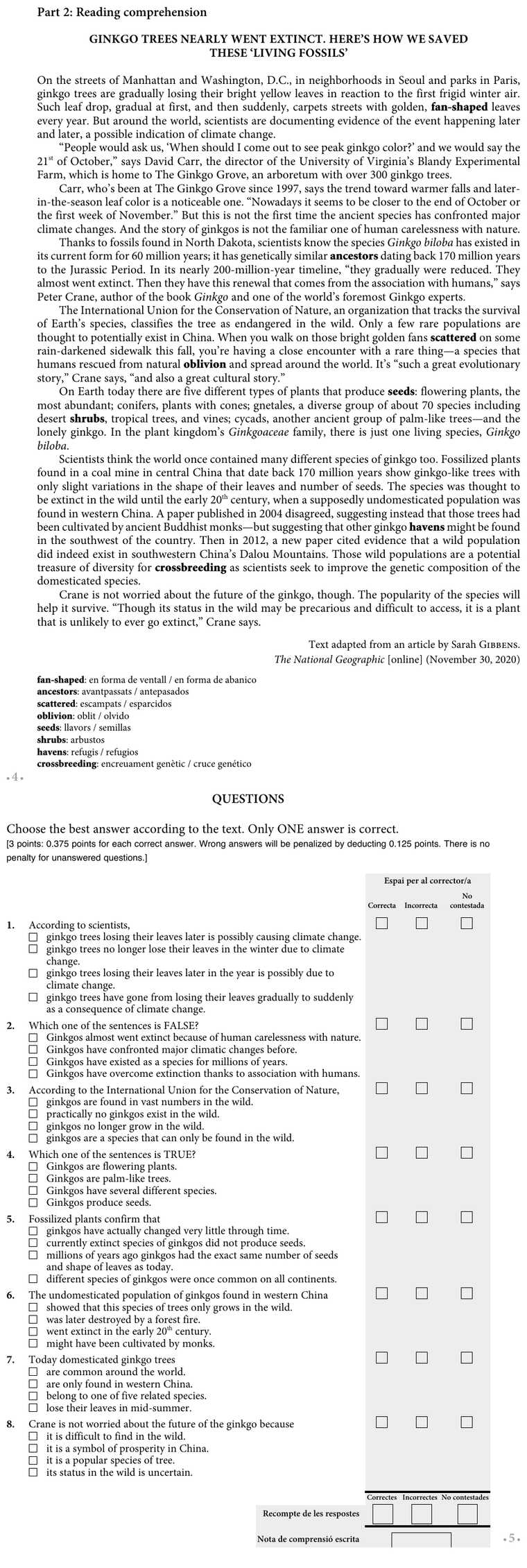
GINKGO TREES NEARLY WENT EXTINCT. HERE’S HOW WE SAVED THESE ‘LIVING FOSSILS’
On the streets of Manhattan and Washington, D.C., in neighborhoods in Seoul and parks in Paris, ginkgo trees are gradually losing their bright yellow leaves in reaction to the first frigid winter air. Such leaf drop, gradual at first, and then suddenly, carpets streets with golden, fan-shaped leaves every year. But around the world, scientists are documenting evidence of the event happening later and later, a possible indication of climate change. “People would ask us, ‘When should I come out to see peak ginkgo color?’ and we would say the 21st of October,” says David Carr, the director of the University of Virginia’s Blandy Experimental Farm, which is home to The Ginkgo Grove, an arboretum with over 300 ginkgo trees. Carr, who’s been at The Ginkgo Grove since 1997, says the trend toward warmer falls and later-in-the-season leaf color is a noticeable one. “Nowadays it seems to be closer to the end of October or the first week of November.” But this is not the first time the ancient species has confronted major climate changes. And the story of ginkgos is not the familiar one of human carelessness with nature. Thanks to fossils found in North Dakota, scientists know the species Ginkgo biloba has existed in its current form for 60 million years; it has genetically similar ancestors dating back 170 million years to the Jurassic Period. In its nearly 200-million-year timeline, “they gradually were reduced. They almost went extinct. Then they have this renewal that comes from the association with humans,” says Peter Crane, author of the book Ginkgo and one of the world’s foremost Ginkgo experts. The International Union for the Conservation of Nature, an organization that tracks the survival of Earth’s species, classifies the tree as endangered in the wild. Only a few rare populations are thought to potentially exist in China. When you walk on those bright golden fans scattered on some rain-darkened sidewalk this fall, you’re having a close encounter with a rare thing—a species that humans rescued from natural oblivion and spread around the world. It’s “such a great evolutionary story,” Crane says, “and also a great cultural story.” On Earth today there are five different types of plants that produce seeds: flowering plants, the most abundant; conifers, plants with cones; gnetales, a diverse group of about 70 species including desert shrubs, tropical trees, and vines; cycads, another ancient group of palm-like trees—and the lonely ginkgo. In the plant kingdom’s Ginkgoaceae family, there is just one living species, Ginkgo biloba. Scientists think the world once contained many different species of ginkgo too. Fossilized plants found in a coal mine in central China that date back 170 million years show ginkgo-like trees with only slight variations in the shape of their leaves and number of seeds. The species was thought to be extinct in the wild until the early 20th century, when a supposedly undomesticated population was found in western China. A paper published in 2004 disagreed, suggesting instead that those trees had been cultivated by ancient Buddhist monks—but suggesting that other ginkgo havens might be found in the southwest of the country. Then in 2012, a new paper cited evidence that a wild population did indeed exist in southwestern China’s Dalou Mountains. Those wild populations are a potential treasure of diversity for crossbreeding as scientists seek to improve the genetic composition of the domesticated species. Crane is not worried about the future of the ginkgo, though. The popularity of the species will help it survive. “Though its status in the wild may be precarious and difficult to access, it is a plant that is unlikely to ever go extinct,” Crane says. Text adapted from an article by Sarah Gibbens. The National Geographic [online] (November 30, 2020) fan-shaped: en forma de ventall / en forma de abanico ancestors: avantpassats / antepasados scattered: escampats / esparcidos oblivion: oblit / olvido seeds: llavors / semillas shrubs: arbustos havens: refugis / refugios crossbreeding: encreuament genètic / cruce genético
See the shared reading text and glossary in Part 2, question 1 (item 2.1).
According to scientists,
ginkgo trees losing their leaves later is possibly causing climate change.
ginkgo trees no longer lose their leaves in the winter due to climate
change.
ginkgo trees losing their leaves later in the year is possibly due to
climate change.
ginkgo trees have gone from losing their leaves gradually to suddenly
as a consequence of climate change.
Which one of the sentences is FALSE?
Ginkgos almost went extinct because of human carelessness with nature.
Ginkgos have confronted major climatic changes before.
Ginkgos have existed as a species for millions of years.
Ginkgos have overcome extinction thanks to association with humans.
According to the International Union for the Conservation of Nature,
ginkgos are found in vast numbers in the wild.
practically no ginkgos exist in the wild.
ginkgos no longer grow in the wild.
ginkgos are a species that can only be found in the wild.
Which one of the sentences is TRUE?
Ginkgos are flowering plants.
Ginkgos are palm-like trees.
Ginkgos have several different species.
Ginkgos produce seeds.
Fossilized plants confirm that
ginkgos have actually changed very little through time.
currently extinct species of ginkgos did not produce seeds.
millions of years ago ginkgos had the exact same number of seeds
and shape of leaves as today.
different species of ginkgos were once common on all continents.
The undomesticated population of ginkgos found in western China
showed that this species of trees only grows in the wild.
was later destroyed by a forest fire.
went extinct in the early 20th century.
might have been cultivated by monks.
Today domesticated ginkgo trees
are common around the world.
are only found in western China.
belong to one of five related species.
lose their leaves in mid-summer.
Crane is not worried about the future of the ginkgo because
it is difficult to find in the wild.
it is a symbol of prosperity in China.
it is a popular species of tree.
its status in the wild is uncertain.
Toca per ampliar- 0,375 pSeleccionar la resposta de la clau oficial: ginkgo trees losing their leaves later in the year is possibly due to climate change.Penalització: Resposta incorrecta: −0.125 punts; pregunta no contestada: sense penalització.
Toca per ampliar- 0,375 pSeleccionar la resposta de la clau oficial: ginkgos almost went extinct because of human carelessness with nature.Penalització: Resposta incorrecta: −0.125 punts; pregunta no contestada: sense penalització.
Toca per ampliar- 0,375 pSeleccionar la resposta de la clau oficial: practically no ginkgos exist in the wild.Penalització: Resposta incorrecta: −0.125 punts; pregunta no contestada: sense penalització.
Toca per ampliar- 0,375 pSeleccionar la resposta de la clau oficial: ginkgos produce seeds.Penalització: Resposta incorrecta: −0.125 punts; pregunta no contestada: sense penalització.
Toca per ampliar- 0,375 pSeleccionar la resposta de la clau oficial: ginkgos have actually changed very little through time.Penalització: Resposta incorrecta: −0.125 punts; pregunta no contestada: sense penalització.
Toca per ampliar- 0,375 pSeleccionar la resposta de la clau oficial: might have been cultivated by monks.Penalització: Resposta incorrecta: −0.125 punts; pregunta no contestada: sense penalització.
Toca per ampliar- 0,375 pSeleccionar la resposta de la clau oficial: are common around the world.Penalització: Resposta incorrecta: −0.125 punts; pregunta no contestada: sense penalització.
Toca per ampliar- 0,375 pSeleccionar la resposta de la clau oficial: it is a popular species of tree.Penalització: Resposta incorrecta: −0.125 punts; pregunta no contestada: sense penalització.
Exercici 3 · opció A
Writing
 Toca per ampliar
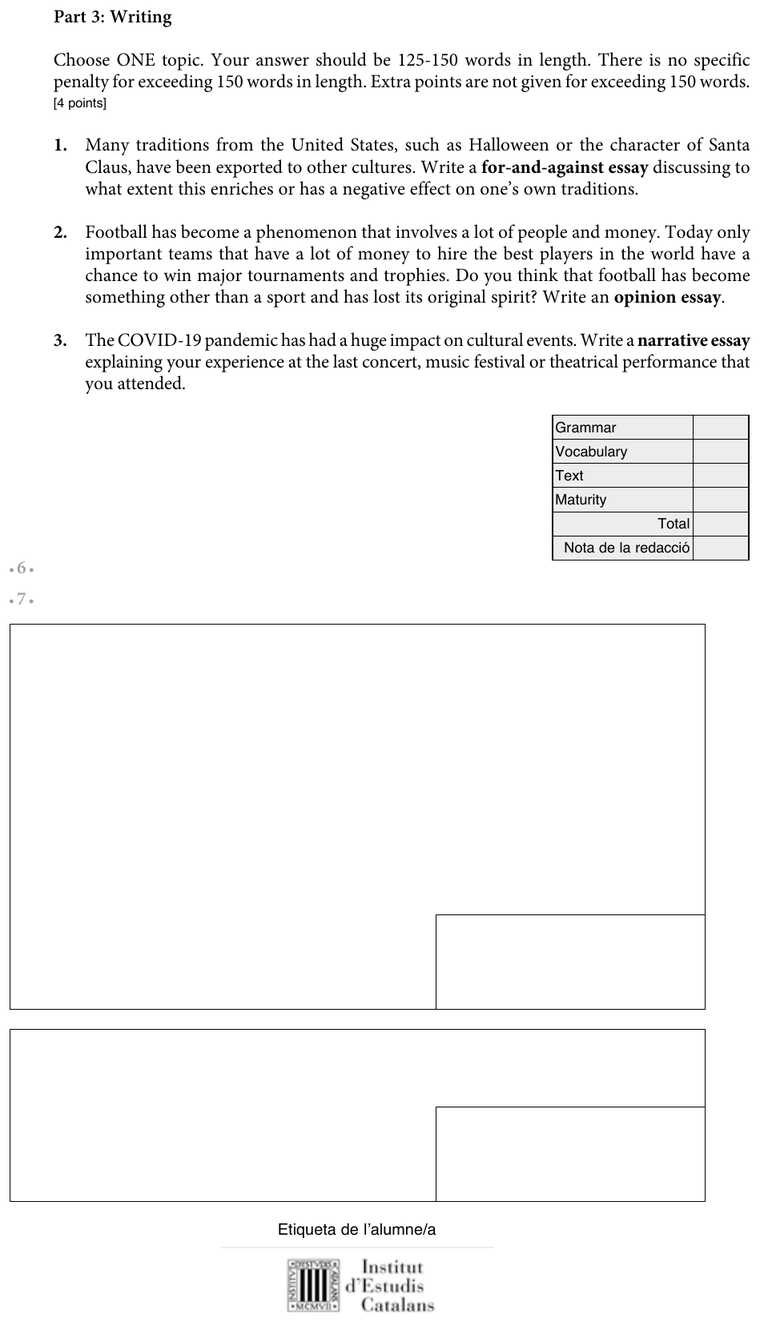
Choose ONE topic. Your answer should be 125-150 words in length. There is no specific penalty for exceeding 150 words in length. Extra points are not given for exceeding 150 words. [4 points]
Many traditions from the United States, such as Halloween or the character of Santa Claus, have been exported to other cultures. Write a for-and-against essay discussing to what extent this enriches or has a negative effect on one’s own traditions.
Toca per ampliar- 4 pSense desglossament: valoració global de la redacció (4 punts). La graella oficial compartida per tots els temes inclou Grammar, Vocabulary, Text i Maturity, sense pesos per categoria, descriptors de banda ni deduccions per error als PDF aportats.
Exercici 3 · opció B
Writing
Toca per ampliarChoose ONE topic. Your answer should be 125-150 words in length. There is no specific penalty for exceeding 150 words in length. Extra points are not given for exceeding 150 words. [4 points]
Football has become a phenomenon that involves a lot of people and money. Today only important teams that have a lot of money to hire the best players in the world have a chance to win major tournaments and trophies. Do you think that football has become something other than a sport and has lost its original spirit? Write an opinion essay.
Toca per ampliar- 4 pSense desglossament: valoració global de la redacció (4 punts). La graella oficial compartida per tots els temes inclou Grammar, Vocabulary, Text i Maturity, sense pesos per categoria, descriptors de banda ni deduccions per error als PDF aportats.
Exercici 3 · opció C
Writing
Toca per ampliarChoose ONE topic. Your answer should be 125-150 words in length. There is no specific penalty for exceeding 150 words in length. Extra points are not given for exceeding 150 words. [4 points]
The COVID-19 pandemic has had a huge impact on cultural events. Write a narrative essay explaining your experience at the last concert, music festival or theatrical performance that you attended.
Toca per ampliar- 4 pSense desglossament: valoració global de la redacció (4 punts). La graella oficial compartida per tots els temes inclou Grammar, Vocabulary, Text i Maturity, sense pesos per categoria, descriptors de banda ni deduccions per error als PDF aportats.