Anglès
PAU 2023 · extraordinària · sèrie 2
Examen oficial de la PAU de Catalunya amb la resolució pas a pas de cada apartat i la pauta de correcció. És d’una convocatòria anterior al model 2025: la pauta correspon a aquell examen.
Listening
PAU 2023 · extraordinària · sèrie 2Instruccions de l’examen
Part 1: Listening comprehension
Choose the best answer according to the recording. Only ONE answer is correct. [3 points: 0.375 points for each correct answer. Wrong answers will be penalized by deducting 0.125 points. There is no penalty for unanswered questions.]
Part 2: Reading comprehension
Choose the best answer according to the text. Only ONE answer is correct. [3 points: 0.375 points for each correct answer. Wrong answers will be penalized by deducting 0.125 points. There is no penalty for unanswered questions.]
Part 3: Writing
Choose ONE topic. Your answer should be 125-150 words in length. There is no specific penalty for exceeding 150 words in length. Extra points are not given for exceeding 150 words. [4 points]
Exercici 1
Listening comprehension
 Toca per ampliar
Juanita. The Inca mummy
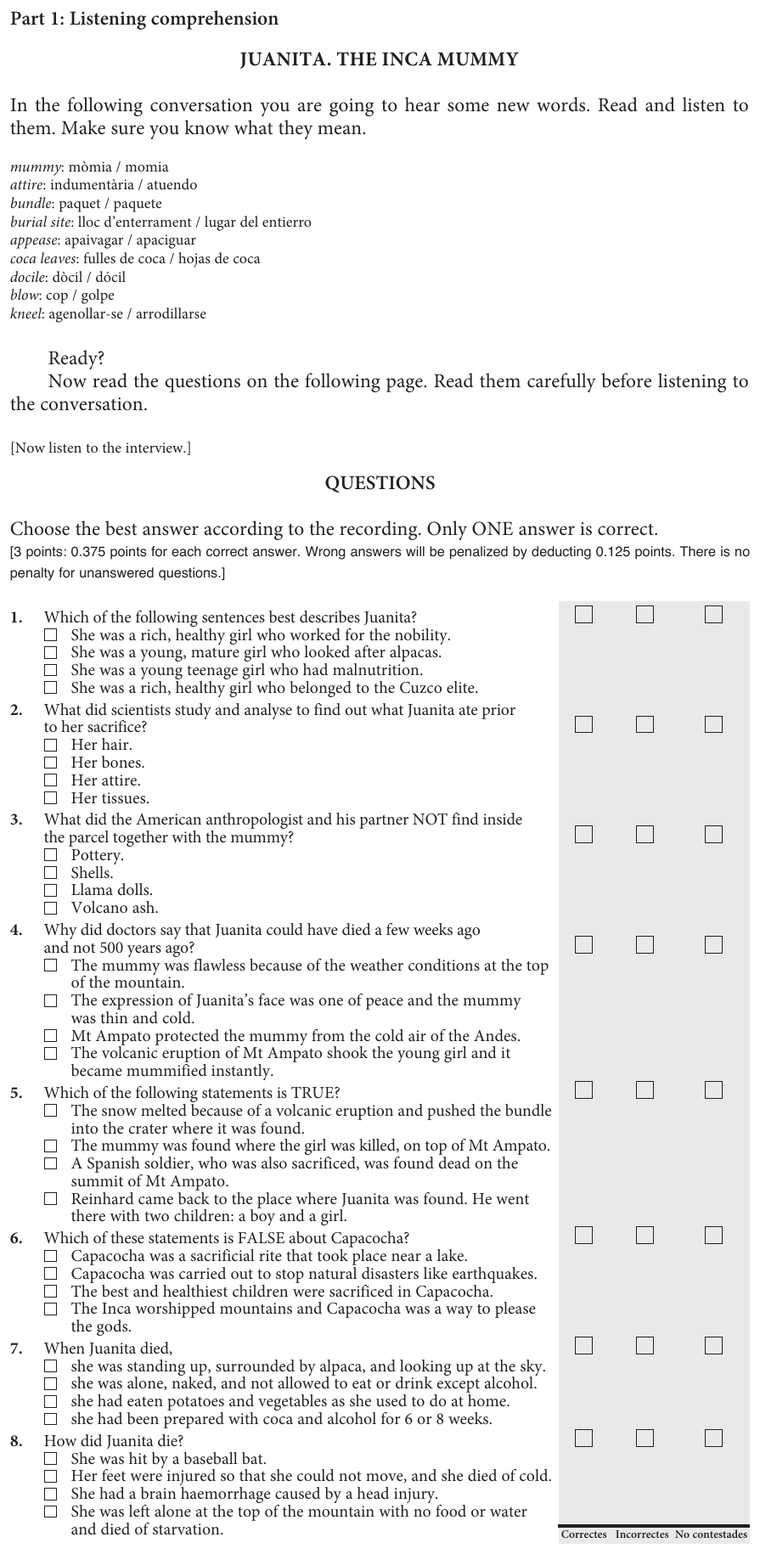
In the following conversation you are going to hear some new words. Read and listen to them. Make sure you know what they mean.
Mummy: mòmia, momia
Attire: indumentària, atuendo
Bundle: paquet, paquete
Burial site: lloc d’enterrament, lugar del entierro
Appease: Apaivagar, apaciguar
Coca leaves: fulles de coca, hojas de coca
Docile: dòcil, dócil
Blow: cop, golpe
Kneel: agenollar-se, arrodillarse
Ready?
Now read the questions on the following page. Read them carefully before listening to the conversation.
INTERVIEWER: Popularly known as Mummy Juanita, the finding of a young Inca girl sacrificed more than 600 years ago made headlines. Dr Chris Van Gils, a specialist in the Inca Culture, is with us today to tell us more about this famous mummy. Good morning, Dr Van Gils. First of all, why is this discovery so significant?
CHRIS: Well, analysing her internal organs, hair, skin, and blood provided scientists a glimpse into the cultural and societal practices of the Incas of the time. It is not the mummy itself, but what we can learn from it.
INTERVIEWER: I see. But let’s start by the beginning. Who was Juanita?
CHRIS: Juanita was a young girl. She was probably between 12 to 14 years old. She seemed to be in excellent health. Biopsies of bone, muscle and other tissues confirmed that the girl had enjoyed good nutrition and had healthy, mature
bones. The mummy was found wearing clothes resembling those of Cusco’s elite, of the nobility. Specialists in textiles were especially impressed with the fine alpaca wool of the girl's garments. She wore a boldly striped dress, encircled by a belt, and her shawl was fastened with a silver pin. Her attire was similar to that of the female statuettes buried with her.
INTERVIEWER: Are you suggesting that Juanita was no ordinary girl?
CHRIS: Probably not. Her attire, along with the geographical location of the sacrifice, suggests to archaeologists that the young girl was part of Cusco’s nobility. Furthermore, by analysing her hair, scientists were able to determine that she ate maize and animal meat prior to the sacrifice, both of which were part of the diet of the elite.
INTERVIEWER: Interesting. Tell us a bit about the discovery. She was found near Arequipa in Peru, right?
CHRIS: Exactly. In September 1995, American anthropologist Johan Reinhard climbed the volcano Mount Ampato in Arequipa located at about 6,300 meters above sea level. He, along with his Peruvian climbing partner Miguel Zárate, came across a bundle inside a crater, most likely fallen from an Inca burial site at the summit. The two men took the frozen bundle to the Catholic University of Santa Maria in Arequipa. It weighed about 40 kilos and included the mummy and numerous burial items including pottery, shells, and small llama figures. The body of the sacrificed girl was given the name Juanita, and is also known as the Lady of Ampato and the Inca Ice Maiden.
INTERVIEWER: So, after her death, sometime between 1450 and 1480, Juanita would sit alone in the mountains until she was uncovered by these two men.
CHRIS: That’s it. The thin, cold air near the summit of Mt. Ampato left the mummy incredibly intact. Reinhard once said in an interview that the doctors had been shaking their heads and saying Juanita sure doesn’t look 500 years old but could have died a few weeks ago.
INTERVIEWER: Amazing. But the fact that it was discovered is also surprising.
CHRIS: If it weren’t for volcanic activity, it’s possible that the mummified young girl would have continued to sit in on the frozen mountain top for centuries to come. But because of the volcanic activity warming the snow, Mt. Ampato’s snow-cap began to melt, pushing the wrapped mummy and her burial site down the mountain.
INTERVIEWER: And was this the only mummy found in the area?
CHRIS: No. In fact, Reinhard returned to the mountain a month later and found two more mummified children, this time a boy and girl. It is believed these may
have been companion sacrifices to the more important sacrifice of Juanita. This is corroborated by a Spanish soldier who witnessed similar sacrifices in 1551 and wrote about them.
INTERVIEWER: OK. So, tell us about these sacrifices.
CHRIS: These sacrifices among the Inca that involved the deaths of children were known as Capacocha. Capacocha can be translated as “royal obligation” and it was the Inca’s attempt at ensuring that the best and healthiest among them were sacrificed to appease the gods, often as a way to stop a natural disaster like an earthquake, or simply to ensure a healthy harvest. This sacrificial rite was also performed to celebrate events such as battle victories, or the death or birth of Inca royalty. Considering that Juanita’s body was discovered atop Ampato, a volcano in the Andes, her sacrifice very likely played into the Inca’s Mountain worship.
INTERVIEWER: What did scientists discover about her death? How did she die?
CHRIS: Well, you can imagine a girl with long black hair and a graceful neck, dressed in fine alpaca wool, knelt on a cold, windswept summit in the Andes. She was in the presence of Inca priests and surrounded by offerings of pottery, coca leaves and golden figurines.
INTERVIEWER: I visualize one of the sacrifices we have watched in an Indiana Jones’ movie.
CHRIS: Sort of. In fact, experts say that Juanita was probably docile.
INTERVIWER: Did she want to die? Did she not fight?
CHRIS: Juanita’s days leading up to her death were very different than the lifestyle of a typical Inca girl. Scientists know what she ate before she died. Markers in her hair indicate that she was selected for sacrifice about a year before her actual death. She had switched from a standard Inca diet of potatoes and vegetables to the more elite foods of animal protein and maize, along with large quantities of coca and alcohol. The final six to eight weeks of life for Inca child sacrifices was one of a very intoxicated psychological state altered by the chemical reaction of coca and alcohol. Archaeologists believe that when she died, she was likely in a very relaxed state.
INTERVIEWER: In other words, she was drugged before she died.
CHRIS: That’s right. Radiologist Elliot Fishman discovered that Juanita’s death was brought about by a massive haemorrhage from a blow to the head. Her injuries were “typical of someone who has been hit by a baseball bat.” After the death blow, her skull swelled with blood, pushing her brain to the side. Dr Fishman said the girl probably never regained consciousness, but might have
lived several hours before dying. Observations of the position of the feet indicate that the girl was probably kneeling when struck, he said, and the posture suggested that her head was bent forward at the time.
INTERVIEWER: One last question, Dr Van Gils. Was this ritual frequent? Juanita wasn’t the only child sacrificed, was she?
CHRIS: All in all, experts estimate that there may be hundreds of Inca children mummified in the mountain peaks of the Andes still waiting to be discovered.
INTERVIEWER: Dr Van Gils, thank you for joining us today.
Adapted from https://allthatsinteresting.com/mummy-juanita-lady-of-ampato , https://www.pbs.org/wgbh/nova/article/ice-mummies-inca/ ,https://www.nytimes.com/1996/05/22/us/mummy-tells-story-of-a-sacrifice-scientists-say.html.
See the official listening transcript in Part 1, question 1 (item 1.1).
Which of the following sentences best describes Juanita?
She was a rich, healthy girl who worked for the nobility.
She was a young, mature girl who looked after alpacas.
She was a young teenage girl who had malnutrition.
She was a rich, healthy girl who belonged to the Cuzco elite.
What did scientists study and analyse to find out what Juanita ate prior
to her sacrifice?
Her hair.
Her bones.
Her attire.
Her tissues.
What did the American anthropologist and his partner NOT find inside
the parcel together with the mummy?
Pottery.
Shells.
Llama dolls.
Volcano ash.
Why did doctors say that Juanita could have died a few weeks ago
and not 500 years ago?
The mummy was flawless because of the weather conditions at the top
of the mountain.
The expression of Juanita’s face was one of peace and the mummy
was thin and cold.
Mt Ampato protected the mummy from the cold air of the Andes.
The volcanic eruption of Mt Ampato shook the young girl and it
became mummified instantly.
Which of the following statements is TRUE?
The snow melted because of a volcanic eruption and pushed the bundle
into the crater where it was found.
The mummy was found where the girl was killed, on top of Mt Ampato.
A Spanish soldier, who was also sacrificed, was found dead on the
summit of Mt Ampato.
Reinhard came back to the place where Juanita was found. He went
there with two children: a boy and a girl.
Which of these statements is FALSE about Capacocha?
Capacocha was a sacrificial rite that took place near a lake.
Capacocha was carried out to stop natural disasters like earthquakes.
The best and healthiest children were sacrificed in Capacocha.
The Inca worshipped mountains and Capacocha was a way to please
the gods.
When Juanita died,
she was standing up, surrounded by alpaca, and looking up at the sky.
she was alone, naked, and not allowed to eat or drink except alcohol.
she had eaten potatoes and vegetables as she used to do at home.
she had been prepared with coca and alcohol for 6 or 8 weeks.
How did Juanita die?
She was hit by a baseball bat.
Her feet were injured so that she could not move, and she died of cold.
She had a brain haemorrhage caused by a head injury.
She was left alone at the top of the mountain with no food or water
and died of starvation.
Per descriure la Juanita, combina les pistes sobre la seva salut amb les que indiquen la seva posició social.
Les biòpsies indiquen que estava ben alimentada. La roba de llana fina i el lloc del sacrifici fan pensar que pertanyia a la noblesa de Cusco.
She was a rich, healthy girl who belonged to the Cuzco elite.
+0,375criteri 1 de la pauta
 Toca per ampliar
- 0,375 pSeleccionar la resposta de la clau oficial: She was a rich, healthy girl who belonged to the Cuzco elite.Penalització: Resposta incorrecta: −0.125 punts; pregunta no contestada: sense penalització.
Identifica quina mostra van analitzar per saber què menjava abans del sacrifici.
L’entrevista relaciona l’anàlisi dels cabells amb la presència de blat de moro i carn en la dieta. Les biòpsies d’ossos i altres teixits els van servir per valorar la salut i la nutrició generals.
Her hair
+0,375criteri 1 de la pauta
Toca per ampliar- 0,375 pSeleccionar la resposta de la clau oficial: Her hairPenalització: Resposta incorrecta: −0.125 punts; pregunta no contestada: sense penalització.
La paraula NOT et demana que marquis l’objecte que queda fora de la llista.
Al farcell hi havia peces de ceràmica (*pottery*), petxines (*shells*) i figuretes de llama (*small llama figures*). L’opció que queda és la cendra volcànica.
Volcano ash
+0,375criteri 1 de la pauta
Toca per ampliar- 0,375 pSeleccionar la resposta de la clau oficial: Volcano ashPenalització: Resposta incorrecta: −0.125 punts; pregunta no contestada: sense penalització.
Relaciona l’aspecte de la mòmia amb les condicions que l’havien conservada.
L’aire fred i poc dens del cim de l’Ampato va mantenir la mòmia gairebé intacta. Per això als metges els va semblar que la mort podia ser recent.
The mummy was flawless because of the weather conditions at the top of the mountain.
+0,375criteri 1 de la pauta
Toca per ampliar- 0,375 pSeleccionar la resposta de la clau oficial: The mummy was flawless because of the weather conditions at the top of the mountain.Penalització: Resposta incorrecta: −0.125 punts; pregunta no contestada: sense penalització.
Segueix el recorregut del farcell des del lloc d’enterrament fins al punt de la troballa.
L’activitat volcànica va escalfar i fondre la neu, i el farcell es va desplaçar muntanya avall. Reinhard i Zárate el van trobar dins d’un cràter. Segons l’entrevista, probablement havia caigut des del lloc d’enterrament, al cim.
The snow melted because of a volcanic eruption and pushed the bundle into the crater where it was found.
+0,375criteri 1 de la pauta
Toca per ampliar- 0,375 pSeleccionar la resposta de la clau oficial: The snow melted because of a volcanic eruption and pushed the bundle into the crater where it was found.Penalització: Resposta incorrecta: −0.125 punts; pregunta no contestada: sense penalització.
Busca l’afirmació falsa sobre on es feia el ritual o quin propòsit tenia.
L’entrevista explica que se sacrificaven infants sans per apaivagar els déus i intentar evitar desastres com els terratrèmols. El cas de la Juanita es vincula al culte a les muntanyes dels Andes. El llac només apareix entre les opcions.
Capacocha was a sacrificial rite that took place near a lake.
+0,375criteri 1 de la pauta
Toca per ampliar- 0,375 pSeleccionar la resposta de la clau oficial: Capacocha was a sacrificial rite that took place near a lake.Penalització: Resposta incorrecta: −0.125 punts; pregunta no contestada: sense penalització.
Fixa’t en el període immediatament anterior a la mort.
La transcripció diu *six to eight weeks* i associa aquest tram final amb el consum de coca i alcohol. Les patates i les verdures formaven part de la dieta anterior.
she had been prepared with coca and alcohol for 6 or 8 weeks.
+0,375criteri 1 de la pauta
Toca per ampliar- 0,375 pSeleccionar la resposta de la clau oficial: she had been prepared with coca and alcohol for 6 or 8 weeks.Penalització: Resposta incorrecta: −0.125 punts; pregunta no contestada: sense penalització.
Identifica la causa de la mort que dona el radiòleg.
El radiòleg atribueix l’hemorràgia a un traumatisme al cap. El bat de beisbol apareix com a comparació per descriure la lesió.
She had a brain haemorrhage caused by a head injury.
+0,375criteri 1 de la pauta
Toca per ampliar- 0,375 pSeleccionar la resposta de la clau oficial: She had a brain haemorrhage caused by a head injury.Penalització: Resposta incorrecta: −0.125 punts; pregunta no contestada: sense penalització.
Exercici 2
Reading comprehension
 Toca per ampliar
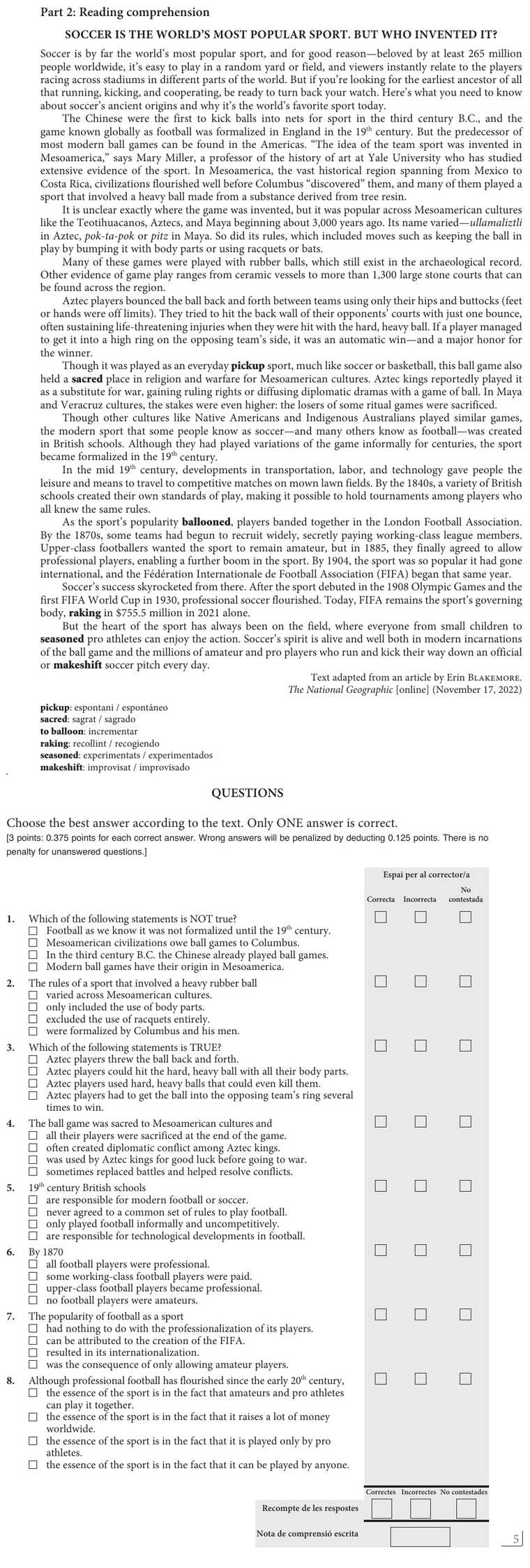
SOCCER IS THE WORLD’S MOST POPULAR SPORT. BUT WHO INVENTED IT? Soccer is by far the world’s most popular sport, and for good reason—beloved by at least 265 million people worldwide, it’s easy to play in a random yard or field, and viewers instantly relate to the players racing across stadiums in different parts of the world. But if you’re looking for the earliest ancestor of all that running, kicking, and cooperating, be ready to turn back your watch. Here’s what you need to know about soccer’s ancient origins and why it’s the world’s favorite sport today. The Chinese were the first to kick balls into nets for sport in the third century B.C., and the game known globally as football was formalized in England in the 19th century. But the predecessor of most modern ball games can be found in the Americas. “The idea of the team sport was invented in Mesoamerica,” says Mary Miller, a professor of the history of art at Yale University who has studied extensive evidence of the sport. In Mesoamerica, the vast historical region spanning from Mexico to Costa Rica, civilizations flourished well before Columbus “discovered” them, and many of them played a sport that involved a heavy ball made from a substance derived from tree resin. It is unclear exactly where the game was invented, but it was popular across Mesoamerican cultures like the Teotihuacanos, Aztecs, and Maya beginning about 3,000 years ago. Its name varied—ullamaliztli in Aztec, pok-ta-pok or pitz in Maya. So did its rules, which included moves such as keeping the ball in play by bumping it with body parts or using racquets or bats. Many of these games were played with rubber balls, which still exist in the archaeological record. Other evidence of game play ranges from ceramic vessels to more than 1,300 large stone courts that can be found across the region. Aztec players bounced the ball back and forth between teams using only their hips and buttocks (feet or hands were off limits). They tried to hit the back wall of their opponents’ courts with just one bounce, often sustaining life-threatening injuries when they were hit with the hard, heavy ball. If a player managed to get it into a high ring on the opposing team’s side, it was an automatic win—and a major honor for the winner. Though it was played as an everyday pickup sport, much like soccer or basketball, this ball game also held a sacred place in religion and warfare for Mesoamerican cultures. Aztec kings reportedly played it as a substitute for war, gaining ruling rights or diffusing diplomatic dramas with a game of ball. In Maya and Veracruz cultures, the stakes were even higher: the losers of some ritual games were sacrificed. Though other cultures like Native Americans and Indigenous Australians played similar games, the modern sport that some people know as soccer—and many others know as football—was created in British schools. Although they had played variations of the game informally for centuries, the sport became formalized in the 19th century. In the mid 19th century, developments in transportation, labor, and technology gave people the leisure and means to travel to competitive matches on mown lawn fields. By the 1840s, a variety of British schools created their own standards of play, making it possible to hold tournaments among players who all knew the same rules. As the sport’s popularity ballooned, players banded together in the London Football Association. By the 1870s, some teams had begun to recruit widely, secretly paying working-class league members. Upper-class footballers wanted the sport to remain amateur, but in 1885, they finally agreed to allow professional players, enabling a further boom in the sport. By 1904, the sport was so popular it had gone international, and the Fédération Internationale de Football Association (FIFA) began that same year. Soccer’s success skyrocketed from there. After the sport debuted in the 1908 Olympic Games and the first FIFA World Cup in 1930, professional soccer flourished. Today, FIFA remains the sport’s governing body, raking in $755.5 million in 2021 alone. But the heart of the sport has always been on the field, where everyone from small children to seasoned pro athletes can enjoy the action. Soccer’s spirit is alive and well both in modern incarnations of the ball game and the millions of amateur and pro players who run and kick their way down an official or makeshift soccer pitch every day. Text adapted from an article by Erin Blakemore. The National Geographic [online] (November 17, 2022) pickup: espontani / espontáneo sacred: sagrat / sagrado to balloon: incrementar raking: recollint / recogiendo seasoned: experimentats / experimentados makeshift: improvisat / improvisado
See the shared reading text and glossary in Part 2, question 1 (item 2.1).
Which of the following statements is NOT true?
Football as we know it was not formalized until the 19th century.
Mesoamerican civilizations owe ball games to Columbus.
In the third century B.C. the Chinese already played ball games.
Modern ball games have their origin in Mesoamerica.
The rules of a sport that involved a heavy rubber ball
varied across Mesoamerican cultures.
only included the use of body parts.
excluded the use of racquets entirely.
were formalized by Columbus and his men.
Which of the following statements is TRUE?
Aztec players threw the ball back and forth.
Aztec players could hit the hard, heavy ball with all their body parts.
Aztec players used hard, heavy balls that could even kill them.
Aztec players had to get the ball into the opposing team’s ring several
times to win.
The ball game was sacred to Mesoamerican cultures and
all their players were sacrificed at the end of the game.
often created diplomatic conflict among Aztec kings.
was used by Aztec kings for good luck before going to war.
sometimes replaced battles and helped resolve conflicts.
19th century British schools
are responsible for modern football or soccer.
never agreed to a common set of rules to play football.
only played football informally and uncompetitively.
are responsible for technological developments in football.
By 1870
all football players were professional.
some working-class football players were paid.
upper-class football players became professional.
no football players were amateurs.
The popularity of football as a sport
had nothing to do with the professionalization of its players.
can be attributed to the creation of the FIFA.
resulted in its internationalization.
was the consequence of only allowing amateur players.
Although professional football has flourished since the early 20th century,
the essence of the sport is in the fact that amateurs and pro athletes
can play it together.
the essence of the sport is in the fact that it raises a lot of money
worldwide.
the essence of the sport is in the fact that it is played only by pro
athletes.
the essence of the sport is in the fact that it can be played by anyone.
La pregunta demana l’afirmació falsa. Comprova si les dates del text encaixen amb cada opció.
Les cultures mesoamericanes ja practicaven jocs de pilota molt abans de l’arribada de Colom. Atribuir-li aquests jocs contradiu la cronologia del text.
Mesoamerican civilizations owe ball games to Columbus.
+0,375criteri 1 de la pauta
Toca per ampliar- 0,375 pSeleccionar la resposta de la clau oficial: Mesoamerican civilizations owe ball games to Columbus.Penalització: Resposta incorrecta: −0.125 punts; pregunta no contestada: sense penalització.
Busca què diu el text sobre les regles en les diferents cultures mesoamericanes.
Després d’explicar que el nom del joc canviava, el text afegeix *So did its rules*. Segons la variant, es podia colpejar la pilota amb parts del cos o fer servir raquetes o bats.
varied across Mesoamerican cultures.
+0,375criteri 1 de la pauta
Toca per ampliar- 0,375 pSeleccionar la resposta de la clau oficial: varied across Mesoamerican cultures.Penalització: Resposta incorrecta: −0.125 punts; pregunta no contestada: sense penalització.
Comprova quina afirmació coincideix amb el paràgraf sobre els jugadors asteques.
El text diu que els impactes de la pilota dura i pesada podien causar lesions *life-threatening*, és a dir, que posaven en perill la vida.
Aztec players used hard, heavy balls that could even kill them.
+0,375criteri 1 de la pauta
Toca per ampliar- 0,375 pSeleccionar la resposta de la clau oficial: Aztec players used hard, heavy balls that could even kill them.Penalització: Resposta incorrecta: −0.125 punts; pregunta no contestada: sense penalització.
Localitza com els reis asteques feien servir el joc per tractar els conflictes.
El text diu que jugaven *as a substitute for war*. Una partida podia evitar un enfrontament i ajudar a resoldre disputes diplomàtiques.
sometimes replaced battles and helped resolve conflicts.
+0,375criteri 1 de la pauta
Toca per ampliar- 0,375 pSeleccionar la resposta de la clau oficial: sometimes replaced battles and helped resolve conflicts.Penalització: Resposta incorrecta: −0.125 punts; pregunta no contestada: sense penalització.
Localitza on va néixer el futbol modern i quan se’n van formalitzar les regles.
El text situa l’origen del futbol modern a les escoles britàniques. A la dècada de 1840, diverses escoles ja havien establert regles de joc que permetien organitzar tornejos.
are responsible for modern football or soccer.
+0,375criteri 1 de la pauta
Toca per ampliar- 0,375 pSeleccionar la resposta de la clau oficial: are responsible for modern football or soccer.Penalització: Resposta incorrecta: −0.125 punts; pregunta no contestada: sense penalització.
Fixa’t en qui cobrava durant els primers anys de professionalització.
A la dècada de 1870, alguns equips ja pagaven en secret un sou a jugadors de classe treballadora. El text situa l’acord per admetre professionals el 1885.
some working-class football players were paid.
+0,375criteri 1 de la pauta- Nota d’OriginalL’enunciat diu «By 1870» i el text diu «By the 1870s». La segona expressió situa els pagaments a la dècada de 1870 i deixa oberta la data exacta en què van començar.
Toca per ampliar- 0,375 pSeleccionar la resposta de la clau oficial: some working-class football players were paid.Penalització: Resposta incorrecta: −0.125 punts; pregunta no contestada: sense penalització.
Segueix l’ordre de causa i conseqüència en el fragment sobre l’expansió del futbol.
El text diu que, cap al 1904, el futbol ja s’havia estès a altres països gràcies a la seva popularitat. També situa la fundació de la FIFA aquell any.
resulted in its internationalization.
+0,375criteri 1 de la pauta
Toca per ampliar- 0,375 pSeleccionar la resposta de la clau oficial: resulted in its internationalization.Penalització: Resposta incorrecta: −0.125 punts; pregunta no contestada: sense penalització.
Busca al darrer paràgraf quina idea resumeix el cor del futbol.
El text inclou des dels infants fins als professionals amb experiència. Aquesta expressió indica que qualsevol persona pot jugar-hi, sigui quin sigui el seu nivell.
the essence of the sport is in the fact that it can be played by anyone.
+0,375criteri 1 de la pauta
Toca per ampliar- 0,375 pSeleccionar la resposta de la clau oficial: the essence of the sport is in the fact that it can be played by anyone.Penalització: Resposta incorrecta: −0.125 punts; pregunta no contestada: sense penalització.
Exercici 3 · opció A
Writing
 Toca per ampliar
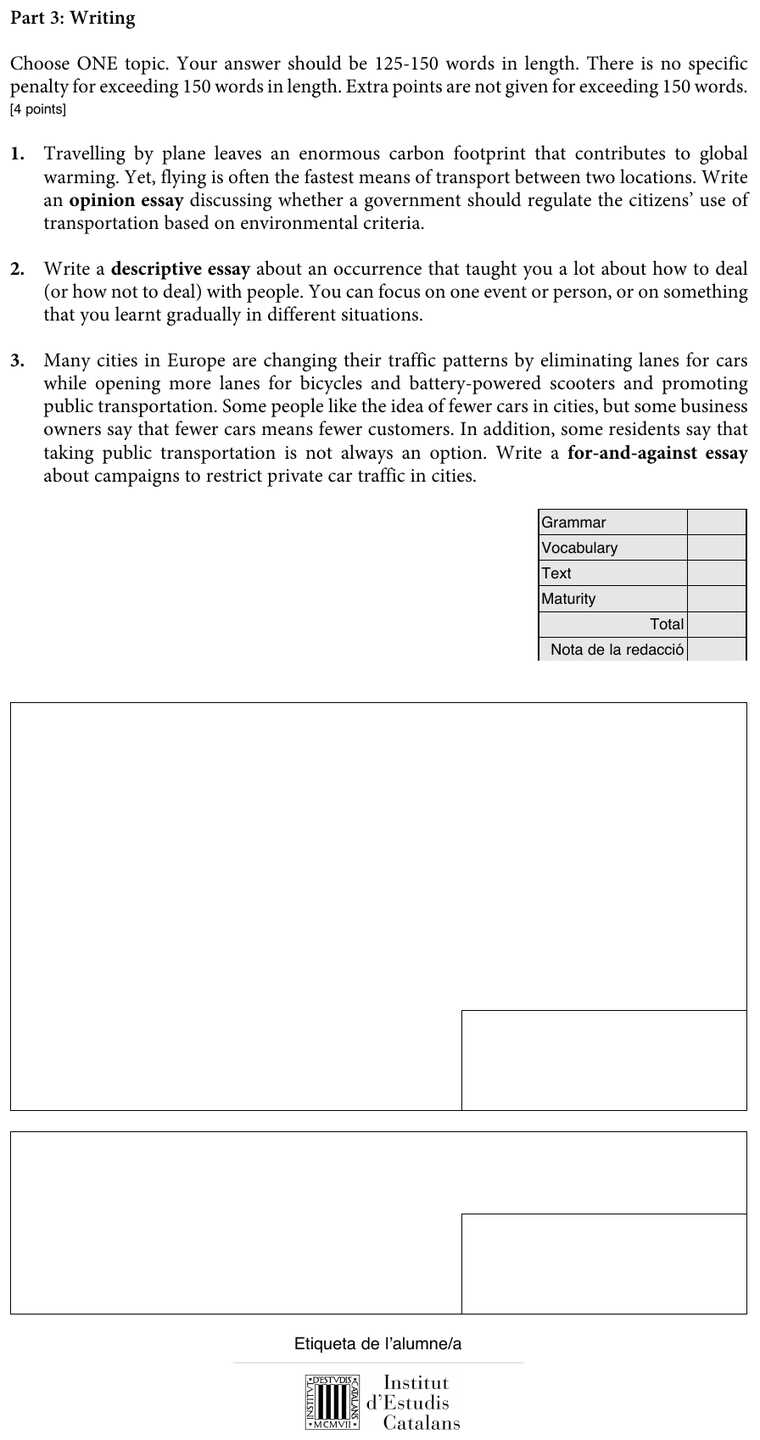
Choose ONE topic. Your answer should be 125-150 words in length. There is no specific penalty for exceeding 150 words in length. Extra points are not given for exceeding 150 words. [4 points]
Travelling by plane leaves an enormous carbon footprint that contributes to global warming. Yet, flying is often the fastest means of transport between two locations. Write an opinion essay discussing whether a government should regulate the citizens’ use of transportation based on environmental criteria.
En un assaig d’opinió, pren partit des del principi i explica en quines condicions defensaries la regulació. El model proposa el tren quan és una alternativa viable i té en compte les comunitats que depenen dels vols.
Governments should regulate transport according to its environmental impact, but they must provide realistic alternatives. Asking citizens to make cleaner choices is unreasonable when those choices are unavailable or unaffordable.
For journeys between well-connected cities, trains can replace some flights. Public investment should make rail services reliable and competitively priced before restrictions are introduced. Otherwise, people with limited incomes may lose opportunities while wealthier travellers simply pay higher prices.
Air travel remains important for remote communities and certain international journeys. Therefore, regulation should distinguish essential connections from routes with practical alternatives. Frequent unnecessary flying deserves closer attention than an occasional family visit.
In my opinion, effective policy combines incentives, investment and proportionate limits. The aim should be to reduce avoidable emissions while protecting mobility. Cleaner transport will gain wider support if citizens can see how it improves their daily lives rather than merely restricting them.
+4criteri 1 de la pauta
Toca per ampliar- 4 pSense desglossament: valoració global de la redacció (4 punts). La graella oficial compartida per tots els temes inclou Grammar, Vocabulary, Text i Maturity, sense pesos per categoria, descriptors de banda ni deduccions per error als PDF aportats.
Exercici 3 · opció B
Writing
Toca per ampliarChoose ONE topic. Your answer should be 125-150 words in length. There is no specific penalty for exceeding 150 words in length. Extra points are not given for exceeding 150 words. [4 points]
Write a descriptive essay about an occurrence that taught you a lot about how to deal (or how not to deal) with people. You can focus on one event or person, or on something that you learnt gradually in different situations.
Descriu l’escena de manera que el lector entengui per què vas canviar la manera de tractar algú. El model parteix de les espatlles tibants i la cara vermella d’en Leo i mostra què aprèn el narrador quan l’escolta.
The classroom was unusually quiet when our group presented its project. Beside me, Leo stared at his notes, his shoulders rigid and his face bright red. I had assumed that his silence during our preparations meant he was unwilling to help.
When the teacher asked him a question, he struggled to answer. I impatiently interrupted, making the silence even heavier. Afterwards, he explained that speaking in front of people terrified him, although he had spent hours checking our research.
His neatly organised notebook made me feel ashamed. I had judged his contribution by how confidently he spoke, overlooking work that mattered just as much.
We agreed to rehearse together before the next presentation and divide the speaking into shorter sections. That uncomfortable afternoon taught me to ask questions before making accusations. People often carry difficulties that are invisible until someone takes the time to listen.
+4criteri 1 de la pauta
Toca per ampliar- 4 pSense desglossament: valoració global de la redacció (4 punts). La graella oficial compartida per tots els temes inclou Grammar, Vocabulary, Text i Maturity, sense pesos per categoria, descriptors de banda ni deduccions per error als PDF aportats.
Exercici 3 · opció C
Writing
Toca per ampliarChoose ONE topic. Your answer should be 125-150 words in length. There is no specific penalty for exceeding 150 words in length. Extra points are not given for exceeding 150 words. [4 points]
Many cities in Europe are changing their traffic patterns by eliminating lanes for cars while opening more lanes for bicycles and battery-powered scooters and promoting public transportation. Some people like the idea of fewer cars in cities, but some business owners say that fewer cars means fewer customers. In addition, some residents say that taking public transportation is not always an option. Write a for-and-against essay about campaigns to restrict private car traffic in cities.
En un assaig a favor i en contra, desenvolupa els beneficis i les dificultats en paràgrafs propis. El model passa dels carrers més tranquils als problemes d’accés i conclou amb les condicions que farien més justa la mesura.
Restricting private cars can make cities healthier and more pleasant, but the effects depend on how the changes are introduced. Residents and businesses have legitimate concerns alongside clear potential benefits.
Fewer vehicles mean quieter streets and more space for walking, cycling and meeting neighbours. Children can travel more safely, while attractive public spaces may encourage people to spend time in local shops instead of driving elsewhere.
However, some residents cannot cycle or rely on buses that stop running early. Shop owners may also worry about deliveries and customers who travel from outside the neighbourhood. Restrictions imposed before alternatives exist can create real hardship.
A gradual approach seems fairest. Cities should improve accessible public transport, arrange delivery access and consult affected businesses. In my view, reducing traffic is worthwhile, provided that the policy helps people reach their destinations rather than simply making car journeys more difficult.
+4criteri 1 de la pauta
Toca per ampliar- 4 pSense desglossament: valoració global de la redacció (4 punts). La graella oficial compartida per tots els temes inclou Grammar, Vocabulary, Text i Maturity, sense pesos per categoria, descriptors de banda ni deduccions per error als PDF aportats.