Anglès
PAU 2023 · ordinària · sèrie 5
Examen oficial de la PAU de Catalunya amb la resolució pas a pas de cada apartat i la pauta de correcció. És d’una convocatòria anterior al model 2025: la pauta correspon a aquell examen.
Listening
PAU 2023 · ordinària · sèrie 5Instruccions de l’examen
Part 1: Listening comprehension
Choose the best answer according to the recording. Only ONE answer is correct. [3 points: 0.375 points for each correct answer. Wrong answers will be penalized by deducting 0.125 points. There is no penalty for unanswered questions.]
Part 2: Reading comprehension
Choose the best answer according to the text. Only ONE answer is correct. [3 points: 0.375 points for each correct answer. Wrong answers will be penalized by deducting 0.125 points. There is no penalty for unanswered questions.]
Part 3: Writing
Choose ONE topic. Your answer should be 125-150 words in length. There is no specific penalty for exceeding 150 words in length. Extra points are not given for exceeding 150 words. [4 points]
Exercici 1
Listening comprehension
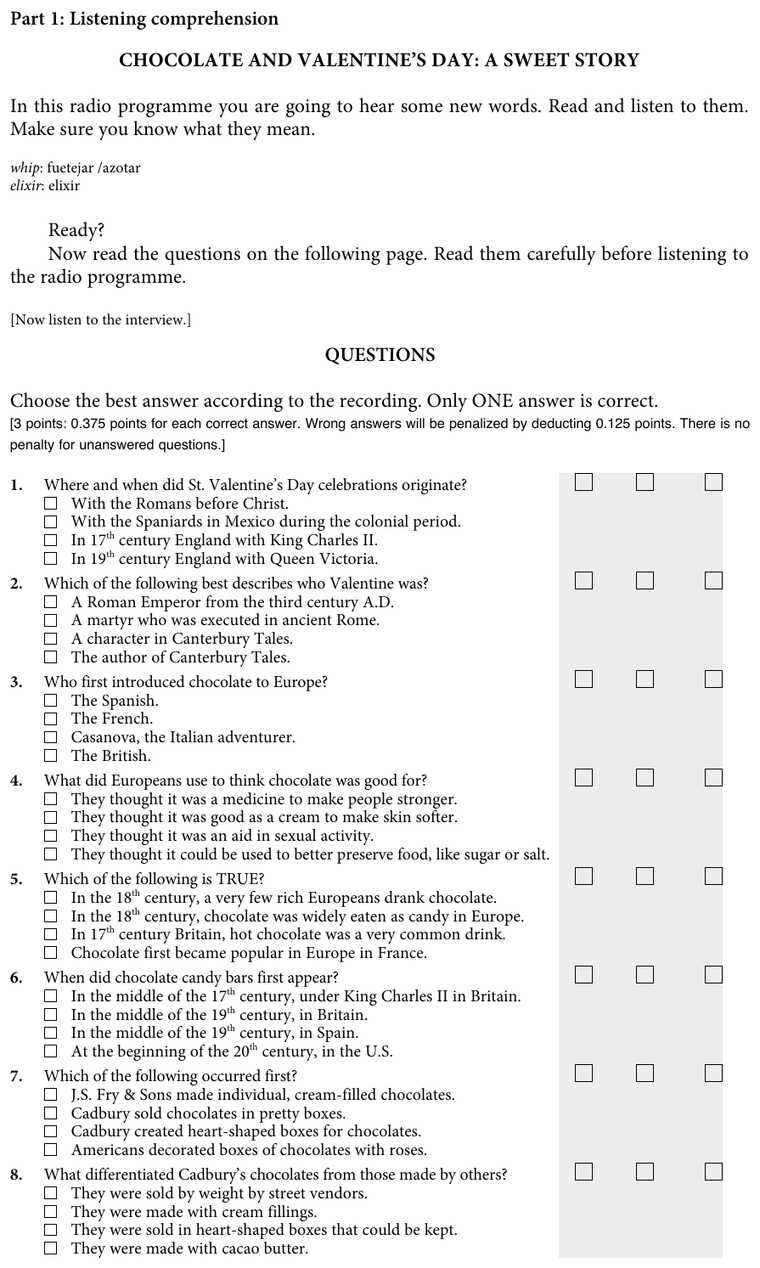 Toca per ampliar
Chocolate and Valentine’s Day: A Sweet Story
In this radio programme you are going to hear some new words. Read and listen to them. Make sure you know what they mean.
whip fuetejar /azotar
elxir elixir/elixir
Ready? Now read the questions on the following page. Read them carefully before listening to the radio programme. [Now listen to the interview.]
Interviewer: Welcome to our weekly chat about holiday celebrations around the world. Today’s guest is going to tell us about our sweetest holiday celebration, Valentine’s Day. Today we know that a heart-shaped box of chocolates is a symbol, and an important part, of Valentine’s Day, but how did that tradition arise? We know that chocolate is not native to Britain, or even to the United States. To find out more about Valentine’s Day and chocolate, we’ve invited Dr. Anne Ward, a professor at King’s College London, to give us some background about this sweet connection.
Welcome, Anne, to the program.
Anne: Thank you, I’m glad to be here.
Interviewer: Has chocolate always been a part of Valentine’s Day? How did we get to celebrate Valentine’s Day in the first place?
Anne: Chocolate is relatively new to Valentine’s Day. The roots of Valentine’s Day are ancient, but not entirely clear. It probably originated with the Romans and a fertility festival they held. But the Romans did not exchange candy, they sacrificed goats and dogs and whipped people, among other things. Eventually, hundreds of years later, this festival became a Christian feast associated with a martyred saint, Valentine. The Roman Emperor Claudius had had Valentine executed on February 14th in the third century A.D.
Interviewer: And how did this martyred saint become associated with love?
Anne: We don’t know exactly, but we do know that in Canterbury Tales, Chaucer talks about St. Valentine’s Day as a day in which birds gather together to choose their mates. That means that by the 14th century, there was a strong link between love, mating, and St. Valentine’s Day.
Interviewer: So when does chocolate come into the picture?
Anne: Obviously, Chaucer didn’t talk about chocolate. Chocolate was first introduced into Europe by the Spanish, who had seen people drink it in Mexico. Chocolate as a drink became very popular in Spain, and from there it traveled to other parts of Europe. It became very popular in France. And people at the time thought that chocolate was a sexual stimulant. Giacomo Casanova, the famous Italian adventurer and womanizer from Venice, called chocolate the “elixir of love.”
Interviewer: Was chocolate always served as a drink?
Anne: Yes, until the mid-19th century, chocolate was always consumed as a drink. They didn’t eat chocolate cake. Chocolate was very popular with Europe’s kings. For example, documents from the 17th century show us that British King Charles II spent 30 times more money on chocolate than on tea. He certainly spent more money on chocolate than on his servants. For most people of that time, though, chocolate was a very extravagant, exotic product. Most never tasted it.
Interviewer: So when did we start eating chocolate bars? Today, we tend to think of chocolate as something that is eaten as a solid, not drunk as a liquid.
Anne: In the mid 19th century, specifically in 1847, the British chocolate maker J.S. Fry & Sons produced the first modern-day candy bar. The company combined cacao powder and sugar with cacao butter, the fat that is extracted from cacao beans, to form a paste that they could shape into bars. A few years later, they started making individual chocolates filled with flavored creams.
Interviewer: So was it this company, J.S. Fry & Sons, that linked chocolate to St. Valentine’s Day?
Anne: No, chocolate didn’t become an important part of St. Valentine’s Day celebrations until a rival chocolate company, Cadbury, decided to start selling fancy boxes of chocolates. Cadbury knew that extreme ornamentation was very popular in Victorian England, so he came up with the idea of selling chocolate in boxes with heavily decorated lids and lace inside. And soon after that, Cadbury created boxes in the shape of a heart. Once the chocolates had been eaten, people would save the pretty boxes and use them to keep special mementos.
Interviewer: I see, you might say that we eat chocolate on St. Valentine’s Day because it was a successful business strategy.
Anne: Yes, Cadbury’s idea was a huge success. This year in the United States alone, companies will sell more than 40 million heart-shaped boxes of chocolate, many of them decorated with roses and lace. Surveys show that 70% of Americans prefer receiving chocolate as opposed to flowers as a Valentine’s Day gift.
Interviewer: And is chocolate really an aphrodisiac? You mentioned that Casanova thought it was.
Anne: Despite what Casanova and others have said, modern science has found little evidence to support chocolate as an aphrodisiac.
Interviewer: That’s all we have time for today, Anne. Thank you for joining us today.
Anne: My pleasure.
See the official listening transcript in Part 1, question 1 (item 1.1).
Where and when did St. Valentine’s Day celebrations originate?
With the Romans before Christ.
With the Spaniards in Mexico during the colonial period.
In 17th century England with King Charles II.
In 19th century England with Queen Victoria.
Which of the following best describes who Valentine was?
A Roman Emperor from the third century A.D.
A martyr who was executed in ancient Rome.
A character in Canterbury Tales.
The author of Canterbury Tales.
Who first introduced chocolate to Europe?
The Spanish.
The French.
Casanova, the Italian adventurer.
The British.
What did Europeans use to think chocolate was good for?
They thought it was a medicine to make people stronger.
They thought it was good as a cream to make skin softer.
They thought it was an aid in sexual activity.
They thought it could be used to better preserve food, like sugar or salt.
Which of the following is TRUE?
In the 18th century, a very few rich Europeans drank chocolate.
In the 18th century, chocolate was widely eaten as candy in Europe.
In 17th century Britain, hot chocolate was a very common drink.
Chocolate first became popular in Europe in France.
When did chocolate candy bars first appear?
In the middle of the 17th century, under King Charles II in Britain.
In the middle of the 19th century, in Britain.
In the middle of the 19th century, in Spain.
At the beginning of the 20th century, in the U.S.
Which of the following occurred first?
J.S. Fry & Sons made individual, cream-filled chocolates.
Cadbury sold chocolates in pretty boxes.
Cadbury created heart-shaped boxes for chocolates.
Americans decorated boxes of chocolates with roses.
What differentiated Cadbury’s chocolates from those made by others?
They were sold by weight by street vendors.
They were made with cream fillings.
They were sold in heart-shaped boxes that could be kept.
They were made with cacao butter.
Identifica l’origen que proposa l’entrevista. L’Anne el relaciona amb una antiga festa romana de la fertilitat, anterior a la celebració cristiana.
With the Romans before Christ.
+0,375criteri 1 de la pauta
 Toca per ampliar
- 0,375 pSeleccionar la resposta de la clau oficial: With the Romans before Christ.Penalització: Resposta incorrecta: −0.125 punts; pregunta no contestada: sense penalització.
Identifica qui va ser Valentí a partir del que li va passar. L’emperador Claudi va ordenar que l’executessin, i més endavant se’l va recordar com a sant màrtir.
A martyr who was executed in ancient Rome.
+0,375criteri 1 de la pauta
Toca per ampliar- 0,375 pSeleccionar la resposta de la clau oficial: A martyr who was executed in ancient Rome.Penalització: Resposta incorrecta: −0.125 punts; pregunta no contestada: sense penalització.
Busca qui va portar la xocolata a Europa. L’entrevista explica que els espanyols van veure com es bevia a Mèxic i la van introduir primer a Espanya.
The Spanish.
+0,375criteri 1 de la pauta
Toca per ampliar- 0,375 pSeleccionar la resposta de la clau oficial: The Spanish.Penalització: Resposta incorrecta: −0.125 punts; pregunta no contestada: sense penalització.
Fixa’t en la creença que hi havia quan la xocolata es va popularitzar a Europa. L’entrevista diu que es considerava un estimulant sexual i que Casanova l’anomenava «elixir of love».
They thought it was an aid in sexual activity.
+0,375criteri 1 de la pauta
Toca per ampliar- 0,375 pSeleccionar la resposta de la clau oficial: They thought it was an aid in sexual activity.Penalització: Resposta incorrecta: −0.125 punts; pregunta no contestada: sense penalització.
Descarta les opcions que contradiuen el que diu l’Anne sobre la xocolata. Es prenia com a beguda fins a mitjan segle XIX, la majoria de gent no se la podia permetre i es va popularitzar a Espanya abans que a França.
Per eliminació, queda l’opció del segle XVIII, que és la que dona la clau. L’exemple que se sent és el de Carles II al segle XVII.
In the 18th century, a very few rich Europeans drank chocolate.
+0,375criteri 1 de la pauta
Toca per ampliar- 0,375 pSeleccionar la resposta de la clau oficial: In the 18th century, a very few rich Europeans drank chocolate.Penalització: Resposta incorrecta: −0.125 punts; pregunta no contestada: sense penalització.
Situa la primera rajola de xocolata en el temps i en el lloc. La va fabricar l’empresa britànica J.S. Fry & Sons el 1847, a mitjan segle XIX.
In the middle of the 19th century, in Britain.
+0,375criteri 1 de la pauta
Toca per ampliar- 0,375 pSeleccionar la resposta de la clau oficial: In the middle of the 19th century, in Britain.Penalització: Resposta incorrecta: −0.125 punts; pregunta no contestada: sense penalització.
Ordena els productes tal com es presenten a l’entrevista. Després de la primera rajola, J.S. Fry & Sons va començar a fer bombons farcits de crema. L’Anne parla després de les capses decorades de Cadbury i diu que les capses en forma de cor van venir més tard.
J.S. Fry made individual, cream-filled chocolates.
+0,375criteri 1 de la pauta
Toca per ampliar- 0,375 pSeleccionar la resposta de la clau oficial: J.S. Fry made individual, cream-filled chocolates.Penalització: Resposta incorrecta: −0.125 punts; pregunta no contestada: sense penalització.
Identifica què tenia d’especial la presentació dels bombons de Cadbury. Quan s’acabaven els bombons, la gent podia guardar records dins les capses en forma de cor.
They were sold in heart-shaped boxes that could be kept.
+0,375criteri 1 de la pauta
Toca per ampliar- 0,375 pSeleccionar la resposta de la clau oficial: They were sold in heart-shaped boxes that could be kept.Penalització: Resposta incorrecta: −0.125 punts; pregunta no contestada: sense penalització.
Exercici 2
Reading comprehension
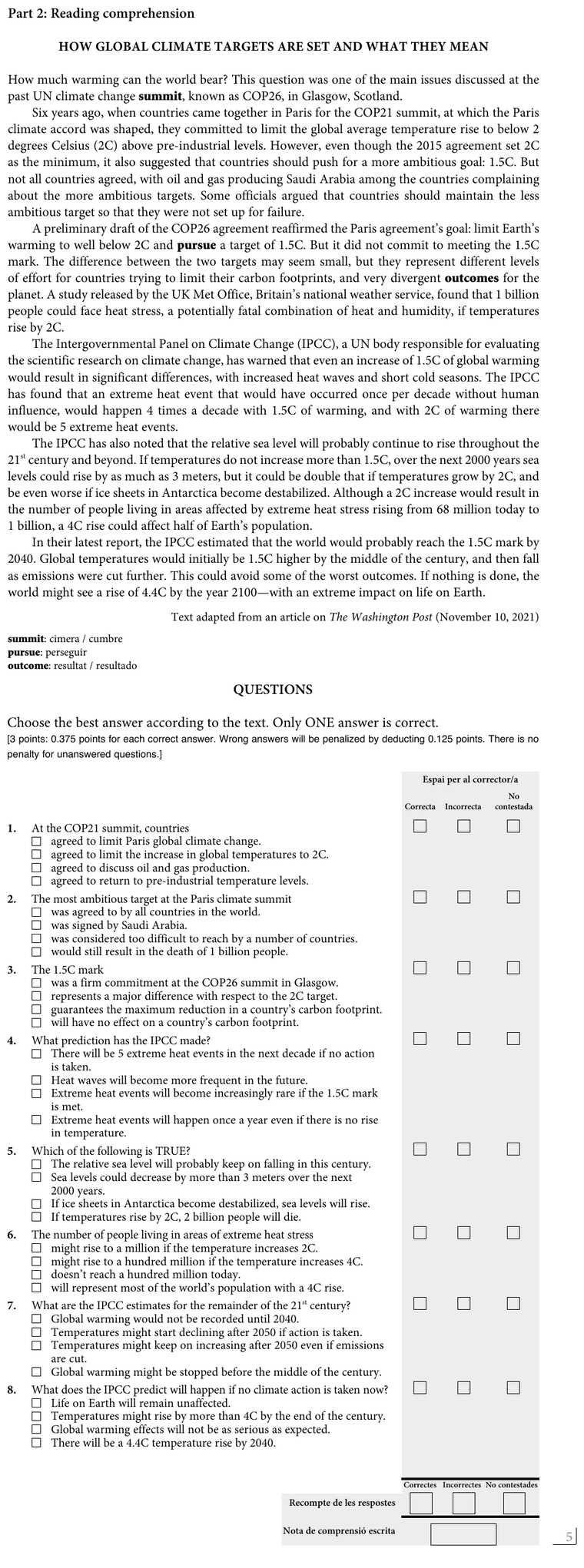 Toca per ampliar
HOW GLOBAL CLIMATE TARGETS ARE SET AND WHAT THEY MEAN
How much warming can the world bear? This question was one of the main issues discussed at the past UN climate change summit, known as COP26, in Glasgow, Scotland. Six years ago, when countries came together in Paris for the COP21 summit, at which the Paris climate accord was shaped, they committed to limit the global average temperature rise to below 2 degrees Celsius (2C) above pre-industrial levels. However, even though the 2015 agreement set 2C as the minimum, it also suggested that countries should push for a more ambitious goal: 1.5C. But not all countries agreed, with oil and gas producing Saudi Arabia among the countries complaining about the more ambitious targets. Some officials argued that countries should maintain the less ambitious target so that they were not set up for failure. A preliminary draft of the COP26 agreement reaffirmed the Paris agreement’s goal: limit Earth’s warming to well below 2C and pursue a target of 1.5C. But it did not commit to meeting the 1.5C mark. The difference between the two targets may seem small, but they represent different levels of effort for countries trying to limit their carbon footprints, and very divergent outcomes for the planet. A study released by the UK Met Office, Britain’s national weather service, found that 1 billion people could face heat stress, a potentially fatal combination of heat and humidity, if temperatures rise by 2C. The Intergovernmental Panel on Climate Change (IPCC), a UN body responsible for evaluating the scientific research on climate change, has warned that even an increase of 1.5C of global warming would result in significant differences, with increased heat waves and short cold seasons. The IPCC has found that an extreme heat event that would have occurred once per decade without human influence, would happen 4 times a decade with 1.5C of warming, and with 2C of warming there would be 5 extreme heat events. The IPCC has also noted that the relative sea level will probably continue to rise throughout the 21st century and beyond. If temperatures do not increase more than 1.5C, over the next 2000 years sea
levels could rise by as much as 3 meters, but it could be double that if temperatures grow by 2C, and be even worse if ice sheets in Antarctica become destabilized. Although a 2C increase would result in the number of people living in areas affected by extreme heat stress rising from 68 million today to 1 billion, a 4C rise could affect half of Earth’s population. In their latest report, the IPCC estimated that the world would probably reach the 1.5C mark by 2040. Global temperatures would initially be 1.5C higher by the middle of the century, and then fall as emissions were cut further. This could avoid some of the worst outcomes. If nothing is done, the world might see a rise of 4.4C by the year 2100—with an extreme impact on life on Earth. Text adapted from an article on The Washington Post (November 10, 2021) summit: cimera / cumbre pursue: perseguir outcome: resultat / resultado
See the shared reading text and glossary in Part 2, question 1 (item 2.1).
At the COP21 summit, countries
agreed to limit Paris global climate change.
agreed to limit the increase in global temperatures to 2C.
agreed to discuss oil and gas production.
agreed to return to pre-industrial temperature levels.
The most ambitious target at the Paris climate summit
was agreed to by all countries in the world.
was signed by Saudi Arabia.
was considered too difficult to reach by a number of countries.
would still result in the death of 1 billion people.
The 1.5C mark
was a firm commitment at the COP26 summit in Glasgow.
represents a major difference with respect to the 2C target.
guarantees the maximum reduction in a country’s carbon footprint.
will have no effect on a country’s carbon footprint.
What prediction has the IPCC made?
There will be 5 extreme heat events in the next decade if no action
is taken.
Heat waves will become more frequent in the future.
Extreme heat events will become increasingly rare if the 1.5C mark
is met.
Extreme heat events will happen once a year even if there is no rise
in temperature.
Which of the following is TRUE?
The relative sea level will probably keep on falling in this century.
Sea levels could decrease by more than 3 meters over the next
2000 years.
If ice sheets in Antarctica become destabilized, sea levels will rise.
If temperatures rise by 2C, 2 billion people will die.
The number of people living in areas of extreme heat stress
might rise to a million if the temperature increases 2C.
might rise to a hundred million if the temperature increases 4C.
doesn’t reach a hundred million today.
will represent most of the world’s population with a 4C rise.
What are the IPCC estimates for the remainder of the 21st century?
Global warming would not be recorded until 2040.
Temperatures might start declining after 2050 if action is taken.
Temperatures might keep on increasing after 2050 even if emissions
are cut.
Global warming might be stopped before the middle of the century.
What does the IPCC predict will happen if no climate action is taken now?
Life on Earth will remain unaffected.
Temperatures might rise by more than 4C by the end of the century.
Global warming effects will not be as serious as expected.
There will be a 4.4C temperature rise by 2040.
Recupera el compromís que es va adoptar a la cimera de París del 2015. Es tractava de limitar l’augment de la temperatura mitjana global per sota dels 2 °C respecte dels nivells preindustrials.
agreed to limit the increase in global temperatures to 2C.
+0,375criteri 1 de la pauta
Toca per ampliar- 0,375 pSeleccionar la resposta de la clau oficial: agreed to limit the increase in global temperatures to 2C.Penalització: Resposta incorrecta: −0.125 punts; pregunta no contestada: sense penalització.
Busca com van reaccionar alguns països davant l’objectiu d’1,5 °C. El text explica que alguns responsables preferien mantenir el llindar menys ambiciós per evitar comprometre’s amb una fita que veien difícil d’assolir.
was considered too difficult to reach by a number of countries.
+0,375criteri 1 de la pauta
Toca per ampliar- 0,375 pSeleccionar la resposta de la clau oficial: was considered too difficult to reach by a number of countries.Penalització: Resposta incorrecta: −0.125 punts; pregunta no contestada: sense penalització.
Compara què implica limitar l’escalfament a 1,5 °C o a 2 °C. Segons el text, aquest mig grau canvia l’esforç necessari per reduir la petjada de carboni i té conseqüències molt diferents per al planeta.
represents a major difference with respect to the 2C target.
+0,375criteri 1 de la pauta
Toca per ampliar- 0,375 pSeleccionar la resposta de la clau oficial: represents a major difference with respect to the 2C target.Penalització: Resposta incorrecta: −0.125 punts; pregunta no contestada: sense penalització.
Fixa’t en com canvia la freqüència de la calor extrema. Segons l’IPCC, un episodi que passaria un cop per dècada sense influència humana es repetiria quatre cops per dècada amb 1,5 °C d’escalfament.
Heat waves will become more frequent in the future.
+0,375criteri 1 de la pauta
Toca per ampliar- 0,375 pSeleccionar la resposta de la clau oficial: Heat waves will become more frequent in the future.Penalització: Resposta incorrecta: −0.125 punts; pregunta no contestada: sense penalització.
Segueix la condició que posa el text sobre el gel antàrtic. La pujada prevista del nivell del mar podria ser encara més gran si es desestabilitzen les capes de gel de l’Antàrtida.
If ice sheets in Antarctica become destabilized, sea levels will rise.
+0,375criteri 1 de la pauta
Toca per ampliar- 0,375 pSeleccionar la resposta de la clau oficial: If ice sheets in Antarctica become destabilized, sea levels will rise.Penalització: Resposta incorrecta: −0.125 punts; pregunta no contestada: sense penalització.
Pren la xifra que el text dona per al moment en què es va escriure. Llavors, 68 milions de persones vivien en zones d’estrès tèrmic extrem, per sota dels 100 milions.
doesn’t reach a hundred million today.
+0,375criteri 1 de la pauta
Toca per ampliar- 0,375 pSeleccionar la resposta de la clau oficial: doesn’t reach a hundred million today.Penalització: Resposta incorrecta: −0.125 punts; pregunta no contestada: sense penalització.
Segueix les dues fases de la projecció de l’IPCC. Cap a mitjan segle la temperatura seria 1,5 °C més alta que en l’època preindustrial i, si les emissions es continuessin reduint, després podria baixar.
Temperatures might start declining after 2050 if action is taken.
+0,375criteri 1 de la pauta
Toca per ampliar- 0,375 pSeleccionar la resposta de la clau oficial: Temperatures might start declining after 2050 if action is taken.Penalització: Resposta incorrecta: −0.125 punts; pregunta no contestada: sense penalització.
Llegeix l’última projecció, la que correspon a l’escenari d’inacció. El text indica que l’escalfament podria arribar als 4,4 °C l’any 2100.
Temperatures might rise by more than 4C by the end of the century.
+0,375criteri 1 de la pauta
Toca per ampliar- 0,375 pSeleccionar la resposta de la clau oficial: Temperatures might rise by more than 4C by the end of the century.Penalització: Resposta incorrecta: −0.125 punts; pregunta no contestada: sense penalització.
Exercici 3 · opció A
Writing
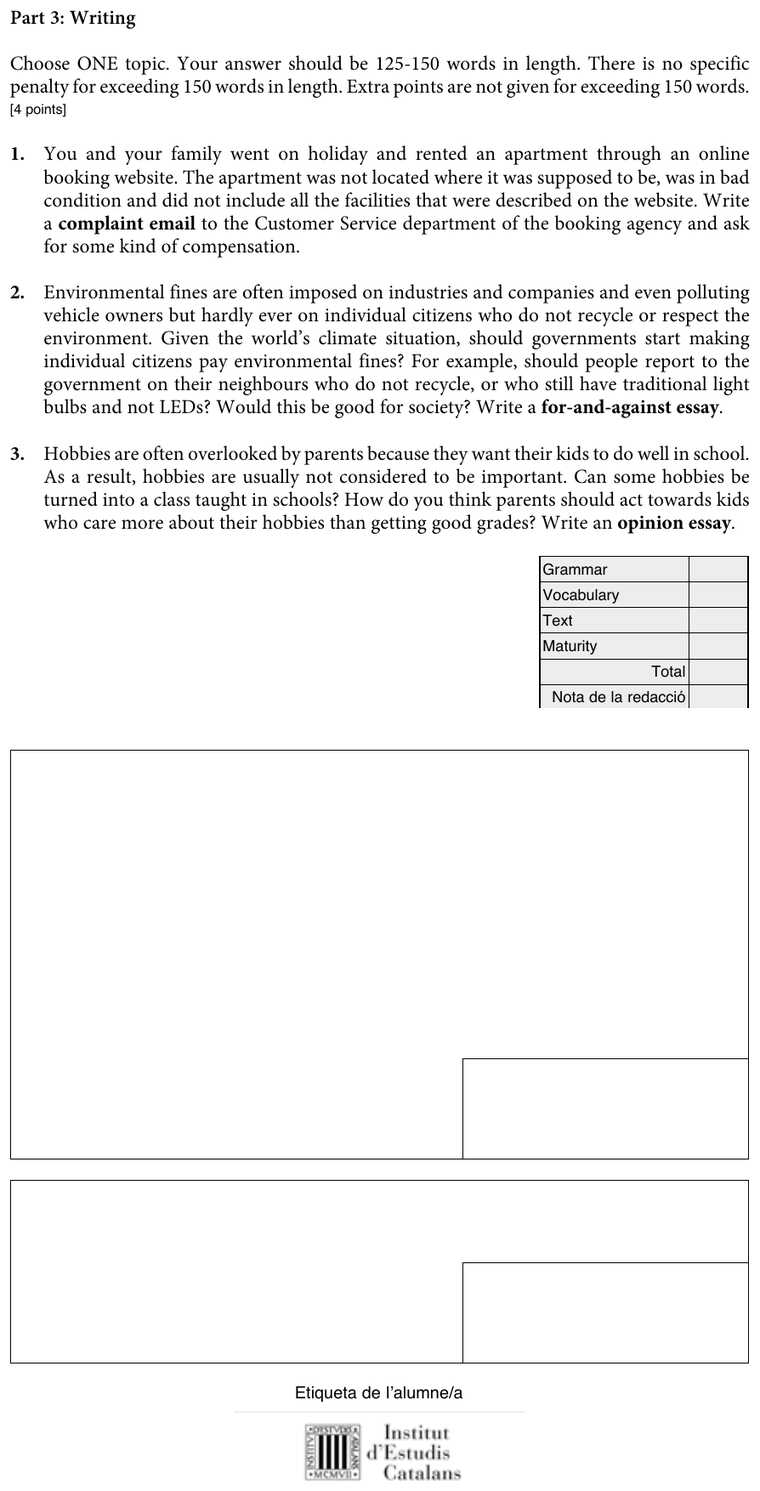 Toca per ampliar
Choose ONE topic. Your answer should be 125-150 words in length. There is no specific penalty for exceeding 150 words in length. Extra points are not given for exceeding 150 words. [4 points]
You and your family went on holiday and rented an apartment through an online booking website. The apartment was not located where it was supposed to be, was in bad condition and did not include all the facilities that were described on the website. Write a complaint email to the Customer Service department of the booking agency and ask for some kind of compensation.
En un correu formal de reclamació, explica on era realment l’apartament, en quin estat el vau trobar i quins serveis hi faltaven, i demana una compensació concreta.
Dear Customer Service Team,
I am writing to complain about the apartment my family rented through your website from 10 to 17 July, booking reference BC482. The accommodation differed substantially from the advertised description.
Your listing placed it within walking distance of the beach, whereas we needed a bus to get there. On arrival, we also discovered dirty bedding, a leaking shower and a broken cooker. Furthermore, the promised internet connection was unavailable throughout our stay.
We contacted the local representative immediately, but no repairs or alternative accommodation were provided. These problems caused considerable inconvenience and forced us to spend extra money on transport and meals.
I would therefore request a partial refund and reimbursement of these additional expenses. I have attached photographs, receipts and our original booking confirmation. Please respond within fourteen days with a proposed resolution.
Yours faithfully,
Alex Martin
+4criteri 1 de la pauta
Toca per ampliar- 4 pSense desglossament: valoració global de la redacció (4 punts). La graella oficial compartida per tots els temes inclou Grammar, Vocabulary, Text i Maturity, sense pesos per categoria, descriptors de banda ni deduccions per error als PDF aportats.
Exercici 3 · opció B
Writing
Toca per ampliarChoose ONE topic. Your answer should be 125-150 words in length. There is no specific penalty for exceeding 150 words in length. Extra points are not given for exceeding 150 words. [4 points]
Environmental fines are often imposed on industries and companies and even polluting vehicle owners but hardly ever on individual citizens who do not recycle or respect the environment. Given the world’s climate situation, should governments start making individual citizens pay environmental fines? For example, should people report to the government on their neighbours who do not recycle, or who still have traditional light bulbs and not LEDs? Would this be good for society? Write a for-and-against essay.
En un assaig a favor i en contra, explica què podrien aconseguir les multes i quin efecte tindria denunciar els veïns, i tanca el text amb una conclusió que sospesi els dos costats.
Environmental fines for individuals could encourage responsible behaviour, but they also risk creating unfairness and distrust. Their value depends on which actions are punished and whether people have realistic alternatives.
On the one hand, clear penalties may discourage deliberate littering or dumping. Citizens should not expect others to pay for damage they knowingly cause. Consistent enforcement can also reassure those who already make an effort to protect shared spaces.
On the other hand, punishing households for not buying efficient equipment may penalise poverty. Encouraging neighbours to report every minor mistake could damage relationships without achieving meaningful environmental improvements.
In my view, governments should provide accessible recycling facilities, practical information and support for necessary changes first. Fines are justified for serious, deliberate breaches, but should be proportionate. A successful environmental policy needs cooperation as well as accountability; suspicion between neighbours is a poor foundation for lasting change.
+4criteri 1 de la pauta
Toca per ampliar- 4 pSense desglossament: valoració global de la redacció (4 punts). La graella oficial compartida per tots els temes inclou Grammar, Vocabulary, Text i Maturity, sense pesos per categoria, descriptors de banda ni deduccions per error als PDF aportats.
Exercici 3 · opció C
Writing
Toca per ampliarChoose ONE topic. Your answer should be 125-150 words in length. There is no specific penalty for exceeding 150 words in length. Extra points are not given for exceeding 150 words. [4 points]
Hobbies are often overlooked by parents because they want their kids to do well in school. As a result, hobbies are usually not considered to be important. Can some hobbies be turned into a class taught in schools? How do you think parents should act towards kids who care more about their hobbies than getting good grades? Write an opinion essay.
En un assaig d’opinió, exposa la teva postura des del principi i defensa-la amb exemples. Explica quines aficions es podrien ensenyar a l’escola i com poden reaccionar els pares quan als fills els interessen més les aficions que les notes.
Hobbies deserve a place in education because they can develop abilities that examination results do not fully reveal. I believe schools and parents should treat them as opportunities for learning rather than distractions by definition.
Some interests could readily become school subjects or practical projects. Gardening teaches planning and observation, while photography combines technical knowledge with creative decisions. Working towards an exhibition or harvest can also help pupils understand why persistence matters.
Parents are understandably concerned when a child neglects schoolwork. However, demanding that the hobby stop altogether may destroy motivation and trust. A better response is to agree on a realistic timetable and discuss the consequences of unfinished assignments.
Not every interest will become a career, and need not. Children need both a sound general education and room to discover what absorbs them. Supporting that balance is more useful than forcing them to choose between enjoyment and achievement.
+4criteri 1 de la pauta
Toca per ampliar- 4 pSense desglossament: valoració global de la redacció (4 punts). La graella oficial compartida per tots els temes inclou Grammar, Vocabulary, Text i Maturity, sense pesos per categoria, descriptors de banda ni deduccions per error als PDF aportats.