Anglès
PAU 2024 · extraordinària · sèrie 3
Examen oficial de la PAU de Catalunya amb la resolució pas a pas de cada apartat i la pauta de correcció. És d’una convocatòria anterior al model 2025: la pauta correspon a aquell examen.
Listening
PAU 2024 · extraordinària · sèrie 3Instruccions de l’examen
Part 1: Listening comprehension
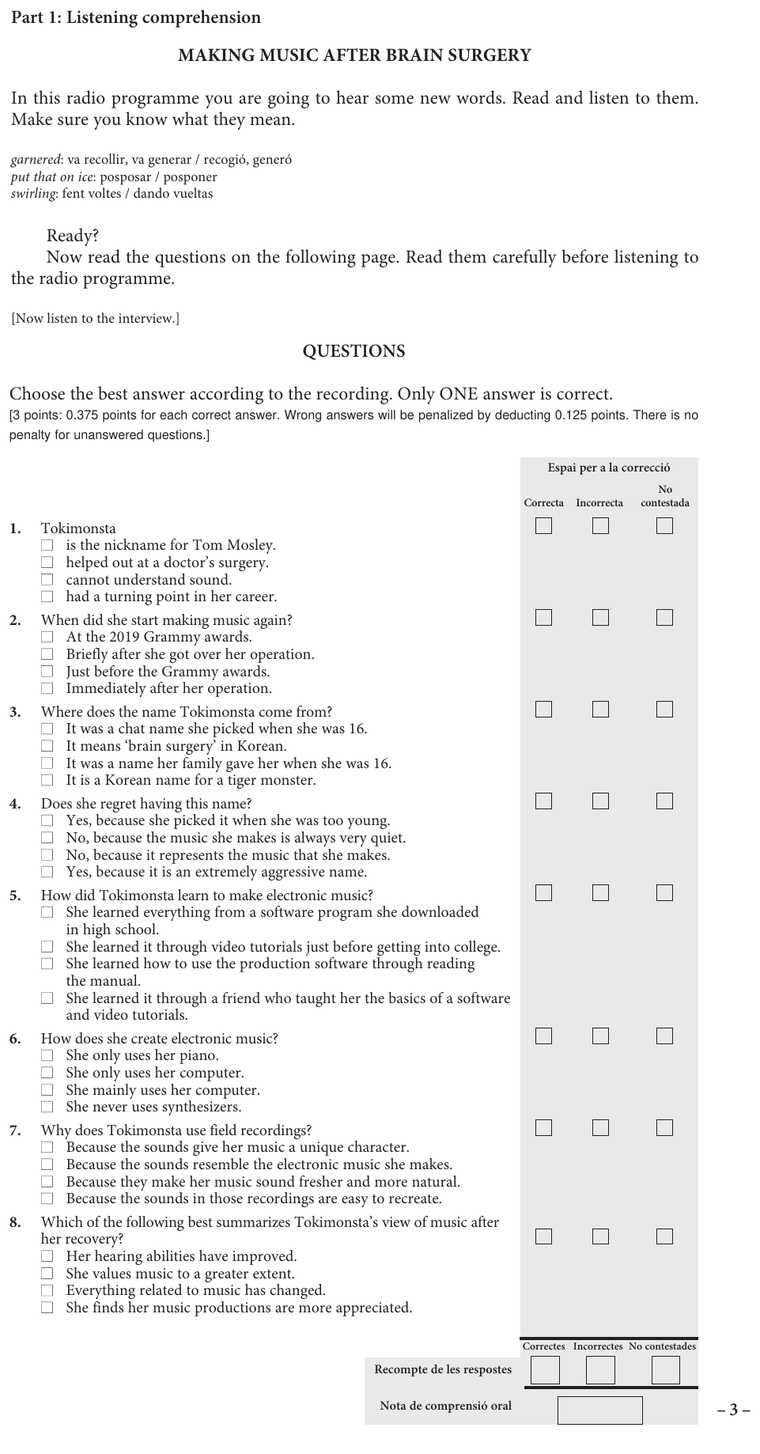
Choose the best answer according to the recording. Only ONE answer is correct. [3 points: 0.375 points for each correct answer. Wrong answers will be penalized by deducting 0.125 points. There is no penalty for unanswered questions.]
Part 2: Reading comprehension
Choose the best answer according to the text. Only ONE answer is correct. [3 points: 0.375 points for each correct answer. Wrong answers will be penalized by deducting 0.125 points. There is no penalty for unanswered questions.]
Part 3: Writing
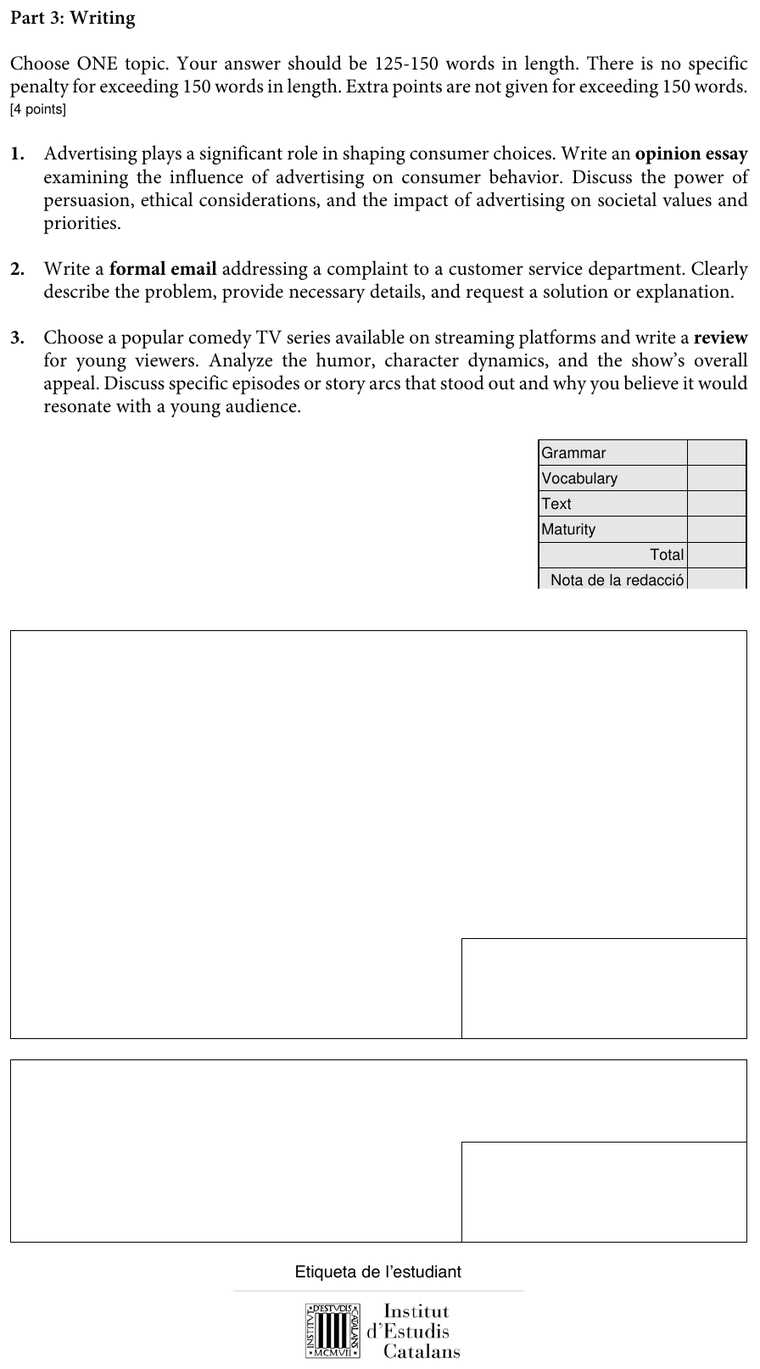
Choose ONE topic. Your answer should be 125-150 words in length. There is no specific penalty for exceeding 150 words in length. Extra points are not given for exceeding 150 words. [4 points]
Exercici 1
Listening comprehension
 Toca per ampliar
MAKING MUSIC AFTER BRAIN SURGERY
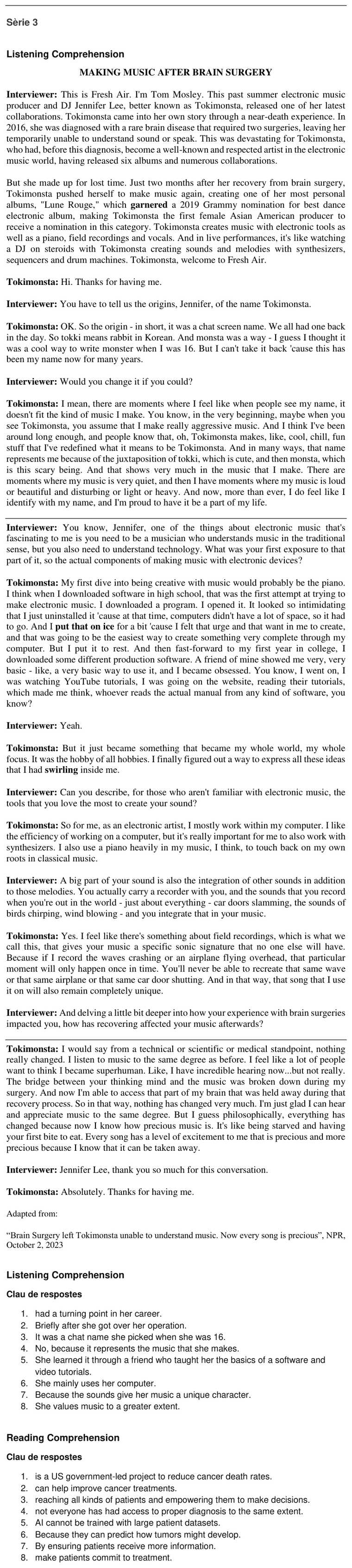
Interviewer: This is Fresh Air. I'm Tom Mosley. This past summer electronic music producer and DJ Jennifer Lee, better known as Tokimonsta, released one of her latest collaborations. Tokimonsta came into her own story through a near-death experience. In 2016, she was diagnosed with a rare brain disease that required two surgeries, leaving her temporarily unable to understand sound or speak. This was devastating for Tokimonsta, who had, before this diagnosis, become a well-known and respected artist in the electronic music world, having released six albums and numerous collaborations.
But she made up for lost time. Just two months after her recovery from brain surgery, Tokimonsta pushed herself to make music again, creating one of her most personal albums, "Lune Rouge," which garnered a 2019 Grammy nomination for best dance electronic album, making Tokimonsta the first female Asian American producer to receive a nomination in this category. Tokimonsta creates music with electronic tools as well as a piano, field recordings and vocals. And in live performances, it's like watching a DJ on steroids with Tokimonsta creating sounds and melodies with synthesizers, sequencers and drum machines. Tokimonsta, welcome to Fresh Air.
Tokimonsta: Hi. Thanks for having me.
Interviewer: You have to tell us the origins, Jennifer, of the name Tokimonsta.
Tokimonsta: OK. So the origin - in short, it was a chat screen name. We all had one back in the day. So tokki means rabbit in Korean. And monsta was a way - I guess I thought it was a cool way to write monster when I was 16. But I can't take it back 'cause this has been my name now for many years.
Interviewer: Would you change it if you could?
Tokimonsta: I mean, there are moments where I feel like when people see my name, it doesn't fit the kind of music I make. You know, in the very beginning, maybe when you see Tokimonsta, you assume that I make really aggressive music. And I think I've been around long enough, and people know that, oh, Tokimonsta makes, like, cool, chill, fun stuff that I've redefined what it means to be Tokimonsta. And in many ways, that name represents me because of the juxtaposition of tokki, which is cute, and then monsta, which is this scary being. And that shows very much in the music that I make. There are moments where my music is very quiet, and then I have moments where my music is loud or beautiful and disturbing or light or heavy. And now, more than ever, I do feel like I identify with my name, and I'm proud to have it be a part of my life.
Interviewer: You know, Jennifer, one of the things about electronic music that's fascinating to me is you need to be a musician who understands music in the traditional sense, but you also need to understand technology. What was your first exposure to that part of it, so the actual components of making music with electronic devices?
Tokimonsta: My first dive into being creative with music would probably be the piano. I think when I downloaded software in high school, that was the first attempt at trying to make electronic music. I downloaded a program. I opened it. It looked so intimidating that I just uninstalled it 'cause at that time, computers didn't have a lot of space, so it had to go. And I put that on ice for a bit 'cause I felt that urge and that want in me to create, and that was going to be the easiest way to create something very complete through my computer. But I put it to rest. And then fast-forward to my first year in college, I downloaded some different production software. A friend of mine showed me very, very basic - like, a very basic way to use it, and I became obsessed. You know, I went on, I was watching YouTube tutorials, I was going on the website, reading their tutorials, which made me think, whoever reads the actual manual from any kind of software, you know?
Interviewer: Yeah.
Tokimonsta: But it just became something that became my whole world, my whole focus. It was the hobby of all hobbies. I finally figured out a way to express all these ideas that I had swirling inside me.
Interviewer: Can you describe, for those who aren't familiar with electronic music, the tools that you love the most to create your sound?
Tokimonsta: So for me, as an electronic artist, I mostly work within my computer. I like the efficiency of working on a computer, but it's really important for me to also work with synthesizers. I also use a piano heavily in my music, I think, to touch back on my own roots in classical music.
Interviewer: A big part of your sound is also the integration of other sounds in addition to those melodies. You actually carry a recorder with you, and the sounds that you record when you're out in the world - just about everything - car doors slamming, the sounds of birds chirping, wind blowing - and you integrate that in your music.
Tokimonsta: Yes. I feel like there's something about field recordings, which is what we call this, that gives your music a specific sonic signature that no one else will have. Because if I record the waves crashing or an airplane flying overhead, that particular moment will only happen once in time. You'll never be able to recreate that same wave or that same airplane or that same car door shutting. And in that way, that song that I use it on will also remain completely unique.
Interviewer: And delving a little bit deeper into how your experience with brain surgeries impacted you, how has recovering affected your music afterwards?
Tokimonsta: I would say from a technical or scientific or medical standpoint, nothing really changed. I listen to music to the same degree as before. I feel like a lot of people want to think I became superhuman. Like, I have incredible hearing now...but not really. The bridge between your thinking mind and the music was broken down during my surgery. And now I'm able to access that part of my brain that was held away during that recovery process. So in that way, nothing has changed very much. I'm just glad I can hear and appreciate music to the same degree. But I guess philosophically, everything has changed because now I know how precious music is. It's like being starved and having your first bite to eat. Every song has a level of excitement to me that is precious and more precious because I know that it can be taken away.
Interviewer: Jennifer Lee, thank you so much for this conversation.
Tokimonsta: Absolutely. Thanks for having me.
Adapted from:
“Brain Surgery left Tokimonsta unable to understand music. Now every song is precious”, NPR, October 2, 2023
See the official listening transcript in Part 1, question 1 (item 1.1).
Tokimonsta
■ is the nickname for Tom Mosley.
■ helped out at a doctor’s surgery.
■ cannot understand sound.
■ had a turning point in her career.
When did she start making music again?
■ At the 2019 Grammy awards.
■ Briefly after she got over her operation.
■ Just before the Grammy awards.
■ Immediately after her operation.
Where does the name Tokimonsta come from?
■ It was a chat name she picked when she was 16.
■ It means ‘brain surgery’ in Korean.
■ It was a name her family gave her when she was 16.
■ It is a Korean name for a tiger monster.
Does she regret having this name?
■ Yes, because she picked it when she was too young.
■ No, because the music she makes is always very quiet.
■ No, because it represents the music that she makes.
■ Yes, because it is an extremely aggressive name.
How did Tokimonsta learn to make electronic music?
■ She learned everything from a software program she downloaded
in high school.
■ She learned it through video tutorials just before getting into college.
■ She learned how to use the production software through reading
the manual.
■ She learned it through a friend who taught her the basics of a software
and video tutorials.
How does she create electronic music?
■ She only uses her piano.
■ She only uses her computer.
■ She mainly uses her computer.
■ She never uses synthesizers.
Why does Tokimonsta use field recordings?
■ Because the sounds give her music a unique character.
■ Because the sounds resemble the electronic music she makes.
■ Because they make her music sound fresher and more natural.
■ Because the sounds in those recordings are easy to recreate.
Which of the following best summarizes Tokimonsta’s view of music after
her recovery?
■ Her hearing abilities have improved.
■ She values music to a greater extent.
■ Everything related to music has changed.
■ She finds her music productions are more appreciated.
La pregunta demana què va marcar la trajectòria de Tokimonsta. Al començament, l’entrevistador explica com va perdre temporalment la capacitat d’entendre els sons i com va tornar a fer música després de recuperar-se.
had a turning point in her career.
+0,375criteri 1 de la pauta
 Toca per ampliar
- 0,375 pSeleccionar la resposta de la clau oficial: had a turning point in her career.Penalització: Resposta incorrecta: −0.125 punts; pregunta no contestada: sense penalització.
Compta el temps a partir de la recuperació. L’entrevistador diu que va reprendre la música dos mesos després de recuperar-se i esmenta els Grammy per la nominació que va rebre l’àlbum.
Briefly after she got over her operation.
+0,375criteri 1 de la pauta
Toca per ampliar- 0,375 pSeleccionar la resposta de la clau oficial: Briefly after she got over her operation.Penalització: Resposta incorrecta: −0.125 punts; pregunta no contestada: sense penalització.
Quan li pregunten per l’origen del nom, ella diu que era el seu àlies de xat. Als setze anys va combinar tokki (conill en coreà) amb monsta, la seva manera d’escriure monster.
It was a chat name she picked when she was 16.
+0,375criteri 1 de la pauta
Toca per ampliar- 0,375 pSeleccionar la resposta de la clau oficial: It was a chat name she picked when she was 16.Penalització: Resposta incorrecta: −0.125 punts; pregunta no contestada: sense penalització.
Fixa’t en com veu el nom ara. Diu que n’està orgullosa perquè el contrast entre el conill tendre i el monstre espantós reflecteix els moments tranquils i els més intensos de la seva música.
No, because it represents the music that she makes.
+0,375criteri 1 de la pauta
Toca per ampliar- 0,375 pSeleccionar la resposta de la clau oficial: No, because it represents the music that she makes.Penalització: Resposta incorrecta: −0.125 punts; pregunta no contestada: sense penalització.
El primer intent, a l’institut, va acabar quan va desinstal·lar el programa. El primer any d’universitat, un amic li va ensenyar les funcions bàsiques d’un altre programa i ella va continuar aprenent amb tutorials de YouTube i del web.
She learned it through a friend who taught her the basics of a software and video tutorials.
+0,375criteri 1 de la pauta
Toca per ampliar- 0,375 pSeleccionar la resposta de la clau oficial: She learned it through a friend who taught her the basics of a software and video tutorials.Penalització: Resposta incorrecta: −0.125 punts; pregunta no contestada: sense penalització.
La paraula clau és mostly («principalment»). L’ordinador és la seva eina principal i també fa servir sintetitzadors i piano.
She mainly uses her computer.
+0,375criteri 1 de la pauta
Toca per ampliar- 0,375 pSeleccionar la resposta de la clau oficial: She mainly uses her computer.Penalització: Resposta incorrecta: −0.125 punts; pregunta no contestada: sense penalització.
Una gravació de camp captura un moment irrepetible, com el so d’una onada concreta. Incorporar-la a una cançó li dona una empremta sonora pròpia.
Because the sounds give her music a unique character.
+0,375criteri 1 de la pauta
Toca per ampliar- 0,375 pSeleccionar la resposta de la clau oficial: Because the sounds give her music a unique character.Penalització: Resposta incorrecta: −0.125 punts; pregunta no contestada: sense penalització.
Al final de l’entrevista, explica que la seva capacitat auditiva és la mateixa. Ara, però, cada cançó li sembla més valuosa perquè sap que podria tornar a perdre la capacitat de gaudir-ne.
She values music to a greater extent.
+0,375criteri 1 de la pauta
Toca per ampliar- 0,375 pSeleccionar la resposta de la clau oficial: She values music to a greater extent.Penalització: Resposta incorrecta: −0.125 punts; pregunta no contestada: sense penalització.
Exercici 2
Reading comprehension
 Toca per ampliar
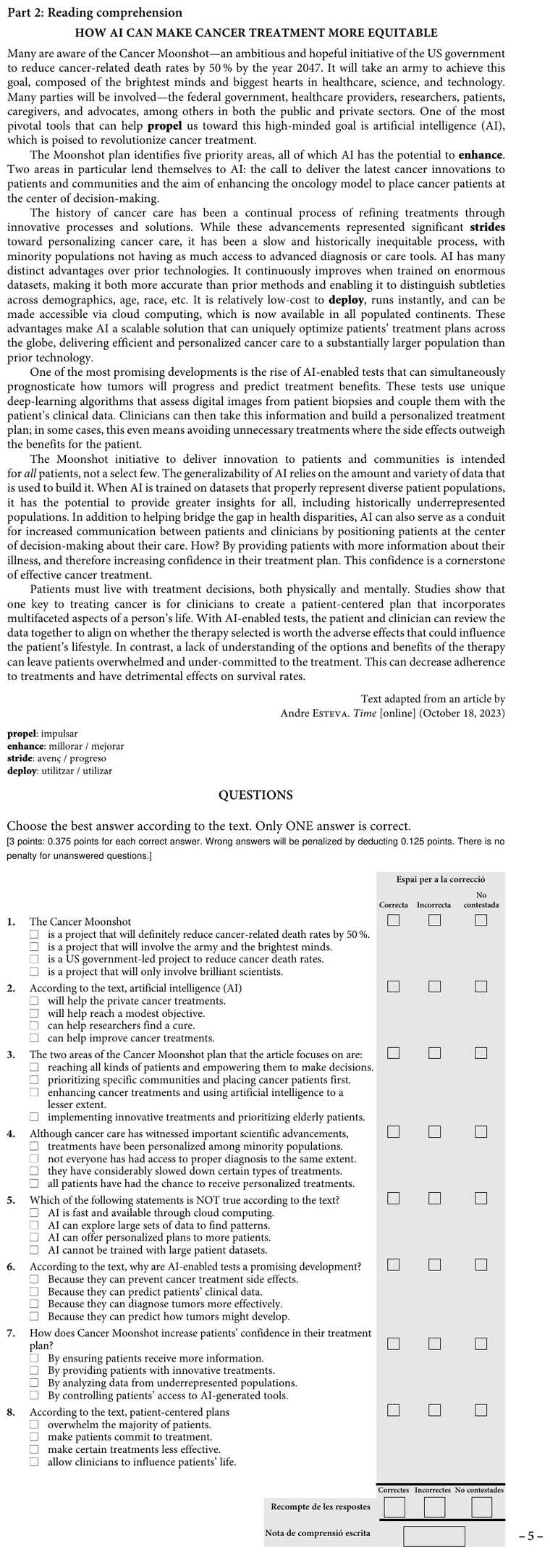
HOW AI CAN MAKE CANCER TREATMENT MORE EQUITABLE Many are aware of the Cancer Moonshot—an ambitious and hopeful initiative of the US government to reduce cancer-related death rates by 50 % by the year 2047. It will take an army to achieve this goal, composed of the brightest minds and biggest hearts in healthcare, science, and technology. Many parties will be involved—the federal government, healthcare providers, researchers, patients, caregivers, and advocates, among others in both the public and private sectors. One of the most pivotal tools that can help propel us toward this high-minded goal is artificial intelligence (AI), which is poised to revolutionize cancer treatment. The Moonshot plan identifies five priority areas, all of which AI has the potential to enhance. Two areas in particular lend themselves to AI: the call to deliver the latest cancer innovations to patients and communities and the aim of enhancing the oncology model to place cancer patients at the center of decision-making. The history of cancer care has been a continual process of refining treatments through innovative processes and solutions. While these advancements represented significant strides toward personalizing cancer care, it has been a slow and historically inequitable process, with minority populations not having as much access to advanced diagnosis or care tools. AI has many distinct advantages over prior technologies. It continuously improves when trained on enormous datasets, making it both more accurate than prior methods and enabling it to distinguish subtleties across demographics, age, race, etc. It is relatively low-cost to deploy, runs instantly, and can be made accessible via cloud computing, which is now available in all populated continents. These advantages make AI a scalable solution that can uniquely optimize patients’ treatment plans across the globe, delivering efficient and personalized cancer care to a substantially larger population than prior technology. One of the most promising developments is the rise of AI-enabled tests that can simultaneously prognosticate how tumors will progress and predict treatment benefits. These tests use unique deep-learning algorithms that assess digital images from patient biopsies and couple them with the patient’s clinical data. Clinicians can then take this information and build a personalized treatment plan; in some cases, this even means avoiding unnecessary treatments where the side effects outweigh the benefits for the patient. The Moonshot initiative to deliver innovation to patients and communities is intended for all patients, not a select few. The generalizability of AI relies on the amount and variety of data that is used to build it. When AI is trained on datasets that properly represent diverse patient populations, it has the potential to provide greater insights for all, including historically underrepresented populations. In addition to helping bridge the gap in health disparities, AI can also serve as a conduit for increased communication between patients and clinicians by positioning patients at the center of decision-making about their care. How? By providing patients with more information about their illness, and therefore increasing confidence in their treatment plan. This confidence is a cornerstone of effective cancer treatment. Patients must live with treatment decisions, both physically and mentally. Studies show that one key to treating cancer is for clinicians to create a patient-centered plan that incorporates multifaceted aspects of a person’s life. With AI-enabled tests, the patient and clinician can review the data together to align on whether the therapy selected is worth the adverse effects that could influence the patient’s lifestyle. In contrast, a lack of understanding of the options and benefits of the therapy can leave patients overwhelmed and under-committed to the treatment. This can decrease adherence to treatments and have detrimental effects on survival rates. Text adapted from an article by Andre Esteva. Time [online] (October 18, 2023) propel: impulsar enhance: millorar / mejorar stride: avenç / progreso deploy: utilitzar / utilizar
See the shared reading text and glossary in Part 2, question 1 (item 2.1).
The Cancer Moonshot
■ is a project that will definitely reduce cancer-related death rates by 50 %.
■ is a project that will involve the army and the brightest minds.
■ is a US government-led project to reduce cancer death rates.
■ is a project that will only involve brilliant scientists.
According to the text, artificial intelligence (AI)
■ will help the private cancer treatments.
■ will help reach a modest objective.
■ can help researchers find a cure.
■ can help improve cancer treatments.
The two areas of the Cancer Moonshot plan that the article focuses on are:
■ reaching all kinds of patients and empowering them to make decisions.
■ prioritizing specific communities and placing cancer patients first.
■ enhancing cancer treatments and using artificial intelligence to a
lesser extent.
■ implementing innovative treatments and prioritizing elderly patients.
Although cancer care has witnessed important scientific advancements,
■ treatments have been personalized among minority populations.
■ not everyone has had access to proper diagnosis to the same extent.
■ they have considerably slowed down certain types of treatments.
■ all patients have had the chance to receive personalized treatments.
Which of the following statements is NOT true according to the text?
■ AI is fast and available through cloud computing.
■ AI can explore large sets of data to find patterns.
■ AI can offer personalized plans to more patients.
■ AI cannot be trained with large patient datasets.
According to the text, why are AI-enabled tests a promising development?
■ Because they can prevent cancer treatment side effects.
■ Because they can predict patients’ clinical data.
■ Because they can diagnose tumors more effectively.
■ Because they can predict how tumors might develop.
How does Cancer Moonshot increase patients’ confidence in their treatment
plan?
■ By ensuring patients receive more information.
■ By providing patients with innovative treatments.
■ By analyzing data from underrepresented populations.
■ By controlling patients’ access to AI-generated tools.
According to the text, patient-centered plans
■ overwhelm the majority of patients.
■ make patients commit to treatment.
■ make certain treatments less effective.
■ allow clinicians to influence patients’ life.
El primer paràgraf identifica qui impulsa el projecte i amb quin objectiu. Reduir la mortalitat per càncer a la meitat per al 2047 és la fita que es proposa el govern dels Estats Units.
is a US government-led project to reduce cancer death rates.
+0,375criteri 1 de la pauta
Toca per ampliar- 0,375 pSeleccionar la resposta de la clau oficial: is a US government-led project to reduce cancer death rates.Penalització: Resposta incorrecta: −0.125 punts; pregunta no contestada: sense penalització.
El text presenta la IA com una eina per millorar l’atenció oncològica. Un exemple concret és l’ús de prediccions per triar un tractament més adequat a cada pacient.
can help improve cancer treatments.
+0,375criteri 1 de la pauta
Toca per ampliar- 0,375 pSeleccionar la resposta de la clau oficial: can help improve cancer treatments.Penalització: Resposta incorrecta: −0.125 punts; pregunta no contestada: sense penalització.
El segon paràgraf destaca dues prioritats del pla. Una és fer arribar les innovacions oncològiques a pacients i comunitats diversos i l’altra és donar als pacients un paper central en les decisions sobre la seva atenció.
reaching all kinds of patients and empowering them to make decisions.
+0,375criteri 1 de la pauta
Toca per ampliar- 0,375 pSeleccionar la resposta de la clau oficial: reaching all kinds of patients and empowering them to make decisions.Penalització: Resposta incorrecta: −0.125 punts; pregunta no contestada: sense penalització.
Amb although, l’enunciat demana la dificultat que ha persistit malgrat els avenços. El tercer paràgraf explica que les poblacions minoritàries han tingut menys accés a eines avançades de diagnòstic i d’atenció.
not everyone has had access to proper diagnosis to the same extent.
+0,375criteri 1 de la pauta
Toca per ampliar- 0,375 pSeleccionar la resposta de la clau oficial: not everyone has had access to proper diagnosis to the same extent.Penalització: Resposta incorrecta: −0.125 punts; pregunta no contestada: sense penalització.
El NOT et demana que marquis l’opció falsa. El tercer paràgraf diu que entrenar la IA amb conjunts de dades molt grans li permet millorar, així que l’opció amb cannot contradiu el text.
AI cannot be trained with large patient datasets.
+0,375criteri 1 de la pauta
Toca per ampliar- 0,375 pSeleccionar la resposta de la clau oficial: AI cannot be trained with large patient datasets.Penalització: Resposta incorrecta: −0.125 punts; pregunta no contestada: sense penalització.
El quart paràgraf explica que les proves combinen imatges de biòpsies amb dades clíniques per anticipar l’evolució d’un tumor i estimar els beneficis del tractament.
Because they can predict how tumors might develop.
+0,375criteri 1 de la pauta
Toca per ampliar- 0,375 pSeleccionar la resposta de la clau oficial: Because they can predict how tumors might develop.Penalització: Resposta incorrecta: −0.125 punts; pregunta no contestada: sense penalització.
Cap al final del cinquè paràgraf, el text relaciona la confiança amb allò que sap el pacient. Amb més informació sobre la seva malaltia, pot entendre millor el pla de tractament i participar en les decisions.
By ensuring patients receive more information.
+0,375criteri 1 de la pauta
Toca per ampliar- 0,375 pSeleccionar la resposta de la clau oficial: By ensuring patients receive more information.Penalització: Resposta incorrecta: −0.125 punts; pregunta no contestada: sense penalització.
L’últim paràgraf explica que el pacient i el metge poden valorar junts els beneficis i els efectes adversos. Entendre per què han triat aquell tractament fa més fàcil seguir-lo.
make patients commit to treatment.
+0,375criteri 1 de la pauta
Toca per ampliar- 0,375 pSeleccionar la resposta de la clau oficial: make patients commit to treatment.Penalització: Resposta incorrecta: −0.125 punts; pregunta no contestada: sense penalització.
Exercici 3 · opció A
Writing
 Toca per ampliar
Choose ONE topic. Your answer should be 125-150 words in length. There is no specific penalty for exceeding 150 words in length. Extra points are not given for exceeding 150 words. [4 points]
Advertising plays a significant role in shaping consumer choices. Write an opinion essay examining the influence of advertising on consumer behavior. Discuss the power of persuasion, ethical considerations, and the impact of advertising on societal values and priorities.
En un assaig d’opinió, presenta la teva tesi a l’inici i defensa-la amb exemples. El model relaciona el desig de comprar amb l’estil de vida que promet la publicitat i explica com aquests missatges poden reforçar el consum com a mesura de l’èxit.
+4criteri 1 de la pauta
Advertising does more than inform us about products: it influences what we consider desirable and successful. In my view, its persuasive power requires stronger ethical limits, particularly when young audiences are involved.
An advertisement rarely sells an object alone. It connects that object with confidence, friendship or an attractive lifestyle. Consequently, consumers may buy things they do not need because they hope to acquire the feelings associated with them.
This becomes troubling when companies exploit insecurities or conceal important information. Edited images can encourage unrealistic expectations, while vague environmental promises may make harmful purchases seem responsible. Such messages suggest that personal value depends on constant consumption.
Nevertheless, advertising can help people discover useful products and compare options. The answer is not to ban persuasion, but to require honesty and clear sponsorship labels. Consumers also need the confidence to ask whether a purchase serves their priorities or somebody else's profit.
Toca per ampliar- 4 pSense desglossament: valoració global de la redacció (4 punts). La graella oficial compartida per tots els temes inclou Grammar, Vocabulary, Text i Maturity, sense pesos per categoria, descriptors de banda ni deduccions per error als PDF aportats.
Exercici 3 · opció B
Writing
Toca per ampliarChoose ONE topic. Your answer should be 125-150 words in length. There is no specific penalty for exceeding 150 words in length. Extra points are not given for exceeding 150 words. [4 points]
Write a formal email addressing a complaint to a customer service department. Clearly describe the problem, provide necessary details, and request a solution or explanation.
En un correu formal de reclamació, indica el número de comanda i descriu el defecte amb detalls que el destinatari pugui comprovar. El model aporta proves, demana una làmpada nova o un reemborsament i sol·licita una resposta en set dies.
+4criteri 1 de la pauta
Dear Customer Service Team,
I am writing regarding a desk lamp purchased from your online shop on 3 September, order number LM731. Unfortunately, the product delivered yesterday is damaged and cannot be used safely.
The base is cracked, and the switch remains loose even when pressed firmly into position. Although the outer packaging appeared intact, the lamp had very little protective material around it. I have attached photographs of the damage and a copy of my receipt.
I would appreciate either an undamaged replacement or a full refund, including the delivery charge. Please also arrange collection of the faulty item at no additional cost. As I need suitable lighting for my studies, a prompt resolution would be particularly helpful.
Could you confirm within seven days how you intend to resolve this matter? Thank you for your attention.
Yours faithfully,
Alex Martin
Toca per ampliar- 4 pSense desglossament: valoració global de la redacció (4 punts). La graella oficial compartida per tots els temes inclou Grammar, Vocabulary, Text i Maturity, sense pesos per categoria, descriptors de banda ni deduccions per error als PDF aportats.
Exercici 3 · opció C
Writing
Toca per ampliarChoose ONE topic. Your answer should be 125-150 words in length. There is no specific penalty for exceeding 150 words in length. Extra points are not given for exceeding 150 words. [4 points]
Choose a popular comedy TV series available on streaming platforms and write a review for young viewers. Analyze the humor, character dynamics, and the show’s overall appeal. Discuss specific episodes or story arcs that stood out and why you believe it would resonate with a young audience.
En una ressenya, explica què fa gràcia i com les relacions entre els personatges creen situacions còmiques. El model en dona un exemple amb els episodis de Halloween i justifica la recomanació a partir d’una experiència propera als joves.
+4criteri 1 de la pauta
Brooklyn Nine-Nine: Beyond Jokes
Looking for a comedy with memorable characters? Brooklyn Nine-Nine combines lively workplace humour with friendships that develop beyond the punchlines.
The contrast between impulsive detective Jake and painstakingly organised Amy drives many of the funniest scenes. Captain Holt's restrained reactions make their chaotic behaviour even more entertaining. Instead of relying only on embarrassment, the series often finds humour in the different ways colleagues approach the same problem.
The Halloween competition episodes are particular highlights. Elaborate plans repeatedly collapse as apparently unlikely characters outsmart everyone else. They also reveal how closely the team members understand one another.
Some jokes are exaggerated, and the police setting may not appeal to everyone. Nevertheless, young viewers may recognise the anxiety of proving themselves and finding where they belong. I would recommend it for its affectionate ensemble and the way rivalry gradually becomes mutual respect.
Toca per ampliar- 4 pSense desglossament: valoració global de la redacció (4 punts). La graella oficial compartida per tots els temes inclou Grammar, Vocabulary, Text i Maturity, sense pesos per categoria, descriptors de banda ni deduccions per error als PDF aportats.