Anglès
PAU 2024 · ordinària · tribunal d’incidències · sèrie 5
Examen oficial de la PAU de Catalunya amb la pauta de correcció. És d’una convocatòria anterior al model 2025: la pauta correspon a aquell examen.
Listening
PAU 2024 · ordinària · tribunal d’incidències · sèrie 5Instruccions de l’examen
Part 1: Listening comprehension
Choose the best answer according to the recording. Only ONE answer is correct. [3 points: 0.375 points for each correct answer. Wrong answers will be penalized by deducting 0.125 points. There is no penalty for unanswered questions.]
Part 2: Reading comprehension
Choose the best answer according to the text. Only ONE answer is correct. [3 points: 0.375 points for each correct answer. Wrong answers will be penalized by deducting 0.125 points. There is no penalty for unanswered questions.]
Part 3: Writing
Choose ONE topic. Your answer should be 125-150 words in length. There is no specific penalty for exceeding 150 words in length. Extra points are not given for exceeding 150 words. [4 points]
Exercici 1
Listening comprehension
 Toca per ampliar
K-POP, MORE THAN JUST A MUSIC STYLE
Interviewer: South Korea is known for its festivals, some of which have been celebrated since the 16th century. Due to its rich history, there are also many traditional buildings, such as Buddhist temples and huge palaces. But among young people, South Korea is famous for K-pop. Early in the pandemic, sociologist Chris Resa began watching K-pop videos, largely for fun. Now she’s exploring the societal impact of the popular genre. Good morning, Chris.
Chris: Good morning. A pleasure to be here.
Interviewer: Well Chris, K-pop stands for Korean Pop but now it belongs to the whole world as it has transformed into a global cultural phenomenon. Is it true?
Chris: I couldn’t agree more. During the 1990s, it was a musical subculture popular in South Korea but K-pop now frequently tops the billboard charts, attracts fiercely dedicated online followers, and generates billions of dollars. Its best-known artists, the boy band BTS, were nominated in three different categories at the Grammy Awards last year, and they are the most-listened-to group in Spotify history.
Interviewer: UCLA professor Yao Kim, who has also written about the K-pop phenomenon, said, "It's way more than music. It is a total entertainment that incorporates choreography, fashion and lifestyle.” Do you agree?
Chris: Sure. We used to have very prominent boy bands and girl groups, such as New Kids on the Block, Spice Girls or One Direction. I think K-pop really hits kind of a vacuum that Western pop cultural trends left behind.
Interviewer: Chris, as a Professor of Sociology and Professor of ethnicity, race, and migration in Yale’s Faculty of Arts and Sciences, you have done research on why the genre’s rise has been important to so many Asian Americans. You have said that watching a TV programme on Saturday Night Live changed your view of K-pop. How did that performance turn your personal interest in K-pop into an academic one?
Chris: I saw that performance, and it stayed in the back of my mind. Then, when we were on lockdown because of COVID, being stuck at home set the stage for having time to watch more K-pop videos. At first, I was just watching them for fun. I knew K-pop was something important, but I didn’t know anything about it. I thought “I should educate myself on this.” I’ve always been interested in race and ethnicity and Asian Americans. I knew that K-pop was important, so I started investigating the phenomenon.
Interviewer: What kind of research are you doing?
Chris: My colleagues and I, we are studying the link between 80s synth-pop and current K-pop. Others have argued that K-pop borrows heavily from American Black music. And it’s true, but we’re arguing that K-pop has links to many different genres (black music, synth pop, hip hop, new wave synth, even reggae). In another project, with two data scientists, we’re looking at Twitter data related to a tweet that BTS posted in 2021, about a week after a gunman in Atlanta murdered eight women, including six of Asian descent. K-pop fans are really well organized, and they may be ready to take political action. K-pop is extremely influential. So, we’re looking at how the conversation about the shootings before and after they tweeted changed.
Interviewer: Why do you think K-pop is so influential? I mean, yeah, they are really popular in Korea but what about the States, for example? Do you think that K-pop may have a role in American society?
Chris: Sure! Think about this. BTS performed on Saturday Night Live, NBC's Emmy-winning late-night comedy showcase. Especially people my age in their mid-thirties, we had never seen a bunch of East Asian people on the stage singing in a non- English, non-Western language. I knew that was an important moment regardless of whether or not you like the music or the performance. Asians were visible! BTS made Asian faces more visible. They were on the cover of Time magazine, every major publication. They were everywhere. But it also brought up questions of xenophobia. People were making fun of them because of how they looked. At the time, there was also the extra baggage that comes with being Asian. But any time BTS were attacked, because their fandom is so big and so passionate, their fans would jump on anyone who did anything to them. Then journalists would cover it, and suddenly there were all these stories about how you shouldn’t be racist against Asians.
Interviewer: Are you saying that BTS fans could stop xenophobia?
Chris: Well, many of us who study Asian Americans have observed over time that it often seems acceptable for people to make fun of Asian things. Now, BTS fans are protecting them, and that that gets elevated to the news is a big deal. President Biden invited them to the White House. These are all things I would have had trouble imagining even just five years ago.
Interviewer: I have heard that many fans would like to become K-pop idols themselves. But that’s not easy at all.
Chris: Right. Many go for an audition. If you're chosen, you'll spend up to ten years in South Korea's K-pop training centres, operated by the entertainment companies. It's kind of like a boot camp. You go to your acting class, you go to your singing class, you go to your dance class. Your appearance will also be managed: you get camera tested on every angle, hair and makeup. They change up different hairstyles, different colours.
Interviewer: Is there a dark side to it?
Chris: When there's a good side, there's always going to be a bad side. It was a pressure of success. While the training camps may sound intense to Americans, that
kind of competitive pressure pervades Korean culture. I'm not sure that it's unique to K-pop. It's a societal thing in Korea. There is a lot of pressure on doing well in school. They're all up until whatever time at night, like, studying, doing the work. There is this idea of wanting to do your best, and not disappointing others.
Interviewer: I see…but if K-pop idols are often put on extremely strict diets, strenuous training schedules, and are heavily scrutinized, ... no one, no adults criticize this situation?
Chris: Well, in fact, last year a bill was passed amidst rising concerns from the public about the health and safety of minors in the highly demanding Korean entertainment industry, as companies continue to debut K-pop idols at younger ages. It is a bill to protect underage K-pop idols from exploitation and it is meant to reinforce financial transparency. Previously, entertainers under the age of 15 could work up to 35 hours a week, while those older than 15 were allowed 40 hours a week. Now, entertainers under the age of 12 can only work a maximum of 25 hours a week, up to 6 hours a day. Those aged 12 to 15 are allowed 30 hours a week, while those above the age of 15 can work 35 hours a week, both of these age groups are limited to 7 hours a day. What is more, the law also prohibits any infringement of underage entertainers' rights to education by forcing them to be absent from or drop out of school. So, K-pop teenagers must attend school.
Interviewer: I see that things are changing for the better. Well, Chris, we do not have time for more. Thanks for your interesting insights into K-pop.
Chris: Thank you.
Adapted from:
The rise of K-pop, and what it reveals about society and culture, Yale News, Caroline Huber (August 21, 2023) https://news.yale.edu/2023/08/21/rise-k-pop-and-what-it-reveals-about-society-and-culture
See the official listening transcript in Part 1, question 1 (item 1.1).
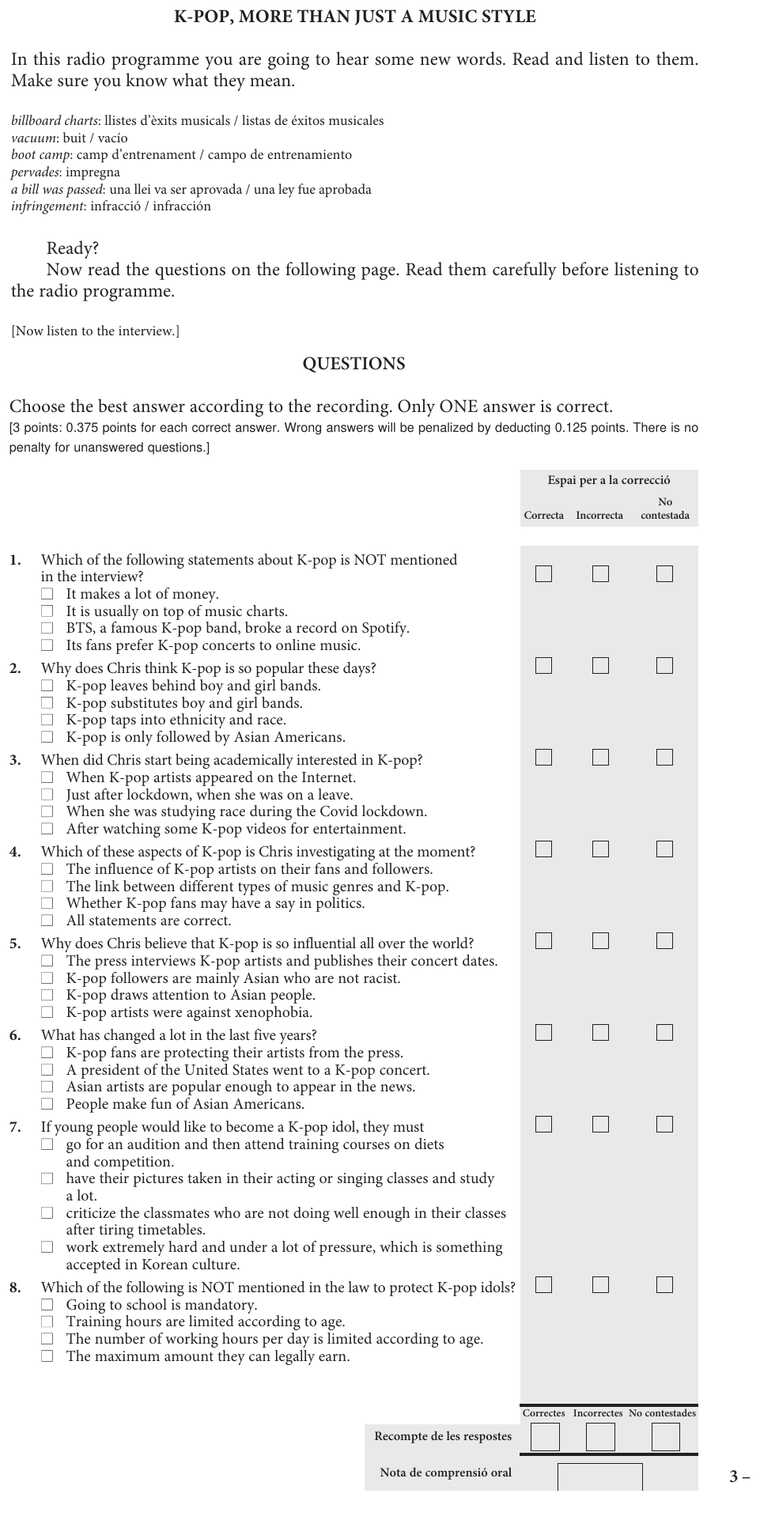
Which of the following statements about K-pop is NOT mentioned
in the interview?
■ It makes a lot of money.
■ It is usually on top of music charts.
■ BTS, a famous K-pop band, broke a record on Spotify.
■ Its fans prefer K-pop concerts to online music.
Why does Chris think K-pop is so popular these days?
■ K-pop leaves behind boy and girl bands.
■ K-pop substitutes boy and girl bands.
■ K-pop taps into ethnicity and race.
■ K-pop is only followed by Asian Americans.
When did Chris start being academically interested in K-pop?
■ When K-pop artists appeared on the Internet.
■ Just after lockdown, when she was on a leave.
■ When she was studying race during the Covid lockdown.
■ After watching some K-pop videos for entertainment.
Which of these aspects of K-pop is Chris investigating at the moment?
■ The influence of K-pop artists on their fans and followers.
■ The link between different types of music genres and K-pop.
■ Whether K-pop fans may have a say in politics.
■ All statements are correct.
Why does Chris believe that K-pop is so influential all over the world?
■ The press interviews K-pop artists and publishes their concert dates.
■ K-pop followers are mainly Asian who are not racist.
■ K-pop draws attention to Asian people.
■ K-pop artists were against xenophobia.
What has changed a lot in the last five years?
■ K-pop fans are protecting their artists from the press.
■ A president of the United States went to a K-pop concert.
■ Asian artists are popular enough to appear in the news.
■ People make fun of Asian Americans.
If young people would like to become a K-pop idol, they must
■ go for an audition and then attend training courses on diets
and competition.
■ have their pictures taken in their acting or singing classes and study
a lot.
■ criticize the classmates who are not doing well enough in their classes
after tiring timetables.
■ work extremely hard and under a lot of pressure, which is something
accepted in Korean culture.
Which of the following is NOT mentioned in the law to protect K-pop idols?
■ Going to school is mandatory.
■ Training hours are limited according to age.
■ The number of working hours per day is limited according to age.
■ The maximum amount they can legally earn.
La paraula NOT t’indica que has de buscar l’afirmació que queda fora de l’entrevista. Chris parla dels ingressos, de les llistes d’èxits i de l’èxit de BTS a Spotify.
Its fans prefer K-pop concerts to online music.
+0,375criteri 1 de la pauta
 Toca per ampliar
- 0,375 pSeleccionar la resposta de la clau oficial: Its fans prefer K-pop concerts to online music.Penalització: Resposta incorrecta: −0.125 punts; pregunta no contestada: sense penalització.
Interpreta què vol dir Chris amb a vacuum. Es refereix al buit que van deixar grups occidentals com les Spice Girls o One Direction i que ara omple el K-pop.
K-pop substitutes boy and girl bands.
+0,375criteri 1 de la pauta
Toca per ampliar- 0,375 pSeleccionar la resposta de la clau oficial: K-pop substitutes boy and girl bands.Penalització: Resposta incorrecta: −0.125 punts; pregunta no contestada: sense penalització.
Situa el moment en què l’interès de Chris es converteix en recerca. Durant el confinament mirava vídeos de K-pop per passar l’estona i, a partir d’aquí, va decidir estudiar el fenomen.
After watching some K-pop videos for entertainment.
+0,375criteri 1 de la pauta
Toca per ampliar- 0,375 pSeleccionar la resposta de la clau oficial: After watching some K-pop videos for entertainment.Penalització: Resposta incorrecta: −0.125 punts; pregunta no contestada: sense penalització.
Comprova si Chris investiga els tres aspectes de la pregunta. Estudia els vincles amb altres gèneres i compara la conversa a Twitter sobre l’atac d’Atlanta abans i després d’un missatge de BTS per entendre la influència del grup i la capacitat de mobilització política dels seguidors.
All statements are correct.
+0,375criteri 1 de la pauta
Toca per ampliar- 0,375 pSeleccionar la resposta de la clau oficial: All statements are correct.Penalització: Resposta incorrecta: −0.125 punts; pregunta no contestada: sense penalització.
Busca l’efecte que Chris destaca quan recorda l’actuació de BTS a Saturday Night Live. Veure un grup de l’Àsia oriental cantar en coreà en un programa nord-americà de gran audiència va donar més visibilitat a les persones asiàtiques.
K-pop draws attention to Asian people.
+0,375criteri 1 de la pauta
Toca per ampliar- 0,375 pSeleccionar la resposta de la clau oficial: K-pop draws attention to Asian people.Penalització: Resposta incorrecta: −0.125 punts; pregunta no contestada: sense penalització.
Identifica què li hauria costat imaginar a Chris cinc anys abans. La defensa de BTS per part dels fans va arribar als mitjans, i el grup fins i tot va rebre una invitació a la Casa Blanca.
Asian artists are popular enough to appear in the news.
+0,375criteri 1 de la pauta
Toca per ampliar- 0,375 pSeleccionar la resposta de la clau oficial: Asian artists are popular enough to appear in the news.Penalització: Resposta incorrecta: −0.125 punts; pregunta no contestada: sense penalització.
Fixa’t en què exigeix la formació dels aspirants i com ho explica Chris. Els centres combinen classes de cant, ball i interpretació, i Chris relaciona la pressió per excel·lir amb una exigència més general de la societat coreana.
work extremely hard and under a lot of pressure, which is something accepted in Korean culture.
+0,375criteri 1 de la pauta
Toca per ampliar- 0,375 pSeleccionar la resposta de la clau oficial: work extremely hard and under a lot of pressure, which is something accepted in Korean culture.Penalització: Resposta incorrecta: −0.125 punts; pregunta no contestada: sense penalització.
Busca quin detall econòmic queda fora de l’entrevista. Chris esmenta la transparència financera, l’assistència a l’escola i els límits d’hores de feina segons l’edat.
The maximum amount they can legally earn.
+0,375criteri 1 de la pauta
Toca per ampliar- 0,375 pSeleccionar la resposta de la clau oficial: The maximum amount they can legally earn.Penalització: Resposta incorrecta: −0.125 punts; pregunta no contestada: sense penalització.
Exercici 2
Reading comprehension
 Toca per ampliar
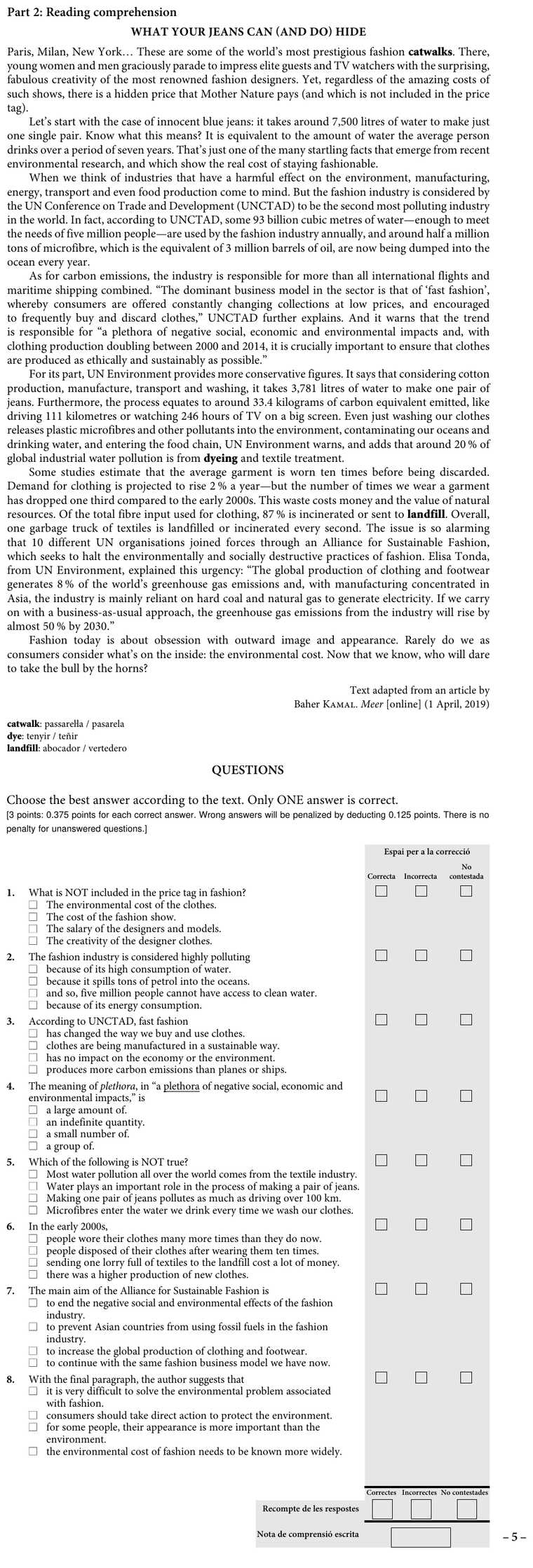
WHAT YOUR JEANS CAN (AND DO) HIDE Paris, Milan, New York… These are some of the world’s most prestigious fashion catwalks. There, young women and men graciously parade to impress elite guests and TV watchers with the surprising, fabulous creativity of the most renowned fashion designers. Yet, regardless of the amazing costs of such shows, there is a hidden price that Mother Nature pays (and which is not included in the price tag). Let’s start with the case of innocent blue jeans: it takes around 7,500 litres of water to make just one single pair. Know what this means? It is equivalent to the amount of water the average person drinks over a period of seven years. That’s just one of the many startling facts that emerge from recent environmental research, and which show the real cost of staying fashionable. When we think of industries that have a harmful effect on the environment, manufacturing, energy, transport and even food production come to mind. But the fashion industry is considered by the UN Conference on Trade and Development (UNCTAD) to be the second most polluting industry in the world. In fact, according to UNCTAD, some 93 billion cubic metres of water—enough to meet the needs of five million people—are used by the fashion industry annually, and around half a million tons of microfibre, which is the equivalent of 3 million barrels of oil, are now being dumped into the ocean every year. As for carbon emissions, the industry is responsible for more than all international flights and maritime shipping combined. “The dominant business model in the sector is that of ‘fast fashion’, whereby consumers are offered constantly changing collections at low prices, and encouraged to frequently buy and discard clothes,” UNCTAD further explains. And it warns that the trend is responsible for “a plethora of negative social, economic and environmental impacts and, with clothing production doubling between 2000 and 2014, it is crucially important to ensure that clothes are produced as ethically and sustainably as possible.” For its part, UN Environment provides more conservative figures. It says that considering cotton production, manufacture, transport and washing, it takes 3,781 litres of water to make one pair of jeans. Furthermore, the process equates to around 33.4 kilograms of carbon equivalent emitted, like driving 111 kilometres or watching 246 hours of TV on a big screen. Even just washing our clothes releases plastic microfibres and other pollutants into the environment, contaminating our oceans and drinking water, and entering the food chain, UN Environment warns, and adds that around 20 % of global industrial water pollution is from dyeing and textile treatment. Some studies estimate that the average garment is worn ten times before being discarded. Demand for clothing is projected to rise 2 % a year—but the number of times we wear a garment has dropped one third compared to the early 2000s. This waste costs money and the value of natural resources. Of the total fibre input used for clothing, 87 % is incinerated or sent to landfill. Overall, one garbage truck of textiles is landfilled or incinerated every second. The issue is so alarming that 10 different UN organisations joined forces through an Alliance for Sustainable Fashion, which seeks to halt the environmentally and socially destructive practices of fashion. Elisa Tonda, from UN Environment, explained this urgency: “The global production of clothing and footwear generates 8 % of the world’s greenhouse gas emissions and, with manufacturing concentrated in Asia, the industry is mainly reliant on hard coal and natural gas to generate electricity. If we carry on with a business-as-usual approach, the greenhouse gas emissions from the industry will rise by almost 50 % by 2030.” Fashion today is about obsession with outward image and appearance. Rarely do we as consumers consider what’s on the inside: the environmental cost. Now that we know, who will dare to take the bull by the horns? Text adapted from an article by Baher Kamal. Meer [online] (1 April, 2019) catwalk: passareŀla / pasarela dye: tenyir / teñir landfill: abocador / vertedero
See the shared reading text and glossary in Part 2, question 1 (item 2.1).
What is NOT included in the price tag in fashion?
■ The environmental cost of the clothes.
■ The cost of the fashion show.
■ The salary of the designers and models.
■ The creativity of the designer clothes.
The fashion industry is considered highly polluting
■ because of its high consumption of water.
■ because it spills tons of petrol into the oceans.
■ and so, five million people cannot have access to clean water.
■ because of its energy consumption.
According to UNCTAD, fast fashion
■ has changed the way we buy and use clothes.
■ clothes are being manufactured in a sustainable way.
■ has no impact on the economy or the environment.
■ produces more carbon emissions than planes or ships.
The meaning of plethora, in “a plethora of negative social, economic and
environmental impacts,” is
■ a large amount of.
■ an indefinite quantity.
■ a small number of.
■ a group of.
Which of the following is NOT true?
■ Most water pollution all over the world comes from the textile industry.
■ Water plays an important role in the process of making a pair of jeans.
■ Making one pair of jeans pollutes as much as driving over 100 km.
■ Microfibres enter the water we drink every time we wash our clothes.
In the early 2000s,
■ people wore their clothes many more times than they do now.
■ people disposed of their clothes after wearing them ten times.
■ sending one lorry full of textiles to the landfill cost a lot of money.
■ there was a higher production of new clothes.
The main aim of the Alliance for Sustainable Fashion is
■ to end the negative social and environmental effects of the fashion
industry.
■ to prevent Asian countries from using fossil fuels in the fashion
industry.
■ to increase the global production of clothing and footwear.
■ to continue with the same fashion business model we have now.
With the final paragraph, the author suggests that
■ it is very difficult to solve the environmental problem associated
with fashion.
■ consumers should take direct action to protect the environment.
■ for some people, their appearance is more important than the
environment.
■ the environmental cost of fashion needs to be known more widely.
Al primer paràgraf, identifica el preu ocult que paga la natura. L’exemple de l’aigua que cal per fabricar uns texans concreta aquest cost.
The environmental cost of the clothes.
+0,375criteri 1 de la pauta
Toca per ampliar- 0,375 pSeleccionar la resposta de la clau oficial: The environmental cost of the clothes.Penalització: Resposta incorrecta: −0.125 punts; pregunta no contestada: sense penalització.
Busca la dada que el text dona just després de presentar la moda com una indústria molt contaminant. Segons el text, el sector consumeix uns 93 mil milions de metres cúbics d’aigua l’any.
because of its high consumption of water.
+0,375criteri 1 de la pauta- Nota d’OriginalLa clau oficial només accepta l’opció sobre el consum d’aigua. L’opció because of its energy consumption també es pot defensar perquè el text relaciona les emissions del sector amb l’ús de carbó i gas natural per generar electricitat.
Toca per ampliar- 0,375 pSeleccionar la resposta de la clau oficial: because of its high consumption of water.Penalització: Resposta incorrecta: −0.125 punts; pregunta no contestada: sense penalització.
Localitza la definició de fast fashion que dona la UNCTAD. Les col·leccions canvien sovint i els preus baixos animen a comprar roba i a descartar-la més de pressa.
has changed the way we buy and use clothes.
+0,375criteri 1 de la pauta
Toca per ampliar- 0,375 pSeleccionar la resposta de la clau oficial: has changed the way we buy and use clothes.Penalització: Resposta incorrecta: −0.125 punts; pregunta no contestada: sense penalització.
Dedueix el significat de plethora a partir de la frase. Les conseqüències negatives s’estenen a diversos àmbits i el text en subratlla l’abundància.
a large amount of.
+0,375criteri 1 de la pauta
Toca per ampliar- 0,375 pSeleccionar la resposta de la clau oficial: a large amount of.Penalització: Resposta incorrecta: −0.125 punts; pregunta no contestada: sense penalització.
Comprova l’abast de la xifra abans de marcar l’afirmació falsa. El text atribueix al tenyit i al tractament tèxtil aproximadament el 20 % de la contaminació industrial de l’aigua, i l’opció parla de la major part de tota la contaminació de l’aigua.
Most water pollution all over the world comes from the textile industry.
+0,375criteri 1 de la pauta
Toca per ampliar- 0,375 pSeleccionar la resposta de la clau oficial: Most water pollution all over the world comes from the textile industry.Penalització: Resposta incorrecta: −0.125 punts; pregunta no contestada: sense penalització.
Compara les vegades que es porta una peça ara i a principis dels anys 2000. El text diu que el nombre d’usos ha baixat un terç des d’aleshores.
people wore their clothes many more times than they do now.
+0,375criteri 1 de la pauta
Toca per ampliar- 0,375 pSeleccionar la resposta de la clau oficial: people wore their clothes many more times than they do now.Penalització: Resposta incorrecta: −0.125 punts; pregunta no contestada: sense penalització.
Localitza la frase que diu per què es va crear l’Aliança per a la Moda Sostenible. L’objectiu és aturar les pràctiques del sector que perjudiquen les persones i el medi ambient.
to end the negative social and environmental effects of the fashion industry.
+0,375criteri 1 de la pauta
Toca per ampliar- 0,375 pSeleccionar la resposta de la clau oficial: to end the negative social and environmental effects of the fashion industry.Penalització: Resposta incorrecta: −0.125 punts; pregunta no contestada: sense penalització.
Toca per ampliar- 0,375 pSeleccionar la resposta de la clau oficial: it is very difficult to solve the environmental problem associated with fashion.Penalització: Resposta incorrecta: −0.125 punts; pregunta no contestada: sense penalització.
Exercici 3 · opció A
Writing
 Toca per ampliar
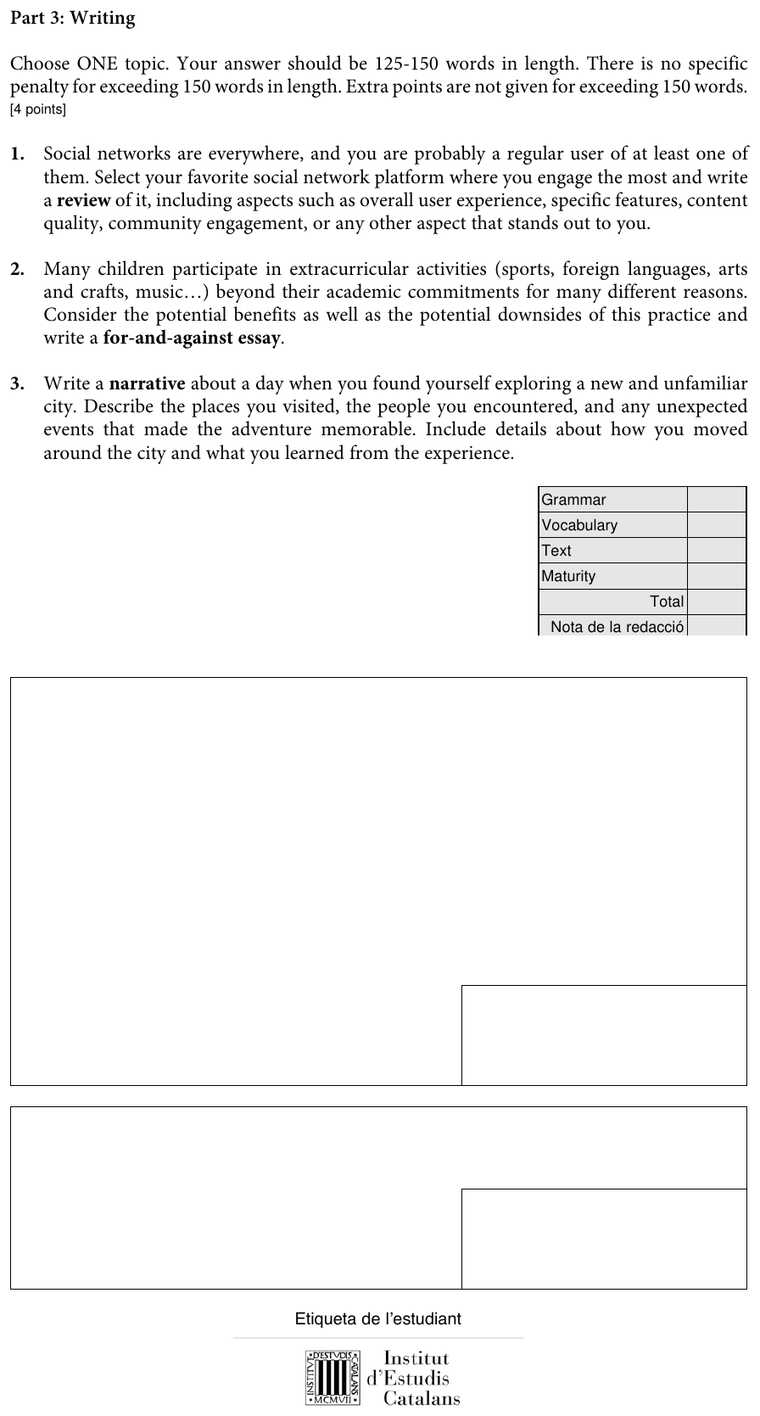
Choose ONE topic. Your answer should be 125-150 words in length. There is no specific penalty for exceeding 150 words in length. Extra points are not given for exceeding 150 words. [4 points]
Social networks are everywhere, and you are probably a regular user of at least one of them. Select your favorite social network platform where you engage the most and write a review of it, including aspects such as overall user experience, specific features, content quality, community engagement, or any other aspect that stands out to you.
En una ressenya, presenta la xarxa que més fas servir i valora-la amb exemples de la teva experiència.
El model explica què hi fa l’autor i com li serveixen les col·leccions i les converses amb artistes. Després valora els anuncis i les recomanacions de vídeos, i acaba indicant a qui recomanaria Instagram i en quines condicions.
+4criteri 1 de la pauta
Instagram: Inspiring, If You Stay in Control
Instagram is the social platform I use most, to follow photographers and share sketches. Its visual layout makes browsing straightforward, and saving posts into collections is particularly useful when I need creative inspiration.
Stories allow quick, informal updates, while comments sometimes lead to helpful conversations about techniques. I have discovered local artists whose work I would otherwise never have seen. For me, these small communities are its strongest feature.
However, content quality varies considerably. Advertisements interrupt the experience, and recommended videos can turn a brief visit into half an hour of mindless scrolling. Carefully edited images also make ordinary life seem unfairly dull.
Overall, I recommend Instagram to creative users who are willing to choose their accounts carefully and set time limits. It works best as a source of ideas and connection, rather than a standard against which to measure yourself.
Toca per ampliar- 4 pSense desglossament: valoració global de la redacció (4 punts). La graella oficial compartida per tots els temes inclou Grammar, Vocabulary, Text i Maturity, sense pesos per categoria, descriptors de banda ni deduccions per error als PDF aportats.
Exercici 3 · opció B
Writing
Toca per ampliarChoose ONE topic. Your answer should be 125-150 words in length. There is no specific penalty for exceeding 150 words in length. Extra points are not given for exceeding 150 words. [4 points]
Many children participate in extracurricular activities (sports, foreign languages, arts and crafts, music…) beyond their academic commitments for many different reasons. Consider the potential benefits as well as the potential downsides of this practice and write a for-and-against essay.
En un text a favor i en contra, desenvolupa els avantatges i els inconvenients de les activitats extraescolars abans de donar el teu parer.
El model dedica un paràgraf a la confiança i les amistats i un altre a la manca de temps lliure i al cost. A la conclusió, l’autor proposa que les famílies ofereixin opcions que puguin assumir i escoltin l’infant a l’hora de triar.
+4criteri 1 de la pauta
Extracurricular activities can broaden a child's education, but a crowded timetable is not necessarily a better one. Both the opportunities and the pressures deserve attention.
Sports, music and other shared interests help children develop confidence beyond the classroom. They can make friends, discover talents and learn that improvement requires practice. For a child who struggles academically, success in another setting may be especially encouraging.
However, too many commitments leave little time for rest, family life or unplanned play. Activities chosen mainly to impress adults can become another source of assessment. Their cost may also place pressure on families and widen differences between children.
In my opinion, the best approach is to offer a manageable choice and listen to the child's response. One enjoyable activity can provide more lasting benefits than several exhausting ones. Free time should remain part of childhood, rather than an empty space adults feel obliged to fill.
Toca per ampliar- 4 pSense desglossament: valoració global de la redacció (4 punts). La graella oficial compartida per tots els temes inclou Grammar, Vocabulary, Text i Maturity, sense pesos per categoria, descriptors de banda ni deduccions per error als PDF aportats.
Exercici 3 · opció C
Writing
Toca per ampliarChoose ONE topic. Your answer should be 125-150 words in length. There is no specific penalty for exceeding 150 words in length. Extra points are not given for exceeding 150 words. [4 points]
Write a narrative about a day when you found yourself exploring a new and unfamiliar city. Describe the places you visited, the people you encountered, and any unexpected events that made the adventure memorable. Include details about how you moved around the city and what you learned from the experience.
En una narració, fes que el recorregut per la ciutat porti a un imprevist i acaba explicant què n’has après.
El narrador es perd a peu pel barri vell de Girona i una fornera s’ofereix a ajudar-lo. La ruta que li recomana el porta a una festa del barri, on un home gran li explica les cançons. Aquest imprevist fa que descobreixi la ciutat a través de les persones que hi coneix.
+4criteri 1 de la pauta
I arrived in Girona with a map, a sandwich and an ambitious list of places to visit. After crossing a bridge over the river, I walked into the old town, where narrow streets quickly defeated my careful navigation.
A baker noticed me turning the map upside down and asked whether I needed help. Instead of simply pointing towards the cathedral, she recommended a quieter route past a tiny courtyard. There, an unexpected burst of music drew me into a neighbourhood celebration.
I stayed to listen, sharing a bench with an elderly man who explained the songs. By the time I reached the cathedral steps, I had abandoned half my schedule.
I returned to the station on foot, tired but delighted. Getting lost had shown me that exploring a city is not just about collecting famous sights. Sometimes the people you meet reveal the place more clearly than any guidebook.
Toca per ampliar- 4 pSense desglossament: valoració global de la redacció (4 punts). La graella oficial compartida per tots els temes inclou Grammar, Vocabulary, Text i Maturity, sense pesos per categoria, descriptors de banda ni deduccions per error als PDF aportats.