Anglès
PAU 2024 · ordinària · sèrie 1
Examen oficial de la PAU de Catalunya amb la resolució pas a pas de cada apartat i la pauta de correcció. És d’una convocatòria anterior al model 2025: la pauta correspon a aquell examen.
Listening
PAU 2024 · ordinària · sèrie 1Instruccions de l’examen
Part 1: Listening comprehension
Choose the best answer according to the recording. Only ONE answer is correct. [3 points: 0.375 points for each correct answer. Wrong answers will be penalized by deducting 0.125 points. There is no penalty for unanswered questions.]
Part 2: Reading comprehension
Choose the best answer according to the text. Only ONE answer is correct. [3 points: 0.375 points for each correct answer. Wrong answers will be penalized by deducting 0.125 points. There is no penalty for unanswered questions.]
Part 3: Writing
Choose ONE topic. Your answer should be 125-150 words in length. There is no specific penalty for exceeding 150 words in length. Extra points are not given for exceeding 150 words. [4 points]
Exercici 1
Listening comprehension
 Toca per ampliar
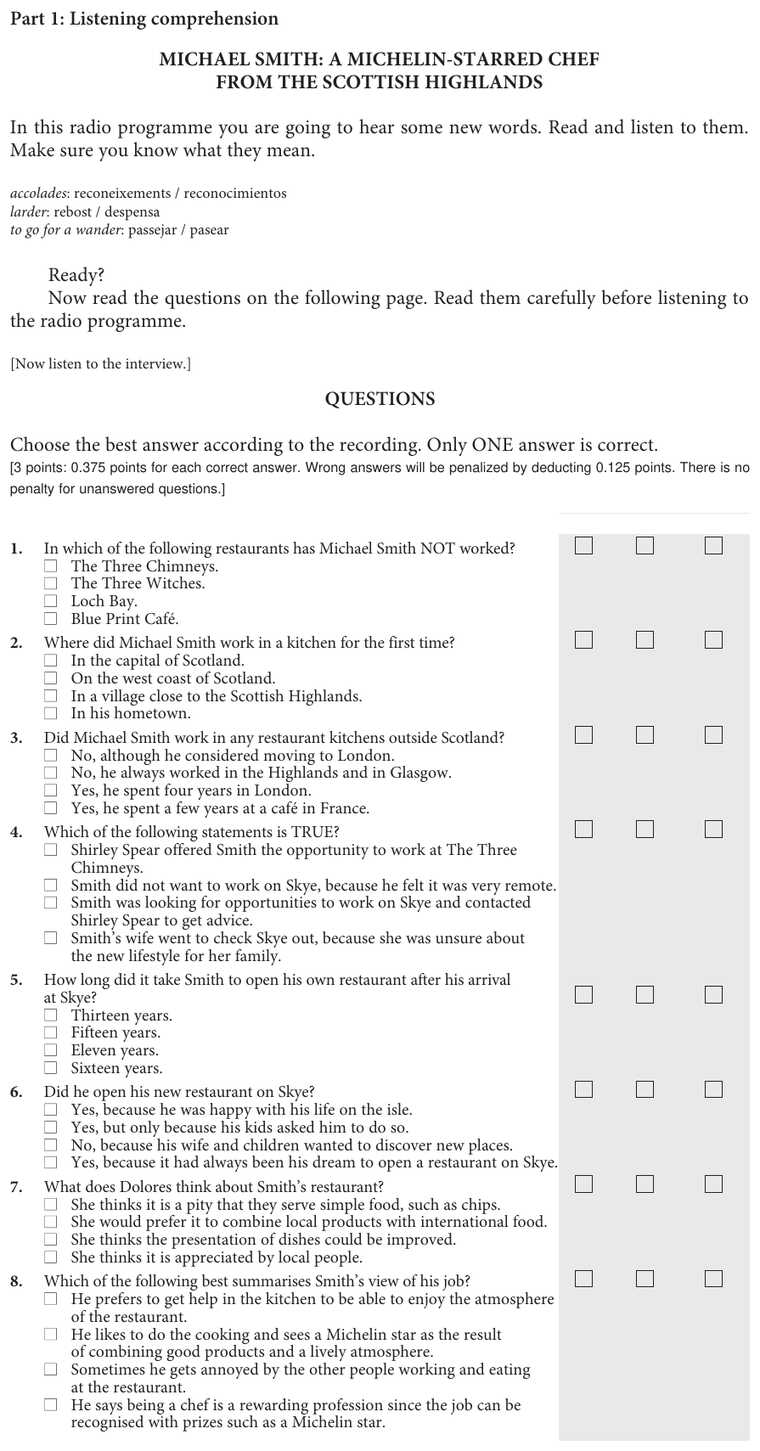
MICHAEL SMITH: A MICHELIN-STARRED CHEF FROM THE SCOTTISH HIGHLANDS
In this radio programme you are going to hear some new words. Read and listen to them. Make sure you know what they mean.
accolades: reconeixements/reconocimientos
larder: rebost/despensa
to go for a wander: passejar/pasear
Ready? Now read the questions on the following page. Read them carefully before listening to the radio programme. [Now listen to the interview.]
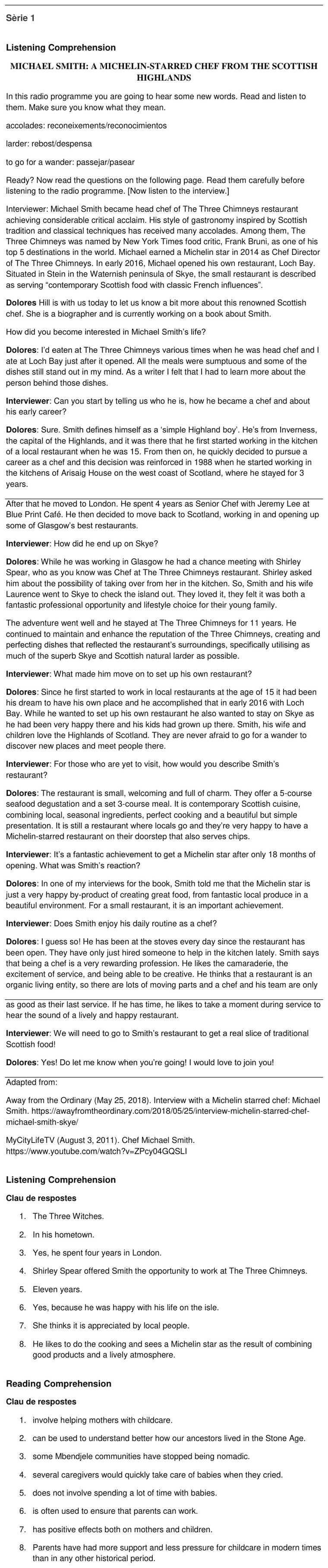
Interviewer: Michael Smith became head chef of The Three Chimneys restaurant achieving considerable critical acclaim. His style of gastronomy inspired by Scottish tradition and classical techniques has received many accolades. Among them, The Three Chimneys was named by New York Times food critic, Frank Bruni, as one of his top 5 destinations in the world. Michael earned a Michelin star in 2014 as Chef Director of The Three Chimneys. In early 2016, Michael opened his own restaurant, Loch Bay. Situated in Stein in the Waternish peninsula of Skye, the small restaurant is described as serving “contemporary Scottish food with classic French influences”.
Dolores Hill is with us today to let us know a bit more about this renowned Scottish chef. She is a biographer and is currently working on a book about Smith.
How did you become interested in Michael Smith’s life?
Dolores: I’d eaten at The Three Chimneys various times when he was head chef and I ate at Loch Bay just after it opened. All the meals were sumptuous and some of the dishes still stand out in my mind. As a writer I felt that I had to learn more about the person behind those dishes.
Interviewer: Can you start by telling us who he is, how he became a chef and about his early career?
Dolores: Sure. Smith defines himself as a ‘simple Highland boy’. He’s from Inverness, the capital of the Highlands, and it was there that he first started working in the kitchen of a local restaurant when he was 15. From then on, he quickly decided to pursue a career as a chef and this decision was reinforced in 1988 when he started working in the kitchens of Arisaig House on the west coast of Scotland, where he stayed for 3 years.
After that he moved to London. He spent 4 years as Senior Chef with Jeremy Lee at Blue Print Café. He then decided to move back to Scotland, working in and opening up some of Glasgow’s best restaurants.
Interviewer: How did he end up on Skye?
Dolores: While he was working in Glasgow he had a chance meeting with Shirley Spear, who as you know was Chef at The Three Chimneys restaurant. Shirley asked him about the possibility of taking over from her in the kitchen. So, Smith and his wife Laurence went to Skye to check the island out. They loved it, they felt it was both a fantastic professional opportunity and lifestyle choice for their young family.
The adventure went well and he stayed at The Three Chimneys for 11 years. He continued to maintain and enhance the reputation of the Three Chimneys, creating and perfecting dishes that reflected the restaurant’s surroundings, specifically utilising as much of the superb Skye and Scottish natural larder as possible.
Interviewer: What made him move on to set up his own restaurant?
Dolores: Since he first started to work in local restaurants at the age of 15 it had been his dream to have his own place and he accomplished that in early 2016 with Loch Bay. While he wanted to set up his own restaurant he also wanted to stay on Skye as he had been very happy there and his kids had grown up there. Smith, his wife and children love the Highlands of Scotland. They are never afraid to go for a wander to discover new places and meet people there.
Interviewer: For those who are yet to visit, how would you describe Smith’s restaurant?
Dolores: The restaurant is small, welcoming and full of charm. They offer a 5-course seafood degustation and a set 3-course meal. It is contemporary Scottish cuisine, combining local, seasonal ingredients, perfect cooking and a beautiful but simple presentation. It is still a restaurant where locals go and they’re very happy to have a Michelin-starred restaurant on their doorstep that also serves chips.
Interviewer: It’s a fantastic achievement to get a Michelin star after only 18 months of opening. What was Smith’s reaction?
Dolores: In one of my interviews for the book, Smith told me that the Michelin star is just a very happy by-product of creating great food, from fantastic local produce in a beautiful environment. For a small restaurant, it is an important achievement.
Interviewer: Does Smith enjoy his daily routine as a chef?
Dolores: I guess so! He has been at the stoves every day since the restaurant has been open. They have only just hired someone to help in the kitchen lately. Smith says that being a chef is a very rewarding profession. He likes the camaraderie, the excitement of service, and being able to be creative. He thinks that a restaurant is an organic living entity, so there are lots of moving parts and a chef and his team are only
as good as their last service. If he has time, he likes to take a moment during service to hear the sound of a lively and happy restaurant.
Interviewer: We will need to go to Smith’s restaurant to get a real slice of traditional Scottish food!
Dolores: Yes! Do let me know when you’re going! I would love to join you!
Adapted from:
Away from the Ordinary (May 25, 2018). Interview with a Michelin starred chef: Michael Smith. https://awayfromtheordinary.com/2018/05/25/interview-michelin-starred-chef-michael-smith-skye/
MyCityLifeTV (August 3, 2011). Chef Michael Smith. https://www.youtube.com/watch?v=ZPcy04GQSLI
See the official listening transcript in Part 1, question 1 (item 1.1).
In which of the following restaurants has Michael Smith NOT worked?
■ The Three Chimneys.
■ The Three Witches.
■ Loch Bay.
■ Blue Print Café.
Where did Michael Smith work in a kitchen for the first time?
■ In the capital of Scotland.
■ On the west coast of Scotland.
■ In a village close to the Scottish Highlands.
■ In his hometown.
Did Michael Smith work in any restaurant kitchens outside Scotland?
■ No, although he considered moving to London.
■ No, he always worked in the Highlands and in Glasgow.
■ Yes, he spent four years in London.
■ Yes, he spent a few years at a café in France.
Which of the following statements is TRUE?
■ Shirley Spear offered Smith the opportunity to work at The Three
Chimneys.
■ Smith did not want to work on Skye, because he felt it was very remote.
■ Smith was looking for opportunities to work on Skye and contacted
Shirley Spear to get advice.
■ Smith’s wife went to check Skye out, because she was unsure about
the new lifestyle for her family.
How long did it take Smith to open his own restaurant after his arrival
at Skye?
■ Thirteen years.
■ Fifteen years.
■ Eleven years.
■ Sixteen years.
Did he open his new restaurant on Skye?
■ Yes, because he was happy with his life on the isle.
■ Yes, but only because his kids asked him to do so.
■ No, because his wife and children wanted to discover new places.
■ Yes, because it had always been his dream to open a restaurant on Skye.
What does Dolores think about Smith’s restaurant?
■ She thinks it is a pity that they serve simple food, such as chips.
■ She would prefer it to combine local products with international food.
■ She thinks the presentation of dishes could be improved.
■ She thinks it is appreciated by local people.
Which of the following best summarises Smith’s view of his job?
■ He prefers to get help in the kitchen to be able to enjoy the atmosphere
of the restaurant.
■ He likes to do the cooking and sees a Michelin star as the result
of combining good products and a lively atmosphere.
■ Sometimes he gets annoyed by the other people working and eating
at the restaurant.
■ He says being a chef is a rewarding profession since the job can be
recognised with prizes such as a Michelin star.
La paraula NOT demana l’excepció. Descarta els tres restaurants que apareixen en la trajectòria de Smith.
L’entrevista explica que Smith va treballar al Blue Print Café, va dirigir la cuina de The Three Chimneys i va obrir el seu propi restaurant, Loch Bay.
B. The Three Witches.
+0,375criteri 1 de la pauta
 Toca per ampliar
- 0,375 pSeleccionar la resposta de la clau oficial: The Three Witches.Penalització: Resposta incorrecta: −0.125 punts; pregunta no contestada: sense penalització.
Fixa’t en for the first time i busca on va començar a treballar a la cuina.
Dolores diu que Smith tenia 15 anys quan va començar en un restaurant d’Inverness, la seva ciutat natal. Arisaig House, a la costa oest, apareix més endavant en el seu recorregut.
D. In his hometown.
+0,375criteri 1 de la pauta
Toca per ampliar- 0,375 pSeleccionar la resposta de la clau oficial: In his hometown.Penalització: Resposta incorrecta: −0.125 punts; pregunta no contestada: sense penalització.
Busca una ciutat de fora d’Escòcia on Smith arribés a treballar i fixa’t en quant de temps hi va passar.
Després d’Arisaig House, Smith se’n va anar a Londres, on va treballar durant quatre anys al Blue Print Café. Després va tornar a Escòcia.
C. Yes, he spent four years in London.
+0,375criteri 1 de la pauta
Toca per ampliar- 0,375 pSeleccionar la resposta de la clau oficial: Yes, he spent four years in London.Penalització: Resposta incorrecta: −0.125 punts; pregunta no contestada: sense penalització.
Per comprovar quina afirmació és certa, fixa’t en qui va fer la proposta i en quin restaurant.
Smith va conèixer Shirley Spear per casualitat a Glasgow. Ella li va proposar que la rellevés a la cuina de The Three Chimneys.
A. Shirley Spear offered Smith the opportunity to work at The Three Chimneys.
+0,375criteri 1 de la pauta
Toca per ampliar- 0,375 pSeleccionar la resposta de la clau oficial: Shirley Spear offered Smith the opportunity to work at The Three Chimneys.Penalització: Resposta incorrecta: −0.125 punts; pregunta no contestada: sense penalització.
Busca quant de temps va passar Smith a The Three Chimneys abans d’obrir el seu restaurant a Skye.
Dolores explica que Smith va anar a Skye per treballar a The Three Chimneys. S’hi va estar onze anys abans d’obrir Loch Bay.
C. Eleven years.
+0,375criteri 1 de la pauta
Toca per ampliar- 0,375 pSeleccionar la resposta de la clau oficial: Eleven years.Penalització: Resposta incorrecta: −0.125 punts; pregunta no contestada: sense penalització.
La resposta ha d’indicar on va obrir el restaurant i per què va triar aquell lloc.
Loch Bay és a Skye. Smith volia quedar-se a l’illa perquè hi havia estat molt feliç i els seus fills hi havien crescut.
A. Yes, because he was happy with his life on the isle.
+0,375criteri 1 de la pauta
Toca per ampliar- 0,375 pSeleccionar la resposta de la clau oficial: Yes, because he was happy with his life on the isle.Penalització: Resposta incorrecta: −0.125 punts; pregunta no contestada: sense penalització.
Busca què diu Dolores sobre la relació entre el restaurant i la gent de l’illa.
Dolores explica que els veïns continuen anant a Loch Bay i celebren tenir a prop un restaurant amb estrella Michelin que també serveix patates fregides.
D. She thinks it is appreciated by local people.
+0,375criteri 1 de la pauta
Toca per ampliar- 0,375 pSeleccionar la resposta de la clau oficial: She thinks it is appreciated by local people.Penalització: Resposta incorrecta: −0.125 punts; pregunta no contestada: sense penalització.
Per resumir la visió de Smith, relaciona el que gaudeix a la cuina amb el valor que dona a l’estrella Michelin.
Smith cuina cada dia i gaudeix de la creativitat i de l’ambient animat del servei. Considera l’estrella una conseqüència de cuinar bé amb bons productes locals en un entorn agradable.
B. He likes to do the cooking and sees a Michelin star as the result of combining good products and a lively atmosphere.
+0,375criteri 1 de la pauta
Toca per ampliar- 0,375 pSeleccionar la resposta de la clau oficial: He likes to do the cooking and sees a Michelin star as the result of combining good products and a lively atmosphere.Penalització: Resposta incorrecta: −0.125 punts; pregunta no contestada: sense penalització.
Exercici 2
Reading comprehension
 Toca per ampliar
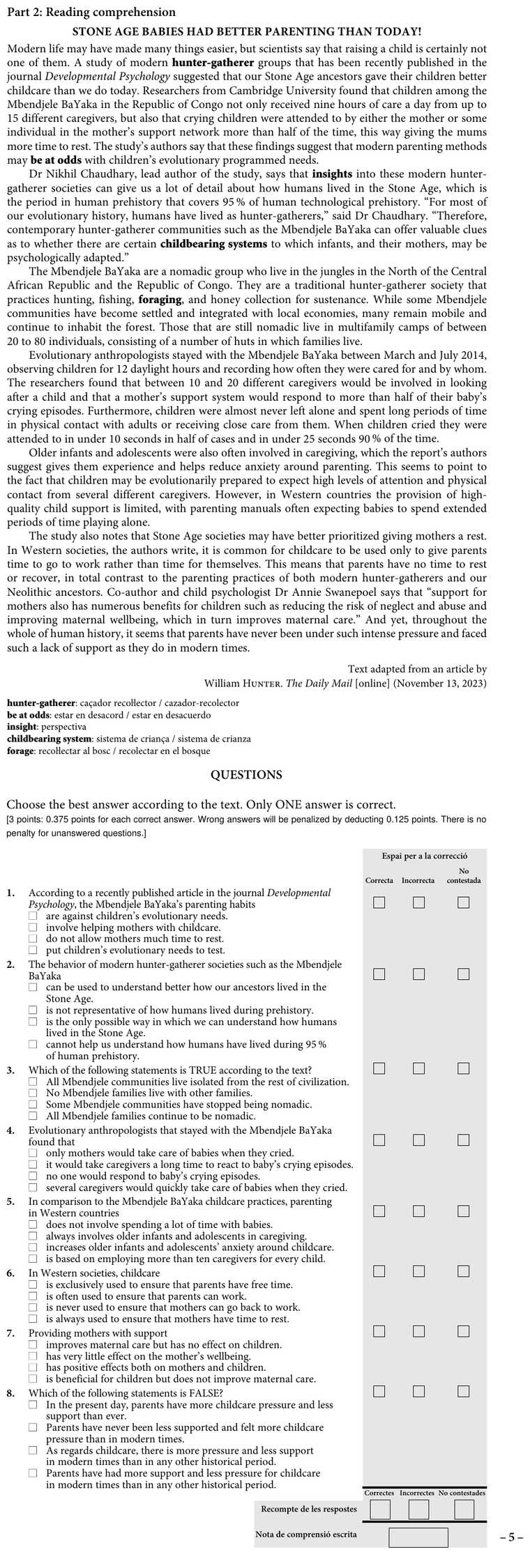
STONE AGE BABIES HAD BETTER PARENTING THAN TODAY! Modern life may have made many things easier, but scientists say that raising a child is certainly not one of them. A study of modern hunter-gatherer groups that has been recently published in the journal Developmental Psychology suggested that our Stone Age ancestors gave their children better childcare than we do today. Researchers from Cambridge University found that children among the Mbendjele BaYaka in the Republic of Congo not only received nine hours of care a day from up to 15 different caregivers, but also that crying children were attended to by either the mother or some individual in the mother’s support network more than half of the time, this way giving the mums more time to rest. The study’s authors say that these findings suggest that modern parenting methods may be at odds with children’s evolutionary programmed needs. Dr Nikhil Chaudhary, lead author of the study, says that insights into these modern hunter-gatherer societies can give us a lot of detail about how humans lived in the Stone Age, which is the period in human prehistory that covers 95 % of human technological prehistory. “For most of our evolutionary history, humans have lived as hunter-gatherers,” said Dr Chaudhary. “Therefore, contemporary hunter-gatherer communities such as the Mbendjele BaYaka can offer valuable clues as to whether there are certain childbearing systems to which infants, and their mothers, may be psychologically adapted.” The Mbendjele BaYaka are a nomadic group who live in the jungles in the North of the Central African Republic and the Republic of Congo. They are a traditional hunter-gatherer society that practices hunting, fishing, foraging, and honey collection for sustenance. While some Mbendjele communities have become settled and integrated with local economies, many remain mobile and continue to inhabit the forest. Those that are still nomadic live in multifamily camps of between 20 to 80 individuals, consisting of a number of huts in which families live. Evolutionary anthropologists stayed with the Mbendjele BaYaka between March and July 2014, observing children for 12 daylight hours and recording how often they were cared for and by whom. The researchers found that between 10 and 20 different caregivers would be involved in looking after a child and that a mother’s support system would respond to more than half of their baby’s crying episodes. Furthermore, children were almost never left alone and spent long periods of time in physical contact with adults or receiving close care from them. When children cried they were attended to in under 10 seconds in half of cases and in under 25 seconds 90 % of the time. Older infants and adolescents were also often involved in caregiving, which the report’s authors suggest gives them experience and helps reduce anxiety around parenting. This seems to point to the fact that children may be evolutionarily prepared to expect high levels of attention and physical contact from several different caregivers. However, in Western countries the provision of high-quality child support is limited, with parenting manuals often expecting babies to spend extended periods of time playing alone. The study also notes that Stone Age societies may have better prioritized giving mothers a rest. In Western societies, the authors write, it is common for childcare to be used only to give parents time to go to work rather than time for themselves. This means that parents have no time to rest or recover, in total contrast to the parenting practices of both modern hunter-gatherers and our Neolithic ancestors. Co-author and child psychologist Dr Annie Swanepoel says that “support for mothers also has numerous benefits for children such as reducing the risk of neglect and abuse and improving maternal wellbeing, which in turn improves maternal care.” And yet, throughout the whole of human history, it seems that parents have never been under such intense pressure and faced such a lack of support as they do in modern times. Text adapted from an article by William Hunter. The Daily Mail [online] (November 13, 2023) hunter-gatherer: caçador recoŀlector / cazador-recolector be at odds: estar en desacord / estar en desacuerdo insight: perspectiva childbearing system: sistema de criança / sistema de crianza forage: recoŀlectar al bosc / recolectar en el bosque
See the shared reading text and glossary in Part 2, question 1 (item 2.1).
According to a recently published article in the journal Developmental
Psychology, the Mbendjele BaYaka’s parenting habits
■ are against children’s evolutionary needs.
■ involve helping mothers with childcare.
■ do not allow mothers much time to rest.
■ put children’s evolutionary needs to test.
The behavior of modern hunter-gatherer societies such as the Mbendjele
BaYaka
■ can be used to understand better how our ancestors lived in the
Stone Age.
■ is not representative of how humans lived during prehistory.
■ is the only possible way in which we can understand how humans
lived in the Stone Age.
■ cannot help us understand how humans have lived during 95 %
of human prehistory.
Which of the following statements is TRUE according to the text?
■ All Mbendjele communities live isolated from the rest of civilization.
■ No Mbendjele families live with other families.
■ Some Mbendjele communities have stopped being nomadic.
■ All Mbendjele families continue to be nomadic.
Evolutionary anthropologists that stayed with the Mbendjele BaYaka
found that
■ only mothers would take care of babies when they cried.
■ it would take caregivers a long time to react to baby’s crying episodes.
■ no one would respond to baby’s crying episodes.
■ several caregivers would quickly take care of babies when they cried.
In comparison to the Mbendjele BaYaka childcare practices, parenting
in Western countries
■ does not involve spending a lot of time with babies.
■ always involves older infants and adolescents in caregiving.
■ increases older infants and adolescents’ anxiety around childcare.
■ is based on employing more than ten caregivers for every child.
In Western societies, childcare
■ is exclusively used to ensure that parents have free time.
■ is often used to ensure that parents can work.
■ is never used to ensure that mothers can go back to work.
■ is always used to ensure that mothers have time to rest.
Providing mothers with support
■ improves maternal care but has no effect on children.
■ has very little effect on the mother’s wellbeing.
■ has positive effects both on mothers and children.
■ is beneficial for children but does not improve maternal care.
Which of the following statements is FALSE?
■ In the present day, parents have more childcare pressure and less
support than ever.
■ Parents have never been less supported and felt more childcare
pressure than in modern times.
■ As regards childcare, there is more pressure and less support
in modern times than in any other historical period.
■ Parents have had more support and less pressure for childcare
in modern times than in any other historical period.
Identifica quin paper té la xarxa de suport de les mares en la cura dels infants.
Entre els Mbendjele BaYaka, diverses persones cuiden els infants. La xarxa de suport també els atén quan ploren, cosa que dona a les mares més temps per descansar.
B. involve helping mothers with childcare.
+0,375criteri 1 de la pauta- Nota d’OriginalEn anglès, childbearing es refereix al fet de tenir fills i child-rearing vol dir criar-los. Al passatge, l’expressió «childbearing systems» fa referència als sistemes de criança.
Toca per ampliar- 0,375 pSeleccionar la resposta de la clau oficial: involve helping mothers with childcare.Penalització: Resposta incorrecta: −0.125 punts; pregunta no contestada: sense penalització.
Fixa’t en què podem aprendre sobre l’edat de pedra a partir de l’observació de societats caçadores i recol·lectores actuals.
Al segon paràgraf, Chaudhary diu que aquestes comunitats ofereixen pistes sobre com vivien els nostres avantpassats. L’expressió can be used recull aquesta idea de possibilitat.
A. can be used to understand better how our ancestors lived in the Stone Age.
+0,375criteri 1 de la pauta
Toca per ampliar- 0,375 pSeleccionar la resposta de la clau oficial: can be used to understand better how our ancestors lived in the Stone Age.Penalització: Resposta incorrecta: −0.125 punts; pregunta no contestada: sense penalització.
Distingeix some (algunes comunitats) d’all (totes) quan el text parla del nomadisme.
Al tercer paràgraf, have become settled indica que algunes comunitats s’han establert en un lloc fix. El text també diu que moltes continuen desplaçant-se pel bosc.
C. some Mbendjele communities have stopped being nomadic.
+0,375criteri 1 de la pauta
Toca per ampliar- 0,375 pSeleccionar la resposta de la clau oficial: some Mbendjele communities have stopped being nomadic.Penalització: Resposta incorrecta: −0.125 punts; pregunta no contestada: sense penalització.
Busca qui atenia els nadons quan ploraven i amb quina rapidesa ho feia.
L’estudi va observar que diverses persones cuidaven cada infant. La xarxa de suport de la mare responia a més de la meitat dels episodis de plor. En la meitat dels casos, els infants rebien atenció en menys de 10 segons.
D. several caregivers would quickly take care of babies when they cried.
+0,375criteri 1 de la pauta
Toca per ampliar- 0,375 pSeleccionar la resposta de la clau oficial: several caregivers would quickly take care of babies when they cried.Penalització: Resposta incorrecta: −0.125 punts; pregunta no contestada: sense penalització.
Compara el temps de contacte i atenció directa que descriu el text en cada cas.
Els infants mbendjele passaven llargs períodes en contacte amb adults. En el cas occidental, el text parla d’un suport limitat i de manuals que esperen que els nadons passin força estona jugant sols.
A. does not involve spending a lot of time with babies.
+0,375criteri 1 de la pauta
Toca per ampliar- 0,375 pSeleccionar la resposta de la clau oficial: does not involve spending a lot of time with babies.Penalització: Resposta incorrecta: −0.125 punts; pregunta no contestada: sense penalització.
Busca per a què es fan servir habitualment els serveis de cura infantil a les societats occidentals.
El text diu que és habitual recórrer a aquests serveis perquè els pares puguin anar a treballar. L’opció ho expressa amb often.
B. is often used to ensure that parents can work.
+0,375criteri 1 de la pauta
Toca per ampliar- 0,375 pSeleccionar la resposta de la clau oficial: is often used to ensure that parents can work.Penalització: Resposta incorrecta: −0.125 punts; pregunta no contestada: sense penalització.
La pregunta demana reconèixer qui es beneficia del suport que reben les mares.
Segons Annie Swanepoel, el suport millora el benestar de les mares i, amb això, l’atenció que poden donar. També redueix per als infants el risc de desatenció i maltractament.
C. has positive effects both on mothers and children.
+0,375criteri 1 de la pauta
Toca per ampliar- 0,375 pSeleccionar la resposta de la clau oficial: has positive effects both on mothers and children.Penalització: Resposta incorrecta: −0.125 punts; pregunta no contestada: sense penalització.
La paraula FALSE et demana l’afirmació que capgira la conclusió del text.
L’última frase afirma que, avui, els pares tenen més pressió i menys suport que mai. L’opció que parla de more support and less pressure inverteix totes dues idees.
D. Parents have had more support and less pressure for childcare in modern times than in any other historical period.
+0,375criteri 1 de la pauta
Toca per ampliar- 0,375 pSeleccionar la resposta de la clau oficial: Parents have had more support and less pressure for childcare in modern times than in any other historical period.Penalització: Resposta incorrecta: −0.125 punts; pregunta no contestada: sense penalització.
Exercici 3 · opció A
Writing
 Toca per ampliar
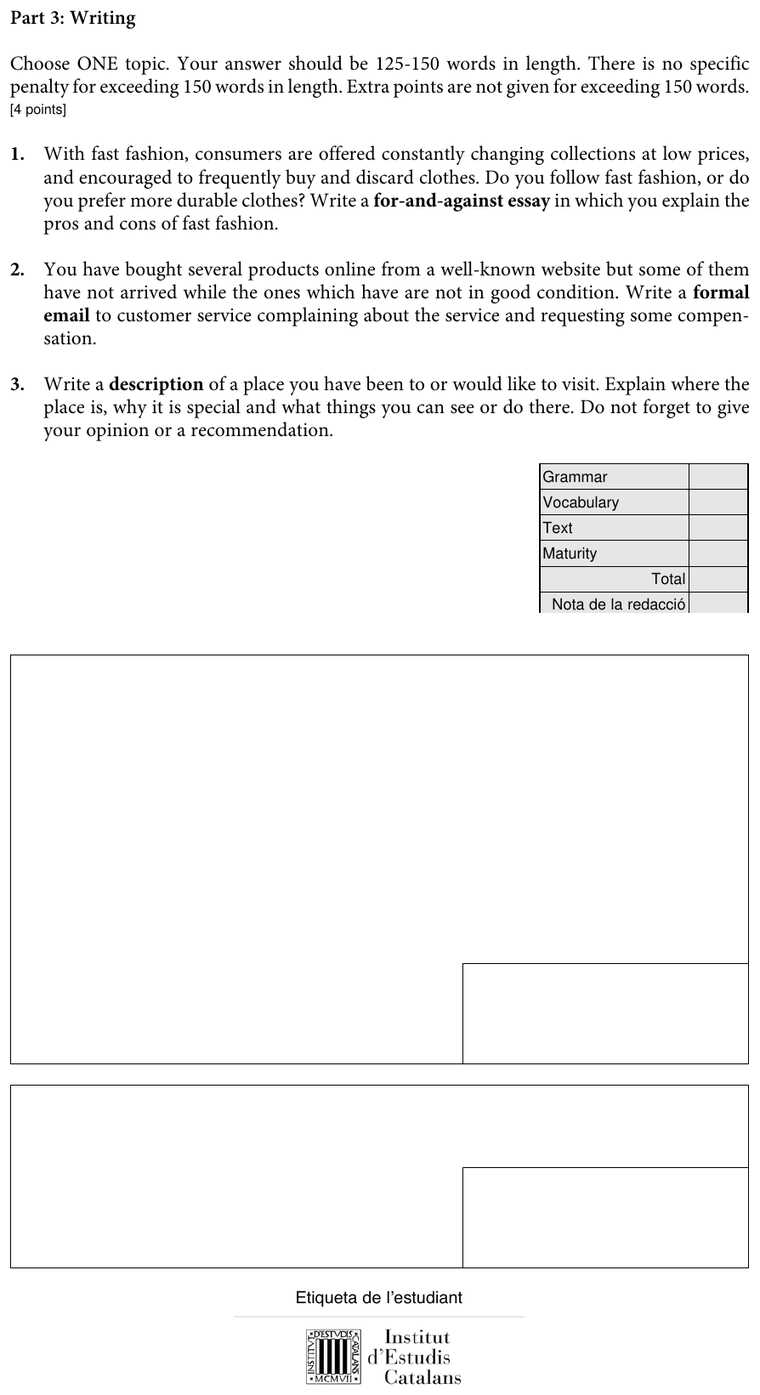
Choose ONE topic. Your answer should be 125-150 words in length. There is no specific penalty for exceeding 150 words in length. Extra points are not given for exceeding 150 words. [4 points]
With fast fashion, consumers are offered constantly changing collections at low prices, and encouraged to frequently buy and discard clothes. Do you follow fast fashion, or do you prefer more durable clothes? Write a for-and-against essay in which you explain the pros and cons of fast fashion.
L’assaig ha de presentar avantatges i inconvenients de la moda ràpida i acabar amb la teva preferència personal.
Els connectors On the positive side i However separen els arguments en dos paràgrafs. Mots com disposable i wages concreten els inconvenients. La frase amb *while* lliga les conseqüències laborals i ambientals. Al final, l’autor defensa la roba duradora i té en compte el pressupost dels compradors.
+4criteri 1 de la pauta
Fast fashion makes changing styles accessible to people who cannot afford expensive labels. Nevertheless, its low prices come with disadvantages that deserve as much attention as its convenience. On the positive side, inexpensive collections allow consumers to experiment and replace essential clothing without a large initial expense. The industry also provides employment, and following trends can be an enjoyable form of personal expression. However, constant new arrivals encourage people to treat usable clothes as disposable. Cheap manufacturing can put pressure on wages and working conditions, while producing and discarding so many garments wastes resources. A low price at the checkout does not reflect every cost involved. Personally, I prefer durable clothes and buy second-hand when possible. This approach is not always affordable immediately, so consumers should not carry all the blame. Companies must improve production practices and offer clothes designed to last rather than disappear after a season.
Toca per ampliar- 4 pSense desglossament: valoració global de la redacció (4 punts). La graella oficial compartida per tots els temes inclou Grammar, Vocabulary, Text i Maturity, sense pesos per categoria, descriptors de banda ni deduccions per error als PDF aportats.
Exercici 3 · opció B
Writing
Toca per ampliarChoose ONE topic. Your answer should be 125-150 words in length. There is no specific penalty for exceeding 150 words in length. Extra points are not given for exceeding 150 words. [4 points]
You have bought several products online from a well-known website but some of them have not arrived while the ones which have are not in good condition. Write a formal email to customer service complaining about the service and requesting some compensation.
El correu formal ha d’identificar la comanda, explicar què falta i què ha arribat malmès, i demanar una compensació concreta.
Cada paràgraf té una funció. El primer identifica la comanda, el segon concreta els problemes i els següents demanen una solució i una resposta. La construcció I would like you to permet fer una petició cortesa. Full refund és el reemborsament complet i reimbursement of the original delivery fee demana que retornin el cost de l’enviament inicial. La fórmula *Yours faithfully* manté el registre formal.
+4criteri 1 de la pauta
Dear Customer Service Team, I am writing to complain about order WS209, placed on your website on 4 May. I purchased a backpack, a desk organiser and two notebooks, but the delivery has been incomplete and unsatisfactory. Only the backpack and organiser arrived. The backpack has a broken zip, and the organiser is scratched along one side. The notebooks remain missing, although your tracking page marks the entire order as delivered. I have attached photographs and my payment confirmation. I would like you to replace the damaged products and send the missing notebooks without further delivery charges. Alternatively, please provide a full refund and arrange collection of the faulty items. Given the inconvenience, I would also appreciate reimbursement of the original delivery fee. Please confirm the proposed solution within seven days. I look forward to your response. Yours faithfully, Alex Martin
Toca per ampliar- 4 pSense desglossament: valoració global de la redacció (4 punts). La graella oficial compartida per tots els temes inclou Grammar, Vocabulary, Text i Maturity, sense pesos per categoria, descriptors de banda ni deduccions per error als PDF aportats.
Exercici 3 · opció C
Writing
Toca per ampliarChoose ONE topic. Your answer should be 125-150 words in length. There is no specific penalty for exceeding 150 words in length. Extra points are not given for exceeding 150 words. [4 points]
Write a description of a place you have been to or would like to visit. Explain where the place is, why it is special and what things you can see or do there. Do not forget to give your opinion or a recommendation.
La descripció ha de situar el lloc, mostrar què el fa especial i indicar què s’hi pot fer abans de recomanar-lo.
El primer paràgraf situa Cadaqués, i expressions com a sheltered bay i the smell of salt ajuden a imaginar el paisatge. El model fa servir *can* per presentar activitats i *would* per indicar quan hi aniria. La recomanació final recupera la idea de gaudir del lloc amb calma.
+4criteri 1 de la pauta
Cadaqués is a seaside town on the Catalan coast, tucked between rocky hills and a sheltered bay. Its white houses seem to gather around the water, while narrow streets lead uphill past doors painted deep blue. What makes the place special is the combination of brightness and quiet detail. Fishing boats rock close to the shore, and the smell of salt drifts through streets where small galleries invite you to pause. Even an ordinary walk offers constantly changing views. Visitors can explore the old town, sit beside the bay or follow a coastal path to discover less crowded corners. I would go outside the busiest summer weeks, when it is easier to enjoy the atmosphere without rushing. In my opinion, Cadaqués rewards slow travel. Bring comfortable shoes and leave time to watch the evening light settle over the sea; that simple experience may be the highlight of your visit.
Toca per ampliar- 4 pSense desglossament: valoració global de la redacció (4 punts). La graella oficial compartida per tots els temes inclou Grammar, Vocabulary, Text i Maturity, sense pesos per categoria, descriptors de banda ni deduccions per error als PDF aportats.