Anglès
PAU 2025 · extraordinària · sèrie 3
Examen oficial de la PAU de Catalunya amb la resolució pas a pas de cada apartat i la pauta de correcció.
Listening
PAU 2025 · extraordinària · sèrie 3Instruccions de l’examen
The exam consists of THREE mandatory parts. In the first part, listening comprehension is assessed through 8 multiple choice questions. It is worth 3 points. In the second part, reading comprehension is assessed through 6 open-ended questions. It is worth 3 points. In the third part, written expression is assessed. Here, you may choose ONE of the two given options. It is worth 4 points.
Part 1: Listening comprehension
Choose the best answer according to the recording. Only ONE answer is correct. [3 points: 0.375 points for each correct answer. Wrong answers will be penalized by deducting 0.125 points. There is no penalty for unanswered questions.]
Part 2: Reading comprehension
Answer the questions below using complete sentences. You may use fragments from the text unless specified not to do so. [3 points: 0.5 points for each correct answer. Up to 0.3 points might be deducted from the total mark for lack of intelligibility in the answers provided.]
Part 3: Writing
Choose ONE topic. Your answer should be 125-150 words in length. There is no specific penalty for exceeding 150 words in length. [4 points: 1 point for grammar, 1 point for vocabulary and spelling, 1 point for cohesion and 1 point for adequacy and coherence.]
Exercici 1
Listening comprehension
 Toca per ampliar
SUBTITLING AS A FOREIGN-LANGUAGE LEARNING TOOL
Interviewer (I): Here we are with Margarita Pavlova, an audiovisual translator who works from English and German into Polish. Margarita managed to use subtitling to inspire interest in audiovisual translation among young students, while fostering motivation for language learning. Margarita, I know you held an audiovisual translation workshop a few years back with a bit of a difference. Tell us a bit more about it.
Margarita (M): Yes. It was part of a bigger educational and cultural project called ‘School in Town’. The idea was to get schools to attend different workshops at universities, museums and all kinds of cultural places. We welcomed students from different schools to show them how it feels to be at university and what we do. The idea was also to get them interested in German as a foreign language.
I: German! How come?
M: In Poland, all students start by learning English as a first foreign language when they are rather young and later, they are required to learn another foreign language – German in most cases. There isn’t the same level of motivation to learn German as to learn English or Polish. Students want to learn English, because they watch English shows, they listen to English music and watch English YouTubers. It’s not that easy with German, so most students struggle with it. So, the idea of the workshop was also to show them that German can be fun as well.
I: I see, so what did you do to engage these students?
M: Well, I picked a German video that I thought would be manageable for them to subtitle. They were beginners, so the idea was for them to translate something without really knowing the language that well. First, we watched the video in German with no subtitles. Then I asked them questions about who they thought the good and the bad characters in this film were, the general atmosphere… This was something that shows how we deal with audiovisual translation. We just don’t focus on the dialogues – we also need to focus on the music, on everything that is happening on the screen and in the background.
I: Given their low German level, wasn’t that too daunting a task?
M: They were surprised to see that they were able to answer all the questions, so they were already feeling a bit more confident. After that, we started working on subtitles. I think the video was about 10 minutes long, and so I divided them into a couple of groups because their level of German was too low for individual work. Everyone was
working on one scene. The technical part was done to save time, they were typing the translation into the software so they could see it on the screen.
I: So the students didn’t actually translate the text…
M: I provided them with German subtitles that I prepared. I tried to underline some of the phrases that they should look up as a unit, encouraging them not to go word-for-word, but to see the dialogues as a bigger units. For example, if they came across idiomatic phrases, then I underlined them so that they knew that they had to look them up as entire phrases, and then come up with Polish equivalents. This is what audiovisual translation is all about: not just translating each word, but an idea, so it is a little more complex.
I: What was the atmosphere in class like?
M: Oh, it was cool as there was an immediate result to what they were doing. What I didn’t tell them was that I was going to add translator credits so that all of their names were listed on the final version. At the end of the workshop, I glued the translations done by different groups together, and we watched the clip one more time with their subtitles. They felt they could understand the entire film now because there were subtitles, and at the end, when they saw their names, they started cheering!
I: Cool! How do you think their attitude towards subtitling and learning German changed?
M: If I had asked them before the workshop if they were able to translate from German, they would have said “No way”, and at the end it turned out that not only did they do it, but they also did a really good job. I don’t think there is any disadvantage to using traditional materials at school, yet we have to understand that students like audiovisual materials – they are on TikTok all the time. They not only watch it, but they also create stuff. We can see the educational profits, and they can use it as a skill for whatever they want. It doesn’t have to be audiovisual translation, but any kind of content that is interactive.
I: One last question. If each one of them went home and started a discussion with their parents after your workshop, what one thing that they learned about subtitling that day would you have liked them to discuss?
M: I would love for them to say two things. First, that they had fun subtitling and translating from German. This is something that parents would never ever have heard of in the context of German learning. And finally, that subtitling is not just translating words, but ideas. If they can explain this to their parents, then that would mean that the workshop was successful.
I: Thank you, Margarita, for talking about your experience, which we hope is inspiring to many others.
M: My pleasure.
Adapted from https://subcomm.co.uk/research/an-interview-with-kwiryna-proczkowska-subtitling-as-a-learning-tool/
See the official listening transcript in Part 1, question 1 (item 1.1).
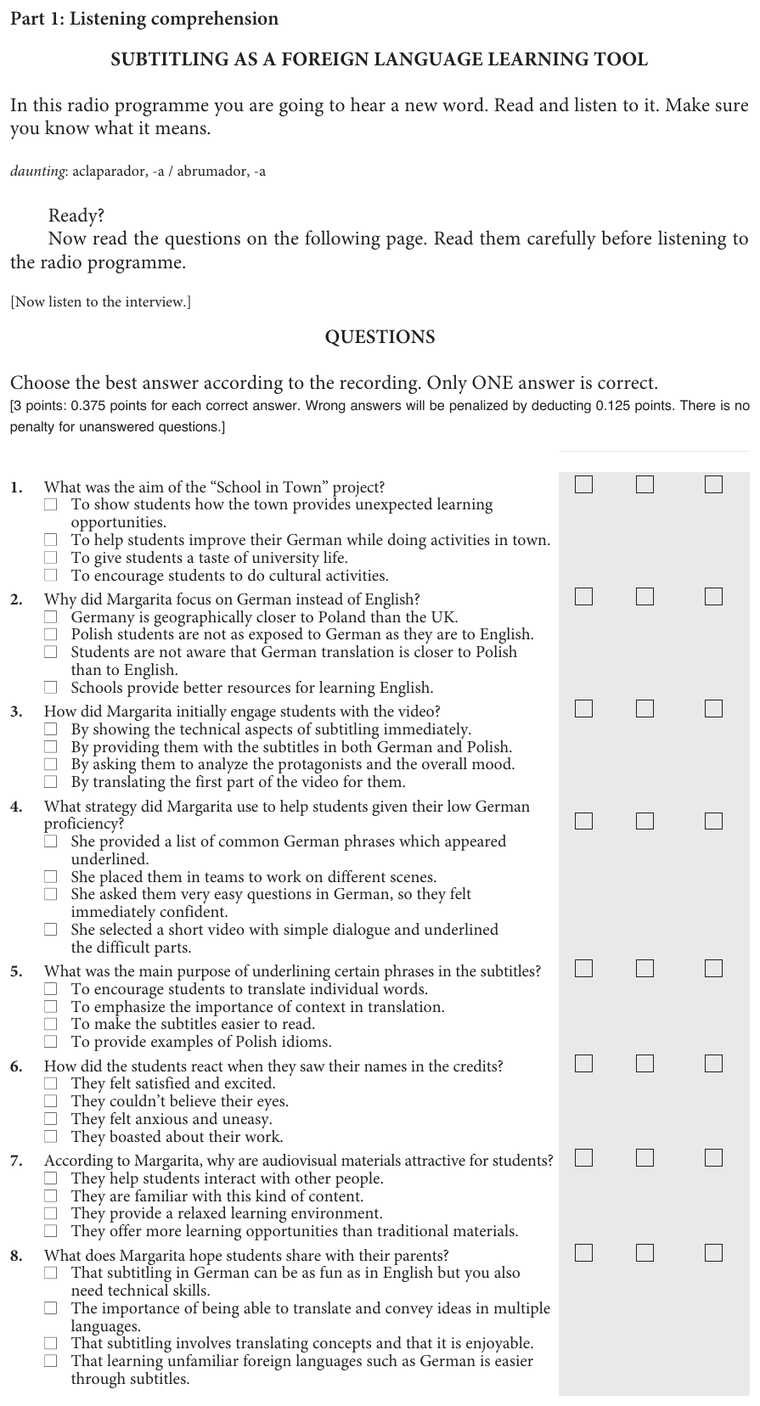
What was the aim of the “School in Town” project?
■ To show students how the town provides unexpected learning
opportunities.
■ To help students improve their German while doing activities in town.
■ To give students a taste of university life.
■ To encourage students to do cultural activities.
Why did Margarita focus on German instead of English?
■ Germany is geographically closer to Poland than the UK.
■ Polish students are not as exposed to German as they are to English.
■ Students are not aware that German translation is closer to Polish
than to English.
■ Schools provide better resources for learning English.
How did Margarita initially engage students with the video?
■ By showing the technical aspects of subtitling immediately.
■ By providing them with the subtitles in both German and Polish.
■ By asking them to analyze the protagonists and the overall mood.
■ By translating the first part of the video for them.
What strategy did Margarita use to help students given their low German
proficiency?
■ She provided a list of common German phrases which appeared
underlined.
■ She placed them in teams to work on different scenes.
■ She asked them very easy questions in German, so they felt
immediately confident.
■ She selected a short video with simple dialogue and underlined
the difficult parts.
What was the main purpose of underlining certain phrases in the subtitles?
■ To encourage students to translate individual words.
■ To emphasize the importance of context in translation.
■ To make the subtitles easier to read.
■ To provide examples of Polish idioms.
How did the students react when they saw their names in the credits?
■ They felt satisfied and excited.
■ They couldn’t believe their eyes.
■ They felt anxious and uneasy.
■ They boasted about their work.
According to Margarita, why are audiovisual materials attractive for students?
■ They help students interact with other people.
■ They are familiar with this kind of content.
■ They provide a relaxed learning environment.
■ They offer more learning opportunities than traditional materials.
What does Margarita hope students share with their parents?
■ That subtitling in German can be as fun as in English but you also
need technical skills.
■ The importance of being able to translate and convey ideas in multiple
languages.
■ That subtitling involves translating concepts and that it is enjoyable.
■ That learning unfamiliar foreign languages such as German is easier
through subtitles.
Quan explica el projecte «School in Town», la Margarita recorda que convidaven els alumnes al campus perquè veiessin com s’hi estudia i què s’hi fa.
To give students a taste of university life.
+0,375criteri 1 de la pauta
 Toca per ampliar
- 0,375 pSeleccionar la resposta de la clau oficial: To give students a taste of university life.Penalització: Resposta incorrecta: −0.125 punts; pregunta no contestada: sense penalització.
Fixa’t en quina llengua senten més sovint els alumnes polonesos fora de classe. La Margarita posa com a exemples les sèries, la música i els youtubers que segueixen en anglès.
Polish students are not as exposed to German as they are to English.
+0,375criteri 1 de la pauta
Toca per ampliar- 0,375 pSeleccionar la resposta de la clau oficial: Polish students are not as exposed to German as they are to English.Penalització: Resposta incorrecta: −0.125 punts; pregunta no contestada: sense penalització.
La paraula initially situa la pregunta just després del primer visionat. La Margarita els va preguntar qui semblava bo o dolent i quin ambient transmetia el vídeo.
By asking them to analyze the protagonists and the overall mood.
+0,375criteri 1 de la pauta
Toca per ampliar- 0,375 pSeleccionar la resposta de la clau oficial: By asking them to analyze the protagonists and the overall mood.Penalització: Resposta incorrecta: −0.125 punts; pregunta no contestada: sense penalització.
Busca com va adaptar el taller al nivell d’alemany dels alumnes. Treballar individualment els hauria costat massa, així que cada grup es va encarregar d’una escena.
She placed them in teams to work on different scenes.
+0,375criteri 1 de la pauta
Toca per ampliar- 0,375 pSeleccionar la resposta de la clau oficial: She placed them in teams to work on different scenes.Penalització: Resposta incorrecta: −0.125 punts; pregunta no contestada: sense penalització.
La Margarita subratllava expressions que calia interpretar senceres. En el cas d’una expressió idiomàtica, el context del diàleg ajuda a trobar-ne un equivalent en polonès.
To emphasize the importance of context in translation.
+0,375criteri 1 de la pauta
Toca per ampliar- 0,375 pSeleccionar la resposta de la clau oficial: To emphasize the importance of context in translation.Penalització: Resposta incorrecta: −0.125 punts; pregunta no contestada: sense penalització.
La reacció que has d’identificar és la del final de la projecció. Quan van veure els seus noms als crèdits de la traducció, els alumnes van esclatar en crits d’alegria.
They felt satisfied and excited.
+0,375criteri 1 de la pauta
Toca per ampliar- 0,375 pSeleccionar la resposta de la clau oficial: They felt satisfied and excited.Penalització: Resposta incorrecta: −0.125 punts; pregunta no contestada: sense penalització.
L’exemple de TikTok explica per què els atrau el format. Els alumnes ja miren vídeos sovint i fins i tot en creen.
They are familiar with this kind of content.
+0,375criteri 1 de la pauta
Toca per ampliar- 0,375 pSeleccionar la resposta de la clau oficial: They are familiar with this kind of content.Penalització: Resposta incorrecta: −0.125 punts; pregunta no contestada: sense penalització.
La Margarita voldria que els alumnes expliquessin a casa que es van divertir traduint i subtitulant el vídeo de l’alemany al polonès. També voldria que expliquessin que fer subtítols implica transmetre idees senceres.
That subtitling involves translating concepts and that it is enjoyable.
+0,375criteri 1 de la pauta
Toca per ampliar- 0,375 pSeleccionar la resposta de la clau oficial: That subtitling involves translating concepts and that it is enjoyable.Penalització: Resposta incorrecta: −0.125 punts; pregunta no contestada: sense penalització.
Exercici 2
Reading comprehension
 Toca per ampliar
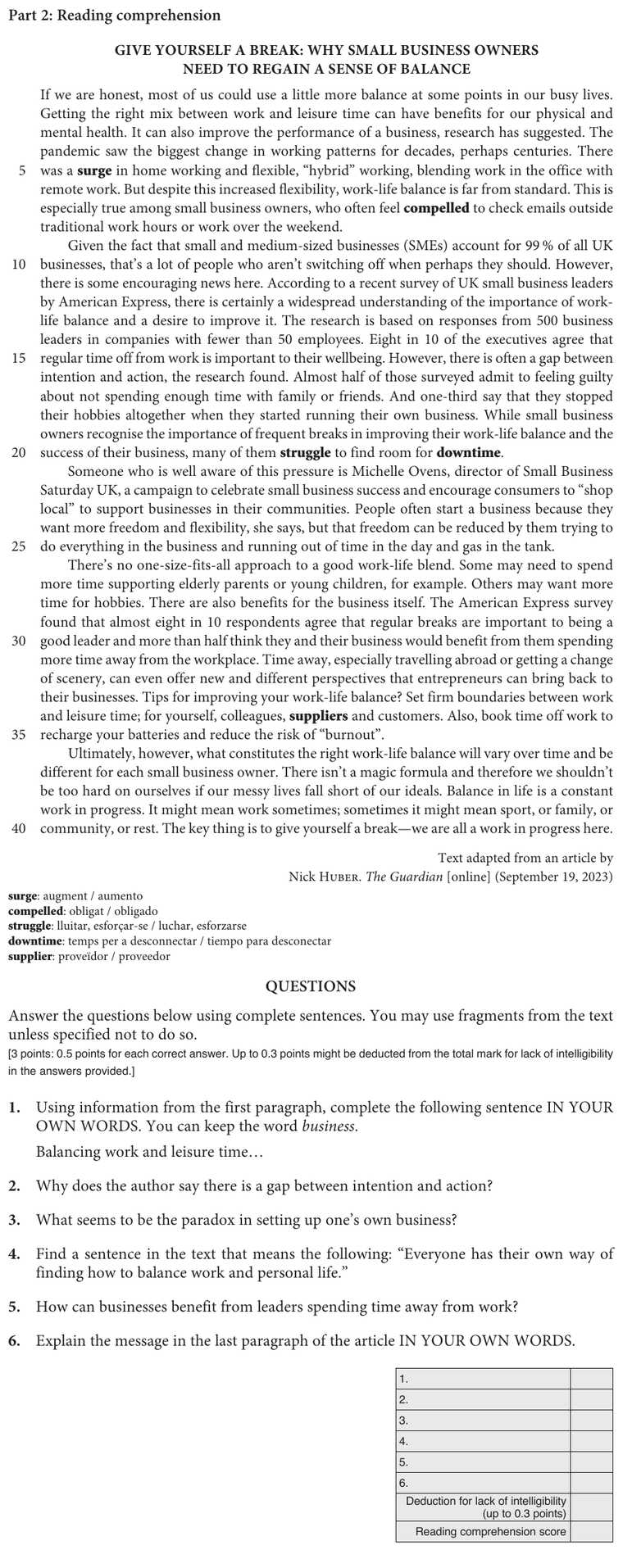
GIVE YOURSELF A BREAK: WHY SMALL BUSINESS OWNERS NEED TO REGAIN A SENSE OF BALANCE If we are honest, most of us could use a little more balance at some points in our busy lives. Getting the right mix between work and leisure time can have benefits for our physical and mental health. It can also improve the performance of a business, research has suggested. The pandemic saw the biggest change in working patterns for decades, perhaps centuries. There was a surge in home working and flexible, “hybrid” working, blending work in the office with remote work. But despite this increased flexibility, work-life balance is far from standard. This is especially true among small business owners, who often feel compelled to check emails outside traditional work hours or work over the weekend. Given the fact that small and medium-sized businesses (SMEs) account for 99 % of all UK businesses, that’s a lot of people who aren’t switching off when perhaps they should. However, there is some encouraging news here. According to a recent survey of UK small business leaders by American Express, there is certainly a widespread understanding of the importance of work-life balance and a desire to improve it. The research is based on responses from 500 business leaders in companies with fewer than 50 employees. Eight in 10 of the executives agree that regular time off from work is important to their wellbeing. However, there is often a gap between intention and action, the research found. Almost half of those surveyed admit to feeling guilty about not spending enough time with family or friends. And one-third say that they stopped their hobbies altogether when they started running their own business. While small business owners recognise the importance of frequent breaks in improving their work-life balance and the success of their business, many of them struggle to find room for downtime. Someone who is well aware of this pressure is Michelle Ovens, director of Small Business Saturday UK, a campaign to celebrate small business success and encourage consumers to “shop local” to support businesses in their communities. People often start a business because they want more freedom and flexibility, she says, but that freedom can be reduced by them trying to do everything in the business and running out of time in the day and gas in the tank. There’s no one-size-fits-all approach to a good work-life blend. Some may need to spend more time supporting elderly parents or young children, for example. Others may want more time for hobbies. There are also benefits for the business itself. The American Express survey found that almost eight in 10 respondents agree that regular breaks are important to being a good leader and more than half think they and their business would benefit from them spending more time away from the workplace. Time away, especially travelling abroad or getting a change of scenery, can even offer new and different perspectives that entrepreneurs can bring back to their businesses. Tips for improving your work-life balance? Set firm boundaries between work and leisure time; for yourself, colleagues, suppliers and customers. Also, book time off work to recharge your batteries and reduce the risk of “burnout”. Ultimately, however, what constitutes the right work-life balance will vary over time and be different for each small business owner. There isn’t a magic formula and therefore we shouldn’t be too hard on ourselves if our messy lives fall short of our ideals. Balance in life is a constant work in progress. It might mean work sometimes; sometimes it might mean sport, or family, or community, or rest. The key thing is to give yourself a break—we are all a work in progress here. Text adapted from an article by Nick Huber. The Guardian [online] (September 19, 2023) surge: augment / aumento compelled: obligat / obligado struggle: lluitar, esforçar-se / luchar, esforzarse downtime: temps per a desconnectar / tiempo para desconectar supplier: proveïdor / proveedor
See the shared reading text and glossary in Part 2, question 1 (item 2.1).
Using information from the first paragraph, complete the following sentence IN YOUR OWN WORDS. You can keep the word business. Balancing work and leisure time…
Why does the author say there is a gap between intention and action?
What seems to be the paradox in setting up one’s own business?
Find a sentence in the text that means the following: “Everyone has their own way of finding how to balance work and personal life.”
How can businesses benefit from leaders spending time away from work?
Explain the message in the last paragraph of the article IN YOUR OWN WORDS.
Completa l’inici amb paraules pròpies a partir del primer paràgraf. Pots explicar els beneficis per a la salut i el negoci o com de poc habitual és aquest equilibri entre els propietaris.
Balancing work and leisure time can help us feel better physically and mentally and help our business thrive.
O bé
Balancing work and leisure time is still uncommon among people who run a small business, as they often keep working after hours or at weekends.
+0,5criteri 1 de la pauta
Toca per ampliar- 0,5 pResposta admesa, sense desglossament de punts dins la pregunta: Balancing work and leisure time…can benefit our body and our mind and make our business more successful. OR Balancing work and leisure time…is not the norm, particularly in small businesses, where the owners often work extra hours or at weekends. Recordeu que aquí han d’utilitzar les seves pròpies paraules però poden mantenir la paraula “business”, si volen.
Explica què reconeixen els propietaris i què els costa fer a la pràctica. La pista és el final del segon paràgraf, on «downtime» vol dir temps per desconnectar.
Small business owners know that regular breaks help them balance work and personal life, but many struggle to find time to take those breaks.
+0,5criteri 1 de la pauta
Toca per ampliar- 0,5 pResposta admesa, sense desglossament de punts dins la pregunta: There is a gap between intention and action because small business owners recognise the importance of frequent breaks in improving their work-life balance but many of them struggle to find room for downtime. Recordeu que aquí poden copiar del text, si volen.
Explica què els porta a obrir un negoci i com el fet d’assumir totes les tasques els pot fer perdre la llibertat que buscaven. «Gas in the tank» es refereix a l’energia que els queda.
People start businesses to gain freedom and flexibility, but trying to do everything themselves can leave them with less control over their time and less energy.
+0,5criteri 1 de la pauta
Toca per ampliar- 0,5 pResposta admesa, sense desglossament de punts dins la pregunta: The freedom and flexibility that starting a business might give you can be reduced if you try to do everything in the business, and then you might run out of time in the day and gas in the tank. Recordeu que aquí poden copiar del text, si volen.
Copia una de les dues frases que expliquen que cadascú ha de trobar el seu equilibri. A la línia 26, «one-size-fits-all» descriu una solució que serviria per a tothom.
There’s no one-size-fits-all approach to a good work-life blend.
O bé, a les línies 36 i 37.
Ultimately, however, what constitutes the right work-life balance will vary over time and be different for each small business owner.
+0,5criteri 1 de la pauta
Toca per ampliar- 0,5 pResposta admesa, sense desglossament de punts dins la pregunta: There’s no one-size-fits-all approach to a good work-life blend (line 26) OR …what constitutes the right work-life balance will vary over time and be different for each small business owner (lines 36-37)
Explica què poden aportar al negoci quan tornen de passar temps fora. La pista és el canvi de perspectiva que els ofereix un canvi d’aires.
By spending time away from work, leaders can gain fresh perspectives and bring them back to their businesses.
+0,5criteri 1 de la pauta
Toca per ampliar- 0,5 pResposta admesa, sense desglossament de punts dins la pregunta: If leaders spend time away from work, they can come back with new and different perspectives that they can bring back to their businesses. Recordeu que aquí poden copiar del text, si volen.
Reformula el missatge del darrer paràgraf. Recull que les necessitats varien amb el temps i segons la persona, i que convé ajustar les expectatives a la situació de cadascú.
The balance that suits us can change as our circumstances change, and each person has different needs. We should set goals we can realistically meet.
+0,5criteri 1 de la pauta
Toca per ampliar- 0,5 pResposta admesa, sense desglossament de punts dins la pregunta: The right work-life balance is dynamic/variable, flexible, different for each of us and should be realistic. Recordeu que aquí han d’utilitzar les seves pròpies paraules
Exercici 3 · opció A
Writing
 Toca per ampliar
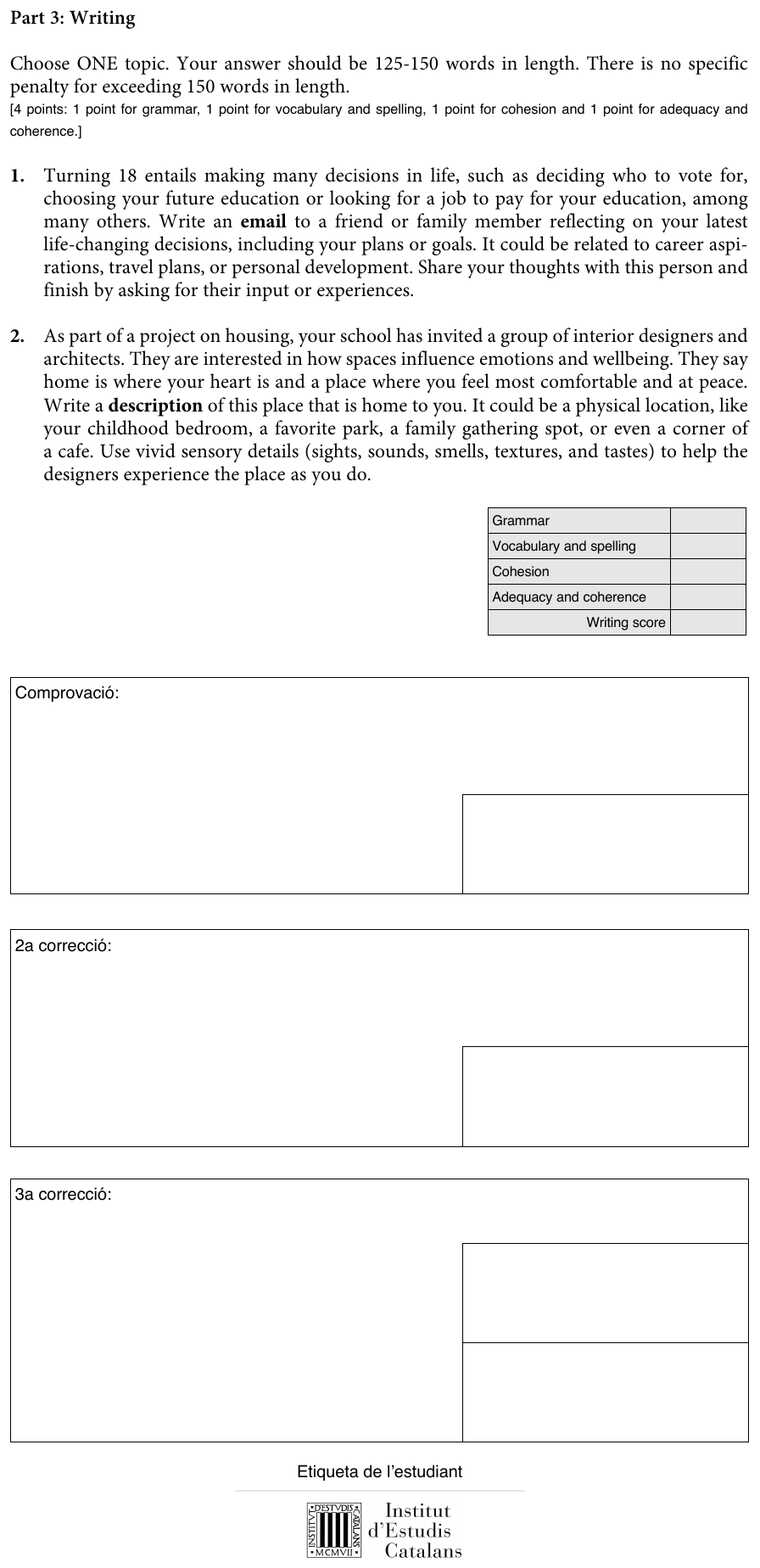
Choose ONE topic. Your answer should be 125-150 words in length. There is no specific penalty for exceeding 150 words in length. [4 points: 1 point for grammar, 1 point for vocabulary and spelling, 1 point for cohesion and 1 point for adequacy and coherence.]
Turning 18 entails making many decisions in life, such as deciding who to vote for, choosing your future education or looking for a job to pay for your education, among many others. Write an email to a friend or family member reflecting on your latest life-changing decisions, including your plans or goals. It could be related to career aspirations, travel plans, or personal development. Share your thoughts with this person and finish by asking for their input or experiences.
Combina temps verbals que situïn les decisions preses i els plans de futur.
En aquest correu de mostra d’Original Academia, «I have decided» presenta una decisió recent que continua vigent. Amb «although», l’Alex afegeix que va trigar setmanes a decidir-se, i amb «I hope to spend» introdueix un pla de futur.
+1criteri 1 de la pautaTria vocabulari precís per explicar com penses guanyar autonomia.
L’Alex parla de la feina de cap de setmana amb «applied for a weekend job», anomena la despesa amb «accommodation» i diu com pensa organitzar-se amb «making a budget».
+1criteri 2 de la pautaEnllaça les idees perquè es vegi com els estudis, els diners i el viatge formen part d’un mateix pla.
«Yet I also worry» enllaça la il·lusió per la universitat amb la preocupació pels diners. «Before the course begins» situa el viatge abans de l’inici del curs.
+1criteri 3 de la pautaEscriu a algú proper amb to de correu informal i acaba demanant-li consell o que t’expliqui la seva experiència.
L’Alex saluda en Sam amb «Hi Sam», explica què ha decidit sobre els estudis i la feina, i comparteix el seu pla de viatge. Al final li pregunta «How did you decide what to study?» i si també va tenir dubtes.
+1criteri 4 de la pauta
Hi Sam,
Turning eighteen has made everything feel unexpectedly real! I have decided to study environmental science next year, although choosing between that and engineering took weeks. I enjoy practical problems, but understanding how communities respond to environmental change interests me most.
I am excited about university, yet I also worry about paying for accommodation. I have applied for a weekend job at a bookshop and started making a budget. For the first time, saving money feels connected to something I genuinely want to achieve.
Before the course begins, I hope to spend a fortnight travelling by train with friends. Planning it ourselves should help us become more independent without pretending we already know everything.
How did you decide what to study? Did you ever feel unsure after making your choice? I would really appreciate your advice.
Love,
Alex
Toca per ampliar- 1 pGramàtica (Grammar) (1 punt, segons l’enunciat). No es publiquen descriptors de banda ni deduccions per error als PDF aportats.
- 1 pVocabulari i ortografia (Vocabulary and spelling) (1 punt, segons l’enunciat). No es publiquen descriptors de banda ni deduccions per error als PDF aportats.
- 1 pCohesió (Cohesion) (1 punt, segons l’enunciat). No es publiquen descriptors de banda ni deduccions per error als PDF aportats.
- 1 pAdequació i coherència (Adequacy and coherence) (1 punt, segons l’enunciat). No es publiquen descriptors de banda ni deduccions per error als PDF aportats.
Exercici 3 · opció B
Writing
Toca per ampliarChoose ONE topic. Your answer should be 125-150 words in length. There is no specific penalty for exceeding 150 words in length. [4 points: 1 point for grammar, 1 point for vocabulary and spelling, 1 point for cohesion and 1 point for adequacy and coherence.]
As part of a project on housing, your school has invited a group of interior designers and architects. They are interested in how spaces influence emotions and wellbeing. They say home is where your heart is and a place where you feel most comfortable and at peace. Write a description of this place that is home to you. It could be a physical location, like your childhood bedroom, a favorite park, a family gathering spot, or even a corner of a cafe. Use vivid sensory details (sights, sounds, smells, textures, and tastes) to help the designers experience the place as you do.
Fes servir el present simple per descriure què passa habitualment en aquest racó.
En la descripció de mostra d’Original Academia, «sunlight passes» i «leaves tremble» mantenen el present. Amb «familiar enough that I never think to move», la persona que escriu explica que es queda quieta perquè el tacte del coixí li resulta molt familiar.
+1criteri 1 de la pautaTria paraules que facin imaginar sensacions concretes.
«Orange peel» evoca una olor concreta, «faint bitterness» descriu l’amargor lleu del te i «slightly rough» permet imaginar el tacte del coixí.
+1criteri 2 de la pautaOrganitza la descripció perquè la mirada i els altres sentits recorrin el mateix racó.
«Beyond the glass» situa les fulles a fora i «Inside» torna als sorolls de la cuina. Després, el pa torrat, el te i el coixí ens acosten a les sensacions de la persona asseguda al costat de la finestra.
+1criteri 3 de la pautaDescriu un lloc concret per als dissenyadors i arquitectes i mostra què fa que t’hi sentis com a casa.
El text fa servir els cinc sentits per descriure el racó de la finestra. Al final, els detalls quotidians expliquen per què la persona que escriu s’hi sent acollida.
+1criteri 4 de la pauta
Home, to me, is the window seat in my grandmother's kitchen. It is a narrow corner, yet its worn wooden frame seems to hold more comfort than any carefully decorated room.
In the afternoon, sunlight passes through a yellow curtain and spreads across the cushions. Beyond the glass, leaves tremble against a pale wall. Inside, the kettle clicks, spoons tap gently against cups and my grandmother hums while preparing tea.
The air smells of toasted bread and orange peel. I wrap my fingers around a warm mug and taste the faint bitterness of the tea beneath its sweetness. The cushion is slightly rough against my wrist, familiar enough that I never think to move.
For visiting designers, this corner shows how belonging grows through repeated sensations. Nothing here is luxurious. What makes it home is the feeling that I can be silent, imperfect and entirely welcome.
Toca per ampliar- 1 pGramàtica (Grammar) (1 punt, segons l’enunciat). No es publiquen descriptors de banda ni deduccions per error als PDF aportats.
- 1 pVocabulari i ortografia (Vocabulary and spelling) (1 punt, segons l’enunciat). No es publiquen descriptors de banda ni deduccions per error als PDF aportats.
- 1 pCohesió (Cohesion) (1 punt, segons l’enunciat). No es publiquen descriptors de banda ni deduccions per error als PDF aportats.
- 1 pAdequació i coherència (Adequacy and coherence) (1 punt, segons l’enunciat). No es publiquen descriptors de banda ni deduccions per error als PDF aportats.