Anglès
PAU 2025 · model oficial · sèrie 0
Examen oficial de la PAU de Catalunya amb la resolució pas a pas de cada apartat i la pauta de correcció.
Listening
PAU 2025 · model oficial · sèrie 0Aquest exemple d’examen fa servir el mateix listening que la PAU 2024 (ordinària, sèrie 1): és la mateixa entrevista, i aquest n’és l’enregistrament oficial. La pàgina oficial de l’exemple no en publica cap àudio propi.
Instruccions de l’examen
Part 1: Listening comprehension
Choose the best answer according to the text. Only ONE answer is correct. [3 points: 0.375 points for each correct answer. Wrong answers will be penalized by deducting 0.125 points. There is no penalty for unanswered questions].
Part 2: Reading comprehension
Answer the questions below using complete sentences. Each question is worth 0.5 points with a total of 3 points. Up to 0.3 points might be deducted from the total mark for lack of intelligibility in the answers provided. You may use fragments from the text unless specified not to do so.
Part 3: Writing
Choose ONE topic. Your answer should be 125-150 words in length. There is no specific penalty for exceeding 150 words in length. Extra points are not given for exceeding 150 words. [4 points]
Exercici 1
Listening comprehension
 Toca per ampliar
MICHAEL SMITH: A MICHELIN-STARRED CHEF FROM THE SCOTTISH HIGHLANDS
In this radio programme you are going to hear some new words. Read and listen to them. Make sure you know what they mean. accolades: reconeixements/reconocimientos larder: rebost/despensa to go for a wander: passejar/pasear
Ready? Now read the questions on the following page. Read them carefully before listening to the radio programme. [Now listen to the interview.]
Interviewer: Michael Smith became head chef of The Three Chimneys restaurant achieving considerable critical acclaim. His style of gastronomy inspired by Scottish tradition and classical techniques has received many accolades. Among them, The Three Chimneys was named by New York Times food critic, Frank Bruni, as one of his top 5 destinations in the world. Michael earned a Michelin star in 2014 as Chef Director of The Three Chimneys. In early 2016, Michael opened his own restaurant, Loch Bay. Situated in Stein in the Waternish peninsula of Skye, the small restaurant is described as serving “contemporary Scottish food with classic French influences”. Dolores Hill is with us today to let us know a bit more about this renowned Scottish chef. She is a biographer and is currently working on a book about Smith. How did you become interested in Michael Smith’s life? Dolores: I’d eaten at The Three Chimneys various times when he was head chef and I ate at Loch Bay just after it opened. All the meals were sumptuous and some of the dishes still stand out in my mind. As a writer I felt that I had to learn more about the person behind those dishes. Interviewer: Can you start by telling us who he is, how he became a chef and about his early career? Dolores: Sure. Smith defines himself as a ‘simple Highland boy’. He’s from Inverness, the capital of the Highlands, and it was there that he first started working in the kitchen of a local restaurant when he was 15. From then on, he quickly decided to pursue a career
as a chef and this decision was reinforced in 1988 when he started working in the kitchens of Arisaig House on the west coast of Scotland, where he stayed for 3 years. After that he moved to London. He spent 4 years as a Senior Chef with Jeremy Lee at Blue Print Café. He then decided to move back to Scotland, working in and opening up some of Glasgow’s best restaurants. Interviewer: How did he end up on Skye? Dolores: While he was working in Glasgow he had a chance meeting with Shirley Spear, who as you know was Chef at The Three Chimneys restaurant. Shirley asked him about the possibility of taking over from her in the kitchen. So, Smith and his wife Laurence went to Skye to check the island out. They loved it, they felt it was both a fantastic professional opportunity and lifestyle choice for their young family. The adventure went well and he stayed at The Three Chimneys for 11 years. He continued to maintain and enhance the reputation of the Three Chimneys, creating and perfecting dishes that reflected the restaurant’s surroundings, specifically utilising as much of the superb Skye and Scottish natural larder as possible. Interviewer: What made him move on to set up his own restaurant? Dolores: Since he first started to work in local restaurants at the age of 15 it had been his dream to have his own place and he accomplished that in early 2016 with Loch Bay. While he wanted to set up his own restaurant he also wanted to stay on Skye as he had been very happy there and his kids had grown up there. Smith, his wife and children love the Highlands of Scotland. They are never afraid to go for a wander to discover new places and meet people there. Interviewer: For those who are yet to visit, how would you describe Smith’s restaurant? Dolores: The restaurant is small, welcoming and full of charm. They offer a 5-course seafood degustation and a set 3-course meal. It is contemporary Scottish cuisine, combining local, seasonal ingredients, perfect cooking and a beautiful but simple presentation. It is still a restaurant where locals go and they’re very happy to have a Michelin-starred restaurant on their doorstep that also serves chips. Interviewer: It’s a fantastic achievement to get a Michelin star after only 18 months of opening. What was Smith’s reaction? Dolores: In one of my interviews for the book, Smith told me that the Michelin star is just a very happy by-product of creating great food, from fantastic local produce in a beautiful environment. For a small restaurant, it is an important achievement. Interviewer: Does Smith enjoy his daily routine as a chef? Dolores: I guess so! He has been at the stoves every day since the restaurant has been open. They have only just hired someone to help in the kitchen lately. Smith says that being a chef is a very rewarding profession. He likes the camaraderie, the excitement of service, and being able to be creative. He thinks that a restaurant is an organic living entity, so there are lots of moving parts and a chef and his team are only as good as their
last service. If he has time, he likes to take a moment during service to hear the sound of a lively and happy restaurant. Interviewer: We will need to go to Smith’s restaurant to get a real slice of traditional Scottish food! Dolores: Yes! Do let me know when you’re going! I would love to join you!
Adapted from: Away from the Ordinary (May 25, 2018). Interview with a Michelin starred chef: Michael Smith. https://awayfromtheordinary.com/2018/05/25/interview-michelin-starred-chef-michael-smith-skye/ MyCityLifeTV (August 3, 2011). Chef Michael Smith. https://www.youtube.com/watch?v=ZPcy04GQSLI
See the official listening transcript in Part 1, question 1 (item 1.1).
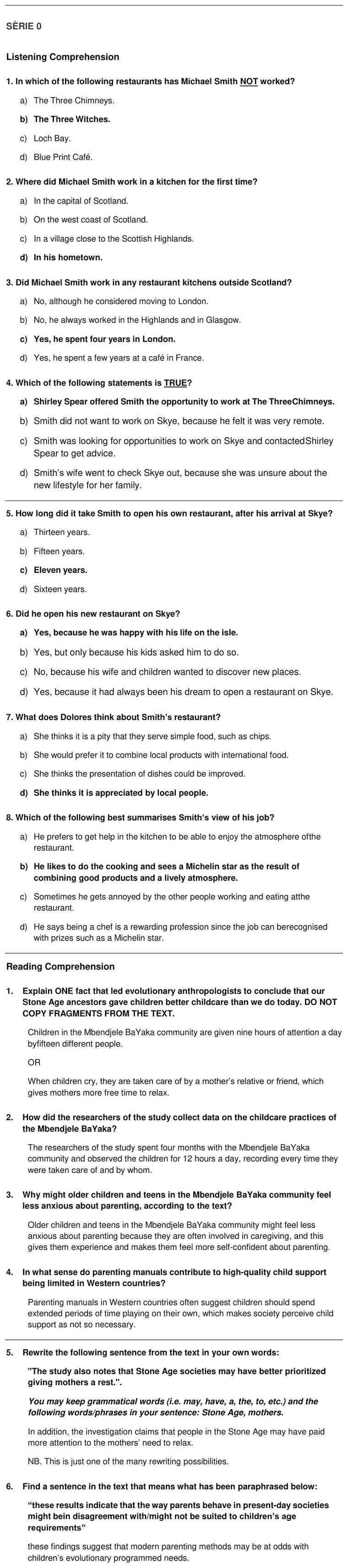
In which of the following restaurants has Michael Smith NOT worked?
a. The Three Chimneys.
b. The Three Witches.
c. Loch Bay.
d. Blue Print Café.
Where did Michael Smith work in a kitchen for the first time?
a. In the capital of Scotland.
b. On the west coast of Scotland.
c. In a village close to the Scottish Highlands.
d. In his hometown.
Did Michael Smith work in any restaurant kitchens outside Scotland?
a. No, although he considered moving to London.
b. No, he always worked in the Highlands and in Glasgow.
c. Yes, he spent four years in London.
d. Yes, he spent a few years at a café in France.
Which of the following statements is TRUE?
a. Shirley Spear offered Smith the opportunity to work at The Three
Chimneys.
b. Smith did not want to work on Skye, because he felt it was very remote.
c. Smith was looking for opportunities to work on Skye and contacted
Shirley Spear to get advice.
d. Smith’s wife went to check Skye out, because she was unsure about the
new lifestyle for her family.
How long did it take Smith to open his own restaurant, after his arrival at Skye?
a. Thirteen years.
b. Fifteen years.
c. Eleven years.
d. Sixteen years.
Did he open his new restaurant on Skye?
a. Yes, because he was happy with his life on the isle.
b. Yes, but only because his kids asked him to do so.
c. No, because his wife and children wanted to discover new places.
d. Yes, because it had always been his dream to open a restaurant on Skye.
What does Dolores think about Smith’s restaurant?
a. She thinks it is a pity that they serve simple food, such as chips.
b. She would prefer it to combine local products with international food.
c. She thinks the presentation of dishes could be improved.
d. She thinks it is appreciated by local people.
Which of the following best summarises Smith’s view of his job?
a. He prefers to get help in the kitchen to be able to enjoy the atmosphere of
the restaurant.
b. He likes to do the cooking and sees a Michelin star as the result of
combining good products and a lively atmosphere.
c. Sometimes he gets annoyed by the other people working and eating at
the restaurant.
d. He says being a chef is a rewarding profession since the job can be
recognised with prizes such as a Michelin star.
El NOT de la pregunta ens fa buscar el restaurant que no forma part de la seva trajectòria. Smith va treballar a The Three Chimneys i al Blue Print Café, i va obrir Loch Bay, on també cuina.
b) The Three Witches.
+0,375criteri 1 de la pauta
 Toca per ampliar
- 0,375 pSense desglossament: triar l’opció b) «The Three Witches.» (resposta marcada en negreta al solucionari oficial; 0,375 punts segons l’enunciat).Penalització: −0,125 punts per resposta incorrecta; cap penalització si es deixa en blanc (instruccions de Part 1 a l’enunciat).
Dolores situa la seva primera feina als 15 anys en un restaurant d’Inverness, la ciutat d’on és Smith. L’etapa a la costa oest va venir més tard.
d) In his hometown.
+0,375criteri 1 de la pauta
Toca per ampliar- 0,375 pSense desglossament: triar l’opció d) «In his hometown.» (resposta marcada en negreta al solucionari oficial; 0,375 punts segons l’enunciat).Penalització: −0,125 punts per resposta incorrecta; cap penalització si es deixa en blanc (instruccions de Part 1 a l’enunciat).
Després de treballar a la costa oest d’Escòcia, Smith va ser xef al Blue Print Café de Londres durant quatre anys abans de tornar a Escòcia.
c) Yes, he spent four years in London.
+0,375criteri 1 de la pauta
Toca per ampliar- 0,375 pSense desglossament: triar l’opció c) «Yes, he spent four years in London.» (resposta marcada en negreta al solucionari oficial; 0,375 punts segons l’enunciat).Penalització: −0,125 punts per resposta incorrecta; cap penalització si es deixa en blanc (instruccions de Part 1 a l’enunciat).
La pista és qui pren la iniciativa. Quan coincideixen a Glasgow, és Shirley Spear qui li proposa que la substitueixi a la cuina de The Three Chimneys.
a) Shirley Spear offered Smith the opportunity to work at The Three Chimneys.
+0,375criteri 1 de la pauta
Toca per ampliar- 0,375 pSense desglossament: triar l’opció a) «Shirley Spear offered Smith the opportunity to work at The Three Chimneys.» (resposta marcada en negreta al solucionari oficial; 0,375 punts segons l’enunciat).Penalització: −0,125 punts per resposta incorrecta; cap penalització si es deixa en blanc (instruccions de Part 1 a l’enunciat).
Comptem des que Smith arriba a Skye. Hi treballa onze anys a The Three Chimneys abans d’obrir Loch Bay, el seu propi restaurant.
c) Eleven years.
+0,375criteri 1 de la pauta
Toca per ampliar- 0,375 pSense desglossament: triar l’opció c) «Eleven years.» (resposta marcada en negreta al solucionari oficial; 0,375 punts segons l’enunciat).Penalització: −0,125 punts per resposta incorrecta; cap penalització si es deixa en blanc (instruccions de Part 1 a l’enunciat).
A la pregunta importa tant el lloc com el motiu. Tenir un restaurant propi era el seu somni, i el que el va fer quedar a Skye va ser que hi era feliç i els fills hi havien crescut.
a) Yes, because he was happy with his life on the isle.
+0,375criteri 1 de la pauta
Toca per ampliar- 0,375 pSense desglossament: triar l’opció a) «Yes, because he was happy with his life on the isle.» (resposta marcada en negreta al solucionari oficial; 0,375 punts segons l’enunciat).Penalització: −0,125 punts per resposta incorrecta; cap penalització si es deixa en blanc (instruccions de Part 1 a l’enunciat).
Dolores diu que la gent de l’illa continua anant a Loch Bay i valora tenir a prop un restaurant amb estrella Michelin on també serveixen patates fregides.
d) She thinks it is appreciated by local people.
+0,375criteri 1 de la pauta
Toca per ampliar- 0,375 pSense desglossament: triar l’opció d) «She thinks it is appreciated by local people.» (resposta marcada en negreta al solucionari oficial; 0,375 punts segons l’enunciat).Penalització: −0,125 punts per resposta incorrecta; cap penalització si es deixa en blanc (instruccions de Part 1 a l’enunciat).
La b) és l’opció que més s’acosta al conjunt de l’entrevista. Smith relaciona l’ambient animat amb el plaer de treballar al restaurant i atribueix l’estrella a la bona cuina amb producte local en un entorn bonic.
b) He likes to do the cooking and sees a Michelin star as the result of combining good products and a lively atmosphere.
+0,375criteri 1 de la pauta
Toca per ampliar- 0,375 pSense desglossament: triar l’opció b) «He likes to do the cooking and sees a Michelin star as the result of combining good products and a lively atmosphere.» (resposta marcada en negreta al solucionari oficial; 0,375 punts segons l’enunciat).Penalització: −0,125 punts per resposta incorrecta; cap penalització si es deixa en blanc (instruccions de Part 1 a l’enunciat).
Exercici 2
Reading comprehension
 Toca per ampliar
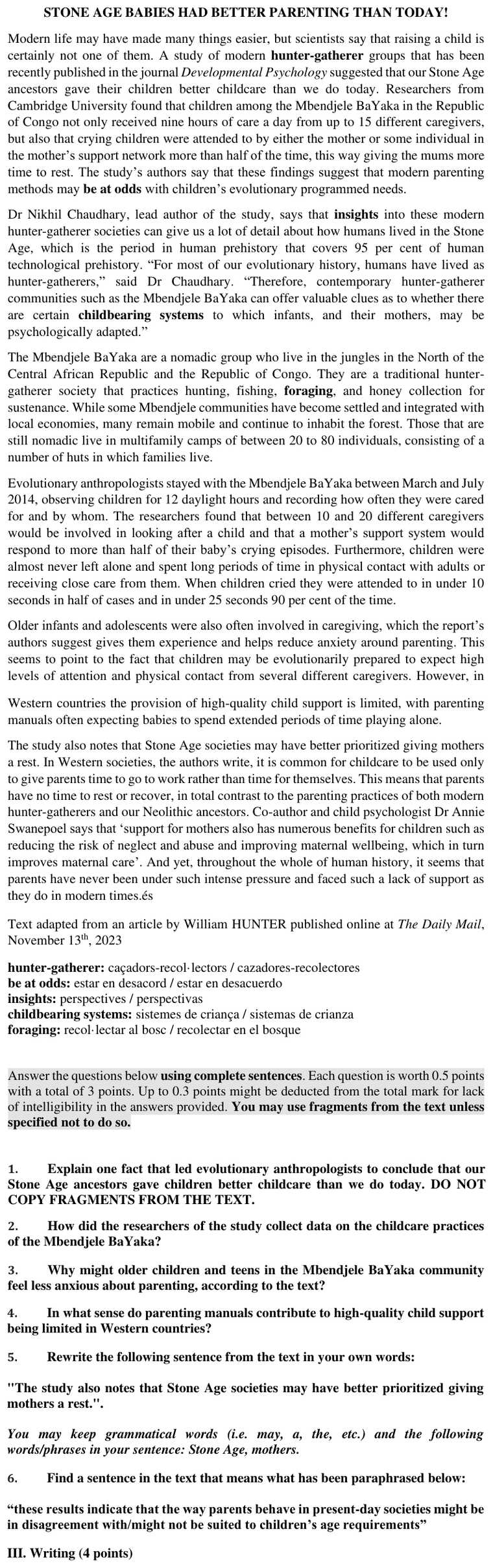
STONE AGE BABIES HAD BETTER PARENTING THAN TODAY!
Modern life may have made many things easier, but scientists say that raising a child is certainly not one of them. A study of modern hunter-gatherer groups that has been recently published in the journal Developmental Psychology suggested that our Stone Age ancestors gave their children better childcare than we do today. Researchers from Cambridge University found that children among the Mbendjele BaYaka in the Republic of Congo not only received nine hours of care a day from up to 15 different caregivers, but also that crying children were attended to by either the mother or some individual in the mother’s support network more than half of the time, this way giving the mums more time to rest. The study’s authors say that these findings suggest that modern parenting methods may be at odds with children’s evolutionary programmed needs. Dr Nikhil Chaudhary, lead author of the study, says that insights into these modern hunter-gatherer societies can give us a lot of detail about how humans lived in the Stone Age, which is the period in human prehistory that covers 95 per cent of human technological prehistory. “For most of our evolutionary history, humans have lived as hunter-gatherers,” said Dr Chaudhary. “Therefore, contemporary hunter-gatherer communities such as the Mbendjele BaYaka can offer valuable clues as to whether there are certain childbearing systems to which infants, and their mothers, may be psychologically adapted.” The Mbendjele BaYaka are a nomadic group who live in the jungles in the North of the Central African Republic and the Republic of Congo. They are a traditional hunter-gatherer society that practices hunting, fishing, foraging, and honey collection for sustenance. While some Mbendjele communities have become settled and integrated with local economies, many remain mobile and continue to inhabit the forest. Those that are still nomadic live in multifamily camps of between 20 to 80 individuals, consisting of a number of huts in which families live. Evolutionary anthropologists stayed with the Mbendjele BaYaka between March and July 2014, observing children for 12 daylight hours and recording how often they were cared for and by whom. The researchers found that between 10 and 20 different caregivers would be involved in looking after a child and that a mother’s support system would respond to more than half of their baby’s crying episodes. Furthermore, children were almost never left alone and spent long periods of time in physical contact with adults or receiving close care from them. When children cried they were attended to in under 10 seconds in half of cases and in under 25 seconds 90 per cent of the time. Older infants and adolescents were also often involved in caregiving, which the report’s authors suggest gives them experience and helps reduce anxiety around parenting. This seems to point to the fact that children may be evolutionarily prepared to expect high levels of attention and physical contact from several different caregivers. However, in
Western countries the provision of high-quality child support is limited, with parenting manuals often expecting babies to spend extended periods of time playing alone. The study also notes that Stone Age societies may have better prioritized giving mothers a rest. In Western societies, the authors write, it is common for childcare to be used only to give parents time to go to work rather than time for themselves. This means that parents have no time to rest or recover, in total contrast to the parenting practices of both modern hunter-gatherers and our Neolithic ancestors. Co-author and child psychologist Dr Annie Swanepoel says that ‘support for mothers also has numerous benefits for children such as reducing the risk of neglect and abuse and improving maternal wellbeing, which in turn improves maternal care’. And yet, throughout the whole of human history, it seems that parents have never been under such intense pressure and faced such a lack of support as they do in modern times.és
Text adapted from an article by William HUNTER published online at The Daily Mail, November 13th, 2023
hunter-gatherer: caçadors-recol·lectors / cazadores-recolectores be at odds: estar en desacord / estar en desacuerdo insights: perspectives / perspectivas childbearing systems: sistemes de criança / sistemas de crianza foraging: recol·lectar al bosc / recolectar en el bosque
See the shared reading text and glossary in Part 2, question 1 (item 2.1).
Explain ONE fact that led evolutionary anthropologists to conclude that our Stone Age ancestors gave children better childcare than we do today. DO NOT COPY FRAGMENTS FROM THE TEXT.
How did the researchers of the study collect data on the childcare practices of the Mbendjele BaYaka?
Why might older children and teens in the Mbendjele BaYaka community feel less anxious about parenting, according to the text?
In what sense do parenting manuals contribute to high-quality child support being limited in Western countries?
Rewrite the following sentence from the text in your own words:
"The study also notes that Stone Age societies may have better prioritized giving mothers a rest.".
You may keep grammatical words (i.e. may, a, the, etc.) and the following words/phrases in your sentence: Stone Age, mothers.
Find a sentence in the text that means what has been paraphrased below:
“these results indicate that the way parents behave in present-day societies might be in disagreement with/might not be suited to children’s age requirements”
Tria un fet del primer paràgraf i explica’l amb paraules pròpies. Pots fixar-te en com es reparteix la cura o en com això permet que les mares descansin.
Among the Mbendjele BaYaka, children had someone looking after them for nine hours each day, with as many as fifteen people sharing that care.
O bé
When babies cried, people close to their mothers often stepped in, giving the mothers a chance to take a break.
+0,5criteri 1 de la pauta- Nota d’OriginalEl primer paràgraf diu «up to 15». L’expressió «as many as fifteen» conserva aquest màxim.
Toca per ampliar- 0,5 pSense desglossament: explicar amb paraules pròpies UN dels dos fets acceptats: els infants reben nou hores d’atenció al dia de quinze persones diferents; O bé, quan ploren, un familiar o amic de la mare els atén i permet que ella descansi.
Separa la durada de l’estada de les hores d’observació i indica què anotaven els investigadors.
The researchers spent about four months with the Mbendjele BaYaka community, from March to July 2014. They observed the children over twelve daylight hours, recording each time they received care and who provided it.
+0,5criteri 1 de la pauta- Nota d’OriginalLa pauta diu «12 hours a day». El text de l’examen parla de dotze hores diürnes, que l’estudi reparteix en tres franges de quatre hores en dies diferents, amb pauses.
Toca per ampliar- 0,5 pSense desglossament: indicar que els investigadors van passar quatre mesos amb la comunitat, van observar els infants dotze hores al dia i van registrar cada vegada que rebien atenció i qui els atenia.
Relaciona l’ajuda que donen els joves amb la confiança que poden guanyar abans de tenir fills.
Older children and teenagers often help look after younger children. This experience can make them more confident about becoming parents and ease their worries.
+0,5criteri 1 de la pauta
Toca per ampliar- 0,5 pSense desglossament: explicar que participar sovint en la cura dels infants els dona experiència i més confiança en les seves capacitats com a futurs pares i mares, i redueix l’ansietat.
Explica com la recomanació de jugar sols pot fer que es vegi com a menys necessari el suport a la criança.
Western parenting manuals often recommend that children play on their own for long periods. This can make people think that support for childcare is less necessary.
+0,5criteri 1 de la pauta
Toca per ampliar- 0,5 pSense desglossament: explicar que els manuals recomanen que els infants passin períodes llargs jugant sols, cosa que fa que la societat percebi el suport a la criança com a menys necessari.
Conserva la idea que és una possibilitat i reformula quina importància donaven al descans de les mares. Pots mantenir «Stone Age», «mothers» i els mots gramaticals.
In addition, the investigation claims that people in the Stone Age may have paid more attention to the mothers’ need to relax.
+0,5criteri 1 de la pauta
Toca per ampliar- 0,5 pSense desglossament: reformular la idea que les societats de l’edat de pedra potser donaven més importància al descans de les mares, amb paraules pròpies i respectant els mots que es poden conservar. Exemple oficial: «In addition, the investigation claims that people in the Stone Age may have paid more attention to the mothers’ need to relax.» El PDF admet expressament altres reformulacions.
La pista és «be at odds with», que expressa que dues coses no encaixen. Copia la frase del primer paràgraf que relaciona els mètodes actuals de criança amb les necessitats dels infants.
The study’s authors say that these findings suggest that modern parenting methods may be at odds with children’s evolutionary programmed needs.
+0,5criteri 1 de la pauta- Nota d’OriginalLa pregunta parla de necessitats associades a l’edat. A la frase del text, «evolutionary programmed needs» fa referència a necessitats que els autors relacionen amb l’evolució.
Toca per ampliar- 0,5 pSense desglossament: localitzar el fragment acceptat pel solucionari: «these findings suggest that modern parenting methods may be at odds with children’s evolutionary programmed needs.»
Exercici 3 · opció A
Writing
 Toca per ampliar
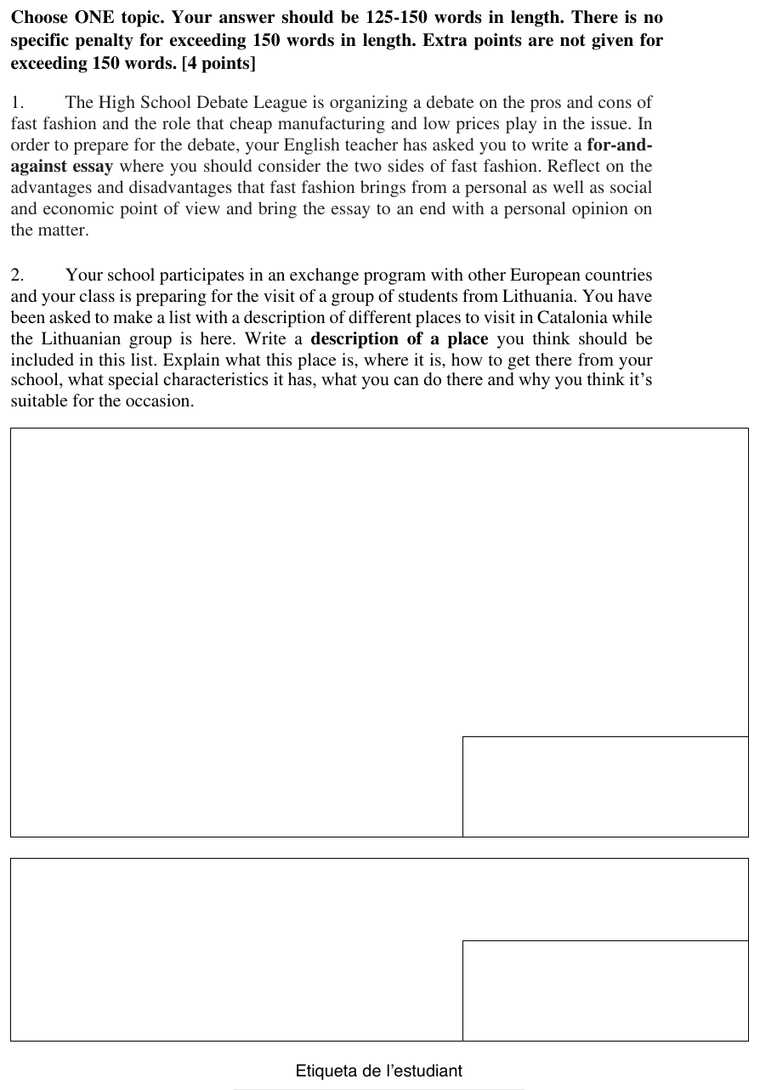
Choose ONE topic. Your answer should be 125-150 words in length. There is no specific penalty for exceeding 150 words in length. Extra points are not given for exceeding 150 words. [4 points]
The High School Debate League is organizing a debate on the pros and cons of fast fashion and the role that cheap manufacturing and low prices play in the issue. In order to prepare for the debate, your English teacher has asked you to write a for-and-against essay where you should consider the two sides of fast fashion. Reflect on the advantages and disadvantages that fast fashion brings from a personal as well as social and economic point of view and bring the essay to an end with a personal opinion on the matter.
Organitza els arguments a favor i en contra i acaba amb la teva opinió. El model relaciona els preus baixos amb l’accés a la roba i el malbaratament, i valora la creació de llocs de treball i les condicions laborals.
Fast fashion offers constantly changing clothes at prices that many people can afford. Its appeal is understandable, but the apparent bargain deserves closer examination.
For individuals, inexpensive manufacturing means greater choice and easier access to essential clothing. Young people can experiment with style without spending a fortune. Economically, the industry creates jobs and supports businesses involved in production, transport and retail.
However, low prices encourage frequent replacement, even when garments remain usable. This increases waste and demand for resources. Socially, the pressure to manufacture cheaply may lead to poor working conditions, while constant advertising suggests that belonging depends on buying something new.
In my view, affordability should not require treating either clothes or workers as disposable. I favour buying fewer, longer-lasting items and using second-hand shops when possible. Companies must also improve working conditions: responsible consumption cannot succeed if responsibility is left entirely to customers.
Toca per ampliarExercici 3 · opció B
Writing
Toca per ampliarChoose ONE topic. Your answer should be 125-150 words in length. There is no specific penalty for exceeding 150 words in length. Extra points are not given for exceeding 150 words. [4 points]
Your school participates in an exchange program with other European countries and your class is preparing for the visit of a group of students from Lithuania. You have been asked to make a list with a description of different places to visit in Catalonia while the Lithuanian group is here. Write a description of a place you think should be included in this list. Explain what this place is, where it is, how to get there from your school, what special characteristics it has, what you can do there and why you think it’s suitable for the occasion.
La descripció per a la llista ha d’incloure on és el lloc, com s’hi arriba des de l’institut, què el fa especial i què hi pot fer el grup. El model explica per què Montserrat és una bona visita per a l’intercanvi amb els estudiants lituans.
I would include Montserrat in our programme for the Lithuanian students. This mountain near Barcelona combines dramatic scenery with an opportunity to discover Catalan cultural life.
From our school in Barcelona, we could travel by train to Monistrol and continue up the mountain on the rack railway. The journey itself would introduce our visitors to a landscape very different from the city streets around school.
Montserrat's rounded rock formations rise above wooded slopes, surrounding a monastery that gives the place its distinctive atmosphere. We could explore the monastery area, discuss its cultural importance and follow a short marked walking route chosen to suit everyone's abilities.
I think it would be ideal for an exchange visit because there is plenty to observe and talk about together. Sharing photographs and impressions afterwards would also give both groups a natural reason to practise English beyond the classroom.
Toca per ampliar