Anglès
PAU 2025 · ordinària · tribunal d’incidències · sèrie 4
Examen oficial de la PAU de Catalunya amb la resolució pas a pas de cada apartat i la pauta de correcció.
Listening
PAU 2025 · ordinària · tribunal d’incidències · sèrie 4Instruccions de l’examen
The exam consists of THREE mandatory parts. In the first part, listening comprehension is assessed through 8 multiple choice questions. It is worth 3 points. In the second part, reading comprehension is assessed through 6 open-ended questions. It is worth 3 points. In the third part, written expression is assessed. Here, you may choose ONE of the two given options. It is worth 4 points.
Part 1: Listening comprehension
Choose the best answer according to the recording. Only ONE answer is correct. [3 points: 0.375 points for each correct answer. Wrong answers will be penalized by deducting 0.125 points. There is no penalty for unanswered questions.]
Part 2: Reading comprehension
Answer the questions below using complete sentences. You may use fragments from the text unless specified not to do so. [3 points: 0.5 points for each correct answer. Up to 0.3 points might be deducted from the total mark for lack of intelligibility in the answers provided.]
Part 3: Writing
Choose ONE topic. Your answer should be 125-150 words in length. There is no specific penalty for exceeding 150 words in length. [4 points: 1 point for grammar, 1 point for vocabulary and spelling, 1 point for cohesion and 1 point for adequacy and coherence.]
Exercici 1
Listening comprehension
 Toca per ampliar
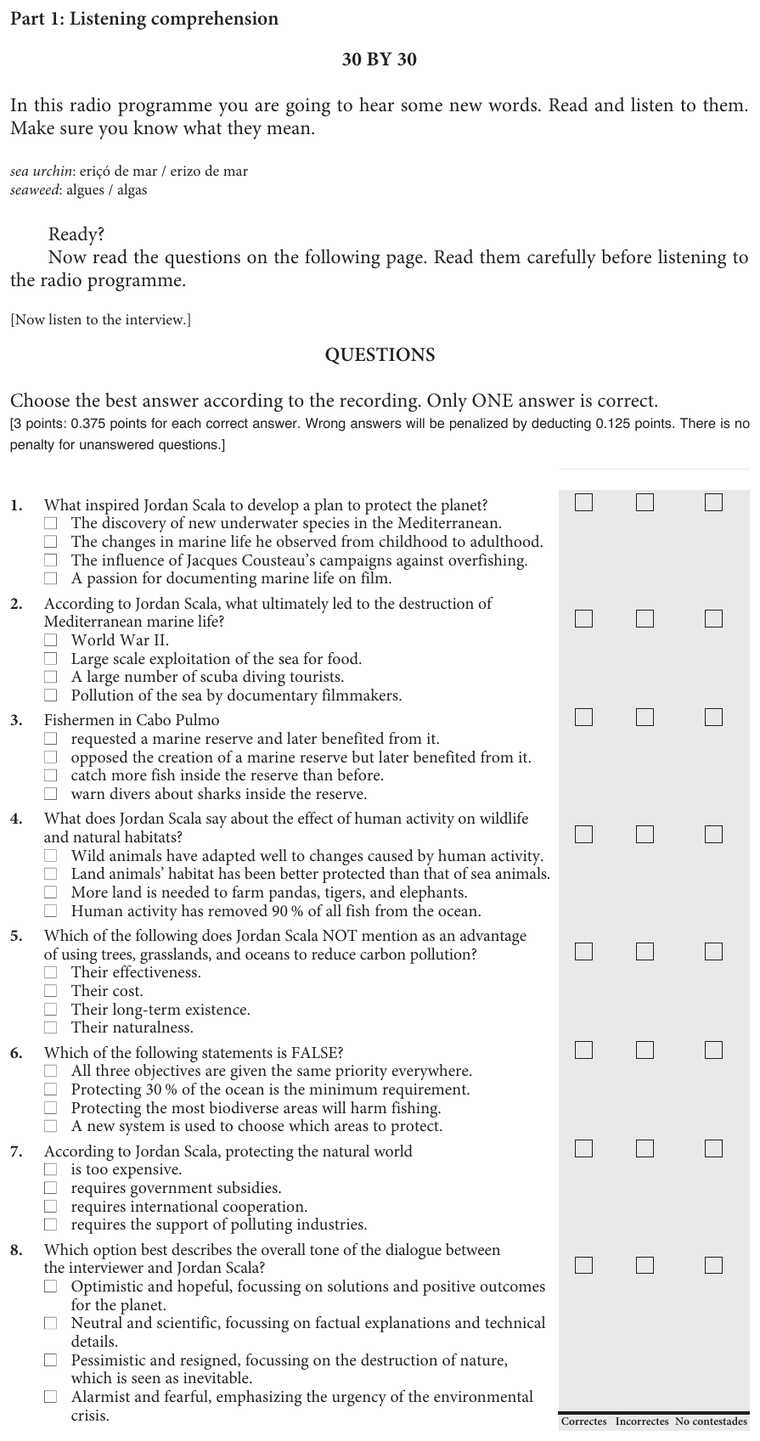
30 BY 30
In this radio programme you are going to hear some new words. Read and listen to them. Make sure you know what they mean.
sea urichin: eriçó de mar/erizo de mar
seaweed: algues/algas
Ready? Now read the questions on the following page. Read them carefully before listening to the radio programme. [Now listen to the interview.]
Interviewer: Today I am joined by marine ecologist Jordan Scala who is here to tell us about 30 by 30, an ambitious plan to protect our planet. Jordan, what made you want to get started with this plan?
Jordan: When I was a kid growing up in the Mediterranean, I was fascinated by the underwater world that Jacques Cousteau showed us in his documentaries. When he started filming during World War II, the Mediterranean shores were still full of large fish. But when I went to the sea to swim in the '70s, I saw none of that. There were sea urchins at the bottom, but I never saw a large fish. The industrialisation of fishing after World War II put the final nail in the coffin of Mediterranean marine life. I thought nature was lost. Until, in my 20s, I started scuba diving in the Medes Islands marine reserve in Spain. One square kilometre fully protected from fishing and other damaging activities. I still remember that first dive in the reserve. As soon as I put my head underwater, I felt like diving into one of Cousteau's films. What was missing from the sea of my childhood was there: octopus, large fish, seaweed forests. Just a few years of protection had allowed the sea to recover.
Interviewer: Is the Medes Islands marine reserve unique, are there other areas of the sea which have recovered?
Jordan: No, I have seen this miracle happen in other areas across the ocean, like in Cabo Pulmo, Mexico, where local fishermen were so upset about not having enough fish to catch, that in the mid-90s, they asked the Mexican government to create a no-fishing area. A national park in the sea. We surveyed the marine environment then, and the place was an underwater desert. When we returned a decade later, everything had changed. What had been an empty sea was now full of life and colour. We saw it recover in only 10 years, including the return of the large fish and sharks. And those visionary fishermen are better off now. From diving tourism inside the reserve and better fishing around it.
Interviewer: So, there is obviously a strong argument for protecting our seas then.
Jordan: Yes, but today, globally, only seven percent of the ocean and around a fifth of our land has been protected. That means that we have converted most of our planet into a tame environment, where we and our farmed animals represent 96 percent of the mammals. Only four percent is everything else, from pandas to tigers to elephants. And we have removed over 90 percent of the large fish in the ocean in the last century alone.
Interviewer: Last summer saw some of the hottest temperatures in human history, in places that one would expect to be cool, like Canada, Finland and Siberia. I imagine this has played a role in the destruction of the natural environment.
Jordan: This extreme heat kills hundreds of thousands of people. If we are to prevent a global disaster, we need to do two things. As we know, we need to reduce emissions of greenhouse gases to almost zero. But we also need to decrease the excess carbon pollution in the atmosphere and in the ocean. We need nature's help. Because trees, grasslands, and healthy oceans are the best and most efficient technologies to remove carbon from the atmosphere, and they already exist. As long as we protect them, they do the removal for free.
Interviewer: So that’s the solution. Surely, it can’t be that simple.
Jordan: The problem is that nature cannot keep up with us. The biodiversity that is left today is not enough to absorb our impacts any longer. That's why I put together a team of top scientists and economists to answer the question of which areas in the ocean we must protect first. And how much of the ocean do we need to protect? We decided to focus on three objectives: biodiversity, food and carbon storage to help the fight against climate change. If we think of each objective in isolation, there are compromises. Protecting the top areas for biodiversity could result in a loss of fish to catch, for example. To solve that problem, we developed a new framework to optimize multiple benefits. Picking which areas to protect depends on how much we value the different objectives. We found that if we gave the same weight to biodiversity, food and carbon, we would need to protect the right 45 percent of the ocean to maximize the three benefits. We also found that even if we didn't value biodiversity, the minimum amount of ocean we would need to protect would be 30 percent.
Interviewer: But what about land?
Jordan: Similar analysis has been done for the land, also showing 30 percent as a minimum. Armed with this research, we launched a campaign for 30 by 30, meaning at least 30 percent of the planet, land and sea, protected by 2030. Getting governments to work together is essential. Working with the governments of Costa Rica, France and the United Kingdom, we built the High Ambition Coalition for Nature and People, which now has 66 countries, all supporting "30 by 30" as a main target for a global deal on nature.
Interviewer: Some will say, however, that we cannot afford to protect our natural world. What do you say to that?
Jordan: I understand that the idea of protecting a third of our land and ocean may feel threatening to those who see only the short-term profits of their destruction. But let's look at the numbers. A study has put the cost of protecting 30 percent of the planet at about 140 billion dollars a year. That's only a fraction of the money that governments use to subsidise industries that pollute our air, damage our land and empty our ocean. We need to reverse the flow of that money from funding the destruction of our life support system to preserving it.
Interviewer: Thank you, Jordan.
Adapted from:
Sala, E. Enric Sala: A bold plan to protect 30 percent of the Earth’s surface and ocean floor. TED Talk. https://www.ted.com/talks/enricsalaaboldplantoprotect30percentoftheeart hssurfaceandoceanfloor
See the official listening transcript in Part 1, question 1 (item 1.1).
What inspired Jordan Scala to develop a plan to protect the planet?
■ The discovery of new underwater species in the Mediterranean.
■ The changes in marine life he observed from childhood to adulthood.
■ The influence of Jacques Cousteau’s campaigns against overfishing.
■ A passion for documenting marine life on film.
According to Jordan Scala, what ultimately led to the destruction of
Mediterranean marine life?
■ World War II.
■ Large scale exploitation of the sea for food.
■ A large number of scuba diving tourists.
■ Pollution of the sea by documentary filmmakers.
Fishermen in Cabo Pulmo
■ requested a marine reserve and later benefited from it.
■ opposed the creation of a marine reserve but later benefited from it.
■ catch more fish inside the reserve than before.
■ warn divers about sharks inside the reserve.
What does Jordan Scala say about the effect of human activity on wildlife
and natural habitats?
■ Wild animals have adapted well to changes caused by human activity.
■ Land animals’ habitat has been better protected than that of sea animals.
■ More land is needed to farm pandas, tigers, and elephants.
■ Human activity has removed 90 % of all fish from the ocean.
Which of the following does Jordan Scala NOT mention as an advantage
of using trees, grasslands, and oceans to reduce carbon pollution?
■ Their effectiveness.
■ Their cost.
■ Their long-term existence.
■ Their naturalness.
Which of the following statements is FALSE?
■ All three objectives are given the same priority everywhere.
■ Protecting 30 % of the ocean is the minimum requirement.
■ Protecting the most biodiverse areas will harm fishing.
■ A new system is used to choose which areas to protect.
According to Jordan Scala, protecting the natural world
■ is too expensive.
■ requires government subsidies.
■ requires international cooperation.
■ requires the support of polluting industries.
Which option best describes the overall tone of the dialogue between
the interviewer and Jordan Scala?
■ Optimistic and hopeful, focussing on solutions and positive outcomes
for the planet.
■ Neutral and scientific, focussing on factual explanations and technical
details.
■ Pessimistic and resigned, focussing on the destruction of nature,
which is seen as inevitable.
■ Alarmist and fearful, emphasizing the urgency of the environmental
crisis.
Relaciona els dos records de Scala. De petit no veia peixos grossos quan nedava al Mediterrani i, anys més tard, en va veure en una immersió a la reserva de les Medes.
B. The changes in marine life he observed from childhood to adulthood.
+0,375criteri 1 de la pauta
 Toca per ampliar
- 0,375 pSeleccionar la resposta de la clau oficial: The changes in marine life he observed from childhood to adulthood.Penalització: Resposta incorrecta: −0.125 punts; pregunta no contestada: sense penalització.
Busca l’activitat a què Scala atribueix la destrucció de la vida marina al Mediterrani. L’expressió «industrialisation of fishing» indica que la pesca es va fer a gran escala després de la Segona Guerra Mundial.
B. Large scale exploitation of the sea for food.
+0,375criteri 1 de la pauta
Toca per ampliar- 0,375 pSeleccionar la resposta de la clau oficial: Large scale exploitation of the sea for foodPenalització: Resposta incorrecta: −0.125 punts; pregunta no contestada: sense penalització.
Relaciona què van demanar els pescadors de Cabo Pulmo amb allò que en van treure. Van sol·licitar una zona sense pesca i, quan es va recuperar la fauna, es van beneficiar del turisme de busseig i de la millora de la pesca al voltant de la reserva.
A. requested a marine reserve and later benefited from it.
+0,375criteri 1 de la pauta
Toca per ampliar- 0,375 pSeleccionar la resposta de la clau oficial: requested a marine reserve and later benefited from it.Penalització: Resposta incorrecta: −0.125 punts; pregunta no contestada: sense penalització.
Compara les superfícies protegides que esmenta Scala, un 7 % de l’oceà i aproximadament una cinquena part de la terra. Quan parla de la pèrdua de més del 90 %, es refereix als peixos grossos.
B. Land animals’ habitat has been better protected than that of sea animals.
+0,375criteri 1 de la pauta
Toca per ampliar- 0,375 pSeleccionar la resposta de la clau oficial: Land animals’ habitat has been better protected than that of sea animals.Penalització: Resposta incorrecta: −0.125 punts; pregunta no contestada: sense penalització.
La paraula «NOT» indica que cal triar la característica que Scala no presenta com un avantatge. Destaca l’eficàcia d’aquests ecosistemes, el fet que ja existeixen i que retiren carboni de franc si els protegim.
D. Their naturalness.
+0,375criteri 1 de la pauta
Toca per ampliar- 0,375 pSeleccionar la resposta de la clau oficial: Their naturalnessPenalització: Resposta incorrecta: −0.125 punts; pregunta no contestada: sense penalització.
Busca l’afirmació falsa sobre el pes dels tres objectius. La tria depèn de la importància que es doni a la biodiversitat, a la pesca com a font d’aliment i a l’emmagatzematge de carboni.
El 45 % correspon al cas hipotètic en què els tres objectius pesen igual. L’opció C formula com una certesa el que Scala presenta com una possibilitat si es prioritza només la biodiversitat.
A. All three objectives are given the same priority everywhere.
+0,375criteri 1 de la pauta
Toca per ampliar- 0,375 pSeleccionar la resposta de la clau oficial: All three objectives are given the same priority everywhere.Penalització: Resposta incorrecta: −0.125 punts; pregunta no contestada: sense penalització.
Fixa’t en qui ha de col·laborar perquè el pla funcioni. Scala considera essencial que els governs treballin plegats i posa com a exemple una coalició de països que dona suport al 30 by 30.
C. requires international cooperation.
+0,375criteri 1 de la pauta
Toca per ampliar- 0,375 pSeleccionar la resposta de la clau oficial: requires international cooperation.Penalització: Resposta incorrecta: −0.125 punts; pregunta no contestada: sense penalització.
Valora el to del diàleg sencer. Scala mostra que protegir una zona permet que la vida marina es recuperi, com va passar a Cabo Pulmo, i presenta un pla de protecció amb accions concretes.
A. Optimistic and hopeful, focussing on solutions and positive outcomes for the planet.
+0,375criteri 1 de la pauta
Toca per ampliar- 0,375 pSeleccionar la resposta de la clau oficial: Optimistic and hopeful, focussing on solutions and positive outcomes for the planet.Penalització: Resposta incorrecta: −0.125 punts; pregunta no contestada: sense penalització.
Exercici 2
Reading comprehension
 Toca per ampliar
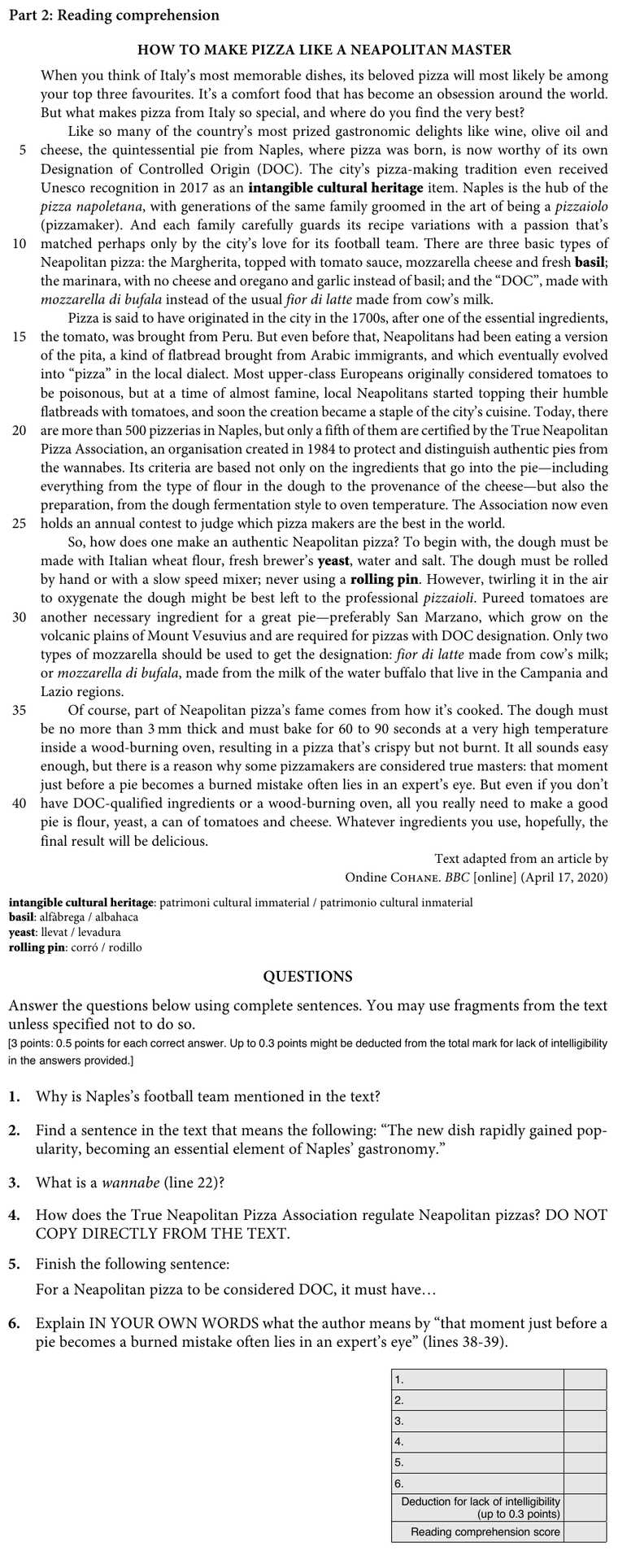
HOW TO MAKE PIZZA LIKE A NEAPOLITAN MASTER When you think of Italy’s most memorable dishes, its beloved pizza will most likely be among your top three favourites. It’s a comfort food that has become an obsession around the world. But what makes pizza from Italy so special, and where do you find the very best? Like so many of the country’s most prized gastronomic delights like wine, olive oil and cheese, the quintessential pie from Naples, where pizza was born, is now worthy of its own Designation of Controlled Origin (DOC). The city’s pizza-making tradition even received Unesco recognition in 2017 as an intangible cultural heritage item. Naples is the hub of the pizza napoletana, with generations of the same family groomed in the art of being a pizzaiolo (pizzamaker). And each family carefully guards its recipe variations with a passion that’s matched perhaps only by the city’s love for its football team. There are three basic types of Neapolitan pizza: the Margherita, topped with tomato sauce, mozzarella cheese and fresh basil; the marinara, with no cheese and oregano and garlic instead of basil; and the “DOC”, made with mozzarella di bufala instead of the usual fior di latte made from cow’s milk. Pizza is said to have originated in the city in the 1700s, after one of the essential ingredients, the tomato, was brought from Peru. But even before that, Neapolitans had been eating a version of the pita, a kind of flatbread brought from Arabic immigrants, and which eventually evolved into “pizza” in the local dialect. Most upper-class Europeans originally considered tomatoes to be poisonous, but at a time of almost famine, local Neapolitans started topping their humble flatbreads with tomatoes, and soon the creation became a staple of the city’s cuisine. Today, there are more than 500 pizzerias in Naples, but only a fifth of them are certified by the True Neapolitan Pizza Association, an organisation created in 1984 to protect and distinguish authentic pies from the wannabes. Its criteria are based not only on the ingredients that go into the pie—including everything from the type of flour in the dough to the provenance of the cheese—but also the preparation, from the dough fermentation style to oven temperature. The Association now even holds an annual contest to judge which pizza makers are the best in the world. So, how does one make an authentic Neapolitan pizza? To begin with, the dough must be made with Italian wheat flour, fresh brewer’s yeast, water and salt. The dough must be rolled by hand or with a slow speed mixer; never using a rolling pin. However, twirling it in the air to oxygenate the dough might be best left to the professional pizzaioli. Pureed tomatoes are another necessary ingredient for a great pie—preferably San Marzano, which grow on the volcanic plains of Mount Vesuvius and are required for pizzas with DOC designation. Only two types of mozzarella should be used to get the designation: fior di latte made from cow’s milk; or mozzarella di bufala, made from the milk of the water buffalo that live in the Campania and Lazio regions. Of course, part of Neapolitan pizza’s fame comes from how it’s cooked. The dough must be no more than 3 mm thick and must bake for 60 to 90 seconds at a very high temperature inside a wood-burning oven, resulting in a pizza that’s crispy but not burnt. It all sounds easy enough, but there is a reason why some pizzamakers are considered true masters: that moment just before a pie becomes a burned mistake often lies in an expert’s eye. But even if you don’t have DOC-qualified ingredients or a wood-burning oven, all you really need to make a good pie is flour, yeast, a can of tomatoes and cheese. Whatever ingredients you use, hopefully, the final result will be delicious. Text adapted from an article by Ondine Cohane. BBC [online] (April 17, 2020) intangible cultural heritage: patrimoni cultural immaterial / patrimonio cultural inmaterial basil: alfàbrega / albahaca yeast: llevat / levadura rolling pin: corró / rodillo
See the shared reading text and glossary in Part 2, question 1 (item 2.1).
Why is Naples’s football team mentioned in the text?
Find a sentence in the text that means the following: “The new dish rapidly gained popularity, becoming an essential element of Naples’ gastronomy.”
What is a wannabe (line 22)?
How does the True Neapolitan Pizza Association regulate Neapolitan pizzas? DO NOT COPY DIRECTLY FROM THE TEXT.
Finish the following sentence: For a Neapolitan pizza to be considered DOC, it must have…
Explain IN YOUR OWN WORDS what the author means by “that moment just before a pie becomes a burned mistake often lies in an expert’s eye” (lines 38-39).
Explica la funció de la referència al futbol. L’autora posa al mateix nivell la passió amb què les famílies guarden les seves receptes i la que desperta l’equip a la ciutat.
The team is mentioned to compare the passion with which Neapolitans protect family pizza recipes to their love for their football club.
+0,5criteri 1 de la pauta
Toca per ampliar- 0,5 pResposta admesa, sense desglossament de punts dins la pregunta: Naples’s football team is mentioned in order to compare the passion families from Naples have to guard pizza recipes with the love Naples’s citizens have for their football team.
Localitza la idea al passatge sobre l’origen de la pizza. La pauta admet aquest fragment de la línia 19.
«Soon» correspon a «rapidly», «the creation» es refereix al plat nou i «a staple of the city’s cuisine» expressa que va esdevenir un element bàsic de la cuina napolitana.
Soon the creation became a staple of the city’s cuisine.
+0,5criteri 1 de la pauta
Toca per ampliar- 0,5 pResposta admesa, sense desglossament de punts dins la pregunta: Soon the creation became a staple of the city’s cuisine (line 22).
Dedueix el sentit de «wannabe» pel contrast amb «authentic pies». En aquest context designa una pizza que imita l’autèntica.
A wannabe is an imitation that is not regarded as authentic.
+0,5criteri 1 de la pauta
Toca per ampliar- 0,5 pResposta admesa, sense desglossament de punts dins la pregunta: Something that is not considered authentic/original/ An imitation / a bad copy
Explica amb paraules pròpies quins dos aspectes regula l’associació. El text posa exemples tant dels ingredients, com la farina i el formatge, com de la preparació, com la fermentació i la temperatura del forn.
The association sets rules about which ingredients may be used and the methods for preparing and cooking the pizzas.
+0,5criteri 1 de la pauta
Toca per ampliar- 0,5 pResposta admesa, sense desglossament de punts dins la pregunta: The Association controls/ They control the ingredients that are put on the pizzas and how they must be cooked. (among others)
Completa la frase amb el tomàquet que cal fer servir i les dues opcions de mozzarella que admet el text. Posa «either … or» per indicar que n’hi ha prou amb un dels dos formatges.
For a Neapolitan pizza to be considered DOC, it must have San Marzano tomatoes and either fior di latte or mozzarella di bufala.
+0,5criteri 1 de la pauta
Toca per ampliar- 0,5 pResposta admesa, sense desglossament de punts dins la pregunta: San Marzano tomatoes (which grow on the volcanic plains of Mount Vesuvius) and either fior di latte (made from cow’s milk) or mozzarella di bufala (made from the milk of the water buffalo that live in the Campania and Lazio regions). NB. Information between brackets is optional.
Explica amb paraules pròpies què permet fer l’experiència del cuiner. L’expressió «an expert’s eye» es refereix al seu criteri per saber quan ha de treure la pizza del forn.
Only a skilled pizza cook can judge the precise instant when a pizza is ready and remove it before it burns.
+0,5criteri 1 de la pauta
Toca per ampliar- 0,5 pResposta admesa, sense desglossament de punts dins la pregunta: Only an experienced cook / pizzaoiolo knows when a pizza is cooked to perfection / the cooking point of a pizza / when a pizza must be taken out of the oven to avoid it being burnt. (among others)
Exercici 3 · opció A
Writing
 Toca per ampliar
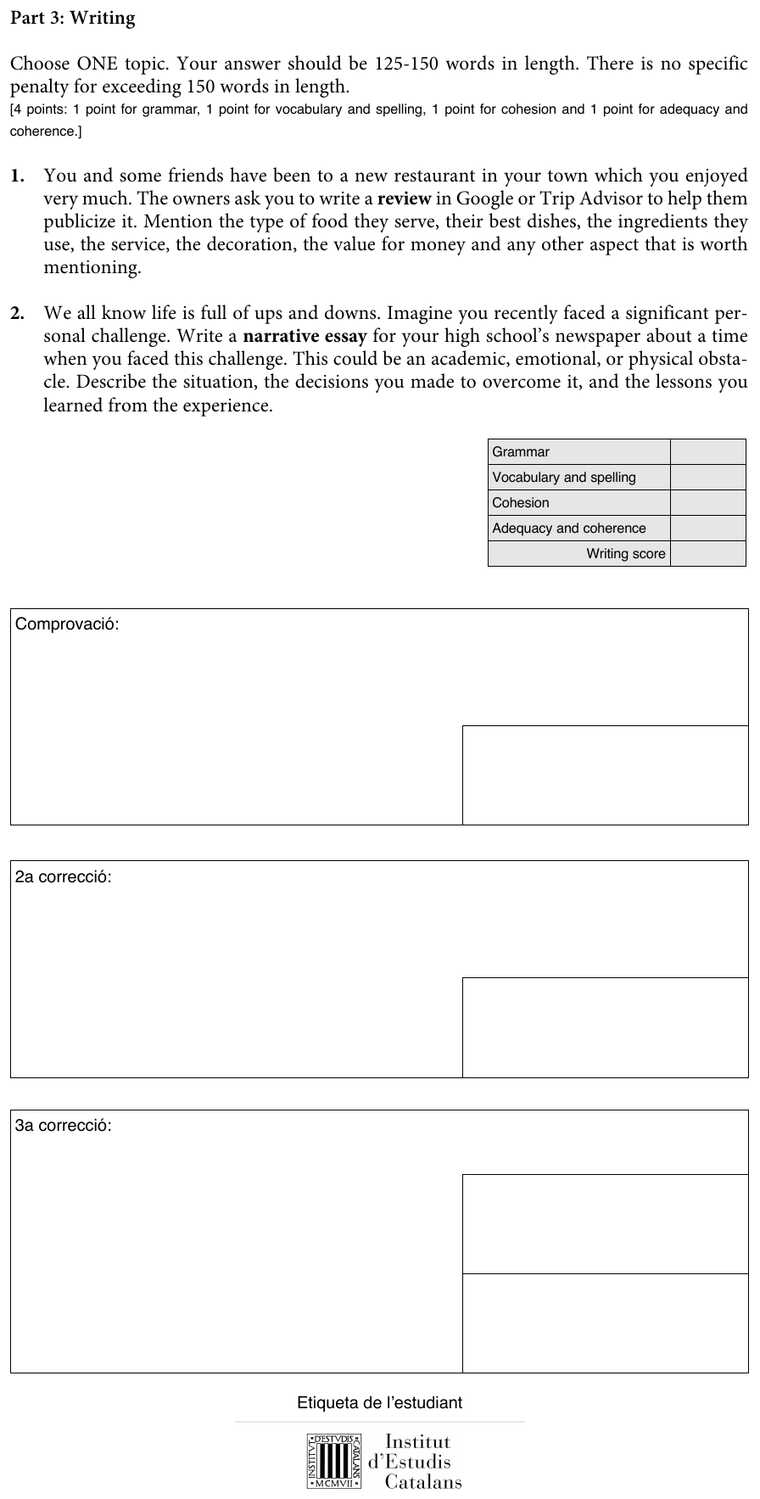
Choose ONE topic. Your answer should be 125-150 words in length. There is no specific penalty for exceeding 150 words in length. [4 points: 1 point for grammar, 1 point for vocabulary and spelling, 1 point for cohesion and 1 point for adequacy and coherence.]
You and some friends have been to a new restaurant in your town which you enjoyed very much. The owners ask you to write a review in Google or Trip Advisor to help them publicize it. Mention the type of food they serve, their best dishes, the ingredients they use, the service, the decoration, the value for money and any other aspect that is worth mentioning.
En gramàtica, tria el temps verbal segons si expliques la visita o valores el restaurant.
Al model d’Original Academia, el passat simple situa la visita i el servei amb «visited» i «explained». El present de «serves» descriu l’oferta habitual i «I would recommend» formula la recomanació.
+1criteri 1 de la pautaEn vocabulari i ortografia, fes servir mots precisos per descriure el menjar i valorar l’experiència.
L’expressió «seasonal mushrooms» concreta l’ingredient, «firm texture» descriu el plat i «generous» valora les racions.
+1criteri 2 de la pautaPer donar cohesió a la ressenya, ordena els detalls tal com els voldria llegir algú que pensa anar-hi.
El model va de la impressió inicial als plats i el servei, i després passa a l’ambient, al preu i a la recomanació. «Its rich flavour» reprèn l’arròs que acaba de presentar i lliga les dues frases.
+1criteri 3 de la pautaPer adequar la ressenya al públic, parla des de l’experiència amb els amics i cobreix els aspectes que demana l’enunciat.
La valoració del menjar mediterrani, el plat preferit, els ingredients, el servei i la decoració justifica la recomanació. «The bill felt fair for the quality» concreta la relació qualitat-preu i el consell de reservar ajuda qui hi vulgui anar en grup.
+1criteri 4 de la pauta
A Delicious Evening at La Plaça
My friends and I visited La Plaça on Friday and left planning our next meal there. This welcoming restaurant serves Mediterranean dishes that allow fresh ingredients to speak for themselves.
The roasted vegetable starter was beautifully seasoned, but the highlight was the rice with seasonal mushrooms. Its rich flavour and firm texture showed real care in the kitchen. We also shared a lemon dessert that tasted refreshing rather than overwhelmingly sweet. Our waiter explained which ingredients came from nearby producers and answered our questions patiently.
Warm lighting, wooden tables and simple ceramic decorations created a relaxed atmosphere. Although the room was busy, we could still hear one another comfortably.
The portions were generous and the bill felt fair for the quality. I would recommend booking, especially for a group. La Plaça is an excellent choice for an unhurried dinner with friends.
Toca per ampliar- 1 pGramàtica (Grammar) (1 punt, segons l’enunciat). No es publiquen descriptors de banda ni deduccions per error als PDF aportats.
- 1 pVocabulari i ortografia (Vocabulary and spelling) (1 punt, segons l’enunciat). No es publiquen descriptors de banda ni deduccions per error als PDF aportats.
- 1 pCohesió (Cohesion) (1 punt, segons l’enunciat). No es publiquen descriptors de banda ni deduccions per error als PDF aportats.
- 1 pAdequació i coherència (Adequacy and coherence) (1 punt, segons l’enunciat). No es publiquen descriptors de banda ni deduccions per error als PDF aportats.
Exercici 3 · opció B
Writing
Toca per ampliarChoose ONE topic. Your answer should be 125-150 words in length. There is no specific penalty for exceeding 150 words in length. [4 points: 1 point for grammar, 1 point for vocabulary and spelling, 1 point for cohesion and 1 point for adequacy and coherence.]
We all know life is full of ups and downs. Imagine you recently faced a significant personal challenge. Write a narrative essay for your high school’s newspaper about a time when you faced this challenge. This could be an academic, emotional, or physical obstacle. Describe the situation, the decisions you made to overcome it, and the lessons you learned from the experience.
En gramàtica, situa la història en el passat i combina els temps segons què passa a cada moment.
Al model d’Original Academia, «When I was chosen» obre el relat amb una acció puntual en passat simple i en veu passiva. A «what was happening», el passat continu descriu la situació que el narrador explica a la professora.
+1criteri 1 de la pautaEn vocabulari i ortografia, tria paraules que mostrin la por, la preparació i el que el narrador aprèn.
L’adjectiu «terrified» expressa la por inicial, «rehearsing» concreta la preparació i «trembled» mostra que a l’actuació encara estava nerviós. El mot «courage» recull el tema de la reflexió final.
+1criteri 2 de la pautaPer donar cohesió al relat, guia el lector des del repte inicial fins al concert i la reflexió.
El connector «Then» introdueix la decisió de demanar ajuda, «On the evening itself» situa l’actuació i «What changed» obre la reflexió sobre l’experiència.
+1criteri 3 de la pautaPer adequar la narració al diari de l’institut, explica un repte personal amb decisions concretes i una lliçó que els companys puguin entendre.
El repte és presentar el concert amb por de parlar en públic. El narrador explica com assaja «in small stages» i com aprèn que demanar ajuda i preparar-se li permeten actuar encara que tingui por.
+1criteri 4 de la pauta
When I was chosen to introduce our school concert, I smiled as though it were wonderful news. Inside, I was terrified. Even answering questions in class sometimes made my voice shake.
For several days, I considered inventing an excuse. Then I told my English teacher what was happening. She suggested rehearsing in small stages: first alone, then with a friend and finally in the empty hall. I also shortened my notes so that I could look at the audience instead of hiding behind a page.
On the evening itself, my hands still trembled. I paused, took a breath and began. One sentence became another, and soon people were applauding.
I did not suddenly become fearless. What changed was my understanding of courage. Asking for help and preparing carefully allowed me to act despite my anxiety. That lesson has stayed with me far longer than the applause.
Toca per ampliar- 1 pGramàtica (Grammar) (1 punt, segons l’enunciat). No es publiquen descriptors de banda ni deduccions per error als PDF aportats.
- 1 pVocabulari i ortografia (Vocabulary and spelling) (1 punt, segons l’enunciat). No es publiquen descriptors de banda ni deduccions per error als PDF aportats.
- 1 pCohesió (Cohesion) (1 punt, segons l’enunciat). No es publiquen descriptors de banda ni deduccions per error als PDF aportats.
- 1 pAdequació i coherència (Adequacy and coherence) (1 punt, segons l’enunciat). No es publiquen descriptors de banda ni deduccions per error als PDF aportats.