Anglès
PAU 2025 · ordinària · sèrie 1
Examen oficial de la PAU de Catalunya amb la resolució pas a pas de cada apartat i la pauta de correcció.
Listening
PAU 2025 · ordinària · sèrie 1Instruccions de l’examen
The exam consists of THREE mandatory parts. In the first part, listening comprehension is assessed through 8 multiple choice questions. It is worth 3 points. In the second part, reading comprehension is assessed through 6 open-ended questions. It is worth 3 points. In the third part, written expression is assessed. Here, you may choose ONE of the two given options. It is worth 4 points.
Part 1: Listening comprehension
Choose the best answer according to the recording. Only ONE answer is correct. [3 points: 0.375 points for each correct answer. Wrong answers will be penalized by deducting 0.125 points. There is no penalty for unanswered questions.]
Part 2: Reading comprehension
Answer the questions below using complete sentences. You may use fragments from the text unless specified not to do so. [3 points: 0.5 points for each correct answer. Up to 0.3 points might be deducted from the total mark for lack of intelligibility in the answers provided.]
Part 3: Writing
Choose ONE topic. Your answer should be 125-150 words in length. There is no specific penalty for exceeding 150 words in length. [4 points: 1 point for grammar, 1 point for vocabulary and spelling, 1 point for cohesion and 1 point for adequacy and coherence.]
Exercici 1
Listening comprehension
 Toca per ampliar
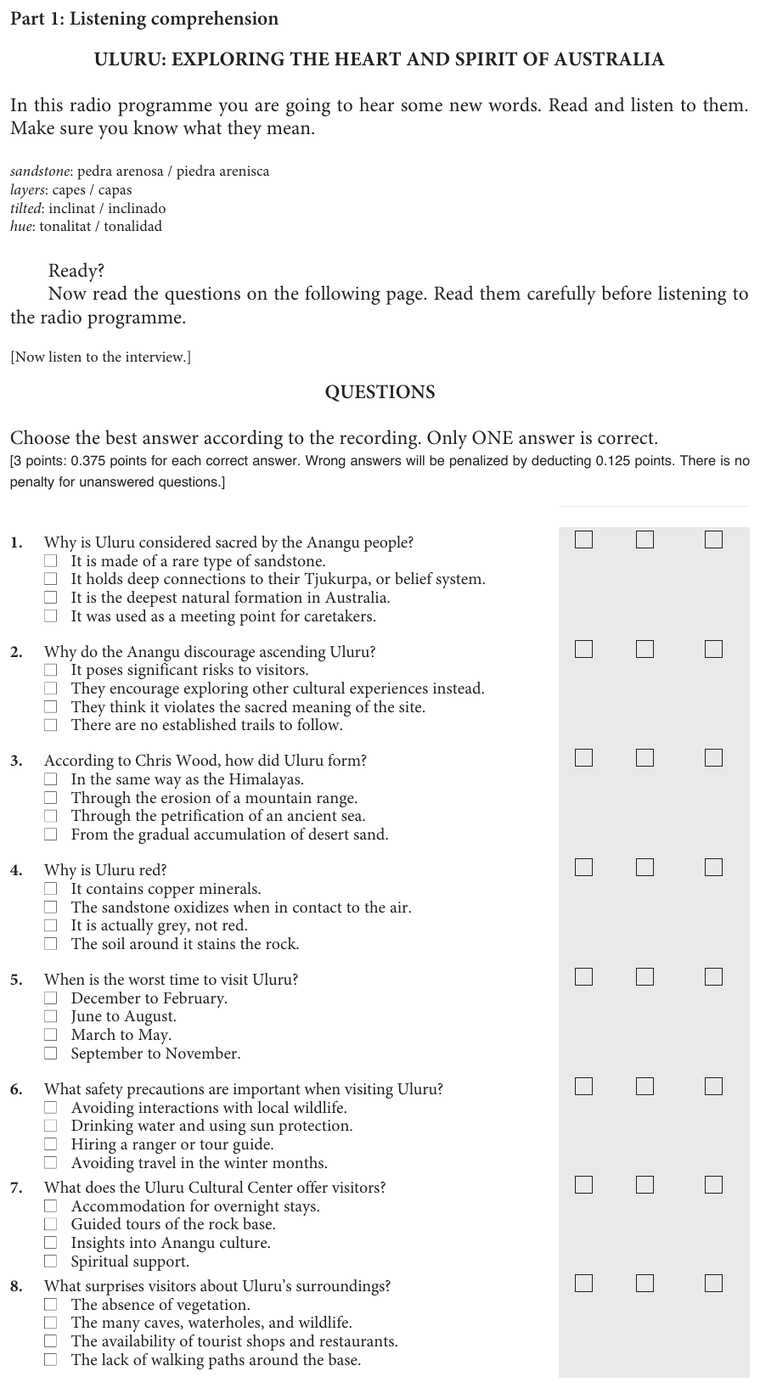
ULURU: EXPLORING THE HEART AND SPIRIT OF AUSTRALIA
In this radio programme you are going to hear some new words. Read and listen to them. Make sure you know what they mean.
sandstone: pedra arenosa / piedra arenisca
layers: capes / capas
tilted: inclinat / inclinado
hue: tonalitat / tonalidad
Ready?
Now read the questions on the following page. Read them carefully before listening to the radio programme.
[Now listen to the interview.]
[Nota d’Original, no oficial: el bloc anterior reprodueix el preàmbul i el glossari de pauangl25jl.pdf, p. 2, que rebia l’alumnat. A continuació es reprodueix la transcripció oficial del listening publicada a pauangl25jp.pdf; és material del corrector, separat de l’enunciat.]
ULURU: EXPLORING THE HEART AND SPIRIT OF AUSTRALIA
Journalist: Welcome to our program! Today we’re joined by Dr. Cris Wood, a geologist and expert on Uluru, one of Australia’s most iconic landmarks. Thank you for being here, Dr. Wood.
Dr. Wood: Thank you for having me. It’s great to share the story of such an incredible place.
Journalist: Uluru is famous worldwide for its striking appearance, but why is it considered so special by the Aboriginal people?
Dr. Wood: Uluru is a sacred site for the Anangu people, the traditional custodians of the land. To them, it’s more than a natural formation; it’s deeply tied to their Tjukurpa, which is their system of beliefs and laws. Tjukurpa includes the creation of stories that explain how the land and its features came to be. Many parts of Uluru, including its caves and waterholes, are connected to these stories. The Anangu see themselves as caretakers of Uluru, and they ask visitors to respect their traditions when visiting.
Journalist: One of those traditions includes discouraging people from climbing the rock, which surprises many visitors. Why is climbing considered disrespectful?
Dr. Wood: For the Anangu, Uluru is a place of spiritual significance. They believe that climbing it disrespects its sacred nature. Traditionally, they don’t climb it themselves. Instead, they encourage visitors to explore the base, visit waterholes, and learn about their culture at the cultural center. Climbing used to be popular, but now many people understand the importance of respecting indigenous beliefs and choose not to climb.
Journalist: Uluru is also a geological marvel. Could you tell us more about how it was formed?
Dr. Wood: Certainly! Uluru’s story began about 550 million years ago. Back then, it was part of a massive mountain range called the Petermann Ranges, which were similar in size to the Himalayas. Over time, the mountains eroded, and rivers carried sand and gravel to the base. This material eventually formed two iconic landmarks: Uluru and Kata Tjuta. Uluru is made of arkose sandstone, which is rich in feldspar crystals. It’s incredibly durable because the sand wasn’t transported far, so it didn’t undergo much erosion. Over millions of years, geological forces tilted the rock layers vertically, which is why we see those striking lines on Uluru’s surface today.
Journalist: The red color of Uluru is so distinctive. What causes it?
Dr. Wood: The red colour comes from oxidation, or rusting, of the iron minerals in the rock. When the sandstone is exposed to the air, the iron reacts with oxygen, giving it that beautiful red hue. Interestingly, the rock underneath, which hasn’t been exposed to the atmosphere, is actually grey.
Journalist: The Red Centre is known for its harsh conditions. What’s the best way for visitors to explore Uluru and its surroundings?
Dr. Wood: The best way is by car. You can hire a vehicle at Ayers Rock Airport and drive around the area, including Uluru, Kata Tjuta, and the nearby town of Yulara. Driving gives you the freedom to explore at your own pace. While there is a shuttle bus in Yulara township, it doesn’t operate within the national park. Beyond Uluru, many of the Northern Territory’s attractions are accessible by well-maintained roads, whether you’re in a regular car, campervan, or a four-by-four.
Journalist: Speaking of visiting, when is the best time of year to see Uluru?
Dr. Wood: Winter, from June to August, is the most popular time. The days are crisp and cool, making it perfect for outdoor activities. Summer, from December to February, is far too hot, with daytime temperatures often exceeding 40°C. Spring and autumn are much better with warm days and cooler evenings, so they’re also great for visiting. No matter the season, it’s essential to plan for the desert climate, which can have extreme temperature changes between day and night.
Journalist: Are there any safety tips you’d recommend for visitors?
Dr. Wood: Absolutely. Stay hydrated, as the desert air is very dry, and always carry water when walking or driving. Protect yourself from the sun with a hat, sunscreen, and lightweight clothing. It’s also important to check the weather before heading out, as conditions can change quickly. Stick to marked paths, respect wildlife, and pay attention to park signals. Luckily, the area around Uluru and Yulara is well-equipped with facilities, rangers, and maps to help visitors stay safe.
Journalist: What do you recommend for visitors who want to learn more about the Anangu culture?
Dr. Wood: The cultural centre near Uluru is an excellent place to start. You cannot stay there overnight, but it offers displays, videos, and artworks that explain the Anangu way of life and their connection to the land. Visitors can also join guided tours led by local guides who share stories and traditions. These experiences help people understand why Uluru is so much more than a tourist attraction—it’s a living, spiritual landscape.
Journalist: What’s something people often don’t expect about visiting Uluru?
Dr. Wood: Many are surprised by the variety of things to see and do around the rock. For instance, Uluru has many caves and waterholes, which are beautiful and have cultural significance. The base walk, which is about 10 kilometers long, lets visitors see the rock
up close, including its unique patterns, plants, and wildlife. It’s also a great way to experience the changing colors of Uluru at sunrise or sunset. These colors are breathtaking and truly unforgettable.
Journalist: Finally, why do you think Uluru leaves such a lasting impression on people?
Dr. Wood: Uluru is a place where natural beauty meets deep cultural history. Its size and color are striking, but it’s the stories and significance behind it that make it truly special. Many visitors say they feel a strong connection to the land when they visit. Whether it’s the spirituality, the geology, or the quiet majesty of the desert, Uluru has a way of staying with you long after you’ve left.
Journalist: Thank you, Dr. Wood, for sharing your insights. Uluru sounds like a destination that offers both natural wonder and cultural depth.
Dr. Wood: It really is. Thank you for having me!
Adapted from:
https://www.youtube.com/watch?v=j9t6kYpYnX4
https://www.abc.net.au/news/science/2017-06-27/how-did-uluru-and-kata-tjuta-form/8572068
See the official listening transcript in Part 1, question 1 (item 1.1).
Why is Uluru considered sacred by the Anangu people?
■ It is made of a rare type of sandstone.
■ It holds deep connections to their Tjukurpa, or belief system.
■ It is the deepest natural formation in Australia.
■ It was used as a meeting point for caretakers.
Why do the Anangu discourage ascending Uluru?
■ It poses significant risks to visitors.
■ They encourage exploring other cultural experiences instead.
■ They think it violates the sacred meaning of the site.
■ There are no established trails to follow.
According to Chris Wood, how did Uluru form?
■ In the same way as the Himalayas.
■ Through the erosion of a mountain range.
■ Through the petrification of an ancient sea.
■ From the gradual accumulation of desert sand.
Why is Uluru red?
■ It contains copper minerals.
■ The sandstone oxidizes when in contact to the air.
■ It is actually grey, not red.
■ The soil around it stains the rock.
When is the worst time to visit Uluru?
■ December to February.
■ June to August.
■ March to May.
■ September to November.
What safety precautions are important when visiting Uluru?
■ Avoiding interactions with local wildlife.
■ Drinking water and using sun protection.
■ Hiring a ranger or tour guide.
■ Avoiding travel in the winter months.
What does the Uluru Cultural Center offer visitors?
■ Accommodation for overnight stays.
■ Guided tours of the rock base.
■ Insights into Anangu culture.
■ Spiritual support.
What surprises visitors about Uluru’s surroundings?
■ The absence of vegetation.
■ The many caves, waterholes, and wildlife.
■ The availability of tourist shops and restaurants.
■ The lack of walking paths around the base.
Busca per què el lloc és sagrat per als anangu. El geòleg vincula la roca i les històries sobre el paisatge amb el Tjukurpa, el seu sistema de creences i lleis.
B. It holds deep connections to their Tjukurpa, or belief system.
+0,375criteri 1 de la pauta
 Toca per ampliar
- 0,375 pSeleccionar la resposta de la clau oficial: It holds deep connections to their Tjukurpa, or belief system.Penalització: Resposta incorrecta: −0.125 punts; pregunta no contestada: sense penalització.
Escolta quin motiu donen els anangu per evitar l’ascens. Consideren que pujar a la roca és una falta de respecte a un lloc sagrat, i visitar-ne la base és una de les activitats que proposen.
C. They think it violates the sacred meaning of the site.
+0,375criteri 1 de la pauta
Toca per ampliar- 0,375 pSeleccionar la resposta de la clau oficial: They think it violates the sacred meaning of the site.Penalització: Resposta incorrecta: −0.125 punts; pregunta no contestada: sense penalització.
Segueix el procés que descriu el geòleg. L’erosió de la serralada de Petermann va proporcionar la sorra i la grava que els rius van arrossegar i que acabarien formant Uluru.
B. Through the erosion of a mountain range.
+0,375criteri 1 de la pauta
Toca per ampliar- 0,375 pSeleccionar la resposta de la clau oficial: Through the erosion of a mountain range.Penalització: Resposta incorrecta: −0.125 punts; pregunta no contestada: sense penalització.
Busca què passa quan el gres queda exposat a l’aire. Els minerals de ferro de la superfície reaccionen amb l’oxigen i donen a la roca el color vermell.
A l’opció B, l’expressió «in contact to the air» vol dir «in contact with the air», que és la forma habitual en anglès.
B. The sandstone oxidizes when in contact to the air.
+0,375criteri 1 de la pauta
Toca per ampliar- 0,375 pSeleccionar la resposta de la clau oficial: The sandstone oxidizes when in contact to the air.Penalització: Resposta incorrecta: −0.125 punts; pregunta no contestada: sense penalització.
La pregunta demana el pitjor moment per fer la visita. El geòleg diu que de desembre a febrer és estiu a Uluru i que durant el dia sovint se superen els 40 °C.
A. December to February.
+0,375criteri 1 de la pauta
Toca per ampliar- 0,375 pSeleccionar la resposta de la clau oficial: December to FebruaryPenalització: Resposta incorrecta: −0.125 punts; pregunta no contestada: sense penalització.
Identifica les precaucions que recomana el geòleg contra la sequedat i el sol. Aconsella portar aigua i protegir-se amb barret, crema solar i roba lleugera.
B. Drinking water and using sun protection.
+0,375criteri 1 de la pauta
Toca per ampliar- 0,375 pSeleccionar la resposta de la clau oficial: Drinking water and using sun protectionPenalització: Resposta incorrecta: −0.125 punts; pregunta no contestada: sense penalització.
Fixa’t en què ofereix el centre cultural. Les exposicions, els vídeos i les obres d’art expliquen la manera de viure dels anangu i el seu vincle amb la terra.
C. Insights into Anangu culture.
+0,375criteri 1 de la pauta
Toca per ampliar- 0,375 pSeleccionar la resposta de la clau oficial: Insights into Anangu culture.Penalització: Resposta incorrecta: −0.125 punts; pregunta no contestada: sense penalització.
La pregunta demana què sorprèn els visitants als voltants de la roca. El geòleg destaca la varietat de coses que es veuen al camí de la base, com ara coves, basses naturals i animals.
B. The many caves, waterholes, and wildlife.
+0,375criteri 1 de la pauta
Toca per ampliar- 0,375 pSeleccionar la resposta de la clau oficial: The many caves, waterholes, and wildlife.Penalització: Resposta incorrecta: −0.125 punts; pregunta no contestada: sense penalització.
Exercici 2
Reading comprehension
 Toca per ampliar
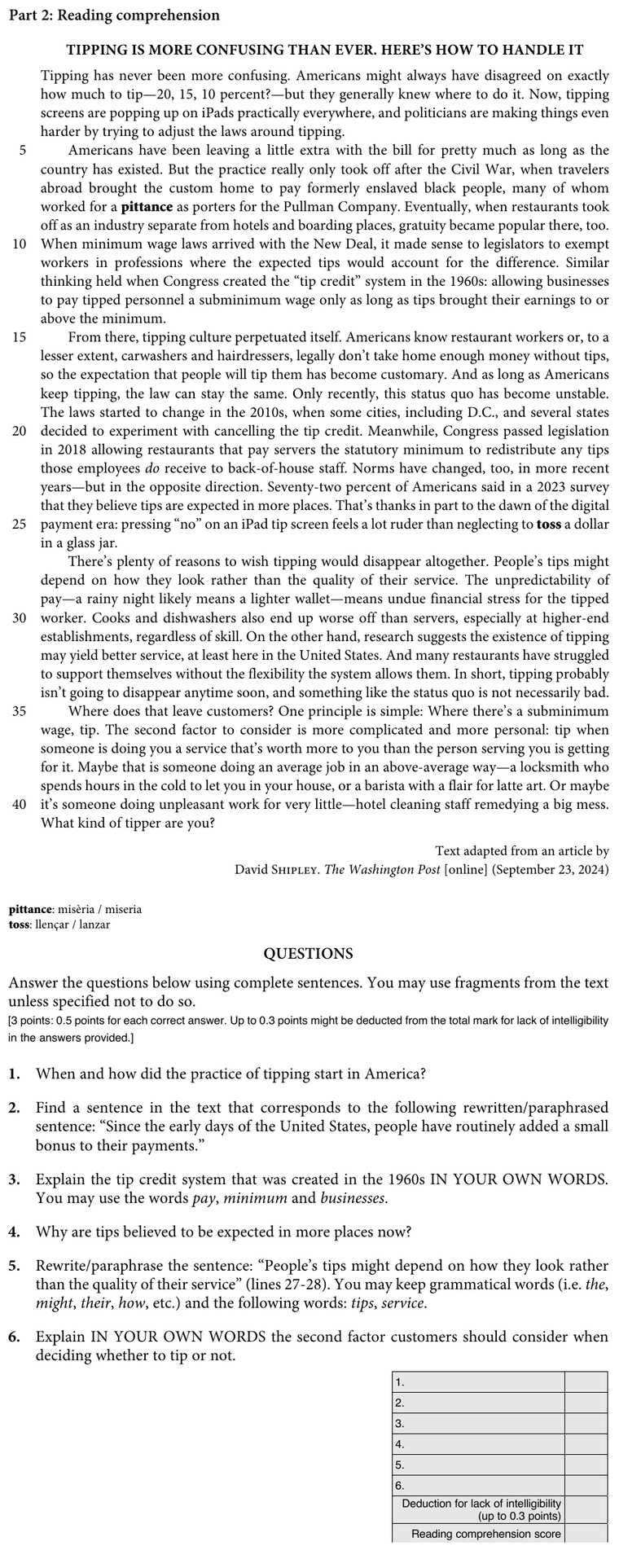
TIPPING IS MORE CONFUSING THAN EVER. HERE’S HOW TO HANDLE IT Tipping has never been more confusing. Americans might always have disagreed on exactly how much to tip—20, 15, 10 percent?—but they generally knew where to do it. Now, tipping screens are popping up on iPads practically everywhere, and politicians are making things even harder by trying to adjust the laws around tipping. Americans have been leaving a little extra with the bill for pretty much as long as the country has existed. But the practice really only took off after the Civil War, when travelers abroad brought the custom home to pay formerly enslaved black people, many of whom worked for a pittance as porters for the Pullman Company. Eventually, when restaurants took off as an industry separate from hotels and boarding places, gratuity became popular there, too. When minimum wage laws arrived with the New Deal, it made sense to legislators to exempt workers in professions where the expected tips would account for the difference. Similar thinking held when Congress created the “tip credit” system in the 1960s: allowing businesses to pay tipped personnel a subminimum wage only as long as tips brought their earnings to or above the minimum. From there, tipping culture perpetuated itself. Americans know restaurant workers or, to a lesser extent, carwashers and hairdressers, legally don’t take home enough money without tips, so the expectation that people will tip them has become customary. And as long as Americans keep tipping, the law can stay the same. Only recently, this status quo has become unstable. The laws started to change in the 2010s, when some cities, including D.C., and several states decided to experiment with cancelling the tip credit. Meanwhile, Congress passed legislation in 2018 allowing restaurants that pay servers the statutory minimum to redistribute any tips those employees do receive to back-of-house staff. Norms have changed, too, in more recent years—but in the opposite direction. Seventy-two percent of Americans said in a 2023 survey that they believe tips are expected in more places. That’s thanks in part to the dawn of the digital payment era: pressing “no” on an iPad tip screen feels a lot ruder than neglecting to toss a dollar in a glass jar. There’s plenty of reasons to wish tipping would disappear altogether. People’s tips might depend on how they look rather than the quality of their service. The unpredictability of pay—a rainy night likely means a lighter wallet—means undue financial stress for the tipped worker. Cooks and dishwashers also end up worse off than servers, especially at higher-end establishments, regardless of skill. On the other hand, research suggests the existence of tipping may yield better service, at least here in the United States. And many restaurants have struggled to support themselves without the flexibility the system allows them. In short, tipping probably isn’t going to disappear anytime soon, and something like the status quo is not necessarily bad. Where does that leave customers? One principle is simple: Where there’s a subminimum wage, tip. The second factor to consider is more complicated and more personal: tip when someone is doing you a service that’s worth more to you than the person serving you is getting for it. Maybe that is someone doing an average job in an above-average way—a locksmith who spends hours in the cold to let you in your house, or a barista with a flair for latte art. Or maybe it’s someone doing unpleasant work for very little—hotel cleaning staff remedying a big mess. What kind of tipper are you? Text adapted from an article by David Shipley. The Washington Post [online] (September 23, 2024)
pittance: misèria / miseria toss: llençar / lanzar
See the shared reading text and glossary in Part 2, question 1 (item 2.1).
When and how did the practice of tipping start in America?
Find a sentence in the text that corresponds to the following rewritten/paraphrased sentence: “Since the early days of the United States, people have routinely added a small bonus to their payments.”
Explain the tip credit system that was created in the 1960s IN YOUR OWN WORDS. You may use the words pay, minimum and businesses.
Why are tips believed to be expected in more places now?
Rewrite/paraphrase the sentence: “People’s tips might depend on how they look rather than the quality of their service” (lines 27-28). You may keep grammatical words (i.e. the, might, their, how, etc.) and the following words: tips, service.
Explain IN YOUR OWN WORDS the second factor customers should consider when deciding whether to tip or not.
La resposta ha d’explicar quan es va estendre el costum i qui el va difondre. Al segon paràgraf, l’expressió took off indica el moment en què es va popularitzar.
The practice became widespread after the Civil War, when travellers brought it back from abroad and used it to pay formerly enslaved Black workers, including Pullman porters.
+0,5criteri 1 de la pauta- Nota d’OriginalLa pauta oficial situa l’inici del costum després de la Guerra de Secessió. El passatge diu que ja es deixaven propines gairebé des dels inicis dels Estats Units i situa la popularització del costum després de la guerra.
Toca per ampliar- 0,5 pResposta admesa, sense desglossament de punts dins la pregunta: The practice of tipping started in America after the Civil War and it was brought by travellers who used to pay formerly enslaved black people, many of whom worked for a pittance as porters for the Pullman Company.
Copia la frase exacta de les línies 5–6. A little extra with the bill correspon a «a small bonus to their payments» i for pretty much as long as the country has existed situa el costum als inicis del país.
Americans have been leaving a little extra with the bill for pretty much as long as the country has existed.
+0,5criteri 1 de la pauta
Toca per ampliar- 0,5 pResposta admesa, sense desglossament de punts dins la pregunta: Americans have been leaving a little extra with the bill for pretty much as long as the country has existed (lines 5-6).
Explica amb paraules teves quant podia pagar l’empresa amb la regla dels anys seixanta i quin mínim havien d’assolir els ingressos del treballador un cop sumades les propines.
Under this arrangement, businesses could pay staff less than the legal minimum only if gratuities raised their total income to that level or higher.
+0,5criteri 1 de la pauta
Toca per ampliar- 0,5 pResposta admesa, sense desglossament de punts dins la pregunta: The tip credit system permitted businesses to pay their staff less than required if tipping increased their salaries to the minimum or more.
Busca quina pressió afegeixen les pantalles de pagament. El text compara prémer «no» davant d’una petició directa amb passar de llarg d’un pot de propines.
Digital payment screens now request tips in more places, and customers feel that refusing on a screen is ruder than leaving nothing in a tip jar.
+0,5criteri 1 de la pauta
Toca per ampliar- 0,5 pResposta admesa, sense desglossament de punts dins la pregunta: Tips are believed to be expected in more places because we are in the digital era and pressing “no” on a screen feels ruder than not leaving any dollars in a jar/neglecting to toss a dollar in a glass jar.
Canvia la formulació però conserva el contrast entre l’aparença i com s’atén el client, amb el matís de possibilitat de might. Pots mantenir els mots gramaticals, a més de tips i service.
The tips workers receive might reflect their appearance instead of how good their service is.
La paràfrasi completa val 0,5 punts si només conserva mots permesos. Si la paràfrasi és parcial o conserva un o dos mots no permesos, val 0,25 punts. Una paràfrasi incorrecta o que conserva més de dos mots no permesos val 0 punts.
+0,5criteri 1 de la pauta
Toca per ampliar- 0,5 pResposta admesa, sense desglossament de punts dins la pregunta: The tips workers get/receive might be determined by/might be related to their appearance rather than/and not by/to how well they treat you/how good the service was. (among others) Ampliació oficial publicada el 2027 (bandes alternatives, no acumulables): 0.5: paràfrasi correcta sense mots no permesos. 0.25: paràfrasi correcta que reutilitza un o dos mots no permesos del text i/o paràfrasi parcialment correcta. 0: paràfrasi correcta que reutilitza més de dos mots no permesos i/o paràfrasi incorrecta.Penalització: La pregunta queda en 0.25 punts si es reutilitzen un o dos mots no permesos i/o la paràfrasi és parcialment correcta; queda en 0 si es reutilitzen més de dos mots no permesos i/o és incorrecta. No és una deducció addicional per cada error.Nota de la pauta: Exemples oficials de 0.25: «Workers’ tips depend on their looks rather than the service quality.»; «The appearance of the workers is related to the service and the tips.» Exemples oficials de 0: «People’s tips depend on their looks rather than the service quality.»; «The service depends on the look and the quality of the tips.»
Compara el valor que el client dona a l’ajuda amb la quantitat que cobra qui la presta.
Customers should decide whether the value they place on the help they receive exceeds the worker’s payment for providing it.
La comparació completa, expressada amb paraules pròpies, val 0,5 punts. Una resposta parcial, incompleta, amb informació sobrera o amb un o dos mots no permesos del passatge val 0,25 punts. Una resposta incorrecta o que conserva més de dos mots no permesos val 0 punts.
+0,5criteri 1 de la pauta
Toca per ampliar- 0,5 pResposta admesa, sense desglossament de punts dins la pregunta: The second factor we should consider when tipping is whether the service you receive/are provided with/get is better/of higher quality/more valuable than the money the person doing it is receiving. Ampliació oficial publicada el 2027 (bandes alternatives, no acumulables): 0.5: resposta correcta amb tota la informació rellevant, sense reutilitzar mots no permesos. 0.25: resposta parcialment correcta, informació rellevant incompleta o informació sobrera i/o reutilització d’un o dos mots no permesos del text. 0: resposta incorrecta i/o reutilització de més de dos mots no permesos.Penalització: 0.25 punts en total si la resposta és parcial, incompleta, té informació sobrera i/o reutilitza un o dos mots no permesos; 0 si és incorrecta i/o reutilitza més de dos mots no permesos.Nota de la pauta: Exemples oficials de 0.25: «The second factor is a more valuable service.»; «The second factor is if the service is worth more than the salary.» Exemple oficial de 0: «The second factor is if you like the person serving you more than the service.»
Exercici 3 · opció A
Writing
 Toca per ampliar
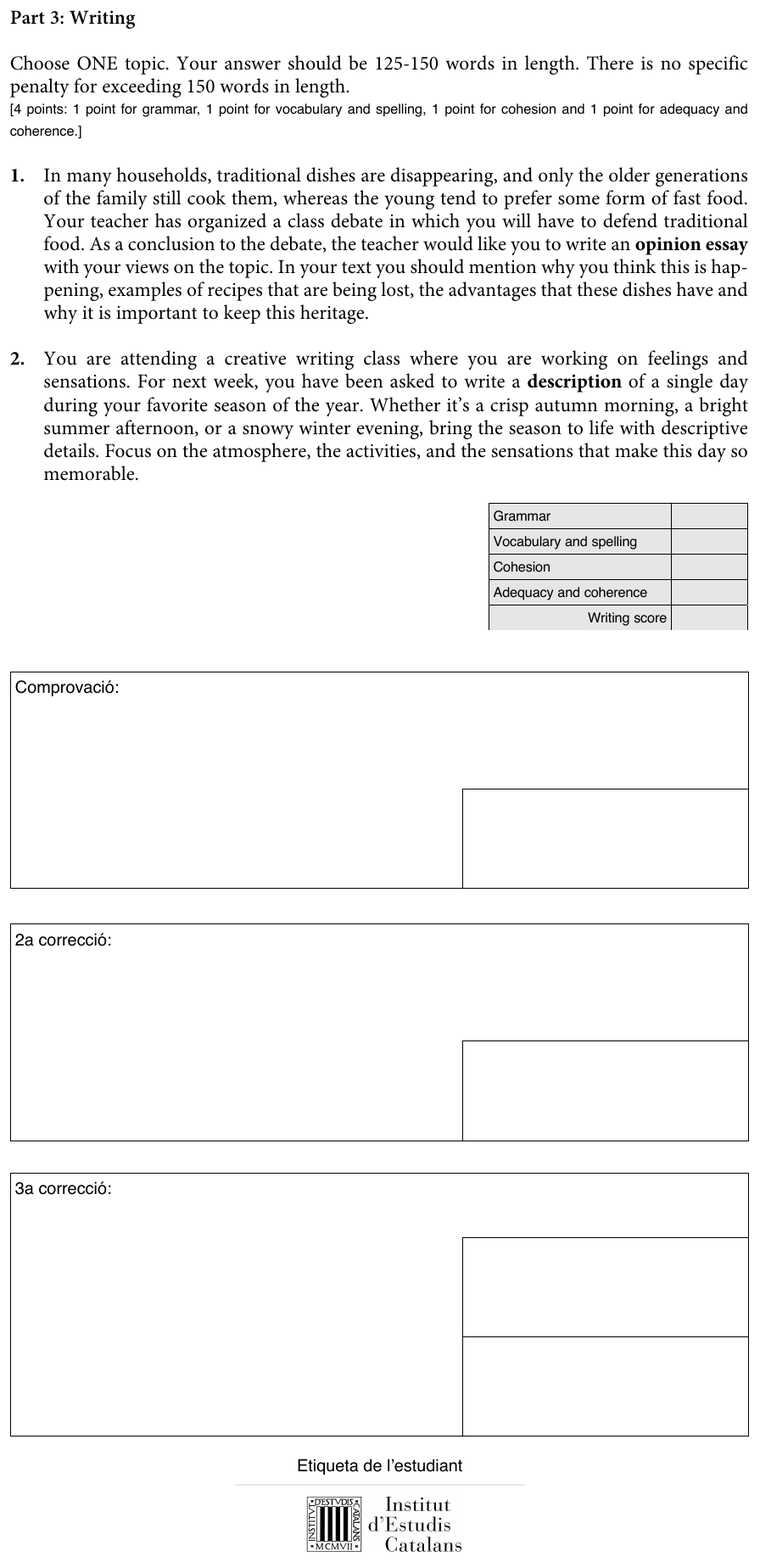
Choose ONE topic. Your answer should be 125-150 words in length. There is no specific penalty for exceeding 150 words in length. [4 points: 1 point for grammar, 1 point for vocabulary and spelling, 1 point for cohesion and 1 point for adequacy and coherence.]
In many households, traditional dishes are disappearing, and only the older generations of the family still cook them, whereas the young tend to prefer some form of fast food. Your teacher has organized a class debate in which you will have to defend traditional food. As a conclusion to the debate, the teacher would like you to write an opinion essay with your views on the topic. In your text you should mention why you think this is happening, examples of recipes that are being lost, the advantages that these dishes have and why it is important to keep this heritage.
En el criteri de gramàtica, fixa’t en com el model expressa una conseqüència possible.
En el model d’Original Academia, would mean losing presenta què passaria si es perdessin les receptes. La relativa that fast food cannot replace concreta quins coneixements i vincles es perdrien.
+1criteri 1 de la pautaEn vocabulari i ortografia, tria exemples concrets i paraules precises del tema.
Escudella i stuffed aubergines posen nom a plats que es podrien perdre. Seasonal ingredients i leftovers concreten com aquestes receptes aprofiten el que tenim a l’abast.
+1criteri 2 de la pautaLa cohesió es veu en com cada paràgraf prepara el següent i en com es relacionen les idees dins de les frases.
Yet introdueix els avantatges després de les causes de la pèrdua, while uneix l’aprofitament dels aliments amb el valor de cuinar plegats i so lliga la supervivència de les tradicions amb la proposta d’aprendre una recepta.
+1criteri 3 de la pautaL’adequació i la coherència demanen un assaig d’opinió que defensi la cuina tradicional i respongui a tots els punts de l’enunciat.
El model pren partit des del principi, explica per què es cuina menys, posa exemples de plats i defensa el valor de les receptes per aprofitar els aliments i transmetre coneixements. Acaba proposant que les famílies les apuntin i les cuinin juntes.
+1criteri 4 de la pauta
Traditional cooking deserves a place in our future, not just in our memories. I believe losing family recipes would mean losing knowledge and connections that fast food cannot replace.
Busy schedules and the convenience of ready-made meals help explain why younger generations cook fewer traditional dishes. Recipes such as escudella or stuffed aubergines may seem demanding when nobody has shown us how to prepare them. Gradually, they become meals we associate only with grandparents.
Yet these dishes offer important advantages. They can make thoughtful use of seasonal ingredients and leftovers, while preparing them together creates opportunities to share stories. Their value lies as much in the process as in the finished meal.
We should record older relatives' recipes and organise family cooking afternoons. Traditions survive through use, so learning one familiar dish is a practical beginning. Preserving this heritage means making room for it in ordinary life.
Toca per ampliar- 1 pGramàtica (Grammar) (1 punt, segons l’enunciat). No es publiquen descriptors de banda ni deduccions per error als PDF aportats.
- 1 pVocabulari i ortografia (Vocabulary and spelling) (1 punt, segons l’enunciat). No es publiquen descriptors de banda ni deduccions per error als PDF aportats.
- 1 pCohesió (Cohesion) (1 punt, segons l’enunciat). No es publiquen descriptors de banda ni deduccions per error als PDF aportats.
- 1 pAdequació i coherència (Adequacy and coherence) (1 punt, segons l’enunciat). No es publiquen descriptors de banda ni deduccions per error als PDF aportats.
Exercici 3 · opció B
Writing
Toca per ampliarChoose ONE topic. Your answer should be 125-150 words in length. There is no specific penalty for exceeding 150 words in length. [4 points: 1 point for grammar, 1 point for vocabulary and spelling, 1 point for cohesion and 1 point for adequacy and coherence.]
You are attending a creative writing class where you are working on feelings and sensations. For next week, you have been asked to write a description of a single day during your favorite season of the year. Whether it’s a crisp autumn morning, a bright summer afternoon, or a snowy winter evening, bring the season to life with descriptive details. Focus on the atmosphere, the activities, and the sensations that make this day so memorable.
En gramàtica, el present narratiu permet descriure el dia com si s’estigués vivint.
En el model d’Original Academia, el present narratiu manté l’escena viva des del matí fins al vespre. La subordinada temporal as rain begins again indica que torna a ploure mentre es llegeix sota el llum.
+1criteri 1 de la pautaEn vocabulari i ortografia, tria paraules que permetin imaginar què se sent en aquell moment.
Damp leaves evoca la humitat del matí, dry whisper suggereix el so de les fulles en trepitjar-les i sharp sweetness descriu l’olor de la poma al forn. Sheltered expressa la sensació de trobar-se a recer.
+1criteri 2 de la pautaLa cohesió segueix el pas de les hores en un únic dia de tardor.
El passeig se situa al matí i By afternoon marca el retorn a casa. Outside desplaça la mirada cap a la llum que s’apaga i I spend the evening situa l’última escena.
+1criteri 3 de la pautaL’adequació i la coherència demanen descriure l’ambient, les activitats i les sensacions d’un dia en l’estació preferida.
El passeig pel parc i la lectura a casa permeten passar del fred i la humitat a la calidesa interior. Al final, la sensació de refugi explica per què aquest dia de tardor és memorable.
+1criteri 4 de la pauta
On my favourite autumn day, the morning arrives in a wash of pale gold. Beyond my window, damp leaves cling to the pavement, and the air entering the room smells of rain and cold earth.
I pull on a soft jumper and walk to the park. Every step releases a dry whisper from the leaves gathered beneath the trees. A dog shakes water from its coat, scattering bright droplets across a bench, while somewhere behind the hedge a child laughs.
By afternoon, I am home with a warm cup between my hands. The sharp sweetness of baked apple drifts from the kitchen. Outside, the light fades early, turning the windows into mirrors.
I spend the evening reading under a lamp as rain begins again. Nothing extraordinary happens, yet the day's gentle rhythm makes me feel sheltered. Autumn is my favourite season because it gives ordinary moments such a comforting texture.
Toca per ampliar- 1 pGramàtica (Grammar) (1 punt, segons l’enunciat). No es publiquen descriptors de banda ni deduccions per error als PDF aportats.
- 1 pVocabulari i ortografia (Vocabulary and spelling) (1 punt, segons l’enunciat). No es publiquen descriptors de banda ni deduccions per error als PDF aportats.
- 1 pCohesió (Cohesion) (1 punt, segons l’enunciat). No es publiquen descriptors de banda ni deduccions per error als PDF aportats.
- 1 pAdequació i coherència (Adequacy and coherence) (1 punt, segons l’enunciat). No es publiquen descriptors de banda ni deduccions per error als PDF aportats.