Anglès
PAU 2026 · extraordinària · sèrie 2
Examen oficial de la PAU de Catalunya amb la resolució pas a pas de cada apartat i la pauta de correcció.
Listening
PAU 2026 · extraordinària · sèrie 2Instruccions de l’examen
The exam consists of THREE mandatory parts. In the first part, listening comprehension is assessed through 8 multiple choice questions. It is worth 3 points. In the second part, reading comprehension is assessed through 6 open-ended questions. It is worth 3 points. In the third part, written expression is assessed. Here, you may choose ONE of the two given options. It is worth 4 points.
Part 1: Listening comprehension
Choose the best answer according to the recording. Only ONE answer is correct. [3 points: 0.375 points for each correct answer. Wrong answers will be penalized by deducting 0.125 points. There is no penalty for unanswered questions.]
Part 2: Reading comprehension
Answer the questions below using complete sentences. You may use fragments from the text unless specified not to do so. [3 points: 0.5 points for each correct answer. Up to 0.3 points might be deducted from the total mark for lack of intelligibility in the answers provided.]
Part 3: Writing
Choose ONE topic. Your answer should be 125-150 words in length. There is no specific penalty for exceeding 150 words in length. [4 points: 1 point for grammar, 1 point for vocabulary and spelling, 1 point for cohesion, and 1 point for adequacy and coherence]
Exercici 1
Listening comprehension
 Toca per ampliar
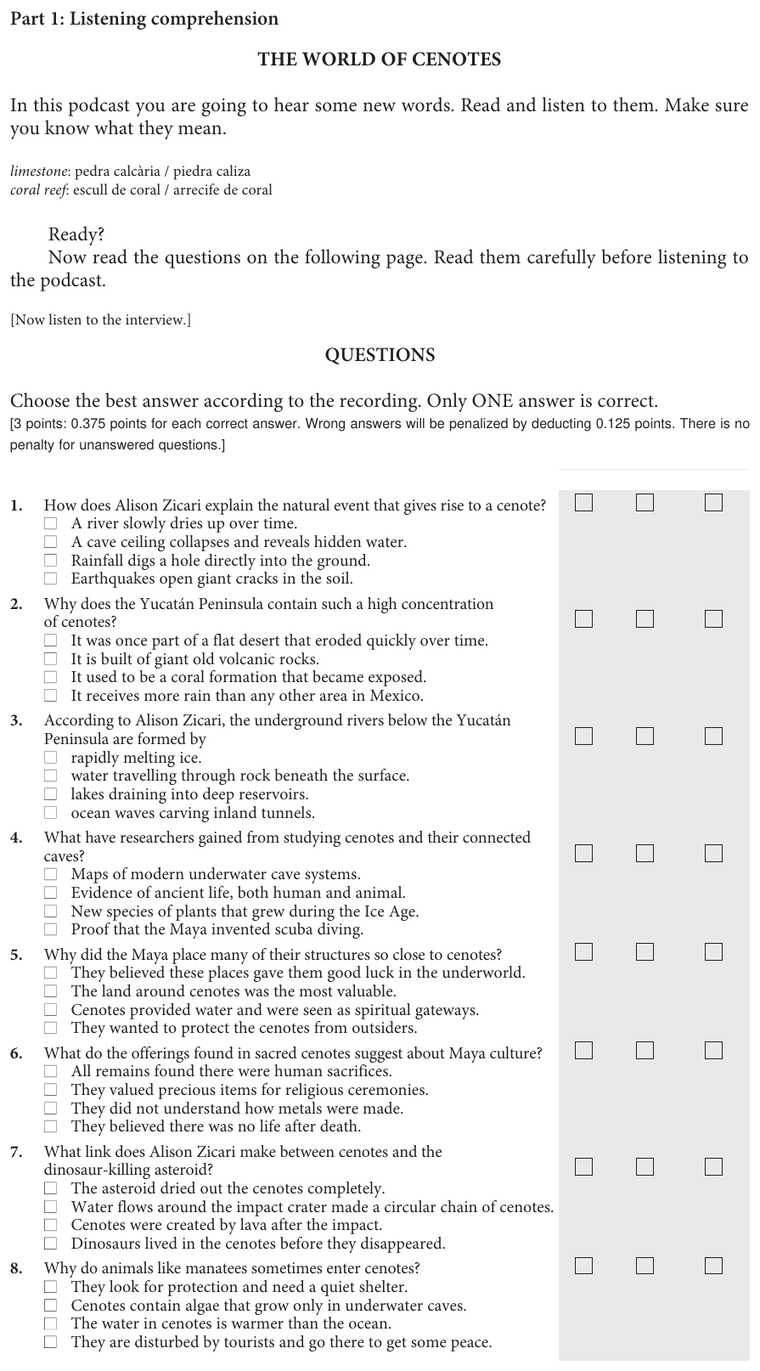
THE WORLD OF CENOTES
In this podcast you are going to hear some new words. Read and listen to them. Make sure you know what they mean.
limestone: pedra calcària / piedra caliza
coral reef: escull de coral / arrecife de coral
Ready?
Now read the questions on the following page. Read them carefully before listening to the podcast.
[Now listen to the interview.]
[Nota d’Original, no oficial: el bloc anterior reprodueix el preàmbul i el glossari de pauangl26sl.pdf, p. 2, que rebia l’alumnat. El bloc següent prové de pauangl26st.pdf: conserva el seu propi preàmbul, glossari i transcripció oficial. Les variants del glossari d’aquest segon bloc són de la pauta, no de l’enunciat.]
THE WORLD OF CENOTES
In this podcast you are going to hear some new words. Read and listen to them. Make sure you know what they mean.
limestone: pedra calcària/caliza
coral reef: escull de coral/arrecife de coral
jade: jade/jade
manatee: manatí/manatí
Ready? Now read the questions on the following page. Read them carefully before listening to the podcast. [Now listen to the interview.]
Journalist: Ms. Zicari, thank you for joining us today. You’re known as one of the top experts on cenotes. To begin, could you explain to our listeners what a cenote actually is?
Alison Zicari: Thank you for having me. A cenote is a natural hole in the ground. It forms when the roof of an underground cave collapses and allows us to see the water inside. The word “cenote” usually describes an underground chamber filled with permanent water.
Journalist: Where can people find these cenotes?
AZ: You can find cenotes in several parts of the world, but the best-known and largest concentration is in Mexico, especially on the Yucatán Peninsula. This whole peninsula is made from limestone, which used to be a huge coral reef millions of years ago. When the sea level dropped, the reef was exposed, and over time, it became full of caves, tunnels, and holes. Today, the land’s almost completely flat, but underneath it’s a giant network of underground rivers filled with rainwater that travels through cracks in the limestone filling caves which sometimes collapse creating cenotes. Scientists estimate that there’re more than 7,000 cenotes in the Yucatán.
Journalist: That number is incredible. Can you tell us more about the cave systems connected to cenotes?
AZ: Yes, the Yucatán is home to some of the world’s longest underwater cave systems. One of the most famous is Sistema Sac Actun, located in the Riviera Maya. It stretches about 350 kilometers and reaches a depth of around 119 meters. Explorers and archaeologists have found many important remains inside these caves, including 9,000-year-old human bones and the bones of animals that lived during the ice age. These discoveries tell us that humans have been exploring or using these caves for thousands of years.
Journalist: Speaking of humans, cenotes played a very important role in the Maya civilization, didn’t they?
AZ: They certainly did. For the Maya, cenotes were not just a source of fresh water, though that alone made them extremely valuable. They also believed cenotes were the entrance to the underworld. According to Maya beliefs, spirits and gods visited cenotes, especially Chaac, the god of rain, thunder, and lightning. Because of this, the Maya built many of their temples and villages near cenotes. In fact, new research shows that some important Maya cities—such as Chichén Itzá—were actually built directly on top of cenotes.
Journalist: Were these cenotes used for ceremonies?
AZ: Yes. Some cenotes became sacred places for rituals and offerings. Archaeologists have found items such as jade, gold, silver, and incense at the bottom of these cenotes. They have also discovered human remains. At places like the Sacred Cenote at Chichén Itzá, many of the bodies show wounds that suggest human sacrifice. However, other cenotes contain human remains without signs of violence, so these may have been peaceful burials, perhaps to prepare people for the next life.
Journalist: And today, people visit cenotes for very different reasons, right?
AZ: That’s right. Today cenotes are still important for water, but they’re also major tourist attractions. Millions of visitors come every year to swim, dive, snorkel, and explore. Some cenotes offer cultural experiences where visitors can watch modern Maya ceremonies. These ceremonies aren’t dangerous—of course, no one’s sacrificed—but they still include symbolic offerings like resin, cacao, seeds, corn, flower petals, and sugar.
Journalist: There’s also a surprising connection between cenotes and the asteroid that killed the dinosaurs. Can you explain that?
AZ: Yes, it’s a fascinating story. About 66 million years ago, an asteroid about 10 to 15 kilometers wide crashed on the Yucatán Peninsula. The explosion released as much energy as 100 trillion tons of TNT. This event caused huge fires, tsunamis, and climate changes that led to the extinction of many species, including the dinosaurs. The impact also changed the structure of the limestone underground. It made the rock weaker and
easier to erode. Over millions of years, groundwater moved in special patterns around the edge of the impact crater. This process created the “Ring of Cenotes.” The crater itself is buried under layers of ground and ocean, so we cannot see it with our eyes, but the ring of cenotes is still visible from space. The city of Mérida is right in the middle of this ancient crater.
Journalist: Besides history and geology, cenotes also have interesting wildlife. Can you tell us about that?
AZ: Yes, cenotes are important habitats for many animals. Because they’re protected from the open ocean, they offer calm, safe spaces. Manatees, for example, sometimes travel from the Caribbean Sea into cenotes through underwater caves. They rest there and even nurse their young. Crocodiles also live in some cenotes. They’re part of the natural ecosystem, and tourists need to keep a respectful distance. They’re usually calm, but like all wild animals, they should never be disturbed.
Journalist: All of this makes cenotes sound like truly remarkable places. Any final thoughts for our audience?
AZ: Yes. I think cenotes are some of the most unique natural wonders in the world. They combine geology, history, culture, wildlife, and adventure in one place. They’ve been important for thousands of years—from the time of the Maya to the present day— and they’re still full of discoveries waiting to be made. Anyone who visits the Yucatán should explore at least one cenote. It’s an experience you’ll never forget.
Adapted from:
https://cenotefinder.com/what-are-cenotes/#googlevignette https://www.bbc.com/travel/article/20240628-the-hidden-wonders-of-mexicos-sacred-underwater-world
See the official listening transcript in Part 1, question 1 (item 1.1).
How does Alison Zicari explain the natural event that gives rise to a cenote?
■ A river slowly dries up over time.
■ A cave ceiling collapses and reveals hidden water.
■ Rainfall digs a hole directly into the ground.
■ Earthquakes open giant cracks in the soil.
Why does the Yucatán Peninsula contain such a high concentration
of cenotes?
■ It was once part of a flat desert that eroded quickly over time.
■ It is built of giant old volcanic rocks.
■ It used to be a coral formation that became exposed.
■ It receives more rain than any other area in Mexico.
According to Alison Zicari, the underground rivers below the Yucatán
Peninsula are formed by
■ rapidly melting ice.
■ water travelling through rock beneath the surface.
■ lakes draining into deep reservoirs.
■ ocean waves carving inland tunnels.
What have researchers gained from studying cenotes and their connected
caves?
■ Maps of modern underwater cave systems.
■ Evidence of ancient life, both human and animal.
■ New species of plants that grew during the Ice Age.
■ Proof that the Maya invented scuba diving.
Why did the Maya place many of their structures so close to cenotes?
■ They believed these places gave them good luck in the underworld.
■ The land around cenotes was the most valuable.
■ Cenotes provided water and were seen as spiritual gateways.
■ They wanted to protect the cenotes from outsiders.
What do the offerings found in sacred cenotes suggest about Maya culture?
■ All remains found there were human sacrifices.
■ They valued precious items for religious ceremonies.
■ They did not understand how metals were made.
■ They believed there was no life after death.
What link does Alison Zicari make between cenotes and the
dinosaur-killing asteroid?
■ The asteroid dried out the cenotes completely.
■ Water flows around the impact crater made a circular chain of cenotes.
■ Cenotes were created by lava after the impact.
■ Dinosaurs lived in the cenotes before they disappeared.
Why do animals like manatees sometimes enter cenotes?
■ They look for protection and need a quiet shelter.
■ Cenotes contain algae that grow only in underwater caves.
■ The water in cenotes is warmer than the ocean.
■ They are disturbed by tourists and go there to get some peace.
Identifica el fet concret que fa aparèixer el cenote. Quan Zicari diu «the roof of an underground cave collapses», explica que el sostre s’esfondra i deixa a la vista l’aigua que ja era dins la cova.
A cave ceiling collapses and reveals hidden water.
+0,375criteri 1 de la pauta
 Toca per ampliar
- 0,375 pSeleccionar la resposta de la clau oficial: A cave ceiling collapses and reveals hidden waterPenalització: Resposta incorrecta: −0.125 punts; pregunta no contestada: sense penalització.
Per explicar per què n’hi ha tants al Yucatán, fixa’t en l’origen de la roca. Segons l’entrevista, quan va baixar el nivell del mar, un escull de corall («coral reef») va quedar al descobert i, amb el temps, a la roca s’hi van formar coves i túnels.
It used to be a coral formation that became exposed.
+0,375criteri 1 de la pauta
Toca per ampliar- 0,375 pSeleccionar la resposta de la clau oficial: It used to be a coral formation that became exposed.Penalització: Resposta incorrecta: −0.125 punts; pregunta no contestada: sense penalització.
Segueix el recorregut de l’aigua que alimenta els rius subterranis. La frase «rainwater that travels through cracks in the limestone» explica que l’aigua de pluja es filtra per les esquerdes de la calcària.
water travelling through rock beneath the surface.
+0,375criteri 1 de la pauta
Toca per ampliar- 0,375 pSeleccionar la resposta de la clau oficial: water traveling through rock beneath the SurfacePenalització: Resposta incorrecta: −0.125 punts; pregunta no contestada: sense penalització.
Fixa’t en què van trobar els investigadors dins les coves. Els ossos humans de fa 9.000 anys i els ossos d’animals de l’edat de gel són proves de vida antiga de tots dos tipus.
Evidence of ancient life, both human and animal.
+0,375criteri 1 de la pauta
Toca per ampliar- 0,375 pSeleccionar la resposta de la clau oficial: Evidence of ancient life, both human and animalPenalització: Resposta incorrecta: −0.125 punts; pregunta no contestada: sense penalització.
Tria l’opció que recull els dos motius pels quals els maies construïen a prop dels cenotes. Els servien de font d’aigua dolça i, segons les seves creences, eren entrades al món subterrani.
Cenotes provided water and were seen as spiritual gateways.
+0,375criteri 1 de la pauta
Toca per ampliar- 0,375 pSeleccionar la resposta de la clau oficial: Cenotes provided water and were seen as spiritual gatewaysPenalització: Resposta incorrecta: −0.125 punts; pregunta no contestada: sense penalització.
Relaciona els objectes trobats amb l’ús ritual dels cenotes sagrats. El jade, l’or i la plata són exemples d’objectes valuosos que els maies hi dipositaven com a ofrenes.
They valued precious items for religious ceremonies.
+0,375criteri 1 de la pauta
Toca per ampliar- 0,375 pSeleccionar la resposta de la clau oficial: They valued precious items for religious ceremoniesPenalització: Resposta incorrecta: −0.125 punts; pregunta no contestada: sense penalització.
Segueix la cadena de causes que uneix l’impacte amb la forma de l’anell. L’impacte va debilitar la calcària i, amb el temps, l’aigua subterrània va circular al voltant de la vora del cràter i hi va formar una cadena de cenotes.
Water flows around the impact crater made a circular chain of cenotes.
+0,375criteri 1 de la pauta
Toca per ampliar- 0,375 pSeleccionar la resposta de la clau oficial: Water flows around the impact crater made a circular chain of cenotes.Penalització: Resposta incorrecta: −0.125 punts; pregunta no contestada: sense penalització.
Busca què hi troben els manatís quan hi entren des del mar. L’entrevista descriu els cenotes com a «calm, safe spaces» on poden descansar i fins i tot alletar les cries.
They look for protection and need a quiet shelter.
+0,375criteri 1 de la pauta
Toca per ampliar- 0,375 pSeleccionar la resposta de la clau oficial: They look for protection and need a quiet shelterPenalització: Resposta incorrecta: −0.125 punts; pregunta no contestada: sense penalització.
Exercici 2
Reading comprehension
 Toca per ampliar
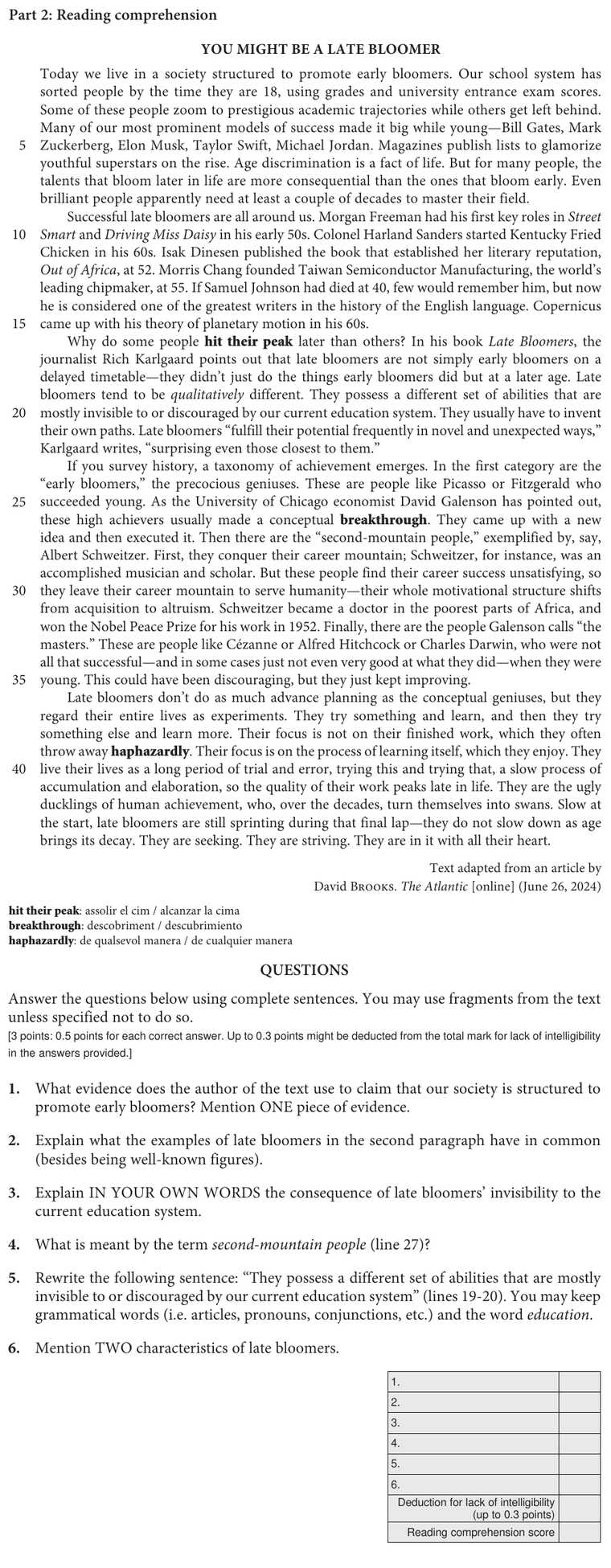
YOU MIGHT BE A LATE BLOOMER Today we live in a society structured to promote early bloomers. Our school system has sorted people by the time they are 18, using grades and university entrance exam scores. Some of these people zoom to prestigious academic trajectories while others get left behind. Many of our most prominent models of success made it big while young—Bill Gates, Mark Zuckerberg, Elon Musk, Taylor Swift, Michael Jordan. Magazines publish lists to glamorize youthful superstars on the rise. Age discrimination is a fact of life. But for many people, the talents that bloom later in life are more consequential than the ones that bloom early. Even brilliant people apparently need at least a couple of decades to master their field. Successful late bloomers are all around us. Morgan Freeman had his first key roles in Street Smart and Driving Miss Daisy in his early 50s. Colonel Harland Sanders started Kentucky Fried Chicken in his 60s. Isak Dinesen published the book that established her literary reputation, Out of Africa, at 52. Morris Chang founded Taiwan Semiconductor Manufacturing, the world’s leading chipmaker, at 55. If Samuel Johnson had died at 40, few would remember him, but now he is considered one of the greatest writers in the history of the English language. Copernicus came up with his theory of planetary motion in his 60s. Why do some people hit their peak later than others? In his book Late Bloomers, the journalist Rich Karlgaard points out that late bloomers are not simply early bloomers on a delayed timetable—they didn’t just do the things early bloomers did but at a later age. Late bloomers tend to be qualitatively different. They possess a different set of abilities that are mostly invisible to or discouraged by our current education system. They usually have to invent their own paths. Late bloomers “fulfill their potential frequently in novel and unexpected ways,” Karlgaard writes, “surprising even those closest to them.” If you survey history, a taxonomy of achievement emerges. In the first category are the “early bloomers,” the precocious geniuses. These are people like Picasso or Fitzgerald who succeeded young. As the University of Chicago economist David Galenson has pointed out, these high achievers usually made a conceptual breakthrough. They came up with a new idea and then executed it. Then there are the “second-mountain people,” exemplified by, say, Albert Schweitzer. First, they conquer their career mountain; Schweitzer, for instance, was an accomplished musician and scholar. But these people find their career success unsatisfying, so they leave their career mountain to serve humanity—their whole motivational structure shifts from acquisition to altruism. Schweitzer became a doctor in the poorest parts of Africa, and won the Nobel Peace Prize for his work in 1952. Finally, there are the people Galenson calls “the masters.” These are people like Cézanne or Alfred Hitchcock or Charles Darwin, who were not all that successful—and in some cases just not even very good at what they did—when they were young. This could have been discouraging, but they just kept improving. Late bloomers don’t do as much advance planning as the conceptual geniuses, but they regard their entire lives as experiments. They try something and learn, and then they try something else and learn more. Their focus is not on their finished work, which they often throw away haphazardly. Their focus is on the process of learning itself, which they enjoy. They live their lives as a long period of trial and error, trying this and trying that, a slow process of accumulation and elaboration, so the quality of their work peaks late in life. They are the ugly ducklings of human achievement, who, over the decades, turn themselves into swans. Slow at the start, late bloomers are still sprinting during that final lap—they do not slow down as age brings its decay. They are seeking. They are striving. They are in it with all their heart. Text adapted from an article by David Brooks. The Atlantic [online] (June 26, 2024) hit their peak: assolir el cim / alcanzar la cima breakthrough: descobriment / descubrimiento haphazardly: de qualsevol manera / de cualquier manera
See the shared reading text and glossary in Part 2, question 1 (item 2.1).
What evidence does the author of the text use to claim that our society is structured to promote early bloomers? Mention ONE piece of evidence.
Explain what the examples of late bloomers in the second paragraph have in common (besides being well-known figures).
Explain IN YOUR OWN WORDS the consequence of late bloomers’ invisibility to the current education system.
What is meant by the term second-mountain people (line 27)?
Rewrite the following sentence: “They possess a different set of abilities that are mostly invisible to or discouraged by our current education system” (lines 19-20). You may keep grammatical words (i.e. articles, pronouns, conjunctions, etc.) and the word education.
Mention TWO characteristics of late bloomers.
Tria una sola prova del primer paràgraf, com ara el paper del sistema escolar.
Les notes i els resultats de les proves d’accés ja condicionen la trajectòria acadèmica dels estudiants quan tenen divuit anys.
Our school system sorts people by the time they are eighteen using grades and university entrance exam scores.
+0,5criteri 1 de la pauta- Nota d’OriginalSi dones més d’un exemple, la pauta redueix la puntuació d’aquesta pregunta a 0,25 punts.
Toca per ampliar- 0,5 pEsmentar exactament UNA evidència: el sistema escolar classifica als 18 anys; molts models d’èxit triomfen joves; o les revistes publiquen llistes de joves estrelles. (0.5 punts).Penalització: Si s’esmenta més d’una evidència, la pregunta val 0.25 punts (deducció de 0.25).
Compara en quin moment de la vida aquestes persones van aconseguir els èxits que cita el text.
Per exemple, Morgan Freeman va tenir els seus primers papers importants passats els cinquanta i Morris Chang va fundar la seva empresa de semiconductors als cinquanta-cinc.
They all became successful relatively late in life.
+0,5criteri 1 de la pauta
Toca per ampliar- 0,5 pResposta admesa, sense desglossament de punts dins la pregunta: They are all people who became successful late in life.
Explica amb paraules teves com progressen quan el sistema educatiu passa per alt el seu talent.
Al tercer paràgraf, l’autor explica que el poc reconeixement dels seus talents els porta a buscar vies poc habituals per tirar endavant.
Since schools tend to miss what these people are good at, they often have to take an unusual route to succeed.
+0,5criteri 1 de la pauta
Toca per ampliar- 0,5 pResposta admesa, sense desglossament de punts dins la pregunta: Late bloomers accomplish success/live their lives/succeed in life/make progress (…) in ways that are different from the usual ones.
Explica què representa cadascuna de les dues muntanyes en la vida d’aquestes persones.
La primera és l’èxit a la feina. Quan aquest èxit els deixa insatisfets, abandonen la carrera per dedicar-se als altres.
Second-mountain people first achieve career success but find it unsatisfying, so they leave their careers to serve humanity.
+0,5criteri 1 de la pauta- Nota d’OriginalSegons la guia d’exemples, dir només que triomfen al principi o que canvien de carrera val 0,25 punts. Per obtenir el mig punt, lliga l’èxit inicial, la insatisfacció i la decisió de dedicar-se als altres.
Toca per ampliar- 0,5 pResposta admesa, sense desglossament de punts dins la pregunta: Second-mountain people conquer their career mountain first/succeed early in life but find their success unsatisfying and they leave their careers to serve humanity. Ampliació oficial publicada el 2027 (bandes alternatives, no acumulables): 0.5: resposta correcta amb tota la informació rellevant; es pot copiar del text o reformular. 0.25: resposta parcialment correcta, manca d’informació rellevant o informació sobrera. 0: resposta incorrecta.Penalització: 0.25 punts en total si la resposta és parcial, incompleta o conté més informació de la necessària; 0 si és incorrecta.Nota de la pauta: Exemples oficials de resposta parcial (0.25): «Second-mountain people succeed early in life.»; «Second-mountain people change their careers later on.»; «Second-mountain people do not like their careers.» Exemple oficial incorrecte (0): «Second-mountain people feel invisible.»
Reformula tant el tipus de talent que tenen com la manera en què el tracta el sistema educatiu.
Pots conservar els mots gramaticals i «education». «Go unrecognised» expressa que aquests talents passen desapercebuts i «meet with disapproval» indica que es veuen amb mals ulls.
Their distinctive talents tend to go unrecognised or meet with disapproval in today’s education framework.
+0,5criteri 1 de la pauta- Nota d’OriginalSegons la guia d’exemples, una paràfrasi correcta amb un o dos mots no permesos, o una de parcialment correcta, val 0,25 punts. Amb més de dos mots no permesos o una resposta incorrecta, la puntuació és 0.
Toca per ampliar- 0,5 pResposta admesa, sense desglossament de punts dins la pregunta: They have distinct characteristics that are not considered/seen/taken into account/encouraged by the present-day education authorities/laws. (among other options) Ampliació oficial publicada el 2027 (bandes alternatives, no acumulables): 0.5: paràfrasi correcta sense mots no permesos. 0.25: paràfrasi correcta que reutilitza un o dos mots no permesos del text i/o paràfrasi parcialment correcta. 0: paràfrasi correcta que reutilitza més de dos mots no permesos i/o paràfrasi incorrecta.Penalització: La pregunta queda en 0.25 punts si es reutilitzen un o dos mots no permesos i/o la paràfrasi és parcialment correcta; queda en 0 si es reutilitzen més de dos mots no permesos i/o és incorrecta. No és una deducció addicional per cada error.Nota de la pauta: Exemples oficials de 0.25: «They have different characteristics that are not considered by the current education authorities.»; «They have different educational characteristics.» Exemples oficials de 0: «They have different characteristics that are invisible to the current education system.»; «The abilities by our education system are invisible.»
Tria exactament dos trets de l’últim paràgraf i posa’ls en una frase completa.
El text explica que els «late bloomers» van provant coses noves i que gaudeixen mentre aprenen.
Late bloomers treat their lives as experiments and enjoy the process of learning.
+0,5criteri 1 de la pauta- Nota d’OriginalLa pauta dona 0,25 punts si esmentes un sol tret o si n’esmentes més de dos. Si tries el tret de la planificació, el text diu que planifiquen menys que els genis conceptuals.
Toca per ampliar- 0,5 pCriteri únic de 0.5 punts, sense desglossament: esmentar exactament DUES característiques. Alternatives de la pauta oficial (text conservat): Any TWO of the following: - Late bloomers do not plan ahead. - They regard their lives as experiments. - They focus on the process of learning. - They enjoy the process of learning. - They live their lives as a long period of trial and error. - They are slow at the start but fast as they age.Penalització: (If they mention one, 0.25. If they mention more than two, 0.25).
Exercici 3 · opció A
Writing
 Toca per ampliar
Choose ONE topic. Your answer should be 125-150 words in length. There is no specific penalty for exceeding 150 words in length. [4 points: 1 point for grammar, 1 point for vocabulary and spelling, 1 point for cohesion, and 1 point for adequacy and coherence]
During your school’s Communication Week, students will take part in a debate about the growing impact that social media influencers have on teenagers’ behaviour, lifestyle choices, and opinions. You have been asked to write a for and against essay discussing both the positive and negative effects that influencers may have on young people. In your text, you should consider aspects such as the promotion of healthy or unhealthy habits, the reliability of sponsored content, and the pressure to conform to certain beauty or success standards.
En aquest model d’Original Academia, els temps verbals i els modals permeten parlar d’una tendència i matisar-ne els efectes.
El present perfect de «have become» presenta un canvi que té efectes en el present. Els modals «can encourage» i «would help» expressen un efecte possible i el benefici esperat d’una proposta.
+1criteri 1 de la pautaTria vocabulari precís i adequat al registre d’un assaig escolar.
«Sponsored recommendations» identifica les recomanacions pagades, «expertise» es refereix als coneixements de qui les fa i «unrealistic expectations» descriu les expectatives que poden crear les imatges editades. Fixa’t en l’ortografia britànica de «labelled».
+1criteri 2 de la pautaDedica un paràgraf a cada part de l’argument perquè el lector pugui seguir el debat.
El model planteja el tema a la introducció. «On the positive side» introdueix els beneficis, «However» obre el paràgraf dels riscos i «In my view» dona pas a la conclusió. En aquests tres casos, una coma separa el connector de la resta de la frase.
+1criteri 3 de la pautaDesenvolupa tots dos costats del debat amb exemples rellevants per a la Setmana de la Comunicació.
L’assaig presenta hàbits saludables com l’exercici i els àpats equilibrats, qüestiona la fiabilitat dels continguts patrocinats i explica la pressió dels cànons de bellesa i d’èxit. La conclusió proposa maneres de valorar les publicacions amb criteri. El model té 147 paraules.
+1criteri 4 de la pauta
Influencers have become familiar voices in teenagers' daily lives. Their impact can be encouraging, but it also creates pressures that deserve discussion during our school's Communication Week.
On the positive side, responsible creators can make exercise, balanced meals or creative hobbies seem achievable. Sharing ordinary difficulties may help followers feel less isolated. Influencers can also introduce young people to useful information and communities they would otherwise miss.
However, popularity does not guarantee expertise or honesty. Sponsored recommendations may reflect payment rather than quality, particularly when advertising is poorly labelled. Edited images and carefully selected success stories can encourage unhealthy comparison, extreme habits and unrealistic expectations about appearance or achievement.
In my view, influencers are most useful when treated as starting points rather than authorities. Clear sponsorship labels and critical media education would help teenagers enjoy inspiring content while questioning the commercial interests and impossible standards behind it.
Toca per ampliar- 1 pGramàtica, màxim 1 punt. Bandes alternatives oficials: 0–0.1, frases sense sentit o amb molts errors; 0.2–0.4, estructures molt simples i errors greus, freqüents i sistemàtics; 0.5–0.6, alguns/pocs errors, estructures molt simples i poca variació; 0.7–0.8, alguns errors però estructures més elaborades i variades; 0.9–1, molt pocs errors o cap (o lapsus molt ocasional) i estructures elaborades. Cal que els trets de la banda siguin consistents al llarg de tota la redacció. Les orientacions oficials indiquen que les dificultats relacionades amb la dislèxia es tenen en compte en l’avaluació de l’ortografia, el vocabulari i l’estructura de les frases.Nota de la pauta: Exemples oficials d’errors: «Reclamations, change, or devolution of all my money. I have spend.»; «You must be send all the command again.» La banda 0.2–0.4 cita adjectius després del nom, adjectius en plural, errors de concordança, manca de subjecte i «bare forms». Els exemples lingüísticament incorrectes de la rúbrica són deliberats.
- 1 pVocabulari, màxim 1 punt. Bandes alternatives oficials: 0.1–0.2, vocabulari inexistent/sense sentit, molts errors bàsics i faltes ortogràfiques greus; 0.3–0.4, vocabulari repetitiu i simple, errors i faltes ortogràfiques; 0.5–0.6, vocabulari simple però generalment correcte; 0.7–0.8, vocabulari elaborat i variat, que pot contenir errors; 0.9–1, vocabulari complex, elaborat i variat sense errors o amb lapsus ocasional. L’adequació del registre també es valora aquí. La guia no publica una banda numèrica addicional per sota de 0.1.Nota de la pauta: Exemples oficials amb errors: «The fridge is braken and the wather font not shoot.»; «That place is so nice, the beach in front. The restaurants were so nice and I like the sea and the peple.»; «Fast fashion is considered to be affordable, but this is an unfair believe.»
- 1 pCohesió, màxim 1 punt, sense desglossament numèric intern: paràgrafs ben estructurats amb més d’una frase, puntuació, ús correcte de connectors, conjuncions i oracions complexes (conjuntament amb Grammar), organització i absència d’idees repetitives. No es publiquen bandes numèriques per a aquests trets.Nota de la pauta: La guia exemplifica usos incorrectes amb «Nowadays I didn’t visit that place yet.» i «Although, there are dangers everywhere.» També dona com a exemple de repetició/manca d’organització: «People enjoy travelling for many reasons. Some people like visiting new places. Travelling can also be expensive. Moreover, it is time-consuming. Travelling teaches people about different cultures.»
- 1 pAdequació i coherència, màxim 1 punt, sense desglossament numèric intern: rellevància i organització del contingut, registre adequat al gènere (també a Vocabulary), pensaments clars i madurs. El títol no és obligatori i es poden fer servir contraccions. No es publiquen bandes numèriques per a aquests trets.Penalització: Els fragments llargs apresos de memòria que no siguin rellevants o pertinents es penalitzen pel contingut i no es compten en el nombre de paraules. Això no afecta connectors ni expressions curtes. No s’especifica cap deducció numèrica.Nota de la pauta: Exemples oficials de pensaments infantils o immadurs: «The important is to have fun and gain all the money possible.»; «Fast fashion makes girls happy because they can buy more clothes.»
Exercici 3 · opció B
Writing
Toca per ampliarChoose ONE topic. Your answer should be 125-150 words in length. There is no specific penalty for exceeding 150 words in length. [4 points: 1 point for grammar, 1 point for vocabulary and spelling, 1 point for cohesion, and 1 point for adequacy and coherence]
Imagine working in your ideal job. Write a description of a full day at work in detail, beginning with how you commute to your workplace and what your morning routine is like. Explain your exact daily tasks and responsibilities, the people you work with, and the type of environment you work in. Include information about your colleagues, your interactions with them, and how you collaborate. Finally, explain whether you enjoy this job or not, giving clear reasons for your satisfaction or dissatisfaction.
En aquest model d’Original Academia, el present simple en primera persona situa el lector en un dia habitual de feina.
Amb «I check messages» i «I revise the plans» expliques accions habituals. Les formes en -ing permeten enllaçar accions amb «After hanging up my coat» i presentar una altra manera d’actuar amb «rather than trying to solve everything alone».
+1criteri 1 de la pautaTria vocabulari que permeti imaginar el lloc de treball i les responsabilitats.
«Architectural studio» situa la feina i «accessible community library» concreta el projecte. «Check measurements» indica què fas a l’obra amb el «site manager», la persona que dirigeix l’obra.
+1criteri 2 de la pautaOrdena els paràgrafs seguint la jornada i indica quan canvien l’hora o el lloc.
«After lunch» marca el pas a la tarda, «Back at the studio» indica el retorn de l’obra i «Before cycling home» introdueix el tancament de la jornada.
+1criteri 3 de la pautaDescriu un dia complet i acaba explicant per què t’agrada aquesta feina.
El model va del trajecte en bicicleta a la preparació de les tasques de l’endemà. Descriu l’espai compartit, mostra com es revisen plànols amb l’equip i explica la satisfacció de dissenyar espais accessibles. Té 150 paraules.
+1criteri 4 de la pauta
My ideal working day begins with a bicycle ride to a small architectural studio beside the river. After hanging up my coat, I check messages and review the day's priorities with our project coordinator.
The morning is devoted to designing an accessible community library. I adjust drawings, compare materials and discuss lighting with an engineer. Our bright, shared workspace is lively without being noisy, and colleagues freely ask one another for advice.
After lunch, we visit the building site. I check measurements with the site manager and listen to the builders explain a practical difficulty. Back at the studio, I revise the plans with a colleague rather than trying to solve everything alone.
Before cycling home, I record our decisions and prepare tomorrow's tasks. I enjoy this work because creativity has a clear purpose: making spaces that people can use comfortably. Seeing an idea improve through cooperation is especially satisfying.
Toca per ampliar- 1 pGramàtica, màxim 1 punt. Bandes alternatives oficials: 0–0.1, frases sense sentit o amb molts errors; 0.2–0.4, estructures molt simples i errors greus, freqüents i sistemàtics; 0.5–0.6, alguns/pocs errors, estructures molt simples i poca variació; 0.7–0.8, alguns errors però estructures més elaborades i variades; 0.9–1, molt pocs errors o cap (o lapsus molt ocasional) i estructures elaborades. Cal que els trets de la banda siguin consistents al llarg de tota la redacció. Les orientacions oficials indiquen que les dificultats relacionades amb la dislèxia es tenen en compte en l’avaluació de l’ortografia, el vocabulari i l’estructura de les frases.Nota de la pauta: Exemples oficials d’errors: «Reclamations, change, or devolution of all my money. I have spend.»; «You must be send all the command again.» La banda 0.2–0.4 cita adjectius després del nom, adjectius en plural, errors de concordança, manca de subjecte i «bare forms». Els exemples lingüísticament incorrectes de la rúbrica són deliberats.
- 1 pVocabulari, màxim 1 punt. Bandes alternatives oficials: 0.1–0.2, vocabulari inexistent/sense sentit, molts errors bàsics i faltes ortogràfiques greus; 0.3–0.4, vocabulari repetitiu i simple, errors i faltes ortogràfiques; 0.5–0.6, vocabulari simple però generalment correcte; 0.7–0.8, vocabulari elaborat i variat, que pot contenir errors; 0.9–1, vocabulari complex, elaborat i variat sense errors o amb lapsus ocasional. L’adequació del registre també es valora aquí. La guia no publica una banda numèrica addicional per sota de 0.1.Nota de la pauta: Exemples oficials amb errors: «The fridge is braken and the wather font not shoot.»; «That place is so nice, the beach in front. The restaurants were so nice and I like the sea and the peple.»; «Fast fashion is considered to be affordable, but this is an unfair believe.»
- 1 pCohesió, màxim 1 punt, sense desglossament numèric intern: paràgrafs ben estructurats amb més d’una frase, puntuació, ús correcte de connectors, conjuncions i oracions complexes (conjuntament amb Grammar), organització i absència d’idees repetitives. No es publiquen bandes numèriques per a aquests trets.Nota de la pauta: La guia exemplifica usos incorrectes amb «Nowadays I didn’t visit that place yet.» i «Although, there are dangers everywhere.» També dona com a exemple de repetició/manca d’organització: «People enjoy travelling for many reasons. Some people like visiting new places. Travelling can also be expensive. Moreover, it is time-consuming. Travelling teaches people about different cultures.»
- 1 pAdequació i coherència, màxim 1 punt, sense desglossament numèric intern: rellevància i organització del contingut, registre adequat al gènere (també a Vocabulary), pensaments clars i madurs. El títol no és obligatori i es poden fer servir contraccions. No es publiquen bandes numèriques per a aquests trets.Penalització: Els fragments llargs apresos de memòria que no siguin rellevants o pertinents es penalitzen pel contingut i no es compten en el nombre de paraules. Això no afecta connectors ni expressions curtes. No s’especifica cap deducció numèrica.Nota de la pauta: Exemples oficials de pensaments infantils o immadurs: «The important is to have fun and gain all the money possible.»; «Fast fashion makes girls happy because they can buy more clothes.»