Anglès
PAU 2026 · ordinària · tribunal d’incidències · sèrie 5
Examen oficial de la PAU de Catalunya amb la resolució pas a pas de cada apartat i la pauta de correcció.
Listening
PAU 2026 · ordinària · tribunal d’incidències · sèrie 5Instruccions de l’examen
The exam consists of THREE mandatory parts. In the first part, listening comprehension is assessed through 8 multiple choice questions. It is worth 3 points. In the second part, reading comprehension is assessed through 6 open-ended questions. It is worth 3 points. In the third part, written expression is assessed. Here, you may choose ONE of the two given options. It is worth 4 points.
Part 1: Listening comprehension
Choose the best answer according to the recording. Only ONE answer is correct. [3 points: 0.375 points for each correct answer. Wrong answers will be penalized by deducting 0.125 points. There is no penalty for unanswered questions.]
Part 2: Reading comprehension
Answer the questions below using complete sentences. You may use fragments from the text unless specified not to do so. [3 points: 0.5 points for each correct answer. Up to 0.3 points might be deducted from the total mark for lack of intelligibility in the answers provided.]
Part 3: Writing
Choose ONE topic. Your answer should be 125-150 words in length. There is no specific penalty for exceeding 150 words in length. [4 points: 1 point for grammar, 1 point for vocabulary and spelling, 1 point for cohesion, and 1 point for adequacy and coherence]
Exercici 1
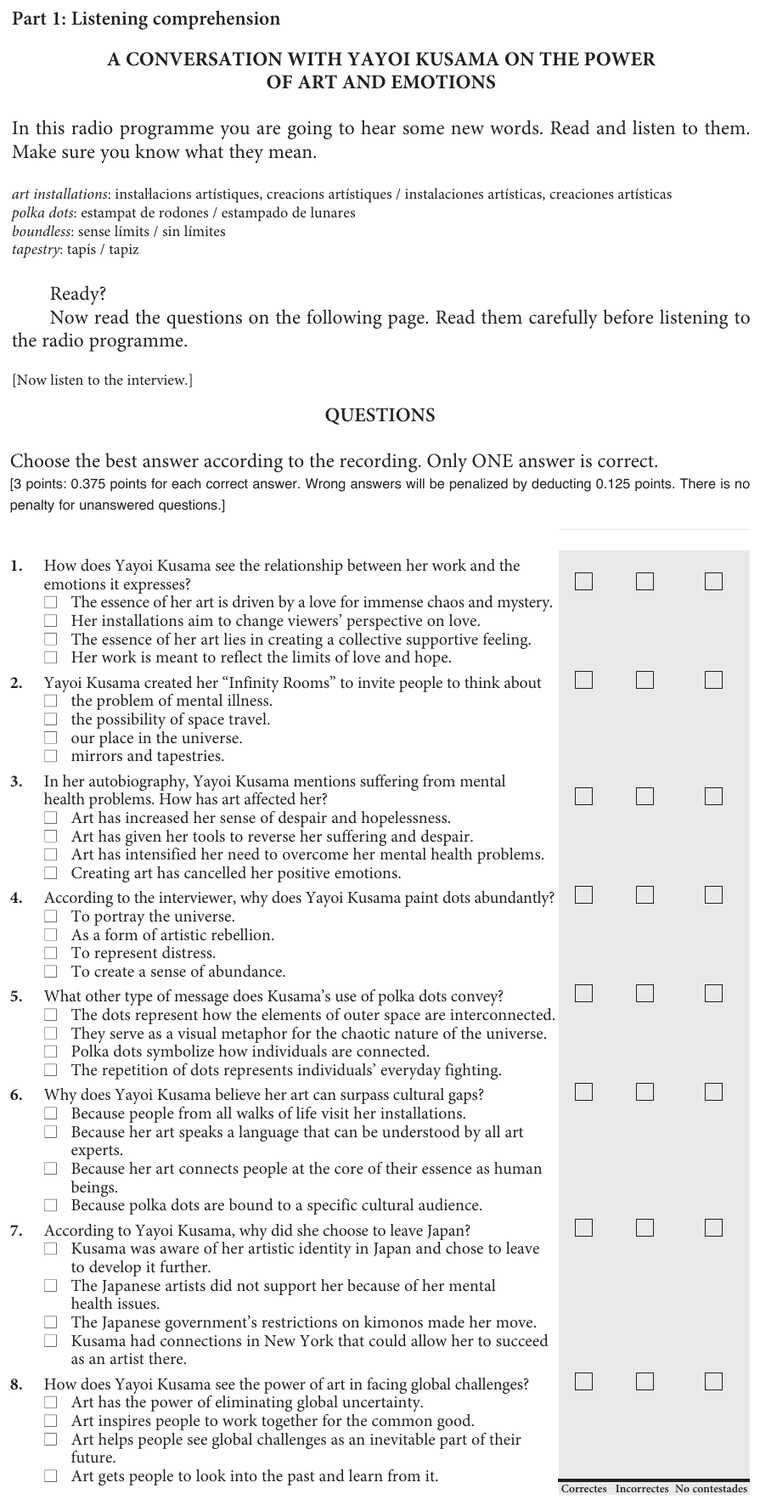
Listening comprehension
 Toca per ampliar
A CONVERSATION WITH YAYOI KUSAMA ON THE POWER OF ART AND EMOTIONS
In this radio programme you are going to hear some new words. Read and listen to them. Make sure you know what they mean.
art installations: instal·lacions artístiques, creacions artístiques / instalaciones artísticas, creaciones artísticas
polka dots: estampat de rodones / estampado de lunares
boundless: sense límits / sin límites
tapestry: tapís / tapiz
Ready?
Now read the questions on the following page. Read them carefully before listening to the radio programme.
[Now listen to the interview.]
[Nota d’Original, no oficial: el bloc anterior reprodueix el preàmbul i el glossari de pauangl26jltei.pdf, p. 2, que rebia l’alumnat. El bloc següent prové de pauangl26jttei.pdf: conserva el seu propi preàmbul, glossari i transcripció oficial. Les variants del glossari d’aquest segon bloc són de la pauta, no de l’enunciat.]
A CONVERSATION WITH YAYOI KUSAMA ON THE POWER OF ART AND EMOTIONS
In this radio programme you are going to hear some new words. Read and listen to them. Make sure you know what they mean.
art installations: instal·lacions artístiques – creacions artístiques / instalaciones artísticas – creaciones artísticas
polka dots: estampat de topos / estampado de topos
boundless: sense límits / sin límites
tapestry: tapís / tapiz
Ready? Now read the questions on the following page. Read them carefully before listening to the radio programme. [Now listen to the interview.]
Interviewer: In the realm of contemporary art, few figures are as iconic and enigmatic as Yayoi Kusama. Renowned for her avant-garde art installations, polka dots, and infinite reflections, Kusama has captivated the world with her unique artistic vision. Today, we have the privilege of delving into the mind of this visionary artist, exploring her thoughts on the transformative power of art. Good morning, thanks for being with us today.
Yayoi Kusama: Good morning, thanks for the invitation.
Interviewer: Your art is often described as a celebration of love and hope. How do you envision the relationship between your work and these powerful emotions?
Yayoi Kusama: Love and hope are the essence of my art. They are the driving forces behind my creations. When people encounter my installations, I want them to feel a sense of boundless love and hope, transcending the boundaries of time and space. Through my work, I aim to cultivate a shared experience that unites people in a profound, positive way.
Interviewer: That was deep indeed! Your "Infinity Rooms" are immersive experiences that transport viewers into realms beyond this world. How do these installations contribute to the exploration of love and hope?
Yayoi Kusama: The "Infinity Rooms" are like cosmic vessels, offering a glimpse into the countless possibilities of love and hope. As visitors step into these spaces, surrounded by endless reflections, they are immersed in a universe of boundless
potential. It's a symbolic journey that mirrors the limitless nature of love and hope, inviting individuals to reflect on their own place within the cosmic tapestry. I believe sharing these positive emotions is the power of art. I fight anxiety and fear every day, and the only method I have found that relieves my illness is to keep creating this type of art.
Interviewer: Actually, in your autobiography, you mention struggling with mental health issues. How has art been a source of healing and hope for you?
Yayoi Kusama: Art has been my refuge, a sanctuary where I can channel my innermost feelings. In the darkest moments of my mental health struggles, creating art became a lifeline. It allowed me to transform pain into beauty, despair into hope. Art has been a cathartic journey, helping me to navigate the complexities of my emotions.
Interviewer: In any case, your use of polka dots is a signature element in your art. I perceive these motifs as a representation of hallucinatory visions. Similar to how episodes of depersonalization invoke fear, these dots create a visual manifestation of anxiety. The dots multiply and attach themselves to the surroundings, becoming a form of psychic obsession that you attempt to run away from.
Yayoi Kusama: Yes, I paint them abundantly; it's my way of trying to escape.
Interviewer: But can you also tell us about the significance of polka dots in conveying positive messages?
Yayoi Kusama: Polka dots are a symbol of the world, the cosmos, and our interconnectedness. When I cover surfaces with dots, I'm expressing the idea that we are all dots in this vast universe. The repetition of dots signifies the multiplicity of individuals, yet the pattern also reflects unity. It's a visual metaphor for the collective energy that binds us together, creating a sense of harmony and love.
Interviewer: Oh wow. Now, your installations are experienced by people from diverse backgrounds. How do you believe your art can bridge cultural gaps and speak a universal language of love and hope?
Yayoi Kusama: Art transcends cultural barriers, you know, it's a universal language that speaks directly to the heart. My installations are intentionally designed to be inclusive, offering a space where people from all walks of life can connect on a fundamental level. Love and hope, being universal emotions, provide a common ground for individuals to come together, fostering a sense of unity that surpasses cultural differences.
Interviewer: Can you tell us about your time in Japan before going to the US? You moved to New York at twenty-seven. By then, you must have already developed your unique style as a painter, rooted in Japan. Yet you didn’t emphasize your identity as a Japanese artist.
Yayoi Kusama: I wasn't really aware of it. In Japan, the art community isolated me because of my mental health struggles. That's why I chose to leave Japan and pursue my art in New York. I picked America because of my connections and the belief that the future of art was in New York. However, I faced challenges due to restrictions on foreign exchange imposed by the Japanese government. I even had to sell my kimonos.
Interviewer: How do you see the role of art evolving in society, especially in fostering a sense of hope and unity in the face of global challenges?
Yayoi Kusama: In times of uncertainty, art becomes a ray of light. It has the power to inspire, uplift, and unite communities. As we confront global challenges, art catalyzes change, encouraging collective action and fostering a shared vision of a better future. It's a testament to the enduring capacity of art to instill hope and bring people together in the pursuit of a brighter tomorrow.
Interviewer: This interview has come to a close, leaving us with a profound understanding of how this visionary artist continues to shape the landscape of contemporary art with her timeless messages of love and hope.
Adapted from:
Yayoi Kusama on Sixties New York, Surviving Mental Illness and Why She's Never Thought About Feminism, Artspace, Akira Tatehata (May 5, 2020).
https://www.artspace.com/magazine/interviewsfeatures/meettheartist/interview-yayoi-kusama-on-sixties-new-york-living-with-mental-illness-and-why-shes-never- thought-56560
Yayoi Kusama on love, hope and the power of art, Wallpaper, Megan C. Hills (March 22, 2023).
https://www.wallpaper.com/art/yayoi-kusama-interview
See the official listening transcript in Part 1, question 1 (item 1.1).
How does Yayoi Kusama see the relationship between her work and the
emotions it expresses?
■ The essence of her art is driven by a love for immense chaos and mystery.
■ Her installations aim to change viewers’ perspective on love.
■ The essence of her art lies in creating a collective supportive feeling.
■ Her work is meant to reflect the limits of love and hope.
Yayoi Kusama created her “Infinity Rooms” to invite people to think about
■ the problem of mental illness.
■ the possibility of space travel.
■ our place in the universe.
■ mirrors and tapestries.
In her autobiography, Yayoi Kusama mentions suffering from mental
health problems. How has art affected her?
■ Art has increased her sense of despair and hopelessness.
■ Art has given her tools to reverse her suffering and despair.
■ Art has intensified her need to overcome her mental health problems.
■ Creating art has cancelled her positive emotions.
According to the interviewer, why does Yayoi Kusama paint dots abundantly?
■ To portray the universe.
■ As a form of artistic rebellion.
■ To represent distress.
■ To create a sense of abundance.
What other type of message does Kusama’s use of polka dots convey?
■ The dots represent how the elements of outer space are interconnected.
■ They serve as a visual metaphor for the chaotic nature of the universe.
■ Polka dots symbolize how individuals are connected.
■ The repetition of dots represents individuals’ everyday fighting.
Why does Yayoi Kusama believe her art can surpass cultural gaps?
■ Because people from all walks of life visit her installations.
■ Because her art speaks a language that can be understood by all art
experts.
■ Because her art connects people at the core of their essence as human
beings.
■ Because polka dots are bound to a specific cultural audience.
According to Yayoi Kusama, why did she choose to leave Japan?
■ Kusama was aware of her artistic identity in Japan and chose to leave
to develop it further.
■ The Japanese artists did not support her because of her mental
health issues.
■ The Japanese government’s restrictions on kimonos made her move.
■ Kusama had connections in New York that could allow her to succeed
as an artist there.
How does Yayoi Kusama see the power of art in facing global challenges?
■ Art has the power of eliminating global uncertainty.
■ Art inspires people to work together for the common good.
■ Art helps people see global challenges as an inevitable part of their
future.
■ Art gets people to look into the past and learn from it.
Identifica com vol Kusama que el públic visqui l’amor i l’esperança que expressa la seva obra.
Vol que els visitants comparteixin aquestes emocions i se sentin units.
The essence of her art lies in creating a collective supportive feeling.
+0,375criteri 1 de la pauta
 Toca per ampliar
- 0,375 pSeleccionar la resposta de la clau oficial: The essence of her art lies in creating a collective supportive feeling.Penalització: Resposta incorrecta: −0.125 punts; pregunta no contestada: sense penalització.
Busca què vol que es preguntin els visitants quan entren a les seves «Infinity Rooms».
Els reflexos infinits els fan imaginar la immensitat del cosmos i pensar quin lloc hi ocupen.
our place in the universe.
+0,375criteri 1 de la pauta
Toca per ampliar- 0,375 pSeleccionar la resposta de la clau oficial: our place in the universe.Penalització: Resposta incorrecta: −0.125 punts; pregunta no contestada: sense penalització.
Relaciona l’acte de crear amb la manera com Kusama afronta el seu malestar.
Explica que crear li permet expressar el que sent i transformar el dolor i la desesperació en bellesa i esperança.
Art has given her tools to reverse her suffering and despair.
+0,375criteri 1 de la pauta
Toca per ampliar- 0,375 pSeleccionar la resposta de la clau oficial: Art has given her tools to reverse her suffering and despair.Penalització: Resposta incorrecta: −0.125 punts; pregunta no contestada: sense penalització.
Fixa’t en com interpreta els punts la persona que l’entrevista.
Veu els punts que es multipliquen com una representació visual de l’angoixa de Kusama.
To represent distress.
+0,375criteri 1 de la pauta
Toca per ampliar- 0,375 pSeleccionar la resposta de la clau oficial: To represent distress.Penalització: Resposta incorrecta: −0.125 punts; pregunta no contestada: sense penalització.
Identifica el missatge positiu que Kusama atribueix als punts.
Cada punt pot representar una persona. El patró que formen junts simbolitza el vincle que les uneix.
Polka dots symbolize how individuals are connected.
+0,375criteri 1 de la pauta
Toca per ampliar- 0,375 pSeleccionar la resposta de la clau oficial: Polka dots symbolize how individuals are connected.Penalització: Resposta incorrecta: −0.125 punts; pregunta no contestada: sense penalització.
Busca què tenen en comú els visitants de cultures diferents.
Kusama diu que l’amor i l’esperança són emocions universals que permeten al públic connectar en les seves instal·lacions.
Because her art connects people at the core of their essence as human beings.
+0,375criteri 1 de la pauta
Toca per ampliar- 0,375 pSeleccionar la resposta de la clau oficial: Because her art connects people at the core of their essence as human beings.Penalització: Resposta incorrecta: −0.125 punts; pregunta no contestada: sense penalització.
Identifica què la va empènyer a marxar del Japó.
Kusama diu que la comunitat artística japonesa la va aïllar arran dels seus problemes de salut mental. Els contactes que tenia a Nova York expliquen per què va triar aquella destinació.
The Japanese artists did not support her because of her mental health issues.
+0,375criteri 1 de la pauta
Toca per ampliar- 0,375 pSeleccionar la resposta de la clau oficial: The Japanese artists did not support her because of her mental health issues.Penalització: Resposta incorrecta: −0.125 punts; pregunta no contestada: sense penalització.
Relaciona els reptes globals amb el que l’art pot impulsar en una comunitat.
Kusama diu que l’art uneix les persones i les anima a actuar plegades per construir un futur millor.
Art inspires people to work together for the common good.
+0,375criteri 1 de la pauta
Toca per ampliar- 0,375 pSeleccionar la resposta de la clau oficial: Art inspires people to work together for the common good.Penalització: Resposta incorrecta: −0.125 punts; pregunta no contestada: sense penalització.
Exercici 2
Reading comprehension
 Toca per ampliar
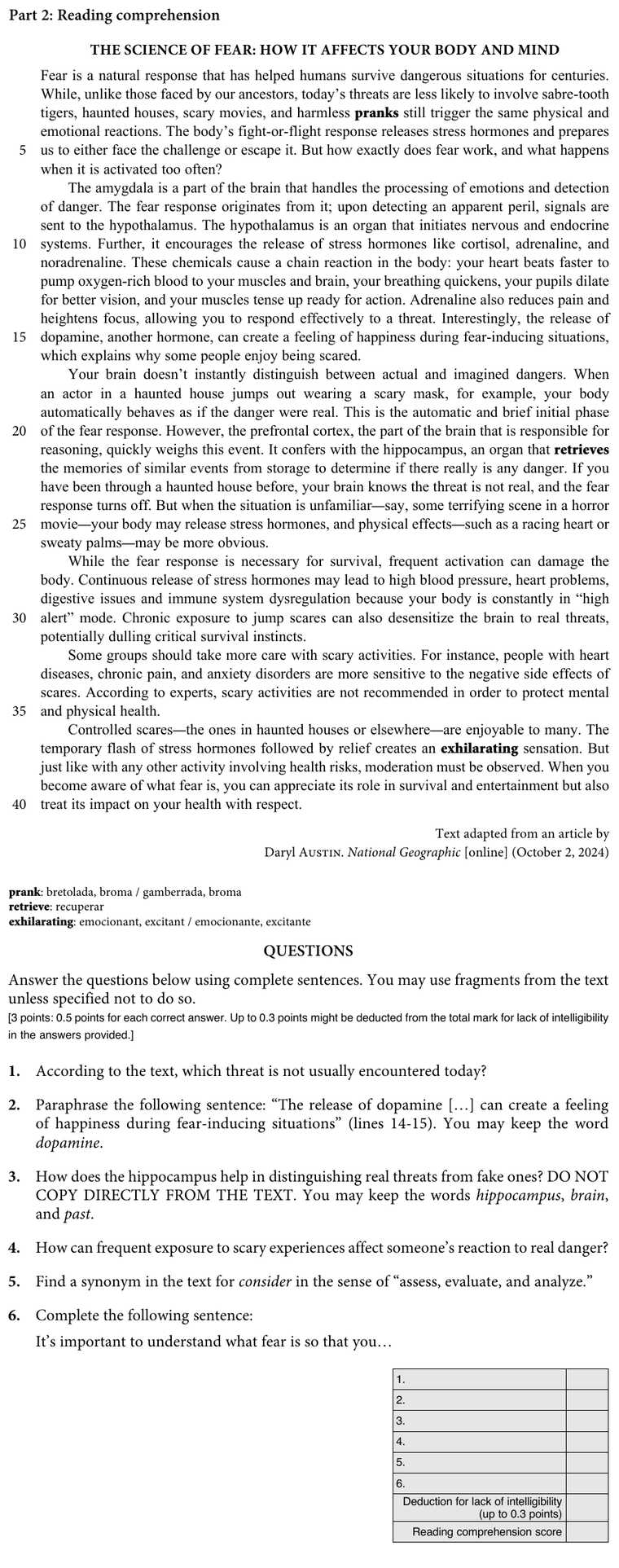
THE SCIENCE OF FEAR: HOW IT AFFECTS YOUR BODY AND MIND Fear is a natural response that has helped humans survive dangerous situations for centuries. While, unlike those faced by our ancestors, today’s threats are less likely to involve sabre-tooth tigers, haunted houses, scary movies, and harmless pranks still trigger the same physical and emotional reactions. The body’s fight-or-flight response releases stress hormones and prepares us to either face the challenge or escape it. But how exactly does fear work, and what happens when it is activated too often? The amygdala is a part of the brain that handles the processing of emotions and detection of danger. The fear response originates from it; upon detecting an apparent peril, signals are sent to the hypothalamus. The hypothalamus is an organ that initiates nervous and endocrine systems. Further, it encourages the release of stress hormones like cortisol, adrenaline, and noradrenaline. These chemicals cause a chain reaction in the body: your heart beats faster to pump oxygen-rich blood to your muscles and brain, your breathing quickens, your pupils dilate for better vision, and your muscles tense up ready for action. Adrenaline also reduces pain and heightens focus, allowing you to respond effectively to a threat. Interestingly, the release of dopamine, another hormone, can create a feeling of happiness during fear-inducing situations, which explains why some people enjoy being scared. Your brain doesn’t instantly distinguish between actual and imagined dangers. When an actor in a haunted house jumps out wearing a scary mask, for example, your body automatically behaves as if the danger were real. This is the automatic and brief initial phase of the fear response. However, the prefrontal cortex, the part of the brain that is responsible for reasoning, quickly weighs this event. It confers with the hippocampus, an organ that retrieves the memories of similar events from storage to determine if there really is any danger. If you have been through a haunted house before, your brain knows the threat is not real, and the fear response turns off. But when the situation is unfamiliar—say, some terrifying scene in a horror movie—your body may release stress hormones, and physical effects—such as a racing heart or sweaty palms—may be more obvious. While the fear response is necessary for survival, frequent activation can damage the body. Continuous release of stress hormones may lead to high blood pressure, heart problems, digestive issues and immune system dysregulation because your body is constantly in “high alert” mode. Chronic exposure to jump scares can also desensitize the brain to real threats, potentially dulling critical survival instincts. Some groups should take more care with scary activities. For instance, people with heart diseases, chronic pain, and anxiety disorders are more sensitive to the negative side effects of scares. According to experts, scary activities are not recommended in order to protect mental and physical health. Controlled scares—the ones in haunted houses or elsewhere—are enjoyable to many. The temporary flash of stress hormones followed by relief creates an exhilarating sensation. But just like with any other activity involving health risks, moderation must be observed. When you become aware of what fear is, you can appreciate its role in survival and entertainment but also treat its impact on your health with respect. Text adapted from an article by Daryl Austin. National Geographic [online] (October 2, 2024)
prank: bretolada, broma / gamberrada, broma retrieve: recuperar exhilarating: emocionant, excitant / emocionante, excitante
See the shared reading text and glossary in Part 2, question 1 (item 2.1).
According to the text, which threat is not usually encountered today?
Paraphrase the following sentence: “The release of dopamine […] can create a feeling of happiness during fear-inducing situations” (lines 14-15). You may keep the word dopamine.
How does the hippocampus help in distinguishing real threats from fake ones? DO NOT COPY DIRECTLY FROM THE TEXT. You may keep the words hippocampus, brain, and past.
How can frequent exposure to scary experiences affect someone’s reaction to real danger?
Find a synonym in the text for consider in the sense of “assess, evaluate, and analyze.”
Complete the following sentence: It’s important to understand what fear is so that you…
Busca al primer paràgraf el perill que l’autor associa amb els nostres avantpassats.
People do not usually encounter sabre-tooth tigers today.
+0,5criteri 1 de la pauta
Toca per ampliar- 0,5 pResposta admesa, sense desglossament de punts dins la pregunta: Sabre-tooth tigers are not usually encountered anymore.
Reformula la relació entre la dopamina i el plaer en un moment que fa por.
Conserva «dopamine» i expressa la possibilitat amb «may». «When dopamine is secreted» manté la idea que la dopamina s’allibera.
When dopamine is secreted, we may feel pleasure even in a scary moment.
+0,5criteri 1 de la pauta- Nota d’OriginalSegons la guia d’exemples, una paràfrasi correcta amb un o dos mots no permesos, o una de parcialment correcta, val 0,25 punts. Amb més de dos mots no permesos o una resposta incorrecta, la puntuació és 0.
Toca per ampliar- 0,5 pResposta admesa, sense desglossament de punts dins la pregunta: The production of dopamine can cause a sense of joy/satisfaction/bliss when experiencing/during/in frightening moments/events. (among others) Ampliació oficial publicada el 2027 (bandes alternatives, no acumulables): 0.5: paràfrasi correcta sense mots no permesos. 0.25: paràfrasi correcta que reutilitza un o dos mots no permesos del text i/o paràfrasi parcialment correcta. 0: paràfrasi correcta que reutilitza més de dos mots no permesos i/o paràfrasi incorrecta.Penalització: La pregunta queda en 0.25 punts si es reutilitzen un o dos mots no permesos i/o la paràfrasi és parcialment correcta; queda en 0 si es reutilitzen més de dos mots no permesos i/o és incorrecta. No és una deducció addicional per cada error.Nota de la pauta: Exemples oficials de 0.25: «The production of dopamine can create a feeling of satisfaction during afraid moments» (la guia avisa que «afraid» és incorrecte aquí, però es capta el significat); «The dopamine can create a feeling of satisfaction.» Exemples oficials de 0: «The production of dopamine can create a feeling of happiness during afraid moments» (mateix avís sobre «afraid»); «Dopamine creates frightening moments.»
Explica amb paraules teves com l’hipocamp ajuda a valorar un possible perill.
El cervell es guia pel que ens ha passat abans. L’exemple de la casa encantada mostra com una experiència prèvia ens ajuda a entendre que l’ensurt està preparat.
The hippocampus calls up past experiences that resemble what is happening now, so the brain can judge if the risk is genuine.
+0,5criteri 1 de la pauta
Toca per ampliar- 0,5 pResposta admesa, sense desglossament de punts dins la pregunta: The hippocampus recalls familiar past events/thoughts/actions to aid the brain know whether the present danger is true or unreal. (among others)
Relaciona els ensurts repetits amb la intensitat de la resposta davant d’un perill real.
Esmenta tant el canvi en la sensibilitat del cervell com la conseqüència que té quan hi ha una amenaça real.
Repeated frightening experiences can desensitize the brain, making it respond less strongly to genuine danger.
+0,5criteri 1 de la pauta- Nota d’OriginalSegons la guia d’exemples, dir només que el cervell es desensibilitza val 0,25 punts. Per obtenir el mig punt, explica com això afebleix la reacció davant del perill real i limita’t a aquesta relació.
Toca per ampliar- 0,5 pResposta admesa, sense desglossament de punts dins la pregunta: Frequent exposure to scary experiences can desensitize the brain, reducing its ability to react strongly to real threats. Ampliació oficial publicada el 2027 (bandes alternatives, no acumulables): 0.5: resposta correcta amb tota la informació rellevant: la desensibilització del cervell redueix la capacitat de reaccionar intensament a perills reals; s’accepta «scary experiences/jump scares». 0.25: resposta parcialment correcta, incompleta o amb més informació de la necessària. 0: resposta incorrecta.Penalització: 0.25 punts en total si la resposta és parcial, incompleta o conté més informació de la necessària; 0 si és incorrecta.Nota de la pauta: Exemples oficials de 0.25: «Frequent exposure to jump scares/scary experiences can desensitize the brain.»; «Frequent exposure to jump scares/scary experiences is dangerous for real threats.» Exemple oficial de 0: «Frequent exposure to scary experiences is necessary for survival/is good for mental health, etc.»
Localitza el verb que descriu com el còrtex prefrontal avalua un possible perill.
Al tercer paràgraf, «quickly weighs this event» vol dir que el còrtex valora el que acaba de passar.
The synonym is weighs.
+0,5criteri 1 de la pauta
Toca per ampliar- 0,5 pResposta admesa, sense desglossament de punts dins la pregunta: weigh(s) (line 20)
Completa la frase amb les dues idees amb què l’autor tanca el text.
Entendre la por ens permet valorar-ne la funció en la supervivència i l’entreteniment i prendre seriosament els efectes sobre la salut.
It’s important to understand what fear is so that you can appreciate its role in survival and entertainment but also treat its impact on your health with respect.
+0,5criteri 1 de la pauta
Toca per ampliar- 0,5 pResposta admesa, sense desglossament de punts dins la pregunta: It’s important to understand what fear is so that you… can appreciate its role in survival and entertainment but also treat its impact on your health with respect.
Exercici 3 · opció A
Writing
 Toca per ampliar
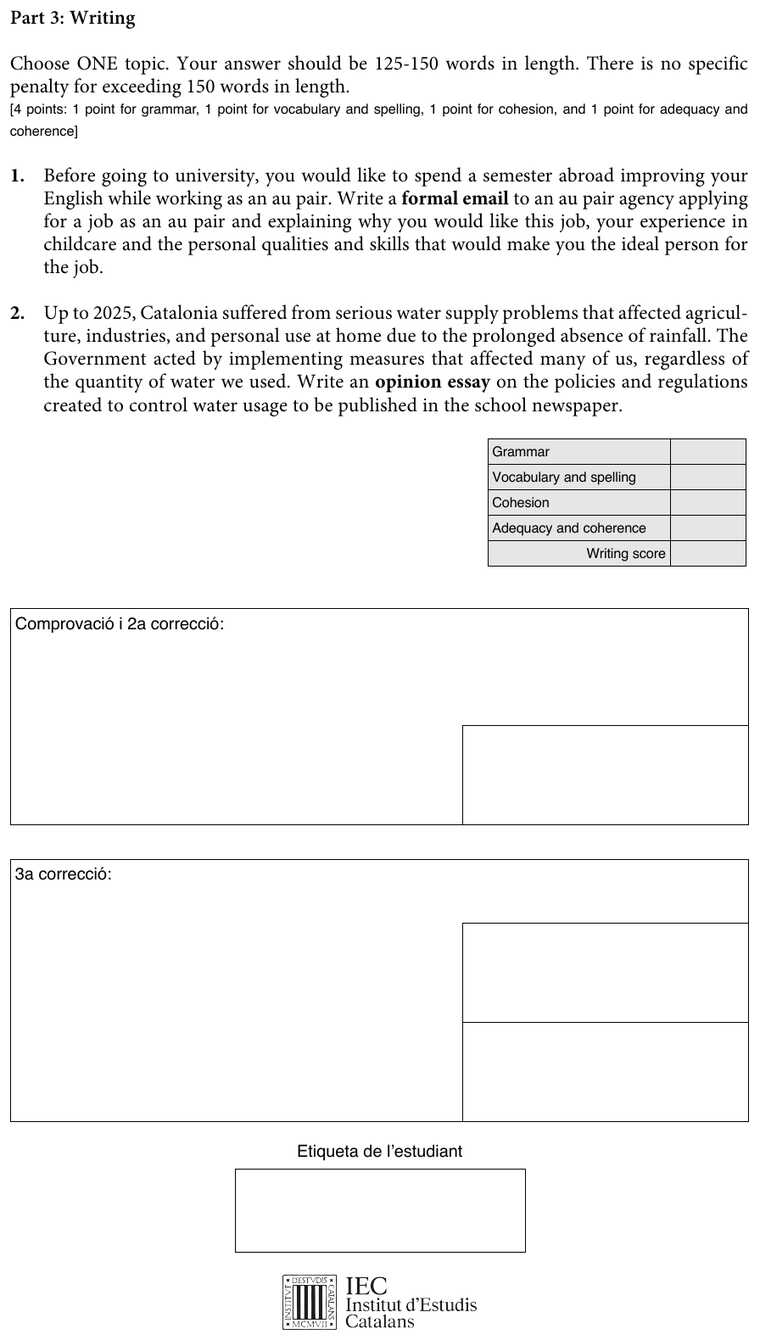
Choose ONE topic. Your answer should be 125-150 words in length. There is no specific penalty for exceeding 150 words in length. [4 points: 1 point for grammar, 1 point for vocabulary and spelling, 1 point for cohesion, and 1 point for adequacy and coherence]
Before going to university, you would like to spend a semester abroad improving your English while working as an au pair. Write a formal email to an au pair agency applying for a job as an au pair and explaining why you would like this job, your experience in childcare and the personal qualities and skills that would make you the ideal person for the job.
Amb el present perfect relaciones l’experiència que has acumulat cuidant infants amb la feina a què optes.
For the past two years, I have regularly looked after my younger cousins after school.
+1criteri 1 de la pautaDescriu què saps fer amb els infants amb verbs i expressions que concretin les responsabilitats.
My responsibilities include preparing simple meals, helping with homework and organising games.
+1criteri 2 de la pautaFes que el correu avanci del motiu de la sol·licitud a l’experiència, i de l’experiència a les qualitats que aportaràs a una família.
I have also volunteered at a children's summer activity programme, where I learned to adapt activities to different ages. I am patient, reliable and comfortable following a family's routines.
+1criteri 3 de la pautaEn un correu formal a l’agència, explica quan vols treballar d’au pair i per què t’interessa. Descriu la teva experiència amb infants i les qualitats i habilitats que t’ajudaran a tenir-ne cura.
I am writing to apply for an au pair placement through your agency for the semester before I begin university. I would welcome the opportunity to improve my English while contributing to family life abroad.
+1criteri 4 de la pauta
Dear Recruitment Team,
I am writing to apply for an au pair placement through your agency for the semester before I begin university. I would welcome the opportunity to improve my English while contributing to family life abroad.
For the past two years, I have regularly looked after my younger cousins after school. My responsibilities include preparing simple meals, helping with homework and organising games. I have also volunteered at a children's summer activity programme, where I learned to adapt activities to different ages.
I am patient, reliable and comfortable following a family's routines. When difficulties arise, I listen carefully and communicate calmly rather than making assumptions. I would be happy to provide references and discuss suitable placements in an interview.
Thank you for considering my application. I look forward to hearing about the next steps.
Yours faithfully, Alex Martin
Toca per ampliar- 1 pGramàtica, màxim 1 punt. Bandes alternatives oficials: 0–0.1, frases sense sentit o amb molts errors; 0.2–0.4, estructures molt simples i errors greus, freqüents i sistemàtics; 0.5–0.6, alguns/pocs errors, estructures molt simples i poca variació; 0.7–0.8, alguns errors però estructures més elaborades i variades; 0.9–1, molt pocs errors o cap (o lapsus molt ocasional) i estructures elaborades. Cal que els trets de la banda siguin consistents al llarg de tota la redacció. Les orientacions oficials indiquen que les dificultats relacionades amb la dislèxia es tenen en compte en l’avaluació de l’ortografia, el vocabulari i l’estructura de les frases.Nota de la pauta: Exemples oficials d’errors: «Reclamations, change, or devolution of all my money. I have spend.»; «You must be send all the command again.» La banda 0.2–0.4 cita adjectius després del nom, adjectius en plural, errors de concordança, manca de subjecte i «bare forms». Els exemples lingüísticament incorrectes de la rúbrica són deliberats.
- 1 pVocabulari, màxim 1 punt. Bandes alternatives oficials: 0.1–0.2, vocabulari inexistent/sense sentit, molts errors bàsics i faltes ortogràfiques greus; 0.3–0.4, vocabulari repetitiu i simple, errors i faltes ortogràfiques; 0.5–0.6, vocabulari simple però generalment correcte; 0.7–0.8, vocabulari elaborat i variat, que pot contenir errors; 0.9–1, vocabulari complex, elaborat i variat sense errors o amb lapsus ocasional. L’adequació del registre també es valora aquí. La guia no publica una banda numèrica addicional per sota de 0.1.Nota de la pauta: Exemples oficials amb errors: «The fridge is braken and the wather font not shoot.»; «That place is so nice, the beach in front. The restaurants were so nice and I like the sea and the peple.»; «Fast fashion is considered to be affordable, but this is an unfair believe.»
- 1 pCohesió, màxim 1 punt, sense desglossament numèric intern: paràgrafs ben estructurats amb més d’una frase, puntuació, ús correcte de connectors, conjuncions i oracions complexes (conjuntament amb Grammar), organització i absència d’idees repetitives. No es publiquen bandes numèriques per a aquests trets.Nota de la pauta: La guia exemplifica usos incorrectes amb «Nowadays I didn’t visit that place yet.» i «Although, there are dangers everywhere.» També dona com a exemple de repetició/manca d’organització: «People enjoy travelling for many reasons. Some people like visiting new places. Travelling can also be expensive. Moreover, it is time-consuming. Travelling teaches people about different cultures.»
- 1 pAdequació i coherència, màxim 1 punt, sense desglossament numèric intern: rellevància i organització del contingut, registre adequat al gènere (també a Vocabulary), pensaments clars i madurs. El títol no és obligatori i es poden fer servir contraccions. No es publiquen bandes numèriques per a aquests trets.Penalització: Els fragments llargs apresos de memòria que no siguin rellevants o pertinents es penalitzen pel contingut i no es compten en el nombre de paraules. Això no afecta connectors ni expressions curtes. No s’especifica cap deducció numèrica.Nota de la pauta: Exemples oficials de pensaments infantils o immadurs: «The important is to have fun and gain all the money possible.»; «Fast fashion makes girls happy because they can buy more clothes.»
Exercici 3 · opció B
Writing
Toca per ampliarChoose ONE topic. Your answer should be 125-150 words in length. There is no specific penalty for exceeding 150 words in length. [4 points: 1 point for grammar, 1 point for vocabulary and spelling, 1 point for cohesion, and 1 point for adequacy and coherence]
Up to 2025, Catalonia suffered from serious water supply problems that affected agriculture, industries, and personal use at home due to the prolonged absence of rainfall. The Government acted by implementing measures that affected many of us, regardless of the quantity of water we used. Write an opinion essay on the policies and regulations created to control water usage to be published in the school newspaper.
Fes servir els verbs modals per distingir una recomanació d’una conseqüència possible.
Authorities should repair leaks, publish understandable information and ensure that major consumers also contribute. Otherwise, households may feel they are making sacrifices while larger problems remain untouched.
+1criteri 1 de la pautaTria expressions que permetin veure de seguida quins usos de l’aigua es poden restringir i quins cal protegir.
During a serious drought, reducing optional uses is reasonable. Limits on filling private pools, for example, can help protect water needed for households and essential services.
+1criteri 2 de la pautaDedica un paràgraf a justificar les restriccions i un altre a explicar com es poden aplicar amb equitat. El connector However marca el pas entre aquestes dues idees.
During a serious drought, reducing optional uses is reasonable. However, identical measures may affect careful users and wasteful users differently.
+1criteri 3 de la pautaPer al diari escolar, defensa una posició clara sobre les restriccions i relaciona-la amb qui ha d’assumir l’esforç d’estalviar aigua.
I support policies that protect essential supplies, but they must distribute responsibility fairly and explain their purpose clearly.
+1criteri 4 de la pauta
The water shortages described in recent years show why restrictions can become necessary. I support policies that protect essential supplies, but they must distribute responsibility fairly and explain their purpose clearly.
During a serious drought, reducing optional uses is reasonable. Limits on filling private pools, for example, can help protect water needed for households and essential services. Schools should also teach practical conservation instead of treating restrictions as someone else's problem.
However, identical measures may affect careful users and wasteful users differently. Authorities should repair leaks, publish understandable information and ensure that major consumers also contribute. Otherwise, households may feel they are making sacrifices while larger problems remain untouched.
In my opinion, emergency rules should form part of a longer strategy, including more efficient infrastructure and realistic planning. Fair restrictions can secure cooperation, but lasting trust depends on demonstrating that every saved litre matters and every sector shares the effort.
Toca per ampliar- 1 pGramàtica, màxim 1 punt. Bandes alternatives oficials: 0–0.1, frases sense sentit o amb molts errors; 0.2–0.4, estructures molt simples i errors greus, freqüents i sistemàtics; 0.5–0.6, alguns/pocs errors, estructures molt simples i poca variació; 0.7–0.8, alguns errors però estructures més elaborades i variades; 0.9–1, molt pocs errors o cap (o lapsus molt ocasional) i estructures elaborades. Cal que els trets de la banda siguin consistents al llarg de tota la redacció. Les orientacions oficials indiquen que les dificultats relacionades amb la dislèxia es tenen en compte en l’avaluació de l’ortografia, el vocabulari i l’estructura de les frases.Nota de la pauta: Exemples oficials d’errors: «Reclamations, change, or devolution of all my money. I have spend.»; «You must be send all the command again.» La banda 0.2–0.4 cita adjectius després del nom, adjectius en plural, errors de concordança, manca de subjecte i «bare forms». Els exemples lingüísticament incorrectes de la rúbrica són deliberats.
- 1 pVocabulari, màxim 1 punt. Bandes alternatives oficials: 0.1–0.2, vocabulari inexistent/sense sentit, molts errors bàsics i faltes ortogràfiques greus; 0.3–0.4, vocabulari repetitiu i simple, errors i faltes ortogràfiques; 0.5–0.6, vocabulari simple però generalment correcte; 0.7–0.8, vocabulari elaborat i variat, que pot contenir errors; 0.9–1, vocabulari complex, elaborat i variat sense errors o amb lapsus ocasional. L’adequació del registre també es valora aquí. La guia no publica una banda numèrica addicional per sota de 0.1.Nota de la pauta: Exemples oficials amb errors: «The fridge is braken and the wather font not shoot.»; «That place is so nice, the beach in front. The restaurants were so nice and I like the sea and the peple.»; «Fast fashion is considered to be affordable, but this is an unfair believe.»
- 1 pCohesió, màxim 1 punt, sense desglossament numèric intern: paràgrafs ben estructurats amb més d’una frase, puntuació, ús correcte de connectors, conjuncions i oracions complexes (conjuntament amb Grammar), organització i absència d’idees repetitives. No es publiquen bandes numèriques per a aquests trets.Nota de la pauta: La guia exemplifica usos incorrectes amb «Nowadays I didn’t visit that place yet.» i «Although, there are dangers everywhere.» També dona com a exemple de repetició/manca d’organització: «People enjoy travelling for many reasons. Some people like visiting new places. Travelling can also be expensive. Moreover, it is time-consuming. Travelling teaches people about different cultures.»
- 1 pAdequació i coherència, màxim 1 punt, sense desglossament numèric intern: rellevància i organització del contingut, registre adequat al gènere (també a Vocabulary), pensaments clars i madurs. El títol no és obligatori i es poden fer servir contraccions. No es publiquen bandes numèriques per a aquests trets.Penalització: Els fragments llargs apresos de memòria que no siguin rellevants o pertinents es penalitzen pel contingut i no es compten en el nombre de paraules. Això no afecta connectors ni expressions curtes. No s’especifica cap deducció numèrica.Nota de la pauta: Exemples oficials de pensaments infantils o immadurs: «The important is to have fun and gain all the money possible.»; «Fast fashion makes girls happy because they can buy more clothes.»