Anglès
PAU 2026 · ordinària · sèrie 1
Examen oficial de la PAU de Catalunya amb la resolució pas a pas de cada apartat i la pauta de correcció.
Listening
PAU 2026 · ordinària · sèrie 1Instruccions de l’examen
The exam consists of THREE mandatory parts. In the first part, listening comprehension is assessed through 8 multiple choice questions. It is worth 3 points. In the second part, reading comprehension is assessed through 6 open-ended questions. It is worth 3 points. In the third part, written expression is assessed. Here, you may choose ONE of the two given options. It is worth 4 points.
Part 1: Listening comprehension
Choose the best answer according to the recording. Only ONE answer is correct. [3 points: 0.375 points for each correct answer. Wrong answers will be penalized by deducting 0.125 points. There is no penalty for unanswered questions.]
Part 2: Reading comprehension
Answer the questions below using complete sentences. You may use fragments from the text unless specified not to do so. [3 points: 0.5 points for each correct answer. Up to 0.3 points might be deducted from the total mark for lack of intelligibility in the answers provided.]
Part 3: Writing
Choose ONE topic. Your answer should be 125-150 words in length. There is no specific penalty for exceeding 150 words in length. [4 points: 1 point for grammar, 1 point for vocabulary and spelling, 1 point for cohesion, and 1 point for adequacy and coherence]
Exercici 1
Listening comprehension
 Toca per ampliar
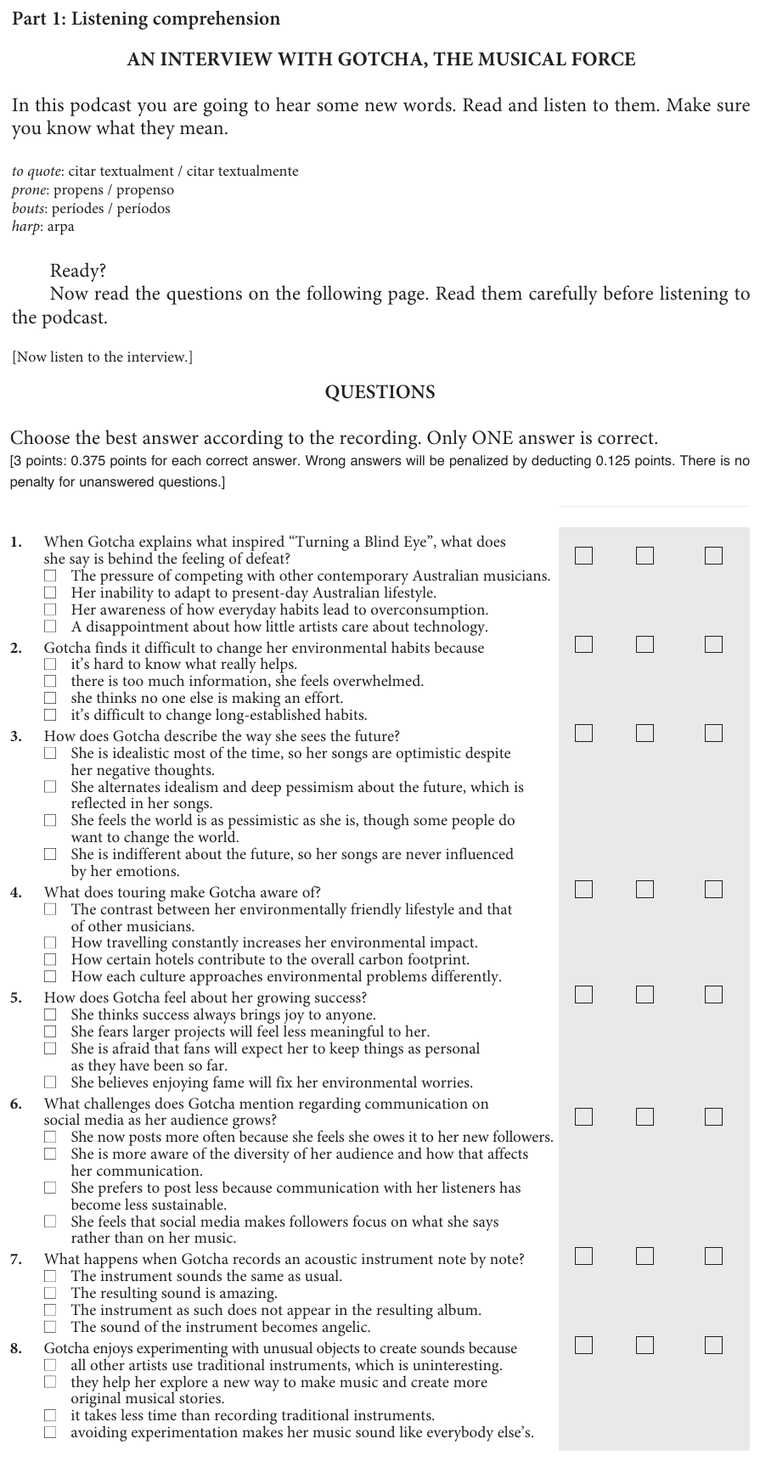
“AN INTERVIEW WITH GOTCHA, THE MUSICAL FORCE!”
In this podcast you are going to hear some new words. Read and listen to them. Make sure you know what they mean.
to quote: citar textualment / citar textualmente
prone: propens/propenso
bouts: período/período
harp: arpa/arpa
Ready? Now read the questions on the following page. Read them carefully before listening to the podcast. [Now listen to the interview.]
Interviewer (I): You are Gotcha, the musical force!
Gotcha (G): Haha, from now on I’m going to introduce myself as Gotcha, the musical force. My real name is Margot Chapman, but I guess I’ve got used to being called Gotcha more often now.
I: Right, I got you. That song we’ve just listened to, ‘Turning a Blind Eye’, is the first Australian single from your latest record, Making Miracles. It's a song that you say describes your feelings of being completely defeated, I'm quoting you, “by the realities of living in contemporary Australia.” What's been difficult about life there?
G: Oh, it's not specifically about living in contemporary Australia, although I’m American. It comes from a place of defeat, I guess, in the sense of being someone who is concerned, maybe a bit more aware than some people, in terms of how things I do in my regular life, in terms of use of materials, driving cars, using so much disposable technology to make music, how that is so implicitly involved in so much... use, maybe overuse of resources?
I: Your carbon footprint.
G: Yeah. And I feel very conflicted about the reliability of the information available. When I try to research it and make changes, it’s incredibly hard to find a clear basis for making informed judgments or decisions. It’s hard to feel like anything I do makes a difference, even in my own life. Whether or not it sets an example for my fans or helps spread a more environmental message, sometimes it just feels like I’m making changes simply to avoid feeling completely defeated.
I: But the feeling of being “completely defeated” when you were writing this song suggests that you're quite pessimistic about our future. Are you?
G: I have moments like that, yeah. I sometimes change my mind a lot when I compose. You know, I think I'm an idealist a lot of the time, but often prone to bouts of very depressive cycles of thought and pessimism about the potential for really fundamental change in the way humans live on earth, at least. It's those moments when I feel like that really prompted the lyrics to ‘Turning a Blind Eye’.
I: And what about the fact that now that you’re touring, you’re inevitably traveling more and experiencing not just different countries, but different cultures and different ways people are trying to deal with issues like the environment and ecological change? Does that make you feel more defeated, or do you find things on those travels that inspire you?
G: You know, touring for a music career does involve seeing a lot of airports, hotel rooms, cars, buses, et cetera, though some artists do it more than I do. Even so, I'm probably more in touch with the reality of having an ever-increasing carbon footprint, at least in terms of what I'm doing in my music career. And it is indeed something I think about.
I: So you wrote the song ‘Turning a Blind Eye’ feeling completely defeated. It's getting worse now because the song's popular and your carbon footprint is harming everybody.
G: Haha. I do think about that. It's funny, more and more people tell me, I must be so overjoyed and amazed by the success and how big everything's getting. But I guess part of what makes me worry and that might lead to writing a song like this, is the sense that the bigger things get, the less likely they are to stay sustainable or be personal. I don't know...
I: And not just environmentally, but materially, emotionally.
G: Emotionally, yeah, trying to communicate with increasing numbers of people. I feel a bit freaked out about it. I think I have a different approach. It’s difficult for me to even write anything on my Twitter account; even though it's not like I have a huge number of people following me there, only around 40, 50,000. I still think about it. I know plenty of people have millions of followers on these social media. But even so, realizing that my audience is broader now, and that lots of different kinds of people are discovering my music, changes how aware I am of who I’m speaking to on these platforms.
I: Let me talk a bit about the record, Making Miracles. You're getting a lot of attention for this record, and that's got to be rewarding given the amount of work that you put into it. You play most of the instruments on it, but even more remarkable is the method of taking acoustic instruments, recording them note by note, and then turning them into virtual instruments. What exactly does that mean you're doing in terms of creating these sounds?
G: Yes, it’s the case of a harp that I found at an antique shop. A harp is not particularly a new-sounding instrument. It's one you've probably heard. The way it sounds on a record is usually quite angelic, because that's the way you can play it, but to record it note by note and then have control over those notes just means that you make the instrument sound incredible. It almost turns into a completely new instrument.
I: That's remarkably creative and innovative, but where does that come from? I mean, do you have an allergy to just playing an acoustic guitar and singing a song?
G: Well, I'm really excited by alternative ways of making music. They open up windows to sound worlds I haven't explored before, and those are the kinds of records I want to make. I'm not against using traditional instruments: there's plenty of piano and regular drum kits on the album, but I have a pretty intense interest in things like, what if you could use... a plastic ball and use that as a drum instead of just getting a drum out and putting a mic on it. It's just more interesting. It just means there's more of a story. I guess it creates a far greater range of textures, though it also takes time.
I: This is so interesting, Gotcha, but I’m afraid we have run out of time. It’s been a pleasure to have you here with us today.
G: Nice to chat, too.
Adapted from:
https://www.youtube.com/watch?v=-0kNQcUHn0
See the official listening transcript in Part 1, question 1 (item 1.1).
When Gotcha explains what inspired “Turning a Blind Eye”, what does
she say is behind the feeling of defeat?
■ The pressure of competing with other contemporary Australian musicians.
■ Her inability to adapt to present-day Australian lifestyle.
■ Her awareness of how everyday habits lead to overconsumption.
■ A disappointment about how little artists care about technology.
Gotcha finds it difficult to change her environmental habits because
■ it’s hard to know what really helps.
■ there is too much information, she feels overwhelmed.
■ she thinks no one else is making an effort.
■ it’s difficult to change long-established habits.
How does Gotcha describe the way she sees the future?
■ She is idealistic most of the time, so her songs are optimistic despite
her negative thoughts.
■ She alternates idealism and deep pessimism about the future, which is
reflected in her songs.
■ She feels the world is as pessimistic as she is, though some people do
want to change the world.
■ She is indifferent about the future, so her songs are never influenced
by her emotions.
What does touring make Gotcha aware of?
■ The contrast between her environmentally friendly lifestyle and that
of other musicians.
■ How travelling constantly increases her environmental impact.
■ How certain hotels contribute to the overall carbon footprint.
■ How each culture approaches environmental problems differently.
How does Gotcha feel about her growing success?
■ She thinks success always brings joy to anyone.
■ She fears larger projects will feel less meaningful to her.
■ She is afraid that fans will expect her to keep things as personal
as they have been so far.
■ She believes enjoying fame will fix her environmental worries.
What challenges does Gotcha mention regarding communication on
social media as her audience grows?
■ She now posts more often because she feels she owes it to her new followers.
■ She is more aware of the diversity of her audience and how that affects
her communication.
■ She prefers to post less because communication with her listeners has
become less sustainable.
■ She feels that social media makes followers focus on what she says
rather than on her music.
What happens when Gotcha records an acoustic instrument note by note?
■ The instrument sounds the same as usual.
■ The resulting sound is amazing.
■ The instrument as such does not appear in the resulting album.
■ The sound of the instrument becomes angelic.
Gotcha enjoys experimenting with unusual objects to create sounds because
■ all other artists use traditional instruments, which is uninteresting.
■ they help her explore a new way to make music and create more
original musical stories.
■ it takes less time than recording traditional instruments.
■ avoiding experimentation makes her music sound like everybody else’s.
Identifica d’on ve la sensació d’impotència que va inspirar la cançó. La Gotcha es refereix als recursos que consumeix en activitats quotidianes com conduir o fer música amb tecnologia d’un sol ús.
Her awareness of how everyday habits lead to overconsumption.
+0,375criteri 1 de la pauta
 Toca per ampliar
- 0,375 pSeleccionar la resposta de la clau oficial: Her awareness of how everyday habits lead to overconsumption.Penalització: Resposta incorrecta: −0.125 punts; pregunta no contestada: sense penalització.
La pista és el dubte sobre la fiabilitat de la informació. Quan investiga quins hàbits pot canviar, a la Gotcha li costa saber si els canvis tindran cap efecte.
it’s hard to know what really helps.
+0,375criteri 1 de la pauta
Toca per ampliar- 0,375 pSeleccionar la resposta de la clau oficial: it’s hard to know what really helps.Penalització: Resposta incorrecta: −0.125 punts; pregunta no contestada: sense penalització.
Recull els dos estats d’ànim que descriu la Gotcha. Sovint és idealista, però també passa per etapes de pessimisme intens que, per exemple, van donar peu a la lletra de «Turning a Blind Eye».
She alternates idealism and deep pessimism about the future, which is reflected in her songs.
+0,375criteri 1 de la pauta
Toca per ampliar- 0,375 pSeleccionar la resposta de la clau oficial: She alternates idealism and deep pessimism about the future, which is reflected in her songs.Penalització: Resposta incorrecta: −0.125 punts; pregunta no contestada: sense penalització.
Quan parla de les gires, la Gotcha enumera aeroports, hotels i trajectes en cotxe i autobús. Aquesta rutina li fa més evident que la seva petjada de carboni creix.
How travelling constantly increases her environmental impact.
+0,375criteri 1 de la pauta
Toca per ampliar- 0,375 pSeleccionar la resposta de la clau oficial: How travelling constantly increases her environmental impact.Penalització: Resposta incorrecta: −0.125 punts; pregunta no contestada: sense penalització.
Busca què li preocupa a mesura que té més èxit. La Gotcha tem que, quan els projectes creixin, li costi mantenir el vincle personal que té amb la seva feina.
She fears larger projects will feel less meaningful to her.
+0,375criteri 1 de la pauta
Toca per ampliar- 0,375 pSeleccionar la resposta de la clau oficial: She fears larger projects will feel less meaningful to her.Penalització: Resposta incorrecta: −0.125 punts; pregunta no contestada: sense penalització.
La Gotcha explica que ara la seva música arriba a gent de perfils molt diversos. Això la fa pensar més en qui la llegirà quan publiqui a les xarxes.
She is more aware of the diversity of her audience and how that affects her communication.
+0,375criteri 1 de la pauta
Toca per ampliar- 0,375 pSeleccionar la resposta de la clau oficial: She is more aware of the diversity of her audience and how that affects her communication.Penalització: Resposta incorrecta: −0.125 punts; pregunta no contestada: sense penalització.
Escolta què aconsegueix amb l’arpa quan n’enregistra les notes per separat. En poder controlar cada nota, obté un so que li sembla increïble, gairebé com si fos un instrument nou.
The resulting sound is amazing.
+0,375criteri 1 de la pauta
Toca per ampliar- 0,375 pSeleccionar la resposta de la clau oficial: The resulting sound is amazing.Penalització: Resposta incorrecta: −0.125 punts; pregunta no contestada: sense penalització.
La Gotcha posa l’exemple d’una pilota de plàstic que pot fer servir com a tambor. Li agrada experimentar perquè aquests objectes li permeten descobrir sons i donar més personalitat a la música.
they help her explore a new way to make music and create more original musical stories.
+0,375criteri 1 de la pauta
Toca per ampliar- 0,375 pSeleccionar la resposta de la clau oficial: they help her explore a new way to make music and create more original musical stories.Penalització: Resposta incorrecta: −0.125 punts; pregunta no contestada: sense penalització.
Exercici 2
Reading comprehension
 Toca per ampliar
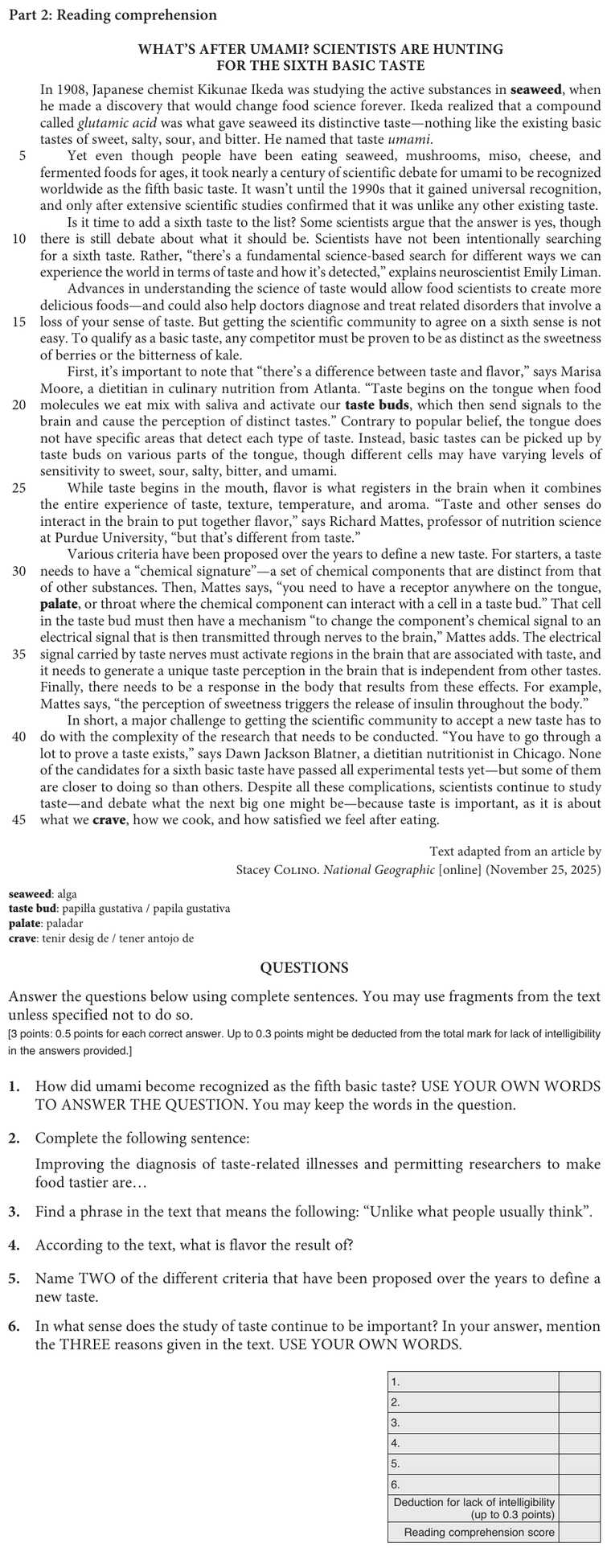
WHAT’S AFTER UMAMI? SCIENTISTS ARE HUNTING FOR THE SIXTH BASIC TASTE In 1908, Japanese chemist Kikunae Ikeda was studying the active substances in seaweed, when he made a discovery that would change food science forever. Ikeda realized that a compound called glutamic acid was what gave seaweed its distinctive taste—nothing like the existing basic tastes of sweet, salty, sour, and bitter. He named that taste umami. Yet even though people have been eating seaweed, mushrooms, miso, cheese, and fermented foods for ages, it took nearly a century of scientific debate for umami to be recognized worldwide as the fifth basic taste. It wasn’t until the 1990s that it gained universal recognition, and only after extensive scientific studies confirmed that it was unlike any other existing taste. Is it time to add a sixth taste to the list? Some scientists argue that the answer is yes, though there is still debate about what it should be. Scientists have not been intentionally searching for a sixth taste. Rather, “there’s a fundamental science-based search for different ways we can experience the world in terms of taste and how it’s detected,” explains neuroscientist Emily Liman. Advances in understanding the science of taste would allow food scientists to create more delicious foods—and could also help doctors diagnose and treat related disorders that involve a loss of your sense of taste. But getting the scientific community to agree on a sixth sense is not easy. To qualify as a basic taste, any competitor must be proven to be as distinct as the sweetness of berries or the bitterness of kale. First, it’s important to note that “there’s a difference between taste and flavor,” says Marisa Moore, a dietitian in culinary nutrition from Atlanta. “Taste begins on the tongue when food molecules we eat mix with saliva and activate our taste buds, which then send signals to the brain and cause the perception of distinct tastes.” Contrary to popular belief, the tongue does not have specific areas that detect each type of taste. Instead, basic tastes can be picked up by taste buds on various parts of the tongue, though different cells may have varying levels of sensitivity to sweet, sour, salty, bitter, and umami. While taste begins in the mouth, flavor is what registers in the brain when it combines the entire experience of taste, texture, temperature, and aroma. “Taste and other senses do interact in the brain to put together flavor,” says Richard Mattes, professor of nutrition science at Purdue University, “but that’s different from taste.” Various criteria have been proposed over the years to define a new taste. For starters, a taste needs to have a “chemical signature”—a set of chemical components that are distinct from that of other substances. Then, Mattes says, “you need to have a receptor anywhere on the tongue, palate, or throat where the chemical component can interact with a cell in a taste bud.” That cell in the taste bud must then have a mechanism “to change the component’s chemical signal to an electrical signal that is then transmitted through nerves to the brain,” Mattes adds. The electrical signal carried by taste nerves must activate regions in the brain that are associated with taste, and it needs to generate a unique taste perception in the brain that is independent from other tastes. Finally, there needs to be a response in the body that results from these effects. For example, Mattes says, “the perception of sweetness triggers the release of insulin throughout the body.” In short, a major challenge to getting the scientific community to accept a new taste has to do with the complexity of the research that needs to be conducted. “You have to go through a lot to prove a taste exists,” says Dawn Jackson Blatner, a dietitian nutritionist in Chicago. None of the candidates for a sixth basic taste have passed all experimental tests yet—but some of them are closer to doing so than others. Despite all these complications, scientists continue to study taste—and debate what the next big one might be—because taste is important, as it is about what we crave, how we cook, and how satisfied we feel after eating.
Text adapted from an article by Stacey Colino. National Geographic [online] (November 25, 2025) seaweed: alga taste bud: papiŀla gustativa / papila gustativa palate: paladar crave: tenir desig de / tener antojo de
See the shared reading text and glossary in Part 2, question 1 (item 2.1).
How did umami become recognized as the fifth basic taste? USE YOUR OWN WORDS TO ANSWER THE QUESTION. You may keep the words in the question.
Complete the following sentence: Improving the diagnosis of taste-related illnesses and permitting researchers to make food tastier are…
Find a phrase in the text that means the following: “Unlike what people usually think”.
According to the text, what is flavor the result of?
Name TWO of the different criteria that have been proposed over the years to define a new taste.
In what sense does the study of taste continue to be important? In your answer, mention the THREE reasons given in the text. USE YOUR OWN WORDS.
El segon paràgraf dona la condició perquè es reconegués l’umami. Explica amb paraules pròpies què van demostrar els estudis sobre aquest gust.
Umami became recognized as the fifth basic taste when research demonstrated that it was distinct from the other established tastes.
+0,5criteri 1 de la pauta
Toca per ampliar- 0,5 pResposta admesa, sense desglossament de punts dins la pregunta: Umami was recognized as the fifth basic taste after research/investigations corroborated/stated/proved that it was different from other tastes we already know/have.
La frase ja dona els dos exemples, un de mèdic i un d’alimentari. Completa-la explicant que tots dos són aplicacions d’un coneixement més profund del gust.
Improving the diagnosis of taste-related illnesses and permitting researchers to make food tastier are two applications of understanding the science of taste.
+0,5criteri 1 de la pauta
Toca per ampliar- 0,5 pResposta admesa, sense desglossament de punts dins la pregunta: two effects/consequences/applications/results of understanding the science of taste.
Copia l’expressió que introdueix la correcció d’una creença estesa. La trobaràs a la línia 21, just abans que el text expliqui com es detecten els gustos a la llengua.
Contrary to popular belief
+0,5criteri 1 de la pauta
Toca per ampliar- 0,5 pResposta admesa, sense desglossament de punts dins la pregunta: Contrary to popular belief
A les línies 25 i 26, el cervell combina el gust amb altres sensacions. Pots enumerar-les com en el model o explicar que el sabor resulta de la interacció del gust amb els altres sentits al cervell.
Flavor results from the brain combining taste with texture, temperature and aroma.
+0,5criteri 1 de la pauta
Toca per ampliar- 0,5 pResposta admesa, sense desglossament de punts dins la pregunta: Flavor is the (result of the) interaction between taste and other senses in the brain. OR Flavor is the (result of the) combination of taste, texture, temperature and aroma in the brain. OR Flavor is what registers in the brain when it combines the entire experience of taste, texture, temperature and aroma.
Tria dos requisits diferents de la llista de les línies 29 a 37. Aquí en triem un sobre la composició química i un altre sobre la sensació que es produeix al cervell.
A new taste must have a distinct chemical signature and produce a unique taste perception in the brain that is independent of other tastes.
+0,5criteri 1 de la pauta
Toca per ampliar- 0,5 pResposta admesa, sense desglossament de punts dins la pregunta: Any two of the following: 1. A taste needs to have a “chemical signature” -a set of chemical components that are distinct from that of other substances. 2. You need to have a receptor anywhere on the tongue, palate, or throat where the chemical component can interact with a cell in a tastebud. 3. That cell in the tastebud must have a mechanism “to change the component’s chemical signal to an electrical signal that is then transmitted through nerves to the brain”. 4. The electrical signal carried by taste nerves must activate regions in the brain that are associated with taste. 5. It needs to generate a unique taste perception in the brain that is independent from other tastes. 6. There needs to be a response in the body that results from these effects.
Reformula amb paraules pròpies les tres idees de l’última línia. El gust influeix en què ens ve de gust menjar, com preparem el menjar i com ens sentim després.
Studying taste matters because taste influences which foods appeal to us, how we prepare our meals and the satisfaction we get from eating.
+0,5criteri 1 de la pauta
Toca per ampliar- 0,5 pResposta admesa, sense desglossament de punts dins la pregunta: The study of taste continues to be important because/since/as taste is about what we feel like eating, how we prepare food, and how happy we are after a meal. The three reasons why the study of taste continues to be important include the relationship between taste and what we feel like eating, how/the way we prepare food and how happy we are after a meal. (among other options)
Exercici 3 · opció A
Writing
 Toca per ampliar
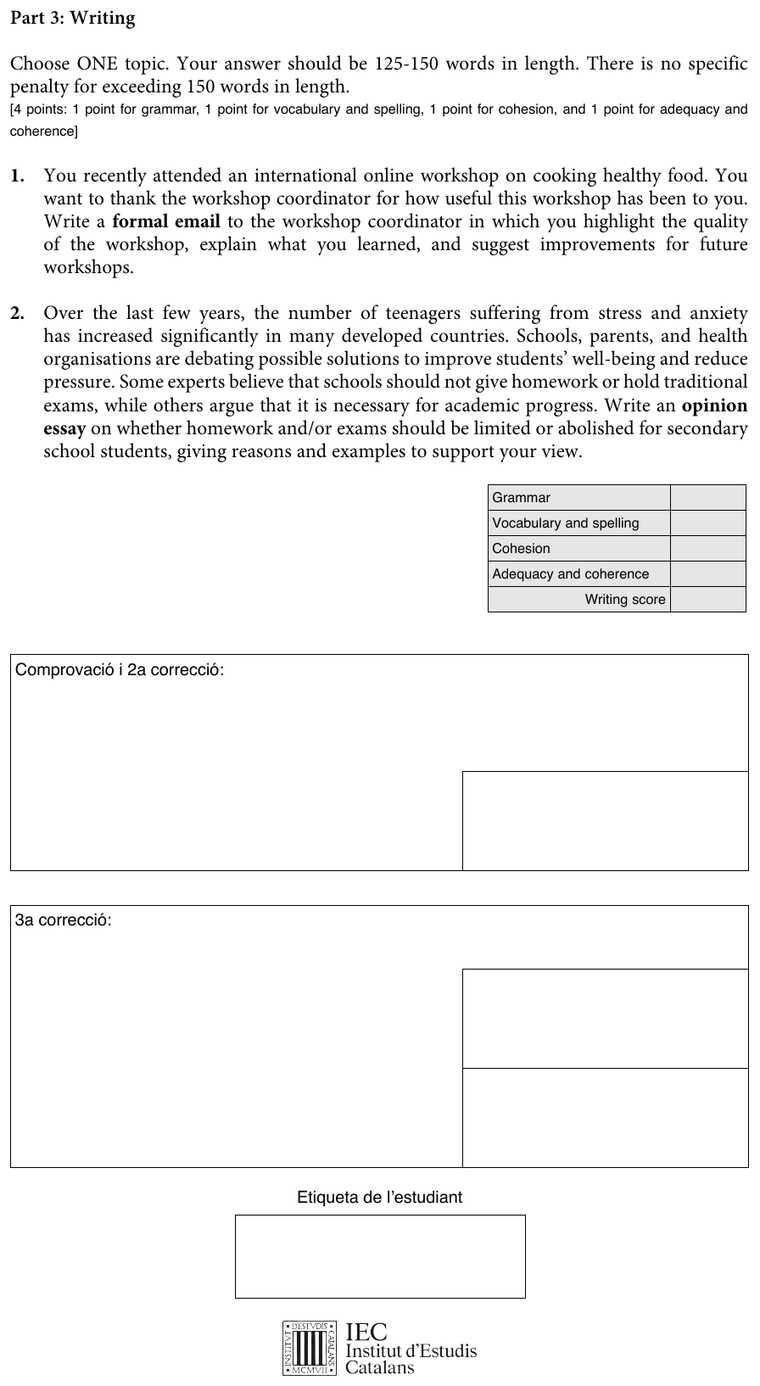
Choose ONE topic. Your answer should be 125-150 words in length. There is no specific penalty for exceeding 150 words in length. [4 points: 1 point for grammar, 1 point for vocabulary and spelling, 1 point for cohesion, and 1 point for adequacy and coherence]
You recently attended an international online workshop on cooking healthy food. You want to thank the workshop coordinator for how useful this workshop has been to you. Write a formal email to the workshop coordinator in which you highlight the quality of the workshop, explain what you learned, and suggest improvements for future workshops.
Tria el temps verbal segons quan passa l’acció. El passat simple explica què vas aprendre al taller i el present perfect mostra què has fet des d’aleshores.
I learned to prepare a balanced meal with inexpensive ingredients and to use herbs creatively instead of relying on ready-made sauces.
Since the workshop, I have cooked dinner for my family twice with much greater confidence.
+1criteri 1 de la pautaFes servir vocabulari concret per descriure el taller, els plats i el material que podria ajudar els participants.
The clear demonstrations and welcoming atmosphere made the sessions both enjoyable and useful.
Downloadable recipe summaries would also help participants practise afterwards.
+1criteri 2 de la pautaOrdena el correu de manera que l’agraïment porti a un aprenentatge concret, a la seva aplicació a casa i als suggeriments per a la propera edició.
Since the workshop, I have cooked dinner for my family twice with much greater confidence. For future sessions, could you provide ingredient lists earlier and include a short break between demonstrations?
+1criteri 3 de la pautaAmb un registre formal, agraeix el taller a la coordinadora, explica què hi va funcionar i què hi vas aprendre, i proposa una millora concreta.
Dear Ms Brown, For future sessions, could you provide ingredient lists earlier and include a short break between demonstrations? Yours sincerely,
+1criteri 4 de la pauta
Dear Ms Brown,
I am writing to thank you for coordinating last week's international online workshop on healthy cooking. The clear demonstrations and welcoming atmosphere made the sessions both enjoyable and useful.
I particularly appreciated the way instructors explained techniques before inviting questions. Hearing participants from different countries suggest variations also showed how adaptable the recipes could be. I learned to prepare a balanced meal with inexpensive ingredients and to use herbs creatively instead of relying on ready-made sauces.
Since the workshop, I have cooked dinner for my family twice with much greater confidence. For future sessions, could you provide ingredient lists earlier and include a short break between demonstrations? Downloadable recipe summaries would also help participants practise afterwards.
Thank you again for organising such a thoughtful learning experience. I would be delighted to attend another workshop.
Yours sincerely, Alex Martin
Toca per ampliar- 1 pGramàtica (Grammar) (1 punt, segons l’enunciat). No es publiquen descriptors de banda ni deduccions per error als PDF aportats.
- 1 pVocabulari i ortografia (Vocabulary and spelling) (1 punt, segons l’enunciat). No es publiquen descriptors de banda ni deduccions per error als PDF aportats.
- 1 pCohesió (Cohesion) (1 punt, segons l’enunciat). No es publiquen descriptors de banda ni deduccions per error als PDF aportats.
- 1 pAdequació i coherència (Adequacy and coherence) (1 punt, segons l’enunciat). No es publiquen descriptors de banda ni deduccions per error als PDF aportats.
Exercici 3 · opció B
Writing
Toca per ampliarChoose ONE topic. Your answer should be 125-150 words in length. There is no specific penalty for exceeding 150 words in length. [4 points: 1 point for grammar, 1 point for vocabulary and spelling, 1 point for cohesion, and 1 point for adequacy and coherence]
Over the last few years, the number of teenagers suffering from stress and anxiety has increased significantly in many developed countries. Schools, parents, and health organisations are debating possible solutions to improve students’ well-being and reduce pressure. Some experts believe that schools should not give homework or hold traditional exams, while others argue that it is necessary for academic progress. Write an opinion essay on whether homework and/or exams should be limited or abolished for secondary school students, giving reasons and examples to support your view.
Combina una recomanació amb una concessió per deixar clar fins on vols que arribin els canvis.
Schools should limit homework and reduce reliance on traditional exams, although abolishing both entirely would be a mistake.
+1criteri 1 de la pautaFes servir lèxic escolar que distingeixi la preparació abans d’un examen del rendiment el dia de la prova.
Similarly, an occasional exam can encourage independent preparation, but a single timed performance should not determine a student's future.
+1criteri 2 de la pautaDesenvolupa els arguments sobre els deures i els exàmens en paràgrafs diferents. Dins el dels deures, fes servir un connector per introduir un exemple i un altre per mostrar quan deixen de ser útils.
For example, a few carefully chosen mathematics problems may reveal a difficulty before it grows. However, repetitive tasks from several subjects can consume an entire evening, leaving little time for sleep, exercise or family life.
+1criteri 3 de la pautaAcaba amb una proposta que respongui a la pregunta de l’enunciat i relacioni el que els alumnes aprenen amb la pressió que suporten.
I favour coordinated homework limits and a wider range of assessment methods. Schools should ask what each task contributes to learning and whether the benefit justifies the pressure.
+1criteri 4 de la pauta
Schools should limit homework and reduce reliance on traditional exams, although abolishing both entirely would be a mistake. Students need opportunities to practise and demonstrate learning without living under constant pressure.
Short, purposeful homework can strengthen understanding. For example, a few carefully chosen mathematics problems may reveal a difficulty before it grows. However, repetitive tasks from several subjects can consume an entire evening, leaving little time for sleep, exercise or family life.
Similarly, an occasional exam can encourage independent preparation, but a single timed performance should not determine a student's future. Projects, classroom work and individual feedback provide other ways to recognise progress, including skills that written tests may miss.
I favour coordinated homework limits and a wider range of assessment methods. Schools should ask what each task contributes to learning and whether the benefit justifies the pressure. Achievement matters, but it should develop alongside confidence and well-being.
Toca per ampliar- 1 pGramàtica (Grammar) (1 punt, segons l’enunciat). No es publiquen descriptors de banda ni deduccions per error als PDF aportats.
- 1 pVocabulari i ortografia (Vocabulary and spelling) (1 punt, segons l’enunciat). No es publiquen descriptors de banda ni deduccions per error als PDF aportats.
- 1 pCohesió (Cohesion) (1 punt, segons l’enunciat). No es publiquen descriptors de banda ni deduccions per error als PDF aportats.
- 1 pAdequació i coherència (Adequacy and coherence) (1 punt, segons l’enunciat). No es publiquen descriptors de banda ni deduccions per error als PDF aportats.