PAU 2026
 Toca per ampliar
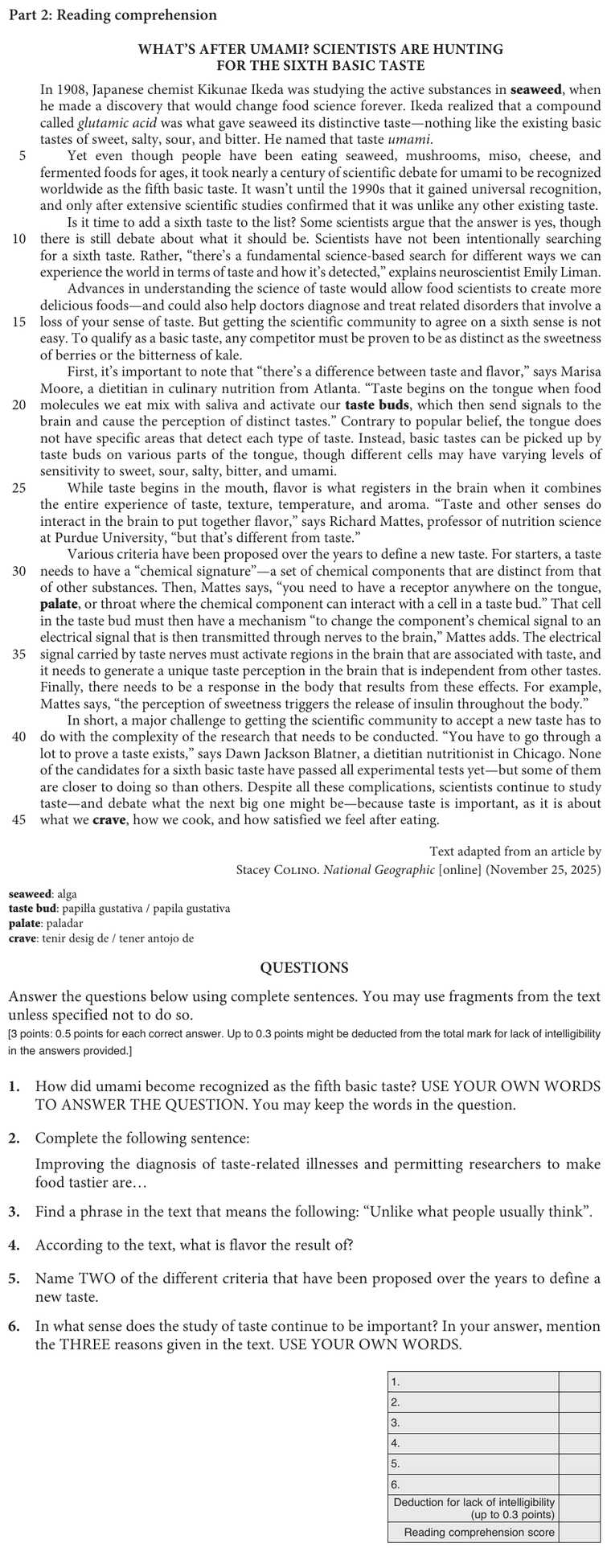
WHAT’S AFTER UMAMI? SCIENTISTS ARE HUNTING FOR THE SIXTH BASIC TASTE In 1908, Japanese chemist Kikunae Ikeda was studying the active substances in seaweed, when he made a discovery that would change food science forever. Ikeda realized that a compound called glutamic acid was what gave seaweed its distinctive taste—nothing like the existing basic tastes of sweet, salty, sour, and bitter. He named that taste umami. Yet even though people have been eating seaweed, mushrooms, miso, cheese, and fermented foods for ages, it took nearly a century of scientific debate for umami to be recognized worldwide as the fifth basic taste. It wasn’t until the 1990s that it gained universal recognition, and only after extensive scientific studies confirmed that it was unlike any other existing taste. Is it time to add a sixth taste to the list? Some scientists argue that the answer is yes, though there is still debate about what it should be. Scientists have not been intentionally searching for a sixth taste. Rather, “there’s a fundamental science-based search for different ways we can experience the world in terms of taste and how it’s detected,” explains neuroscientist Emily Liman. Advances in understanding the science of taste would allow food scientists to create more delicious foods—and could also help doctors diagnose and treat related disorders that involve a loss of your sense of taste. But getting the scientific community to agree on a sixth sense is not easy. To qualify as a basic taste, any competitor must be proven to be as distinct as the sweetness of berries or the bitterness of kale. First, it’s important to note that “there’s a difference between taste and flavor,” says Marisa Moore, a dietitian in culinary nutrition from Atlanta. “Taste begins on the tongue when food molecules we eat mix with saliva and activate our taste buds, which then send signals to the brain and cause the perception of distinct tastes.” Contrary to popular belief, the tongue does not have specific areas that detect each type of taste. Instead, basic tastes can be picked up by taste buds on various parts of the tongue, though different cells may have varying levels of sensitivity to sweet, sour, salty, bitter, and umami. While taste begins in the mouth, flavor is what registers in the brain when it combines the entire experience of taste, texture, temperature, and aroma. “Taste and other senses do interact in the brain to put together flavor,” says Richard Mattes, professor of nutrition science at Purdue University, “but that’s different from taste.” Various criteria have been proposed over the years to define a new taste. For starters, a taste needs to have a “chemical signature”—a set of chemical components that are distinct from that of other substances. Then, Mattes says, “you need to have a receptor anywhere on the tongue, palate, or throat where the chemical component can interact with a cell in a taste bud.” That cell in the taste bud must then have a mechanism “to change the component’s chemical signal to an electrical signal that is then transmitted through nerves to the brain,” Mattes adds. The electrical signal carried by taste nerves must activate regions in the brain that are associated with taste, and it needs to generate a unique taste perception in the brain that is independent from other tastes. Finally, there needs to be a response in the body that results from these effects. For example, Mattes says, “the perception of sweetness triggers the release of insulin throughout the body.” In short, a major challenge to getting the scientific community to accept a new taste has to do with the complexity of the research that needs to be conducted. “You have to go through a lot to prove a taste exists,” says Dawn Jackson Blatner, a dietitian nutritionist in Chicago. None of the candidates for a sixth basic taste have passed all experimental tests yet—but some of them are closer to doing so than others. Despite all these complications, scientists continue to study taste—and debate what the next big one might be—because taste is important, as it is about what we crave, how we cook, and how satisfied we feel after eating.
Text adapted from an article by Stacey Colino. National Geographic [online] (November 25, 2025) seaweed: alga taste bud: papiŀla gustativa / papila gustativa palate: paladar crave: tenir desig de / tener antojo de
See the shared reading text and glossary in Part 2, question 1 (item 2.1).
How did umami become recognized as the fifth basic taste? USE YOUR OWN WORDS TO ANSWER THE QUESTION. You may keep the words in the question.
Complete the following sentence: Improving the diagnosis of taste-related illnesses and permitting researchers to make food tastier are…
Find a phrase in the text that means the following: “Unlike what people usually think”.
According to the text, what is flavor the result of?
Name TWO of the different criteria that have been proposed over the years to define a new taste.
In what sense does the study of taste continue to be important? In your answer, mention the THREE reasons given in the text. USE YOUR OWN WORDS.
El segon paràgraf dona la condició perquè es reconegués l’umami. Explica amb paraules pròpies què van demostrar els estudis sobre aquest gust.
Umami became recognized as the fifth basic taste when research demonstrated that it was distinct from the other established tastes.
+0,5criteri 1 de la pauta
 Toca per ampliar
- 0,5 pResposta admesa, sense desglossament de punts dins la pregunta: Umami was recognized as the fifth basic taste after research/investigations corroborated/stated/proved that it was different from other tastes we already know/have.
La frase ja dona els dos exemples, un de mèdic i un d’alimentari. Completa-la explicant que tots dos són aplicacions d’un coneixement més profund del gust.
Improving the diagnosis of taste-related illnesses and permitting researchers to make food tastier are two applications of understanding the science of taste.
+0,5criteri 1 de la pauta
Toca per ampliar- 0,5 pResposta admesa, sense desglossament de punts dins la pregunta: two effects/consequences/applications/results of understanding the science of taste.
Copia l’expressió que introdueix la correcció d’una creença estesa. La trobaràs a la línia 21, just abans que el text expliqui com es detecten els gustos a la llengua.
Contrary to popular belief
+0,5criteri 1 de la pauta
Toca per ampliar- 0,5 pResposta admesa, sense desglossament de punts dins la pregunta: Contrary to popular belief
A les línies 25 i 26, el cervell combina el gust amb altres sensacions. Pots enumerar-les com en el model o explicar que el sabor resulta de la interacció del gust amb els altres sentits al cervell.
Flavor results from the brain combining taste with texture, temperature and aroma.
+0,5criteri 1 de la pauta
Toca per ampliar- 0,5 pResposta admesa, sense desglossament de punts dins la pregunta: Flavor is the (result of the) interaction between taste and other senses in the brain. OR Flavor is the (result of the) combination of taste, texture, temperature and aroma in the brain. OR Flavor is what registers in the brain when it combines the entire experience of taste, texture, temperature and aroma.
Tria dos requisits diferents de la llista de les línies 29 a 37. Aquí en triem un sobre la composició química i un altre sobre la sensació que es produeix al cervell.
A new taste must have a distinct chemical signature and produce a unique taste perception in the brain that is independent of other tastes.
+0,5criteri 1 de la pauta
Toca per ampliar- 0,5 pResposta admesa, sense desglossament de punts dins la pregunta: Any two of the following: 1. A taste needs to have a “chemical signature” -a set of chemical components that are distinct from that of other substances. 2. You need to have a receptor anywhere on the tongue, palate, or throat where the chemical component can interact with a cell in a tastebud. 3. That cell in the tastebud must have a mechanism “to change the component’s chemical signal to an electrical signal that is then transmitted through nerves to the brain”. 4. The electrical signal carried by taste nerves must activate regions in the brain that are associated with taste. 5. It needs to generate a unique taste perception in the brain that is independent from other tastes. 6. There needs to be a response in the body that results from these effects.
Reformula amb paraules pròpies les tres idees de l’última línia. El gust influeix en què ens ve de gust menjar, com preparem el menjar i com ens sentim després.
Studying taste matters because taste influences which foods appeal to us, how we prepare our meals and the satisfaction we get from eating.
+0,5criteri 1 de la pauta
Toca per ampliar- 0,5 pResposta admesa, sense desglossament de punts dins la pregunta: The study of taste continues to be important because/since/as taste is about what we feel like eating, how we prepare food, and how happy we are after a meal. The three reasons why the study of taste continues to be important include the relationship between taste and what we feel like eating, how/the way we prepare food and how happy we are after a meal. (among other options)