PAU 2022
 Toca per ampliar
ASSATEAGUE’S WILD HORSES
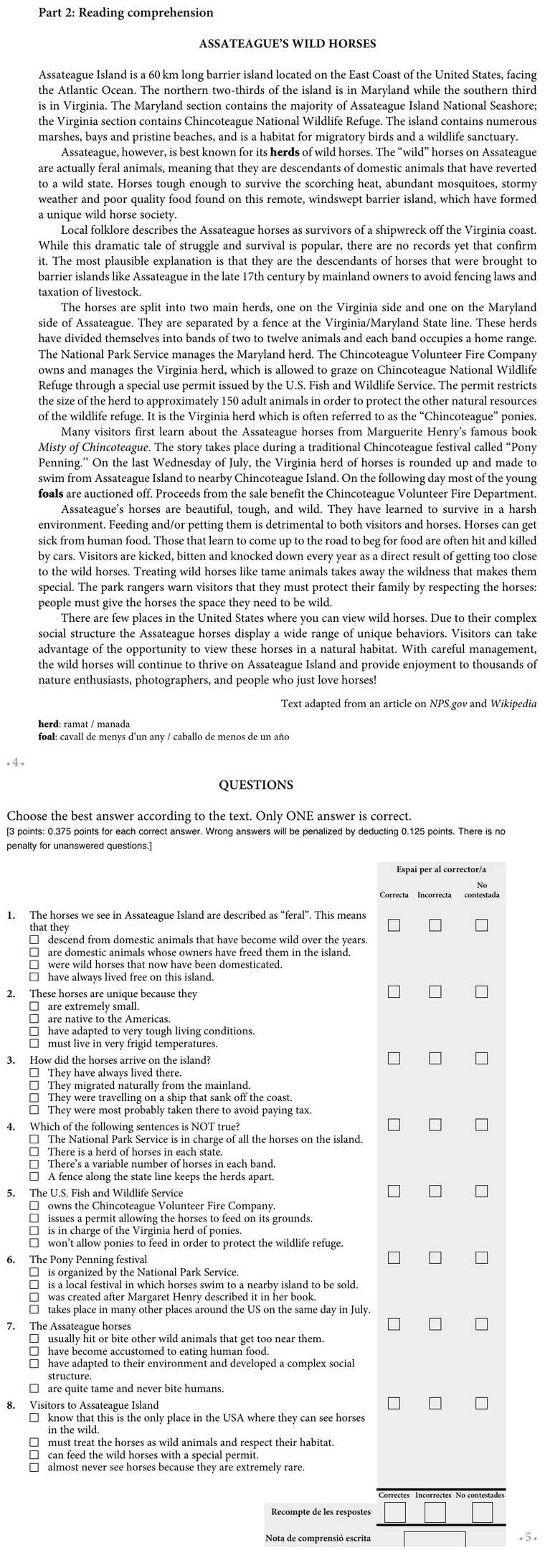
Assateague Island is a 60 km long barrier island located on the East Coast of the United States, facing the Atlantic Ocean. The northern two-thirds of the island is in Maryland while the southern third is in Virginia. The Maryland section contains the majority of Assateague Island National Seashore; the Virginia section contains Chincoteague National Wildlife Refuge. The island contains numerous marshes, bays and pristine beaches, and is a habitat for migratory birds and a wildlife sanctuary. Assateague, however, is best known for its herds of wild horses. The “wild” horses on Assateague are actually feral animals, meaning that they are descendants of domestic animals that have reverted to a wild state. Horses tough enough to survive the scorching heat, abundant mosquitoes, stormy weather and poor quality food found on this remote, windswept barrier island, which have formed a unique wild horse society. Local folklore describes the Assateague horses as survivors of a shipwreck off the Virginia coast. While this dramatic tale of struggle and survival is popular, there are no records yet that confirm it. The most plausible explanation is that they are the descendants of horses that were brought to barrier islands like Assateague in the late 17th century by mainland owners to avoid fencing laws and taxation of livestock. The horses are split into two main herds, one on the Virginia side and one on the Maryland side of Assateague. They are separated by a fence at the Virginia/Maryland State line. These herds have divided themselves into bands of two to twelve animals and each band occupies a home range. The National Park Service manages the Maryland herd. The Chincoteague Volunteer Fire Company owns and manages the Virginia herd, which is allowed to graze on Chincoteague National Wildlife Refuge through a special use permit issued by the U.S. Fish and Wildlife Service. The permit restricts the size of the herd to approximately 150 adult animals in order to protect the other natural resources of the wildlife refuge. It is the Virginia herd which is often referred to as the “Chincoteague” ponies. Many visitors first learn about the Assateague horses from Marguerite Henry’s famous book Misty of Chincoteague. The story takes place during a traditional Chincoteague festival called “Pony Penning.’’ On the last Wednesday of July, the Virginia herd of horses is rounded up and made to swim from Assateague Island to nearby Chincoteague Island. On the following day most of the young foals are auctioned off. Proceeds from the sale benefit the Chincoteague Volunteer Fire Department. Assateague’s horses are beautiful, tough, and wild. They have learned to survive in a harsh environment. Feeding and/or petting them is detrimental to both visitors and horses. Horses can get sick from human food. Those that learn to come up to the road to beg for food are often hit and killed by cars. Visitors are kicked, bitten and knocked down every year as a direct result of getting too close to the wild horses. Treating wild horses like tame animals takes away the wildness that makes them special. The park rangers warn visitors that they must protect their family by respecting the horses: people must give the horses the space they need to be wild. There are few places in the United States where you can view wild horses. Due to their complex social structure the Assateague horses display a wide range of unique behaviors. Visitors can take advantage of the opportunity to view these horses in a natural habitat. With careful management, the wild horses will continue to thrive on Assateague Island and provide enjoyment to thousands of nature enthusiasts, photographers, and people who just love horses! Text adapted from an article on NPS.gov and Wikipedia herd: ramat / manada foal: cavall de menys d’un any / caballo de menos de un año
See the shared reading text and glossary in Part 2, question 1 (item 2.1).
The horses we see in Assateague Island are described as “feral”. This means
that they
descend from domestic animals that have become wild over the years.
are domestic animals whose owners have freed them in the island.
were wild horses that now have been domesticated.
have always lived free on this island.
These horses are unique because they
are extremely small.
are native to the Americas.
have adapted to very tough living conditions.
must live in very frigid temperatures.
How did the horses arrive on the island?
They have always lived there.
They migrated naturally from the mainland.
They were travelling on a ship that sank off the coast.
They were most probably taken there to avoid paying tax.
Which of the following sentences is NOT true?
The National Park Service is in charge of all the horses on the island.
There is a herd of horses in each state.
There’s a variable number of horses in each band.
A fence along the state line keeps the herds apart.
The U.S. Fish and Wildlife Service
owns the Chincoteague Volunteer Fire Company.
issues a permit allowing the horses to feed on its grounds.
is in charge of the Virginia herd of ponies.
won’t allow ponies to feed in order to protect the wildlife refuge.
The Pony Penning festival
is organized by the National Park Service.
is a local festival in which horses swim to a nearby island to be sold.
was created after Margaret Henry described it in her book.
takes place in many other places around the US on the same day in July.
The Assateague horses
usually hit or bite other wild animals that get too near them.
have become accustomed to eating human food.
have adapted to their environment and developed a complex social
structure.
are quite tame and never bite humans.
Visitors to Assateague Island
know that this is the only place in the USA where they can see horses
in the wild.
must treat the horses as wild animals and respect their habitat.
can feed the wild horses with a special permit.
almost never see horses because they are extremely rare.
 Toca per ampliar
- 0,375 pSeleccionar la resposta de la clau oficial: descend from domestic animals that have become wild over the years.Penalització: Resposta incorrecta: −0.125 punts; pregunta no contestada: sense penalització.
Toca per ampliar- 0,375 pSeleccionar la resposta de la clau oficial: have adapted to very tough living conditions.Penalització: Resposta incorrecta: −0.125 punts; pregunta no contestada: sense penalització.
Toca per ampliar- 0,375 pSeleccionar la resposta de la clau oficial: They were most probably taken there to avoid paying tax.Penalització: Resposta incorrecta: −0.125 punts; pregunta no contestada: sense penalització.
Toca per ampliar- 0,375 pSeleccionar la resposta de la clau oficial: The National Park Service is in charge of all the horses on the island.Penalització: Resposta incorrecta: −0.125 punts; pregunta no contestada: sense penalització.
Toca per ampliar- 0,375 pSeleccionar la resposta de la clau oficial: issues a permit allowing the horses to feed on its grounds.Penalització: Resposta incorrecta: −0.125 punts; pregunta no contestada: sense penalització.
Toca per ampliar- 0,375 pSeleccionar la resposta de la clau oficial: is a local festival in which horses swim to a nearby island to be sold.Penalització: Resposta incorrecta: −0.125 punts; pregunta no contestada: sense penalització.
Toca per ampliar- 0,375 pSeleccionar la resposta de la clau oficial: have adapted to their environment and developed a complex social structure.Penalització: Resposta incorrecta: −0.125 punts; pregunta no contestada: sense penalització.
Toca per ampliar- 0,375 pSeleccionar la resposta de la clau oficial: must treat the horses as wild animals and respect their habitat.Penalització: Resposta incorrecta: −0.125 punts; pregunta no contestada: sense penalització.