PAU 2025
 Toca per ampliar
STONE AGE BABIES HAD BETTER PARENTING THAN TODAY!
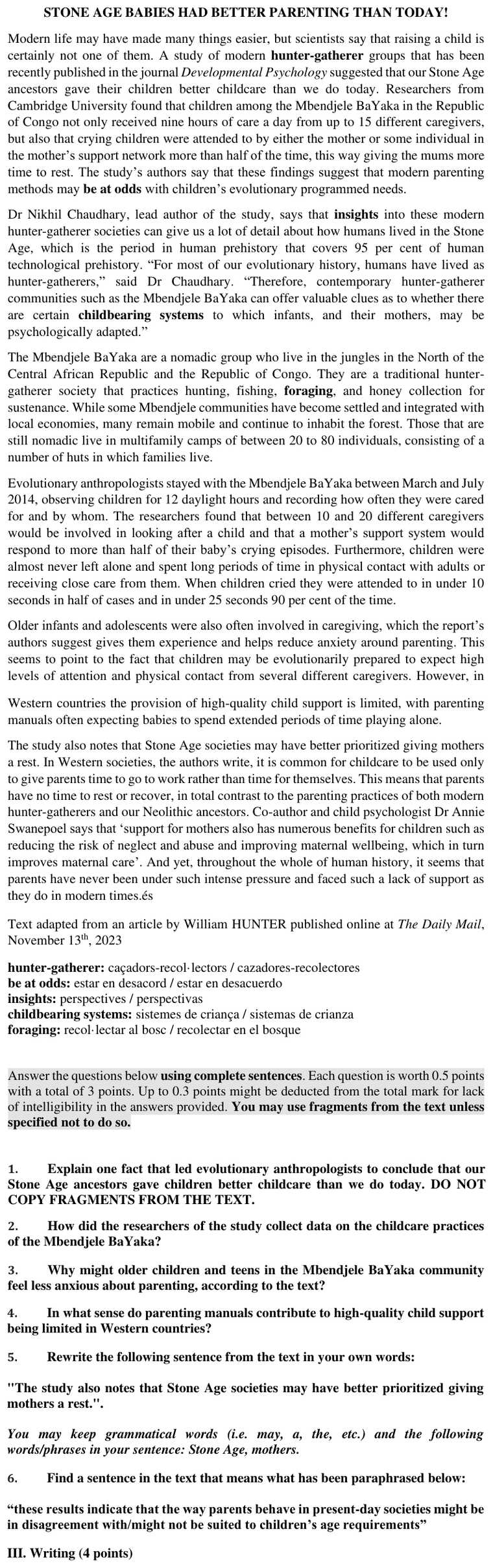
Modern life may have made many things easier, but scientists say that raising a child is certainly not one of them. A study of modern hunter-gatherer groups that has been recently published in the journal Developmental Psychology suggested that our Stone Age ancestors gave their children better childcare than we do today. Researchers from Cambridge University found that children among the Mbendjele BaYaka in the Republic of Congo not only received nine hours of care a day from up to 15 different caregivers, but also that crying children were attended to by either the mother or some individual in the mother’s support network more than half of the time, this way giving the mums more time to rest. The study’s authors say that these findings suggest that modern parenting methods may be at odds with children’s evolutionary programmed needs. Dr Nikhil Chaudhary, lead author of the study, says that insights into these modern hunter-gatherer societies can give us a lot of detail about how humans lived in the Stone Age, which is the period in human prehistory that covers 95 per cent of human technological prehistory. “For most of our evolutionary history, humans have lived as hunter-gatherers,” said Dr Chaudhary. “Therefore, contemporary hunter-gatherer communities such as the Mbendjele BaYaka can offer valuable clues as to whether there are certain childbearing systems to which infants, and their mothers, may be psychologically adapted.” The Mbendjele BaYaka are a nomadic group who live in the jungles in the North of the Central African Republic and the Republic of Congo. They are a traditional hunter-gatherer society that practices hunting, fishing, foraging, and honey collection for sustenance. While some Mbendjele communities have become settled and integrated with local economies, many remain mobile and continue to inhabit the forest. Those that are still nomadic live in multifamily camps of between 20 to 80 individuals, consisting of a number of huts in which families live. Evolutionary anthropologists stayed with the Mbendjele BaYaka between March and July 2014, observing children for 12 daylight hours and recording how often they were cared for and by whom. The researchers found that between 10 and 20 different caregivers would be involved in looking after a child and that a mother’s support system would respond to more than half of their baby’s crying episodes. Furthermore, children were almost never left alone and spent long periods of time in physical contact with adults or receiving close care from them. When children cried they were attended to in under 10 seconds in half of cases and in under 25 seconds 90 per cent of the time. Older infants and adolescents were also often involved in caregiving, which the report’s authors suggest gives them experience and helps reduce anxiety around parenting. This seems to point to the fact that children may be evolutionarily prepared to expect high levels of attention and physical contact from several different caregivers. However, in
Western countries the provision of high-quality child support is limited, with parenting manuals often expecting babies to spend extended periods of time playing alone. The study also notes that Stone Age societies may have better prioritized giving mothers a rest. In Western societies, the authors write, it is common for childcare to be used only to give parents time to go to work rather than time for themselves. This means that parents have no time to rest or recover, in total contrast to the parenting practices of both modern hunter-gatherers and our Neolithic ancestors. Co-author and child psychologist Dr Annie Swanepoel says that ‘support for mothers also has numerous benefits for children such as reducing the risk of neglect and abuse and improving maternal wellbeing, which in turn improves maternal care’. And yet, throughout the whole of human history, it seems that parents have never been under such intense pressure and faced such a lack of support as they do in modern times.és
Text adapted from an article by William HUNTER published online at The Daily Mail, November 13th, 2023
hunter-gatherer: caçadors-recol·lectors / cazadores-recolectores be at odds: estar en desacord / estar en desacuerdo insights: perspectives / perspectivas childbearing systems: sistemes de criança / sistemas de crianza foraging: recol·lectar al bosc / recolectar en el bosque
See the shared reading text and glossary in Part 2, question 1 (item 2.1).
Explain ONE fact that led evolutionary anthropologists to conclude that our Stone Age ancestors gave children better childcare than we do today. DO NOT COPY FRAGMENTS FROM THE TEXT.
How did the researchers of the study collect data on the childcare practices of the Mbendjele BaYaka?
Why might older children and teens in the Mbendjele BaYaka community feel less anxious about parenting, according to the text?
In what sense do parenting manuals contribute to high-quality child support being limited in Western countries?
Rewrite the following sentence from the text in your own words:
"The study also notes that Stone Age societies may have better prioritized giving mothers a rest.".
You may keep grammatical words (i.e. may, a, the, etc.) and the following words/phrases in your sentence: Stone Age, mothers.
Find a sentence in the text that means what has been paraphrased below:
“these results indicate that the way parents behave in present-day societies might be in disagreement with/might not be suited to children’s age requirements”
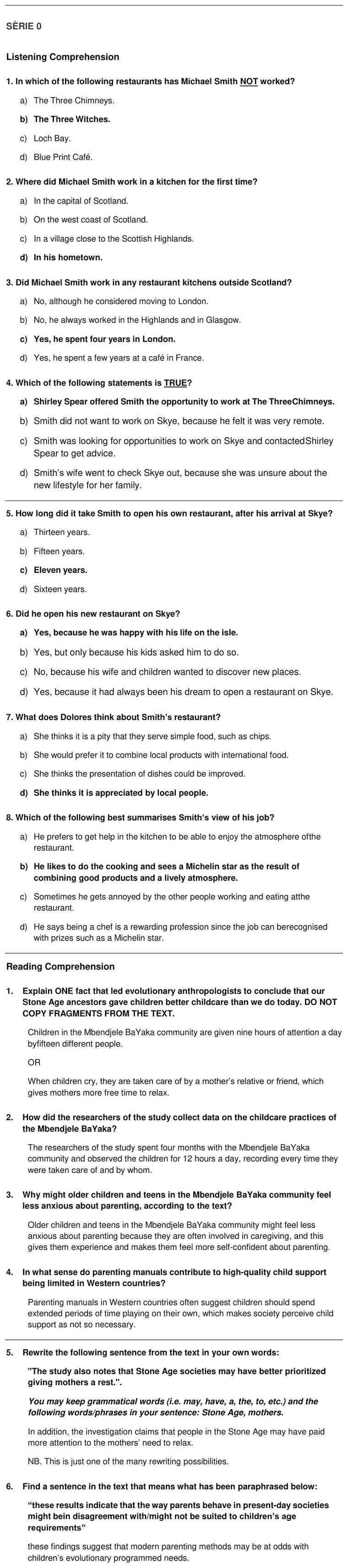
Tria un fet del primer paràgraf i explica’l amb paraules pròpies. Pots fixar-te en com es reparteix la cura o en com això permet que les mares descansin.
Among the Mbendjele BaYaka, children had someone looking after them for nine hours each day, with as many as fifteen people sharing that care.
O bé
When babies cried, people close to their mothers often stepped in, giving the mothers a chance to take a break.
+0,5criteri 1 de la pauta- Nota d’OriginalEl primer paràgraf diu «up to 15». L’expressió «as many as fifteen» conserva aquest màxim.
 Toca per ampliar
- 0,5 pSense desglossament: explicar amb paraules pròpies UN dels dos fets acceptats: els infants reben nou hores d’atenció al dia de quinze persones diferents; O bé, quan ploren, un familiar o amic de la mare els atén i permet que ella descansi.
Separa la durada de l’estada de les hores d’observació i indica què anotaven els investigadors.
The researchers spent about four months with the Mbendjele BaYaka community, from March to July 2014. They observed the children over twelve daylight hours, recording each time they received care and who provided it.
+0,5criteri 1 de la pauta- Nota d’OriginalLa pauta diu «12 hours a day». El text de l’examen parla de dotze hores diürnes, que l’estudi reparteix en tres franges de quatre hores en dies diferents, amb pauses.
Toca per ampliar- 0,5 pSense desglossament: indicar que els investigadors van passar quatre mesos amb la comunitat, van observar els infants dotze hores al dia i van registrar cada vegada que rebien atenció i qui els atenia.
Relaciona l’ajuda que donen els joves amb la confiança que poden guanyar abans de tenir fills.
Older children and teenagers often help look after younger children. This experience can make them more confident about becoming parents and ease their worries.
+0,5criteri 1 de la pauta
Toca per ampliar- 0,5 pSense desglossament: explicar que participar sovint en la cura dels infants els dona experiència i més confiança en les seves capacitats com a futurs pares i mares, i redueix l’ansietat.
Explica com la recomanació de jugar sols pot fer que es vegi com a menys necessari el suport a la criança.
Western parenting manuals often recommend that children play on their own for long periods. This can make people think that support for childcare is less necessary.
+0,5criteri 1 de la pauta
Toca per ampliar- 0,5 pSense desglossament: explicar que els manuals recomanen que els infants passin períodes llargs jugant sols, cosa que fa que la societat percebi el suport a la criança com a menys necessari.
Conserva la idea que és una possibilitat i reformula quina importància donaven al descans de les mares. Pots mantenir «Stone Age», «mothers» i els mots gramaticals.
In addition, the investigation claims that people in the Stone Age may have paid more attention to the mothers’ need to relax.
+0,5criteri 1 de la pauta
Toca per ampliar- 0,5 pSense desglossament: reformular la idea que les societats de l’edat de pedra potser donaven més importància al descans de les mares, amb paraules pròpies i respectant els mots que es poden conservar. Exemple oficial: «In addition, the investigation claims that people in the Stone Age may have paid more attention to the mothers’ need to relax.» El PDF admet expressament altres reformulacions.
La pista és «be at odds with», que expressa que dues coses no encaixen. Copia la frase del primer paràgraf que relaciona els mètodes actuals de criança amb les necessitats dels infants.
The study’s authors say that these findings suggest that modern parenting methods may be at odds with children’s evolutionary programmed needs.
+0,5criteri 1 de la pauta- Nota d’OriginalLa pregunta parla de necessitats associades a l’edat. A la frase del text, «evolutionary programmed needs» fa referència a necessitats que els autors relacionen amb l’evolució.
Toca per ampliar- 0,5 pSense desglossament: localitzar el fragment acceptat pel solucionari: «these findings suggest that modern parenting methods may be at odds with children’s evolutionary programmed needs.»