PAU 2026
 Toca per ampliar
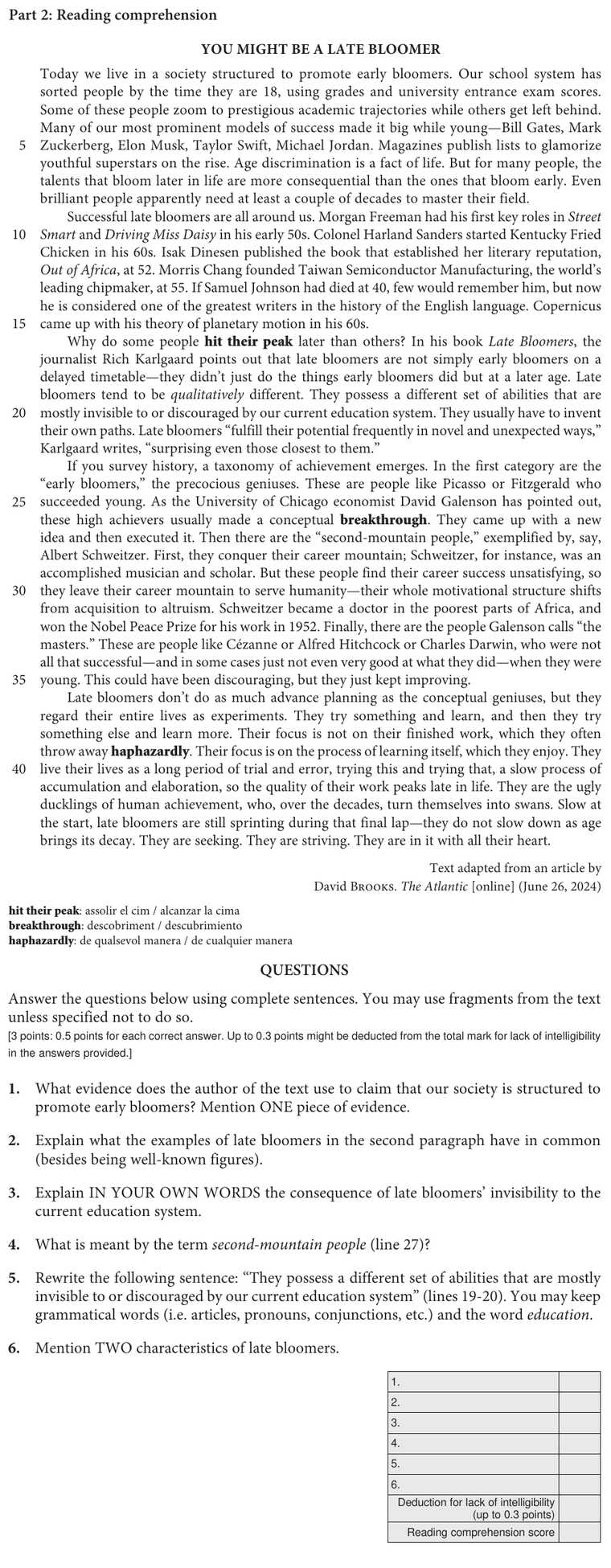
YOU MIGHT BE A LATE BLOOMER Today we live in a society structured to promote early bloomers. Our school system has sorted people by the time they are 18, using grades and university entrance exam scores. Some of these people zoom to prestigious academic trajectories while others get left behind. Many of our most prominent models of success made it big while young—Bill Gates, Mark Zuckerberg, Elon Musk, Taylor Swift, Michael Jordan. Magazines publish lists to glamorize youthful superstars on the rise. Age discrimination is a fact of life. But for many people, the talents that bloom later in life are more consequential than the ones that bloom early. Even brilliant people apparently need at least a couple of decades to master their field. Successful late bloomers are all around us. Morgan Freeman had his first key roles in Street Smart and Driving Miss Daisy in his early 50s. Colonel Harland Sanders started Kentucky Fried Chicken in his 60s. Isak Dinesen published the book that established her literary reputation, Out of Africa, at 52. Morris Chang founded Taiwan Semiconductor Manufacturing, the world’s leading chipmaker, at 55. If Samuel Johnson had died at 40, few would remember him, but now he is considered one of the greatest writers in the history of the English language. Copernicus came up with his theory of planetary motion in his 60s. Why do some people hit their peak later than others? In his book Late Bloomers, the journalist Rich Karlgaard points out that late bloomers are not simply early bloomers on a delayed timetable—they didn’t just do the things early bloomers did but at a later age. Late bloomers tend to be qualitatively different. They possess a different set of abilities that are mostly invisible to or discouraged by our current education system. They usually have to invent their own paths. Late bloomers “fulfill their potential frequently in novel and unexpected ways,” Karlgaard writes, “surprising even those closest to them.” If you survey history, a taxonomy of achievement emerges. In the first category are the “early bloomers,” the precocious geniuses. These are people like Picasso or Fitzgerald who succeeded young. As the University of Chicago economist David Galenson has pointed out, these high achievers usually made a conceptual breakthrough. They came up with a new idea and then executed it. Then there are the “second-mountain people,” exemplified by, say, Albert Schweitzer. First, they conquer their career mountain; Schweitzer, for instance, was an accomplished musician and scholar. But these people find their career success unsatisfying, so they leave their career mountain to serve humanity—their whole motivational structure shifts from acquisition to altruism. Schweitzer became a doctor in the poorest parts of Africa, and won the Nobel Peace Prize for his work in 1952. Finally, there are the people Galenson calls “the masters.” These are people like Cézanne or Alfred Hitchcock or Charles Darwin, who were not all that successful—and in some cases just not even very good at what they did—when they were young. This could have been discouraging, but they just kept improving. Late bloomers don’t do as much advance planning as the conceptual geniuses, but they regard their entire lives as experiments. They try something and learn, and then they try something else and learn more. Their focus is not on their finished work, which they often throw away haphazardly. Their focus is on the process of learning itself, which they enjoy. They live their lives as a long period of trial and error, trying this and trying that, a slow process of accumulation and elaboration, so the quality of their work peaks late in life. They are the ugly ducklings of human achievement, who, over the decades, turn themselves into swans. Slow at the start, late bloomers are still sprinting during that final lap—they do not slow down as age brings its decay. They are seeking. They are striving. They are in it with all their heart. Text adapted from an article by David Brooks. The Atlantic [online] (June 26, 2024) hit their peak: assolir el cim / alcanzar la cima breakthrough: descobriment / descubrimiento haphazardly: de qualsevol manera / de cualquier manera
See the shared reading text and glossary in Part 2, question 1 (item 2.1).
What evidence does the author of the text use to claim that our society is structured to promote early bloomers? Mention ONE piece of evidence.
Explain what the examples of late bloomers in the second paragraph have in common (besides being well-known figures).
Explain IN YOUR OWN WORDS the consequence of late bloomers’ invisibility to the current education system.
What is meant by the term second-mountain people (line 27)?
Rewrite the following sentence: “They possess a different set of abilities that are mostly invisible to or discouraged by our current education system” (lines 19-20). You may keep grammatical words (i.e. articles, pronouns, conjunctions, etc.) and the word education.
Mention TWO characteristics of late bloomers.
Tria una sola prova del primer paràgraf, com ara el paper del sistema escolar.
Les notes i els resultats de les proves d’accés ja condicionen la trajectòria acadèmica dels estudiants quan tenen divuit anys.
Our school system sorts people by the time they are eighteen using grades and university entrance exam scores.
+0,5criteri 1 de la pauta- Nota d’OriginalSi dones més d’un exemple, la pauta redueix la puntuació d’aquesta pregunta a 0,25 punts.
 Toca per ampliar
- 0,5 pEsmentar exactament UNA evidència: el sistema escolar classifica als 18 anys; molts models d’èxit triomfen joves; o les revistes publiquen llistes de joves estrelles. (0.5 punts).Penalització: Si s’esmenta més d’una evidència, la pregunta val 0.25 punts (deducció de 0.25).
Compara en quin moment de la vida aquestes persones van aconseguir els èxits que cita el text.
Per exemple, Morgan Freeman va tenir els seus primers papers importants passats els cinquanta i Morris Chang va fundar la seva empresa de semiconductors als cinquanta-cinc.
They all became successful relatively late in life.
+0,5criteri 1 de la pauta
Toca per ampliar- 0,5 pResposta admesa, sense desglossament de punts dins la pregunta: They are all people who became successful late in life.
Explica amb paraules teves com progressen quan el sistema educatiu passa per alt el seu talent.
Al tercer paràgraf, l’autor explica que el poc reconeixement dels seus talents els porta a buscar vies poc habituals per tirar endavant.
Since schools tend to miss what these people are good at, they often have to take an unusual route to succeed.
+0,5criteri 1 de la pauta
Toca per ampliar- 0,5 pResposta admesa, sense desglossament de punts dins la pregunta: Late bloomers accomplish success/live their lives/succeed in life/make progress (…) in ways that are different from the usual ones.
Explica què representa cadascuna de les dues muntanyes en la vida d’aquestes persones.
La primera és l’èxit a la feina. Quan aquest èxit els deixa insatisfets, abandonen la carrera per dedicar-se als altres.
Second-mountain people first achieve career success but find it unsatisfying, so they leave their careers to serve humanity.
+0,5criteri 1 de la pauta- Nota d’OriginalSegons la guia d’exemples, dir només que triomfen al principi o que canvien de carrera val 0,25 punts. Per obtenir el mig punt, lliga l’èxit inicial, la insatisfacció i la decisió de dedicar-se als altres.
Toca per ampliar- 0,5 pResposta admesa, sense desglossament de punts dins la pregunta: Second-mountain people conquer their career mountain first/succeed early in life but find their success unsatisfying and they leave their careers to serve humanity. Ampliació oficial publicada el 2027 (bandes alternatives, no acumulables): 0.5: resposta correcta amb tota la informació rellevant; es pot copiar del text o reformular. 0.25: resposta parcialment correcta, manca d’informació rellevant o informació sobrera. 0: resposta incorrecta.Penalització: 0.25 punts en total si la resposta és parcial, incompleta o conté més informació de la necessària; 0 si és incorrecta.Nota de la pauta: Exemples oficials de resposta parcial (0.25): «Second-mountain people succeed early in life.»; «Second-mountain people change their careers later on.»; «Second-mountain people do not like their careers.» Exemple oficial incorrecte (0): «Second-mountain people feel invisible.»
Reformula tant el tipus de talent que tenen com la manera en què el tracta el sistema educatiu.
Pots conservar els mots gramaticals i «education». «Go unrecognised» expressa que aquests talents passen desapercebuts i «meet with disapproval» indica que es veuen amb mals ulls.
Their distinctive talents tend to go unrecognised or meet with disapproval in today’s education framework.
+0,5criteri 1 de la pauta- Nota d’OriginalSegons la guia d’exemples, una paràfrasi correcta amb un o dos mots no permesos, o una de parcialment correcta, val 0,25 punts. Amb més de dos mots no permesos o una resposta incorrecta, la puntuació és 0.
Toca per ampliar- 0,5 pResposta admesa, sense desglossament de punts dins la pregunta: They have distinct characteristics that are not considered/seen/taken into account/encouraged by the present-day education authorities/laws. (among other options) Ampliació oficial publicada el 2027 (bandes alternatives, no acumulables): 0.5: paràfrasi correcta sense mots no permesos. 0.25: paràfrasi correcta que reutilitza un o dos mots no permesos del text i/o paràfrasi parcialment correcta. 0: paràfrasi correcta que reutilitza més de dos mots no permesos i/o paràfrasi incorrecta.Penalització: La pregunta queda en 0.25 punts si es reutilitzen un o dos mots no permesos i/o la paràfrasi és parcialment correcta; queda en 0 si es reutilitzen més de dos mots no permesos i/o és incorrecta. No és una deducció addicional per cada error.Nota de la pauta: Exemples oficials de 0.25: «They have different characteristics that are not considered by the current education authorities.»; «They have different educational characteristics.» Exemples oficials de 0: «They have different characteristics that are invisible to the current education system.»; «The abilities by our education system are invisible.»
Tria exactament dos trets de l’últim paràgraf i posa’ls en una frase completa.
El text explica que els «late bloomers» van provant coses noves i que gaudeixen mentre aprenen.
Late bloomers treat their lives as experiments and enjoy the process of learning.
+0,5criteri 1 de la pauta- Nota d’OriginalLa pauta dona 0,25 punts si esmentes un sol tret o si n’esmentes més de dos. Si tries el tret de la planificació, el text diu que planifiquen menys que els genis conceptuals.
Toca per ampliar- 0,5 pCriteri únic de 0.5 punts, sense desglossament: esmentar exactament DUES característiques. Alternatives de la pauta oficial (text conservat): Any TWO of the following: - Late bloomers do not plan ahead. - They regard their lives as experiments. - They focus on the process of learning. - They enjoy the process of learning. - They live their lives as a long period of trial and error. - They are slow at the start but fast as they age.Penalització: (If they mention one, 0.25. If they mention more than two, 0.25).