PAU 2019
 Toca per ampliar
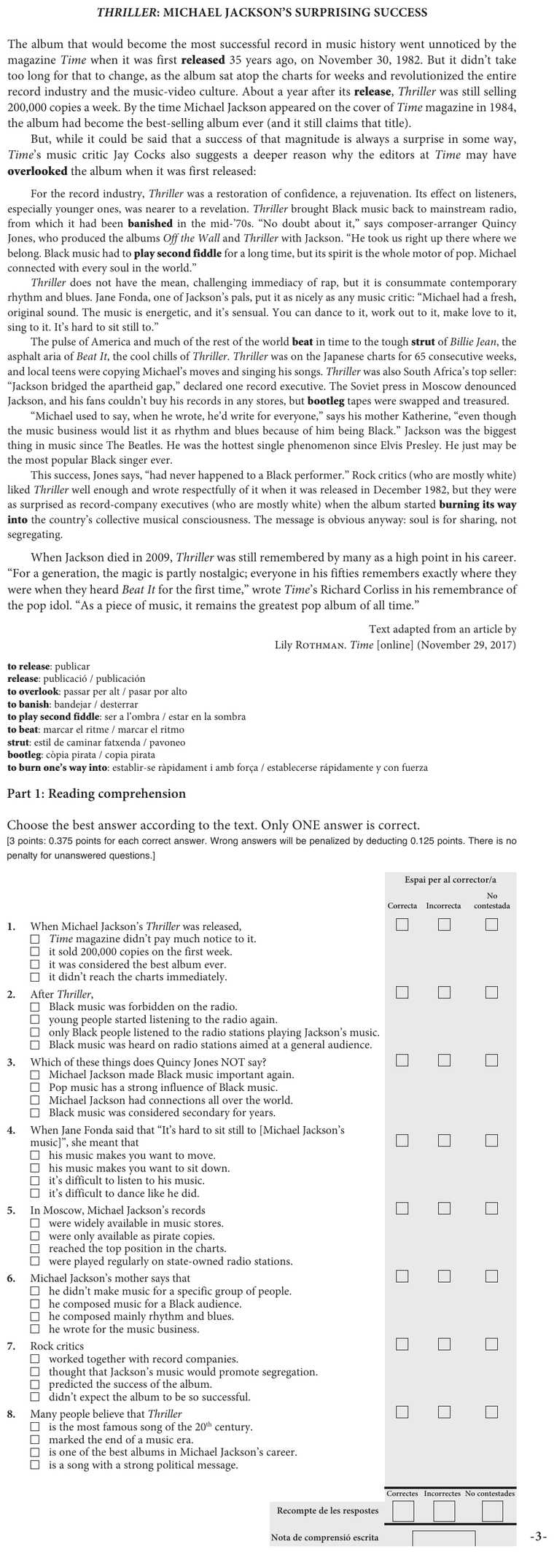
THRILLER: MICHAEL JACKSON’S SURPRISING SUCCESS
The album that would become the most successful record in music history went unnoticed by the
magazine Time when it was first released 35 years ago, on November 30, 1982. But it didn’t take
too long for that to change, as the album sat atop the charts for weeks and revolutionized the entire
record industry and the music-video culture. About a year after its release, Thriller was still selling
200,000 copies a week. By the time Michael Jackson appeared on the cover of Time magazine in 1984,
the album had become the best-selling album ever (and it still claims that title).
But, while it could be said that a success of that magnitude is always a surprise in some way,
Time’s music critic Jay Cocks also suggests a deeper reason why the editors at Time may have
overlooked the album when it was first released:
For the record industry, Thriller was a restoration of confidence, a rejuvenation. Its effect on listeners,
especially younger ones, was nearer to a revelation. Thriller brought Black music back to mainstream radio,
from which it had been banished in the mid-’70s. “No doubt about it,” says composer-arranger Quincy
Jones, who produced the albums Off the Wall and Thriller with Jackson. “He took us right up there where we
belong. Black music had to play second fiddle for a long time, but its spirit is the whole motor of pop. Michael
connected with every soul in the world.”
Thriller does not have the mean, challenging immediacy of rap, but it is consummate contemporary
rhythm and blues. Jane Fonda, one of Jackson’s pals, put it as nicely as any music critic: “Michael had a fresh,
original sound. The music is energetic, and it’s sensual. You can dance to it, work out to it, make love to it,
sing to it. It’s hard to sit still to.”
The pulse of America and much of the rest of the world beat in time to the tough strut of Billie Jean, the
asphalt aria of Beat It, the cool chills of Thriller. Thriller was on the Japanese charts for 65 consecutive weeks,
and local teens were copying Michael’s moves and singing his songs. Thriller was also South Africa’s top seller:
“Jackson bridged the apartheid gap,” declared one record executive. The Soviet press in Moscow denounced
Jackson, and his fans couldn’t buy his records in any stores, but bootleg tapes were swapped and treasured.
“Michael used to say, when he wrote, he’d write for everyone,” says his mother Katherine, “even though
the music business would list it as rhythm and blues because of him being Black.” Jackson was the biggest
thing in music since The Beatles. He was the hottest single phenomenon since Elvis Presley. He just may be
the most popular Black singer ever.
This success, Jones says, “had never happened to a Black performer.” Rock critics (who are mostly white)
liked Thriller well enough and wrote respectfully of it when it was released in December 1982, but they were
as surprised as record-company executives (who are mostly white) when the album started burning its way
into the country’s collective musical consciousness. The message is obvious anyway: soul is for sharing, not
segregating.
When Jackson died in 2009, Thriller was still remembered by many as a high point in his career.
“For a generation, the magic is partly nostalgic; everyone in his fifties remembers exactly where they
were when they heard Beat It for the first time,” wrote Time’s Richard Corliss in his remembrance of
the pop idol. “As a piece of music, it remains the greatest pop album of all time.”
Text adapted from an article by
Lily Rothman. Time [online] (November 29, 2017)
to release: publicar
release: publicació / publicación
to overlook: passar per alt / pasar por alto
to banish: bandejar / desterrar
to play second fiddle: ser a l’ombra / estar en la sombra
to beat: marcar el ritme / marcar el ritmo
strut: estil de caminar fatxenda / pavoneo
bootleg: còpia pirata / copia pirata
to burn one’s way into: establir-se ràpidament i amb força / establecerse rápidamente y con fuerza
Vegeu el text de lectura de la pregunta 1 de Part 1.
1. When Michael Jackson’s Thriller was released,
Time magazine didn’t pay much notice to it.
it sold 200,000 copies on the first week.
it was considered the best album ever.
it didn’t reach the charts immediately.
2. After Thriller,
Black music was forbidden on the radio.
young people started listening to the radio again.
only Black people listened to the radio stations playing Jackson’s music.
Black music was heard on radio stations aimed at a general audience.
3. Which of these things does Quincy Jones NOT say?
Michael Jackson made Black music important again.
Pop music has a strong influence of Black music.
Michael Jackson had connections all over the world.
Black music was considered secondary for years.
4. When Jane Fonda said that “It’s hard to sit still to [Michael Jackson’s
music]”, she meant that
his music makes you want to move.
his music makes you want to sit down.
it’s difficult to listen to his music.
it’s difficult to dance like he did.
5. In Moscow, Michael Jackson’s records
were widely available in music stores.
were only available as pirate copies.
reached the top position in the charts.
were played regularly on state-owned radio stations.
6. Michael Jackson’s mother says that
he didn’t make music for a specific group of people.
he composed music for a Black audience.
he composed mainly rhythm and blues.
he wrote for the music business.
7. Rock critics
worked together with record companies.
thought that Jackson’s music would promote segregation.
predicted the success of the album.
didn’t expect the album to be so successful.
8. Many people believe that Thriller
is the most famous song of the 20th century.
marked the end of a music era.
is one of the best albums in Michael Jackson’s career.
is a song with a strong political message.
 Toca per ampliar
- 0,375 pSeleccionar la resposta de la clau oficial: Time magazine didn’t pay much notice to it.Penalització: Resposta incorrecta: −0,125 punts. Resposta en blanc: cap penalització.
Toca per ampliar- 0,375 pSeleccionar la resposta de la clau oficial: Black music was heard on radio stations aimed at a general audience.Penalització: Resposta incorrecta: −0,125 punts. Resposta en blanc: cap penalització.
Toca per ampliar- 0,375 pSeleccionar la resposta de la clau oficial: Michael Jackson had connections all over the world.Penalització: Resposta incorrecta: −0,125 punts. Resposta en blanc: cap penalització.
Toca per ampliar- 0,375 pSeleccionar la resposta de la clau oficial: his music makes you want to move.Penalització: Resposta incorrecta: −0,125 punts. Resposta en blanc: cap penalització.
Toca per ampliar- 0,375 pSeleccionar la resposta de la clau oficial: were only available as pirate copies.Penalització: Resposta incorrecta: −0,125 punts. Resposta en blanc: cap penalització.
Toca per ampliar- 0,375 pSeleccionar la resposta de la clau oficial: he didn’t make music for a specific group of people.Penalització: Resposta incorrecta: −0,125 punts. Resposta en blanc: cap penalització.
Toca per ampliar- 0,375 pSeleccionar la resposta de la clau oficial: didn’t expect the album to be so successful.Penalització: Resposta incorrecta: −0,125 punts. Resposta en blanc: cap penalització.
Toca per ampliar- 0,375 pSeleccionar la resposta de la clau oficial: is one of the best albums in Michael Jackson’s career.Penalització: Resposta incorrecta: −0,125 punts. Resposta en blanc: cap penalització.