PAU 2023
 Toca per ampliar
HOW GLOBAL CLIMATE TARGETS ARE SET AND WHAT THEY MEAN
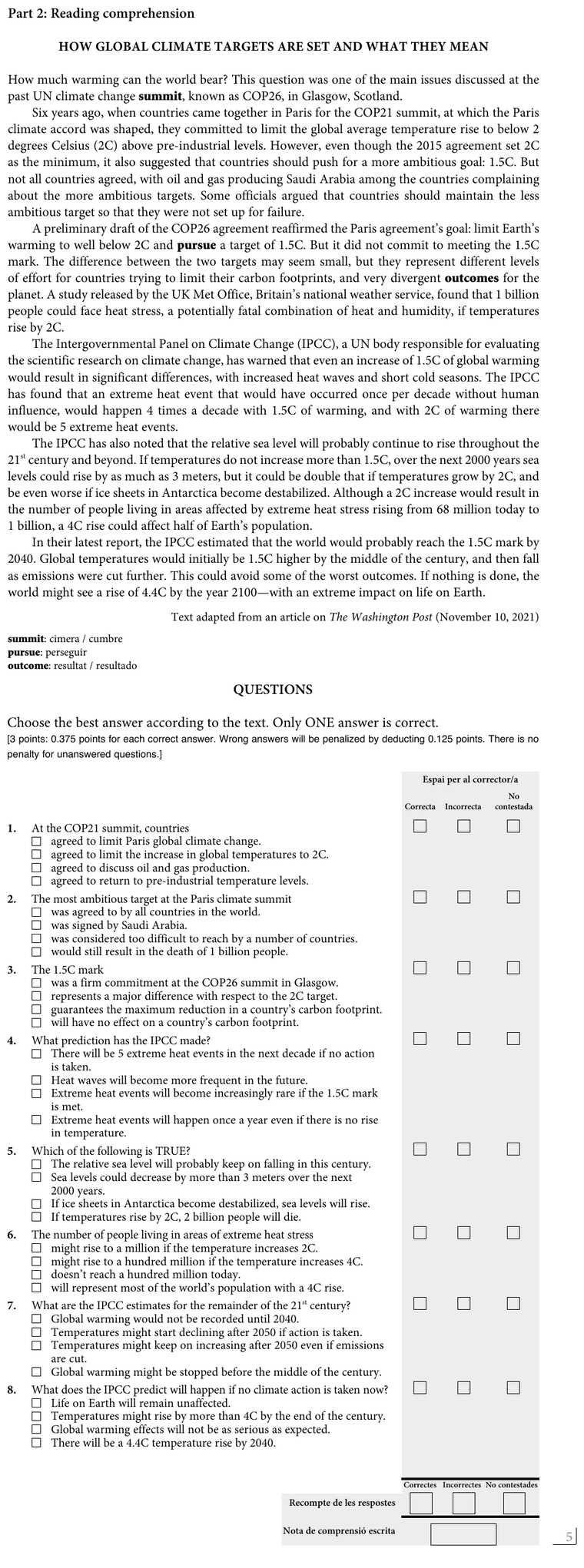
How much warming can the world bear? This question was one of the main issues discussed at the past UN climate change summit, known as COP26, in Glasgow, Scotland. Six years ago, when countries came together in Paris for the COP21 summit, at which the Paris climate accord was shaped, they committed to limit the global average temperature rise to below 2 degrees Celsius (2C) above pre-industrial levels. However, even though the 2015 agreement set 2C as the minimum, it also suggested that countries should push for a more ambitious goal: 1.5C. But not all countries agreed, with oil and gas producing Saudi Arabia among the countries complaining about the more ambitious targets. Some officials argued that countries should maintain the less ambitious target so that they were not set up for failure. A preliminary draft of the COP26 agreement reaffirmed the Paris agreement’s goal: limit Earth’s warming to well below 2C and pursue a target of 1.5C. But it did not commit to meeting the 1.5C mark. The difference between the two targets may seem small, but they represent different levels of effort for countries trying to limit their carbon footprints, and very divergent outcomes for the planet. A study released by the UK Met Office, Britain’s national weather service, found that 1 billion people could face heat stress, a potentially fatal combination of heat and humidity, if temperatures rise by 2C. The Intergovernmental Panel on Climate Change (IPCC), a UN body responsible for evaluating the scientific research on climate change, has warned that even an increase of 1.5C of global warming would result in significant differences, with increased heat waves and short cold seasons. The IPCC has found that an extreme heat event that would have occurred once per decade without human influence, would happen 4 times a decade with 1.5C of warming, and with 2C of warming there would be 5 extreme heat events. The IPCC has also noted that the relative sea level will probably continue to rise throughout the 21st century and beyond. If temperatures do not increase more than 1.5C, over the next 2000 years sea
levels could rise by as much as 3 meters, but it could be double that if temperatures grow by 2C, and be even worse if ice sheets in Antarctica become destabilized. Although a 2C increase would result in the number of people living in areas affected by extreme heat stress rising from 68 million today to 1 billion, a 4C rise could affect half of Earth’s population. In their latest report, the IPCC estimated that the world would probably reach the 1.5C mark by 2040. Global temperatures would initially be 1.5C higher by the middle of the century, and then fall as emissions were cut further. This could avoid some of the worst outcomes. If nothing is done, the world might see a rise of 4.4C by the year 2100—with an extreme impact on life on Earth. Text adapted from an article on The Washington Post (November 10, 2021) summit: cimera / cumbre pursue: perseguir outcome: resultat / resultado
See the shared reading text and glossary in Part 2, question 1 (item 2.1).
At the COP21 summit, countries
agreed to limit Paris global climate change.
agreed to limit the increase in global temperatures to 2C.
agreed to discuss oil and gas production.
agreed to return to pre-industrial temperature levels.
The most ambitious target at the Paris climate summit
was agreed to by all countries in the world.
was signed by Saudi Arabia.
was considered too difficult to reach by a number of countries.
would still result in the death of 1 billion people.
The 1.5C mark
was a firm commitment at the COP26 summit in Glasgow.
represents a major difference with respect to the 2C target.
guarantees the maximum reduction in a country’s carbon footprint.
will have no effect on a country’s carbon footprint.
What prediction has the IPCC made?
There will be 5 extreme heat events in the next decade if no action
is taken.
Heat waves will become more frequent in the future.
Extreme heat events will become increasingly rare if the 1.5C mark
is met.
Extreme heat events will happen once a year even if there is no rise
in temperature.
Which of the following is TRUE?
The relative sea level will probably keep on falling in this century.
Sea levels could decrease by more than 3 meters over the next
2000 years.
If ice sheets in Antarctica become destabilized, sea levels will rise.
If temperatures rise by 2C, 2 billion people will die.
The number of people living in areas of extreme heat stress
might rise to a million if the temperature increases 2C.
might rise to a hundred million if the temperature increases 4C.
doesn’t reach a hundred million today.
will represent most of the world’s population with a 4C rise.
What are the IPCC estimates for the remainder of the 21st century?
Global warming would not be recorded until 2040.
Temperatures might start declining after 2050 if action is taken.
Temperatures might keep on increasing after 2050 even if emissions
are cut.
Global warming might be stopped before the middle of the century.
What does the IPCC predict will happen if no climate action is taken now?
Life on Earth will remain unaffected.
Temperatures might rise by more than 4C by the end of the century.
Global warming effects will not be as serious as expected.
There will be a 4.4C temperature rise by 2040.
Recupera el compromís que es va adoptar a la cimera de París del 2015. Es tractava de limitar l’augment de la temperatura mitjana global per sota dels 2 °C respecte dels nivells preindustrials.
agreed to limit the increase in global temperatures to 2C.
+0,375criteri 1 de la pauta
 Toca per ampliar
- 0,375 pSeleccionar la resposta de la clau oficial: agreed to limit the increase in global temperatures to 2C.Penalització: Resposta incorrecta: −0.125 punts; pregunta no contestada: sense penalització.
Busca com van reaccionar alguns països davant l’objectiu d’1,5 °C. El text explica que alguns responsables preferien mantenir el llindar menys ambiciós per evitar comprometre’s amb una fita que veien difícil d’assolir.
was considered too difficult to reach by a number of countries.
+0,375criteri 1 de la pauta
Toca per ampliar- 0,375 pSeleccionar la resposta de la clau oficial: was considered too difficult to reach by a number of countries.Penalització: Resposta incorrecta: −0.125 punts; pregunta no contestada: sense penalització.
Compara què implica limitar l’escalfament a 1,5 °C o a 2 °C. Segons el text, aquest mig grau canvia l’esforç necessari per reduir la petjada de carboni i té conseqüències molt diferents per al planeta.
represents a major difference with respect to the 2C target.
+0,375criteri 1 de la pauta
Toca per ampliar- 0,375 pSeleccionar la resposta de la clau oficial: represents a major difference with respect to the 2C target.Penalització: Resposta incorrecta: −0.125 punts; pregunta no contestada: sense penalització.
Fixa’t en com canvia la freqüència de la calor extrema. Segons l’IPCC, un episodi que passaria un cop per dècada sense influència humana es repetiria quatre cops per dècada amb 1,5 °C d’escalfament.
Heat waves will become more frequent in the future.
+0,375criteri 1 de la pauta
Toca per ampliar- 0,375 pSeleccionar la resposta de la clau oficial: Heat waves will become more frequent in the future.Penalització: Resposta incorrecta: −0.125 punts; pregunta no contestada: sense penalització.
Segueix la condició que posa el text sobre el gel antàrtic. La pujada prevista del nivell del mar podria ser encara més gran si es desestabilitzen les capes de gel de l’Antàrtida.
If ice sheets in Antarctica become destabilized, sea levels will rise.
+0,375criteri 1 de la pauta
Toca per ampliar- 0,375 pSeleccionar la resposta de la clau oficial: If ice sheets in Antarctica become destabilized, sea levels will rise.Penalització: Resposta incorrecta: −0.125 punts; pregunta no contestada: sense penalització.
Pren la xifra que el text dona per al moment en què es va escriure. Llavors, 68 milions de persones vivien en zones d’estrès tèrmic extrem, per sota dels 100 milions.
doesn’t reach a hundred million today.
+0,375criteri 1 de la pauta
Toca per ampliar- 0,375 pSeleccionar la resposta de la clau oficial: doesn’t reach a hundred million today.Penalització: Resposta incorrecta: −0.125 punts; pregunta no contestada: sense penalització.
Segueix les dues fases de la projecció de l’IPCC. Cap a mitjan segle la temperatura seria 1,5 °C més alta que en l’època preindustrial i, si les emissions es continuessin reduint, després podria baixar.
Temperatures might start declining after 2050 if action is taken.
+0,375criteri 1 de la pauta
Toca per ampliar- 0,375 pSeleccionar la resposta de la clau oficial: Temperatures might start declining after 2050 if action is taken.Penalització: Resposta incorrecta: −0.125 punts; pregunta no contestada: sense penalització.
Llegeix l’última projecció, la que correspon a l’escenari d’inacció. El text indica que l’escalfament podria arribar als 4,4 °C l’any 2100.
Temperatures might rise by more than 4C by the end of the century.
+0,375criteri 1 de la pauta
Toca per ampliar- 0,375 pSeleccionar la resposta de la clau oficial: Temperatures might rise by more than 4C by the end of the century.Penalització: Resposta incorrecta: −0.125 punts; pregunta no contestada: sense penalització.