PAU 2021
 Toca per ampliar
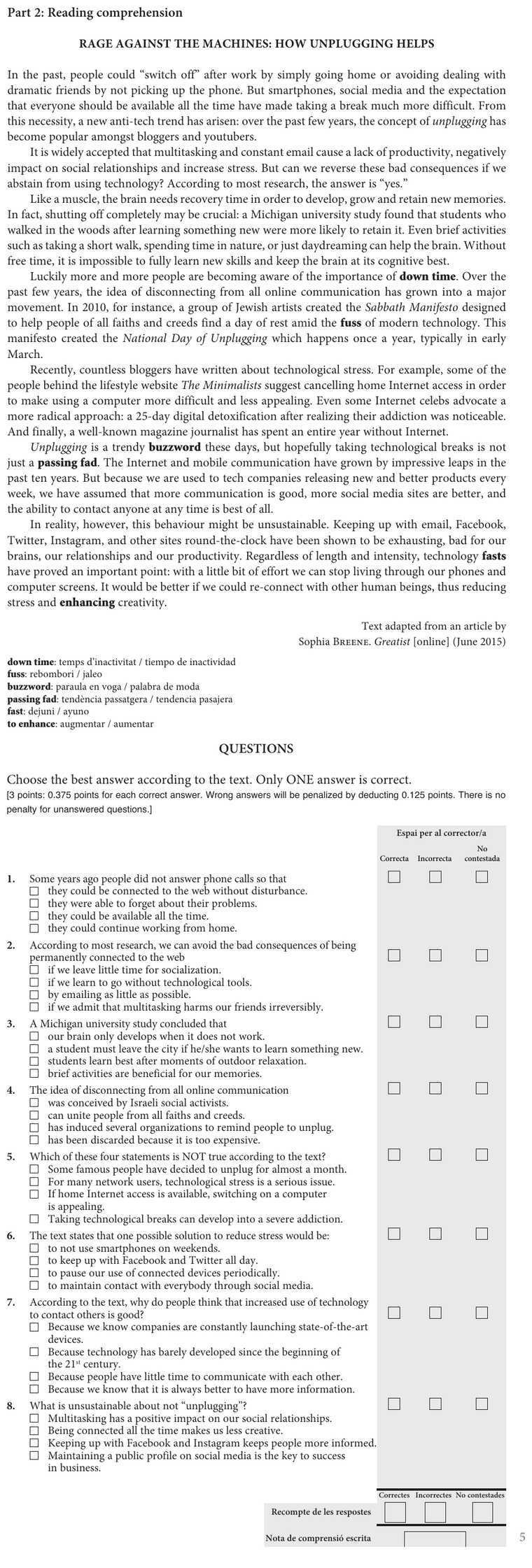
RAGE AGAINST THE MACHINES: HOW UNPLUGGING HELPS
In the past, people could “switch off” after work by simply going home or avoiding dealing with
dramatic friends by not picking up the phone. But smartphones, social media and the expectation
that everyone should be available all the time have made taking a break much more difficult. From
this necessity, a new anti-tech trend has arisen: over the past few years, the concept of unplugging has
become popular amongst bloggers and youtubers.
It is widely accepted that multitasking and constant email cause a lack of productivity, negatively
impact on social relationships and increase stress. But can we reverse these bad consequences if we
abstain from using technology? According to most research, the answer is “yes.”
Like a muscle, the brain needs recovery time in order to develop, grow and retain new memories.
In fact, shutting off completely may be crucial: a Michigan university study found that students who
walked in the woods after learning something new were more likely to retain it. Even brief activities
such as taking a short walk, spending time in nature, or just daydreaming can help the brain. Without
free time, it is impossible to fully learn new skills and keep the brain at its cognitive best.
Luckily more and more people are becoming aware of the importance of down time. Over the
past few years, the idea of disconnecting from all online communication has grown into a major
movement. In 2010, for instance, a group of Jewish artists created the Sabbath Manifesto designed
to help people of all faiths and creeds find a day of rest amid the fuss of modern technology. This
manifesto created the National Day of Unplugging which happens once a year, typically in early
March.
Recently, countless bloggers have written about technological stress. For example, some of the
people behind the lifestyle website The Minimalists suggest cancelling home Internet access in order
to make using a computer more difficult and less appealing. Even some Internet celebs advocate a
more radical approach: a 25-day digital detoxification after realizing their addiction was noticeable.
And finally, a well-known magazine journalist has spent an entire year without Internet.
Unplugging is a trendy buzzword these days, but hopefully taking technological breaks is not
just a passing fad. The Internet and mobile communication have grown by impressive leaps in the
past ten years. But because we are used to tech companies releasing new and better products every
week, we have assumed that more communication is good, more social media sites are better, and
the ability to contact anyone at any time is best of all.
In reality, however, this behaviour might be unsustainable. Keeping up with email, Facebook,
Twitter, Instagram, and other sites round-the-clock have been shown to be exhausting, bad for our
brains, our relationships and our productivity. Regardless of length and intensity, technology fasts
have proved an important point: with a little bit of effort we can stop living through our phones and
computer screens. It would be better if we could re-connect with other human beings, thus reducing
stress and enhancing creativity.
Text adapted from an article by
Sophia Breene. Greatist [online] (June 2015)
down time: temps d’inactivitat / tiempo de inactividad
fuss: rebombori / jaleo
buzzword: paraula en voga / palabra de moda
passing fad: tendència passatgera / tendencia pasajera
fast: dejuni / ayuno
to enhance: augmentar / aumentar
Vegeu el text de lectura de la pregunta 1 de Part 2.
1. Some years ago people did not answer phone calls so that
they could be connected to the web without disturbance.
they were able to forget about their problems.
they could be available all the time.
they could continue working from home.
2. According to most research, we can avoid the bad consequences of being
permanently connected to the web
if we leave little time for socialization.
if we learn to go without technological tools.
by emailing as little as possible.
if we admit that multitasking harms our friends irreversibly.
3. A Michigan university study concluded that
our brain only develops when it does not work.
a student must leave the city if he/she wants to learn something new.
students learn best after moments of outdoor relaxation.
brief activities are beneficial for our memories.
4. The idea of disconnecting from all online communication
was conceived by Israeli social activists.
can unite people from all faiths and creeds.
has induced several organizations to remind people to unplug.
has been discarded because it is too expensive.
5. Which of these four statements is NOT true according to the text?
Some famous people have decided to unplug for almost a month.
For many network users, technological stress is a serious issue.
If home Internet access is available, switching on a computer
is appealing.
Taking technological breaks can develop into a severe addiction.
6. The text states that one possible solution to reduce stress would be:
to not use smartphones on weekends.
to keep up with Facebook and Twitter all day.
to pause our use of connected devices periodically.
to maintain contact with everybody through social media.
7. According to the text, why do people think that increased use of technology
to contact others is good?
Because we know companies are constantly launching state-of-the-art
devices.
Because technology has barely developed since the beginning of
the 21st century.
Because people have little time to communicate with each other.
Because we know that it is always better to have more information.
8. What is unsustainable about not “unplugging”?
Multitasking has a positive impact on our social relationships.
Being connected all the time makes us less creative.
Keeping up with Facebook and Instagram keeps people more informed.
Maintaining a public profile on social media is the key to success
in business.
 Toca per ampliar
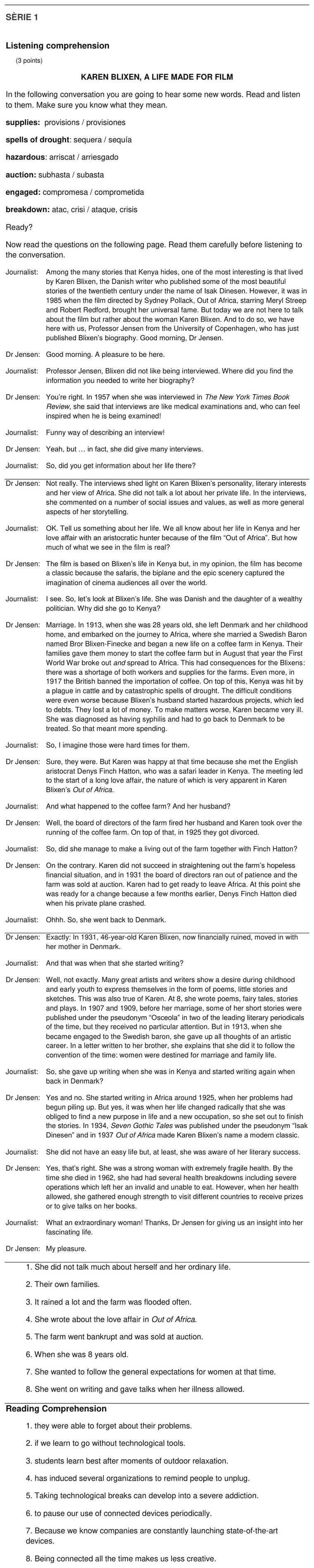
- 0,375 pSeleccionar la resposta de la clau oficial: they were able to forget about their problems.Penalització: Resposta incorrecta: −0,125 punts. Resposta en blanc: cap penalització.
Toca per ampliar- 0,375 pSeleccionar la resposta de la clau oficial: if we learn to go without technological tools.Penalització: Resposta incorrecta: −0,125 punts. Resposta en blanc: cap penalització.
Toca per ampliar- 0,375 pSeleccionar la resposta de la clau oficial: students learn best after moments of outdoor relaxation.Penalització: Resposta incorrecta: −0,125 punts. Resposta en blanc: cap penalització.
Toca per ampliar- 0,375 pSeleccionar la resposta de la clau oficial: has induced several organizations to remind people to unplug.Penalització: Resposta incorrecta: −0,125 punts. Resposta en blanc: cap penalització.
Toca per ampliar- 0,375 pSeleccionar la resposta de la clau oficial: Taking technological breaks can develop into a severe addiction.Penalització: Resposta incorrecta: −0,125 punts. Resposta en blanc: cap penalització.
Toca per ampliar- 0,375 pSeleccionar la resposta de la clau oficial: to pause our use of connected devices periodically.Penalització: Resposta incorrecta: −0,125 punts. Resposta en blanc: cap penalització.
Toca per ampliar- 0,375 pSeleccionar la resposta de la clau oficial: Because we know companies are constantly launching state-of-the-art devices.Penalització: Resposta incorrecta: −0,125 punts. Resposta en blanc: cap penalització.
Toca per ampliar- 0,375 pSeleccionar la resposta de la clau oficial: Being connected all the time makes us less creative.Penalització: Resposta incorrecta: −0,125 punts. Resposta en blanc: cap penalització.