PAU 2020
 Toca per ampliar
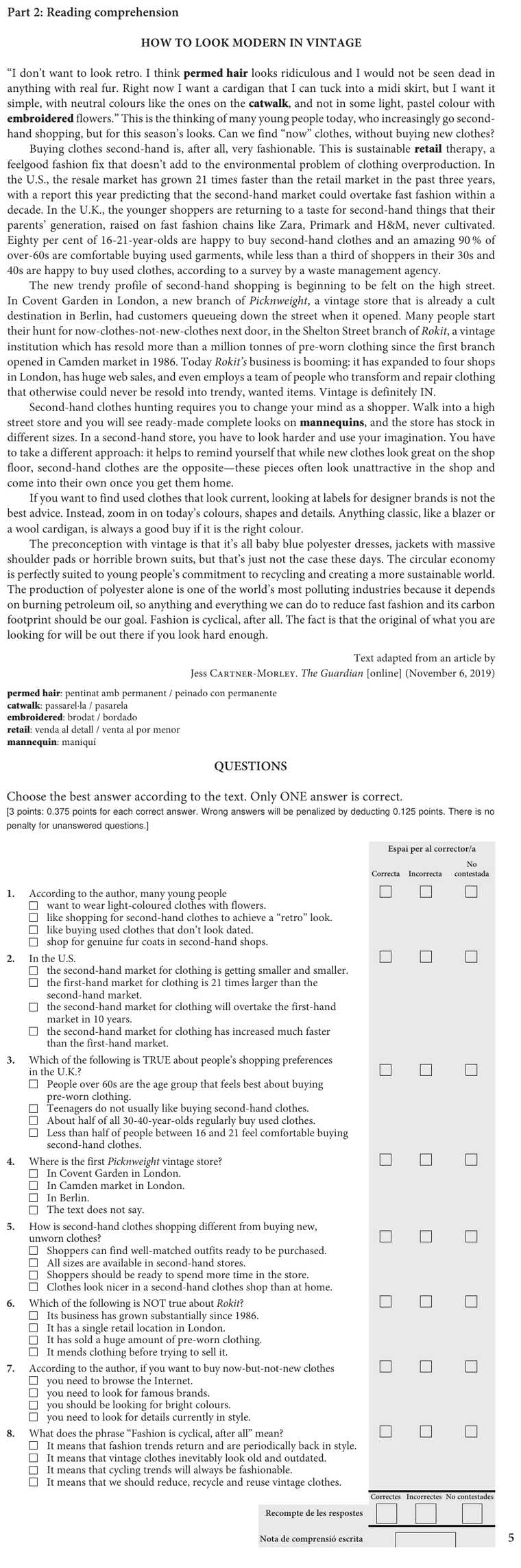
HOW TO LOOK MODERN IN VINTAGE
“I don’t want to look retro. I think permed hair looks ridiculous and I would not be seen dead in
anything with real fur. Right now I want a cardigan that I can tuck into a midi skirt, but I want it
simple, with neutral colours like the ones on the catwalk, and not in some light, pastel colour with
embroidered flowers.” This is the thinking of many young people today, who increasingly go second-
hand shopping, but for this season’s looks. Can we find “now” clothes, without buying new clothes?
Buying clothes second-hand is, after all, very fashionable. This is sustainable retail therapy, a
feelgood fashion fix that doesn’t add to the environmental problem of clothing overproduction. In
the U.S., the resale market has grown 21 times faster than the retail market in the past three years,
with a report this year predicting that the second-hand market could overtake fast fashion within a
decade. In the U.K., the younger shoppers are returning to a taste for second-hand things that their
parents’ generation, raised on fast fashion chains like Zara, Primark and H&M, never cultivated.
Eighty per cent of 16-21-year-olds are happy to buy second-hand clothes and an amazing 90 % of
over-60s are comfortable buying used garments, while less than a third of shoppers in their 30s and
40s are happy to buy used clothes, according to a survey by a waste management agency.
The new trendy profile of second-hand shopping is beginning to be felt on the high street.
In Covent Garden in London, a new branch of Picknweight, a vintage store that is already a cult
destination in Berlin, had customers queueing down the street when it opened. Many people start
their hunt for now-clothes-not-new-clothes next door, in the Shelton Street branch of Rokit, a vintage
institution which has resold more than a million tonnes of pre-worn clothing since the first branch
opened in Camden market in 1986. Today Rokit’s business is booming: it has expanded to four shops
in London, has huge web sales, and even employs a team of people who transform and repair clothing
that otherwise could never be resold into trendy, wanted items. Vintage is definitely IN.
Second-hand clothes hunting requires you to change your mind as a shopper. Walk into a high
street store and you will see ready-made complete looks on mannequins, and the store has stock in
different sizes. In a second-hand store, you have to look harder and use your imagination. You have
to take a different approach: it helps to remind yourself that while new clothes look great on the shop
floor, second-hand clothes are the opposite—these pieces often look unattractive in the shop and
come into their own once you get them home.
If you want to find used clothes that look current, looking at labels for designer brands is not the
best advice. Instead, zoom in on today’s colours, shapes and details. Anything classic, like a blazer or
a wool cardigan, is always a good buy if it is the right colour.
The preconception with vintage is that it’s all baby blue polyester dresses, jackets with massive
shoulder pads or horrible brown suits, but that’s just not the case these days. The circular economy
is perfectly suited to young people’s commitment to recycling and creating a more sustainable world.
The production of polyester alone is one of the world’s most polluting industries because it depends
on burning petroleum oil, so anything and everything we can do to reduce fast fashion and its carbon
footprint should be our goal. Fashion is cyclical, after all. The fact is that the original of what you are
looking for will be out there if you look hard enough.
Text adapted from an article by
Jess Cartner-Morley. The Guardian [online] (November 6, 2019)
permed hair: pentinat amb permanent / peinado con permanente
catwalk: passarel·la / pasarela
embroidered: brodat / bordado
retail: venda al detall / venta al por menor
mannequin: maniquí
Vegeu el text de lectura de la pregunta 1 de Part 2.
1. According to the author, many young people
want to wear light-coloured clothes with flowers.
like shopping for second-hand clothes to achieve a “retro” look.
like buying used clothes that don’t look dated.
shop for genuine fur coats in second-hand shops.
2. In the U.S.
the second-hand market for clothing is getting smaller and smaller.
the first-hand market for clothing is 21 times larger than the
second-hand market.
the second-hand market for clothing will overtake the first-hand
market in 10 years.
the second-hand market for clothing has increased much faster
than the first-hand market.
3. Which of the following is TRUE about people’s shopping preferences
in the U.K.?
People over 60s are the age group that feels best about buying
pre-worn clothing.
Teenagers do not usually like buying second-hand clothes.
About half of all 30-40-year-olds regularly buy used clothes.
Less than half of people between 16 and 21 feel comfortable buying
second-hand clothes.
4. Where is the first Picknweight vintage store?
In Covent Garden in London.
In Camden market in London.
In Berlin.
The text does not say.
5. How is second-hand clothes shopping different from buying new,
unworn clothes?
Shoppers can find well-matched outfits ready to be purchased.
All sizes are available in second-hand stores.
Shoppers should be ready to spend more time in the store.
Clothes look nicer in a second-hand clothes shop than at home.
6. Which of the following is NOT true about Rokit?
Its business has grown substantially since 1986.
It has a single retail location in London.
It has sold a huge amount of pre-worn clothing.
It mends clothing before trying to sell it.
7. According to the author, if you want to buy now-but-not-new clothes
you need to browse the Internet.
you need to look for famous brands.
you should be looking for bright colours.
you need to look for details currently in style.
8. What does the phrase “Fashion is cyclical, after all” mean?
It means that fashion trends return and are periodically back in style.
It means that vintage clothes inevitably look old and outdated.
It means that cycling trends will always be fashionable.
It means that we should reduce, recycle and reuse vintage clothes.
 Toca per ampliar
- 0,375 pSeleccionar la resposta de la clau oficial: like buying used clothes that don’t look dated.Penalització: Resposta incorrecta: −0,125 punts. Resposta en blanc: cap penalització.
Toca per ampliar- 0,375 pSeleccionar la resposta de la clau oficial: the second-hand market for clothing has increased much faster than the first-hand market.Penalització: Resposta incorrecta: −0,125 punts. Resposta en blanc: cap penalització.
Toca per ampliar- 0,375 pSeleccionar la resposta de la clau oficial: People over 60 are the age group that feels best about buying pre-worn clothing.Penalització: Resposta incorrecta: −0,125 punts. Resposta en blanc: cap penalització.
Toca per ampliar- 0,375 pSeleccionar la resposta de la clau oficial: In Berlin.Penalització: Resposta incorrecta: −0,125 punts. Resposta en blanc: cap penalització.
Toca per ampliar- 0,375 pSeleccionar la resposta de la clau oficial: Shoppers should be ready to spend more time in the store.Penalització: Resposta incorrecta: −0,125 punts. Resposta en blanc: cap penalització.
Toca per ampliar- 0,375 pSeleccionar la resposta de la clau oficial: It has a single retail location in London.Penalització: Resposta incorrecta: −0,125 punts. Resposta en blanc: cap penalització.
Toca per ampliar- 0,375 pSeleccionar la resposta de la clau oficial: you need to look for details currently in style.Penalització: Resposta incorrecta: −0,125 punts. Resposta en blanc: cap penalització.
Toca per ampliar- 0,375 pSeleccionar la resposta de la clau oficial: It means that fashion trends return and are periodically back in style.Penalització: Resposta incorrecta: −0,125 punts. Resposta en blanc: cap penalització.