PAU 2020
 Toca per ampliar
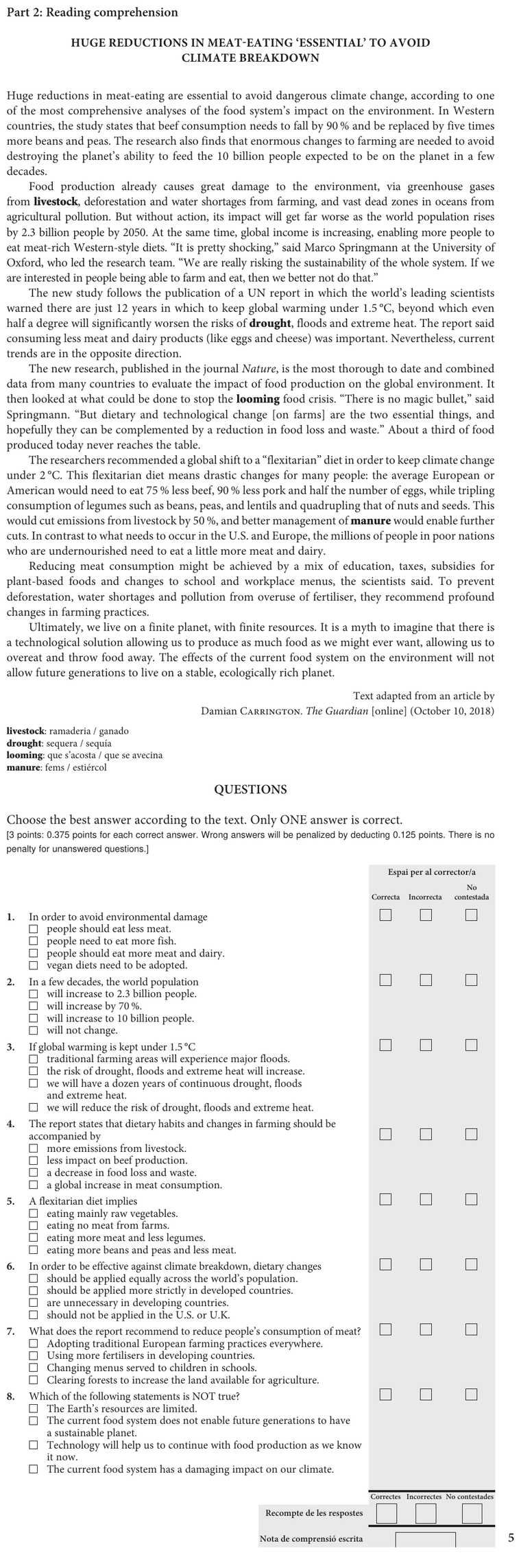
HUGE REDUCTIONS IN MEAT-EATING ‘ESSENTIAL’ TO AVOID
CLIMATE BREAKDOWN
Huge reductions in meat-eating are essential to avoid dangerous climate change, according to one
of the most comprehensive analyses of the food system’s impact on the environment. In Western
countries, the study states that beef consumption needs to fall by 90 % and be replaced by five times
more beans and peas. The research also finds that enormous changes to farming are needed to avoid
destroying the planet’s ability to feed the 10 billion people expected to be on the planet in a few
decades.
Food production already causes great damage to the environment, via greenhouse gases
from livestock, deforestation and water shortages from farming, and vast dead zones in oceans from
agricultural pollution. But without action, its impact will get far worse as the world population rises
by 2.3 billion people by 2050. At the same time, global income is increasing, enabling more people to
eat meat-rich Western-style diets. “It is pretty shocking,” said Marco Springmann at the University of
Oxford, who led the research team. “We are really risking the sustainability of the whole system. If we
are interested in people being able to farm and eat, then we better not do that.”
The new study follows the publication of a UN report in which the world’s leading scientists
warned there are just 12 years in which to keep global warming under 1.5 °C, beyond which even
half a degree will significantly worsen the risks of drought, floods and extreme heat. The report said
consuming less meat and dairy products (like eggs and cheese) was important. Nevertheless, current
trends are in the opposite direction.
The new research, published in the journal Nature, is the most thorough to date and combined
data from many countries to evaluate the impact of food production on the global environment. It
then looked at what could be done to stop the looming food crisis. “There is no magic bullet,” said
Springmann. “But dietary and technological change [on farms] are the two essential things, and
hopefully they can be complemented by a reduction in food loss and waste.” About a third of food
produced today never reaches the table.
The researchers recommended a global shift to a “flexitarian” diet in order to keep climate change
under 2 °C. This flexitarian diet means drastic changes for many people: the average European or
American would need to eat 75 % less beef, 90 % less pork and half the number of eggs, while tripling
consumption of legumes such as beans, peas, and lentils and quadrupling that of nuts and seeds. This
would cut emissions from livestock by 50 %, and better management of manure would enable further
cuts. In contrast to what needs to occur in the U.S. and Europe, the millions of people in poor nations
who are undernourished need to eat a little more meat and dairy.
Reducing meat consumption might be achieved by a mix of education, taxes, subsidies for
plant-based foods and changes to school and workplace menus, the scientists said. To prevent
deforestation, water shortages and pollution from overuse of fertiliser, they recommend profound
changes in farming practices.
Ultimately, we live on a finite planet, with finite resources. It is a myth to imagine that there is
a technological solution allowing us to produce as much food as we might ever want, allowing us to
overeat and throw food away. The effects of the current food system on the environment will not
allow future generations to live on a stable, ecologically rich planet.
Text adapted from an article by
Damian Carrington. The Guardian [online] (October 10, 2018)
livestock: ramaderia / ganado
drought: sequera / sequía
looming: que s’acosta / que se avecina
manure: fems / estiércol
Vegeu el text de lectura de la pregunta 1 de Part 2.
1. In order to avoid environmental damage
people should eat less meat.
people need to eat more fish.
people should eat more meat and dairy.
vegan diets need to be adopted.
2. In a few decades, the world population
will increase to 2.3 billion people.
will increase by 70 %.
will increase to 10 billion people.
will not change.
3. If global warming is kept under 1.5 °C
traditional farming areas will experience major floods.
the risk of drought, floods and extreme heat will increase.
we will have a dozen years of continuous drought, floods
and extreme heat.
we will reduce the risk of drought, floods and extreme heat.
4. The report states that dietary habits and changes in farming should be
accompanied by
more emissions from livestock.
less impact on beef production.
a decrease in food loss and waste.
a global increase in meat consumption.
5. A flexitarian diet implies
eating mainly raw vegetables.
eating no meat from farms.
eating more meat and less legumes.
eating more beans and peas and less meat.
6. In order to be effective against climate breakdown, dietary changes
should be applied equally across the world’s population.
should be applied more strictly in developed countries.
are unnecessary in developing countries.
should not be applied in the U.S. or U.K.
7. What does the report recommend to reduce people’s consumption of meat?
Adopting traditional European farming practices everywhere.
Using more fertilisers in developing countries.
Changing menus served to children in schools.
Clearing forests to increase the land available for agriculture.
8. Which of the following statements is NOT true?
The Earth’s resources are limited.
The current food system does not enable future generations to have
a sustainable planet.
Technology will help us to continue with food production as we know
it now.
The current food system has a damaging impact on our climate.
 Toca per ampliar
- 0,375 pSeleccionar la resposta de la clau oficial: people should eat less meat.Penalització: Resposta incorrecta: −0,125 punts. Resposta en blanc: cap penalització.
Toca per ampliar- 0,375 pSeleccionar la resposta de la clau oficial: will increase to 10 billion people.Penalització: Resposta incorrecta: −0,125 punts. Resposta en blanc: cap penalització.
Toca per ampliar- 0,375 pSeleccionar la resposta de la clau oficial: we will reduce the risk of drought, floods and extreme heat.Penalització: Resposta incorrecta: −0,125 punts. Resposta en blanc: cap penalització.
Toca per ampliar- 0,375 pSeleccionar la resposta de la clau oficial: a decrease in food loss and waste.Penalització: Resposta incorrecta: −0,125 punts. Resposta en blanc: cap penalització.
Toca per ampliar- 0,375 pSeleccionar la resposta de la clau oficial: eating more beans and peas and less meat.Penalització: Resposta incorrecta: −0,125 punts. Resposta en blanc: cap penalització.
Toca per ampliar- 0,375 pSeleccionar la resposta de la clau oficial: should be applied more strictly in developed countries.Penalització: Resposta incorrecta: −0,125 punts. Resposta en blanc: cap penalització.
Toca per ampliar- 0,375 pSeleccionar la resposta de la clau oficial: Changing menus served to children in schools.Penalització: Resposta incorrecta: −0,125 punts. Resposta en blanc: cap penalització.
Toca per ampliar- 0,375 pSeleccionar la resposta de la clau oficial: Technology will help us to continue with food production as we know it now.Penalització: Resposta incorrecta: −0,125 punts. Resposta en blanc: cap penalització.