PAU 2021
 Toca per ampliar
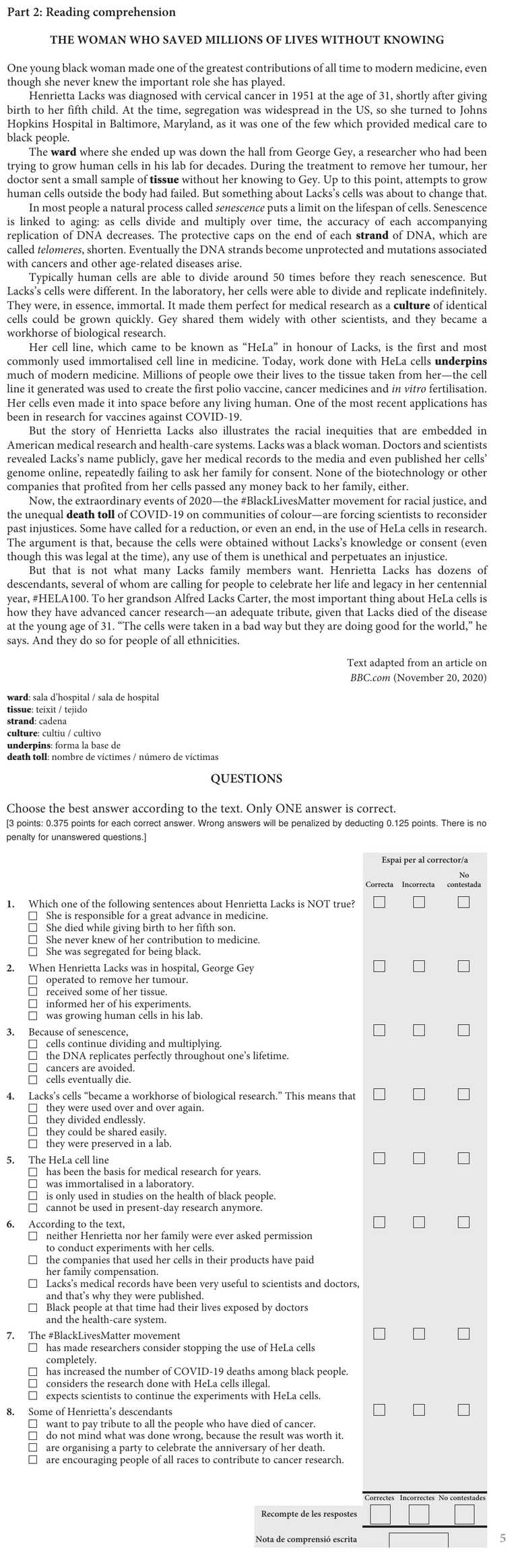
THE WOMAN WHO SAVED MILLIONS OF LIVES WITHOUT KNOWING
One young black woman made one of the greatest contributions of all time to modern medicine, even
though she never knew the important role she has played.
Henrietta Lacks was diagnosed with cervical cancer in 1951 at the age of 31, shortly after giving
birth to her fifth child. At the time, segregation was widespread in the US, so she turned to Johns
Hopkins Hospital in Baltimore, Maryland, as it was one of the few which provided medical care to
black people.
The ward where she ended up was down the hall from George Gey, a researcher who had been
trying to grow human cells in his lab for decades. During the treatment to remove her tumour, her
doctor sent a small sample of tissue without her knowing to Gey. Up to this point, attempts to grow
human cells outside the body had failed. But something about Lacks’s cells was about to change that.
In most people a natural process called senescence puts a limit on the lifespan of cells. Senescence
is linked to aging: as cells divide and multiply over time, the accuracy of each accompanying
replication of DNA decreases. The protective caps on the end of each strand of DNA, which are
called telomeres, shorten. Eventually the DNA strands become unprotected and mutations associated
with cancers and other age-related diseases arise.
Typically human cells are able to divide around 50 times before they reach senescence. But
Lacks’s cells were different. In the laboratory, her cells were able to divide and replicate indefinitely.
They were, in essence, immortal. It made them perfect for medical research as a culture of identical
cells could be grown quickly. Gey shared them widely with other scientists, and they became a
workhorse of biological research.
Her cell line, which came to be known as “HeLa” in honour of Lacks, is the first and most
commonly used immortalised cell line in medicine. Today, work done with HeLa cells underpins
much of modern medicine. Millions of people owe their lives to the tissue taken from her—the cell
line it generated was used to create the first polio vaccine, cancer medicines and in vitro fertilisation.
Her cells even made it into space before any living human. One of the most recent applications has
been in research for vaccines against COVID-19.
But the story of Henrietta Lacks also illustrates the racial inequities that are embedded in
American medical research and health-care systems. Lacks was a black woman. Doctors and scientists
revealed Lacks’s name publicly, gave her medical records to the media and even published her cells’
genome online, repeatedly failing to ask her family for consent. None of the biotechnology or other
companies that profited from her cells passed any money back to her family, either.
Now, the extraordinary events of 2020—the #BlackLivesMatter movement for racial justice, and
the unequal death toll of COVID-19 on communities of colour—are forcing scientists to reconsider
past injustices. Some have called for a reduction, or even an end, in the use of HeLa cells in research.
The argument is that, because the cells were obtained without Lacks’s knowledge or consent (even
though this was legal at the time), any use of them is unethical and perpetuates an injustice.
But that is not what many Lacks family members want. Henrietta Lacks has dozens of
descendants, several of whom are calling for people to celebrate her life and legacy in her centennial
year, #HELA100. To her grandson Alfred Lacks Carter, the most important thing about HeLa cells is
how they have advanced cancer research—an adequate tribute, given that Lacks died of the disease
at the young age of 31. “The cells were taken in a bad way but they are doing good for the world,” he
says. And they do so for people of all ethnicities.
Text adapted from an article on
BBC.com (November 20, 2020)
ward: sala d’hospital / sala de hospital
tissue: teixit / tejido
strand: cadena
culture: cultiu / cultivo
underpins: forma la base de
death toll: nombre de víctimes / número de víctimas
Vegeu el text de lectura de la pregunta 1 de Part 2.
1. Which one of the following sentences about Henrietta Lacks is NOT true?
She is responsible for a great advance in medicine.
She died while giving birth to her fifth son.
She never knew of her contribution to medicine.
She was segregated for being black.
2. When Henrietta Lacks was in hospital, George Gey
operated to remove her tumour.
received some of her tissue.
informed her of his experiments.
was growing human cells in his lab.
3. Because of senescence,
cells continue dividing and multiplying.
the DNA replicates perfectly throughout one’s lifetime.
cancers are avoided.
cells eventually die.
4. Lacks’s cells “became a workhorse of biological research.” This means that
they were used over and over again.
they divided endlessly.
they could be shared easily.
they were preserved in a lab.
5. The HeLa cell line
has been the basis for medical research for years.
was immortalised in a laboratory.
is only used in studies on the health of black people.
cannot be used in present-day research anymore.
6. According to the text,
neither Henrietta nor her family were ever asked permission
to conduct experiments with her cells.
the companies that used her cells in their products have paid
her family compensation.
Lacks’s medical records have been very useful to scientists and doctors,
and that’s why they were published.
Black people at that time had their lives exposed by doctors
and the health-care system.
7. The #BlackLivesMatter movement
has made researchers consider stopping the use of HeLa cells
completely.
has increased the number of COVID-19 deaths among black people.
considers the research done with HeLa cells illegal.
expects scientists to continue the experiments with HeLa cells.
8. Some of Henrietta’s descendants
want to pay tribute to all the people who have died of cancer.
do not mind what was done wrong, because the result was worth it.
are organising a party to celebrate the anniversary of her death.
are encouraging people of all races to contribute to cancer research.
 Toca per ampliar
- 0,375 pSeleccionar la resposta de la clau oficial: She died while giving birth to her fifth son.Penalització: Resposta incorrecta: −0,125 punts. Resposta en blanc: cap penalització.
Toca per ampliar- 0,375 pSeleccionar la resposta de la clau oficial: received some of her tissue.Penalització: Resposta incorrecta: −0,125 punts. Resposta en blanc: cap penalització.
Toca per ampliar- 0,375 pSeleccionar la resposta de la clau oficial: cells eventually die.Penalització: Resposta incorrecta: −0,125 punts. Resposta en blanc: cap penalització.
Toca per ampliar- 0,375 pSeleccionar la resposta de la clau oficial: they were used over and over again.Penalització: Resposta incorrecta: −0,125 punts. Resposta en blanc: cap penalització.
Toca per ampliar- 0,375 pSeleccionar la resposta de la clau oficial: has been the basis for medical research for years.Penalització: Resposta incorrecta: −0,125 punts. Resposta en blanc: cap penalització.
Toca per ampliar- 0,375 pSeleccionar la resposta de la clau oficial: neither Henrietta nor her family were ever asked permission to conduct experiments with her cells.Penalització: Resposta incorrecta: −0,125 punts. Resposta en blanc: cap penalització.
Toca per ampliar- 0,375 pSeleccionar la resposta de la clau oficial: has made researchers consider stopping the use of HeLa cells completely.Penalització: Resposta incorrecta: −0,125 punts. Resposta en blanc: cap penalització.
Toca per ampliar- 0,375 pSeleccionar la resposta de la clau oficial: do not mind what was done wrong, because the result was worth it.Penalització: Resposta incorrecta: −0,125 punts. Resposta en blanc: cap penalització.