PAU 2021
 Toca per ampliar
IS PLASTIC A DEADLY THREAT TO WILDLIFE?
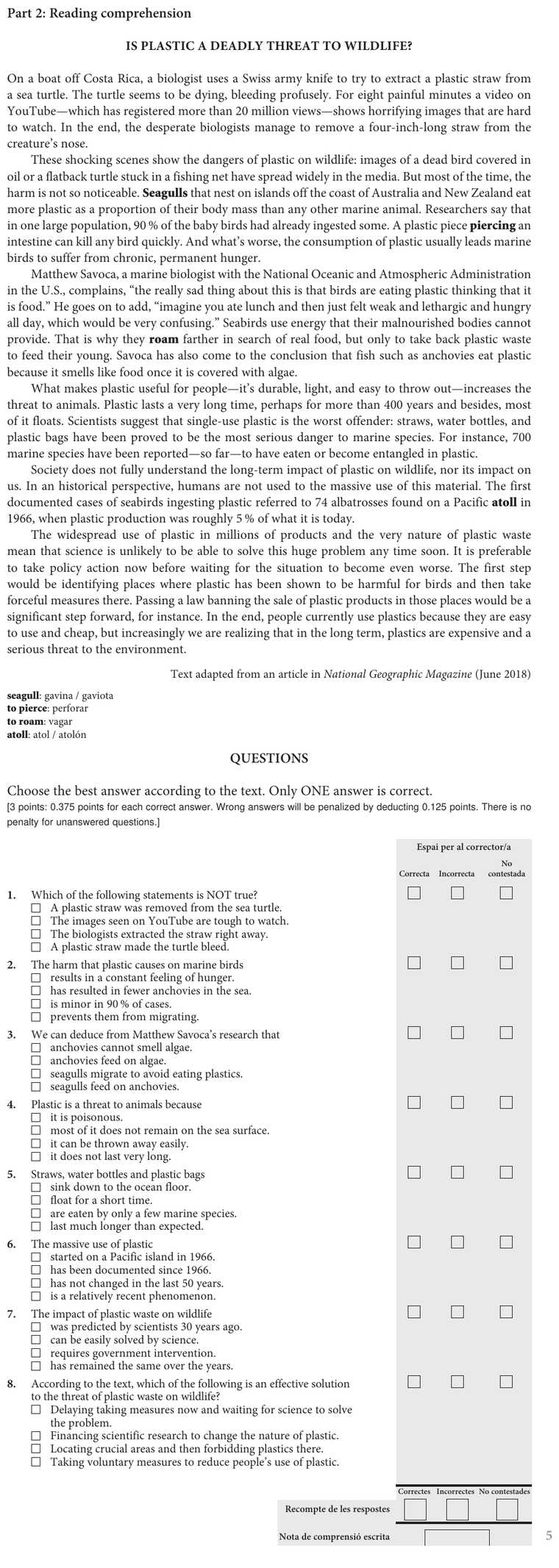
On a boat off Costa Rica, a biologist uses a Swiss army knife to try to extract a plastic straw from
a sea turtle. The turtle seems to be dying, bleeding profusely. For eight painful minutes a video on
YouTube—which has registered more than 20 million views—shows horrifying images that are hard
to watch. In the end, the desperate biologists manage to remove a four-inch-long straw from the
creature’s nose.
These shocking scenes show the dangers of plastic on wildlife: images of a dead bird covered in
oil or a flatback turtle stuck in a fishing net have spread widely in the media. But most of the time, the
harm is not so noticeable. Seagulls that nest on islands off the coast of Australia and New Zealand eat
more plastic as a proportion of their body mass than any other marine animal. Researchers say that
in one large population, 90 % of the baby birds had already ingested some. A plastic piece piercing an
intestine can kill any bird quickly. And what’s worse, the consumption of plastic usually leads marine
birds to suffer from chronic, permanent hunger.
Matthew Savoca, a marine biologist with the National Oceanic and Atmospheric Administration
in the U.S., complains, “the really sad thing about this is that birds are eating plastic thinking that it
is food.” He goes on to add, “imagine you ate lunch and then just felt weak and lethargic and hungry
all day, which would be very confusing.” Seabirds use energy that their malnourished bodies cannot
provide. That is why they roam farther in search of real food, but only to take back plastic waste
to feed their young. Savoca has also come to the conclusion that fish such as anchovies eat plastic
because it smells like food once it is covered with algae.
What makes plastic useful for people—it’s durable, light, and easy to throw out—increases the
threat to animals. Plastic lasts a very long time, perhaps for more than 400 years and besides, most
of it floats. Scientists suggest that single-use plastic is the worst offender: straws, water bottles, and
plastic bags have been proved to be the most serious danger to marine species. For instance, 700
marine species have been reported—so far—to have eaten or become entangled in plastic.
Society does not fully understand the long-term impact of plastic on wildlife, nor its impact on
us. In an historical perspective, humans are not used to the massive use of this material. The first
documented cases of seabirds ingesting plastic referred to 74 albatrosses found on a Pacific atoll in
1966, when plastic production was roughly 5 % of what it is today.
The widespread use of plastic in millions of products and the very nature of plastic waste
mean that science is unlikely to be able to solve this huge problem any time soon. It is preferable
to take policy action now before waiting for the situation to become even worse. The first step
would be identifying places where plastic has been shown to be harmful for birds and then take
forceful measures there. Passing a law banning the sale of plastic products in those places would be a
significant step forward, for instance. In the end, people currently use plastics because they are easy
to use and cheap, but increasingly we are realizing that in the long term, plastics are expensive and a
serious threat to the environment.
Text adapted from an article in National Geographic Magazine (June 2018)
seagull: gavina / gaviota
to pierce: perforar
to roam: vagar
atoll: atol / atolón
Vegeu el text de lectura de la pregunta 1 de Part 2.
1. Which of the following statements is NOT true?
A plastic straw was removed from the sea turtle.
The images seen on YouTube are tough to watch.
The biologists extracted the straw right away.
A plastic straw made the turtle bleed.
2. The harm that plastic causes on marine birds
results in a constant feeling of hunger.
has resulted in fewer anchovies in the sea.
is minor in 90 % of cases.
prevents them from migrating.
3. We can deduce from Matthew Savoca’s research that
anchovies cannot smell algae.
anchovies feed on algae.
seagulls migrate to avoid eating plastics.
seagulls feed on anchovies.
4. Plastic is a threat to animals because
it is poisonous.
most of it does not remain on the sea surface.
it can be thrown away easily.
it does not last very long.
5. Straws, water bottles and plastic bags
sink down to the ocean floor.
float for a short time.
are eaten by only a few marine species.
last much longer than expected.
6. The massive use of plastic
started on a Pacific island in 1966.
has been documented since 1966.
has not changed in the last 50 years.
is a relatively recent phenomenon.
7. The impact of plastic waste on wildlife
was predicted by scientists 30 years ago.
can be easily solved by science.
requires government intervention.
has remained the same over the years.
8. According to the text, which of the following is an effective solution
to the threat of plastic waste on wildlife?
Delaying taking measures now and waiting for science to solve
the problem.
Financing scientific research to change the nature of plastic.
Locating crucial areas and then forbidding plastics there.
Taking voluntary measures to reduce people’s use of plastic.
 Toca per ampliar
- 0,375 pSeleccionar la resposta de la clau oficial: The biologists extracted the straw right away.Penalització: Resposta incorrecta: −0,125 punts. Resposta en blanc: cap penalització.
Toca per ampliar- 0,375 pSeleccionar la resposta de la clau oficial: results in a constant feeling of hunger.Penalització: Resposta incorrecta: −0,125 punts. Resposta en blanc: cap penalització.
Toca per ampliar- 0,375 pSeleccionar la resposta de la clau oficial: anchovies feed on algae.Penalització: Resposta incorrecta: −0,125 punts. Resposta en blanc: cap penalització.
Toca per ampliar- 0,375 pSeleccionar la resposta de la clau oficial: it can be thrown away easily.Penalització: Resposta incorrecta: −0,125 punts. Resposta en blanc: cap penalització.
Toca per ampliar- 0,375 pSeleccionar la resposta de la clau oficial: last much longer than expected.Penalització: Resposta incorrecta: −0,125 punts. Resposta en blanc: cap penalització.
Toca per ampliar- 0,375 pSeleccionar la resposta de la clau oficial: is a relatively recent phenomenon.Penalització: Resposta incorrecta: −0,125 punts. Resposta en blanc: cap penalització.
Toca per ampliar- 0,375 pSeleccionar la resposta de la clau oficial: requires government intervention.Penalització: Resposta incorrecta: −0,125 punts. Resposta en blanc: cap penalització.
Toca per ampliar- 0,375 pSeleccionar la resposta de la clau oficial: Locating crucial areas and then forbidding plastics there.Penalització: Resposta incorrecta: −0,125 punts. Resposta en blanc: cap penalització.