PAU 2023
 Toca per ampliar
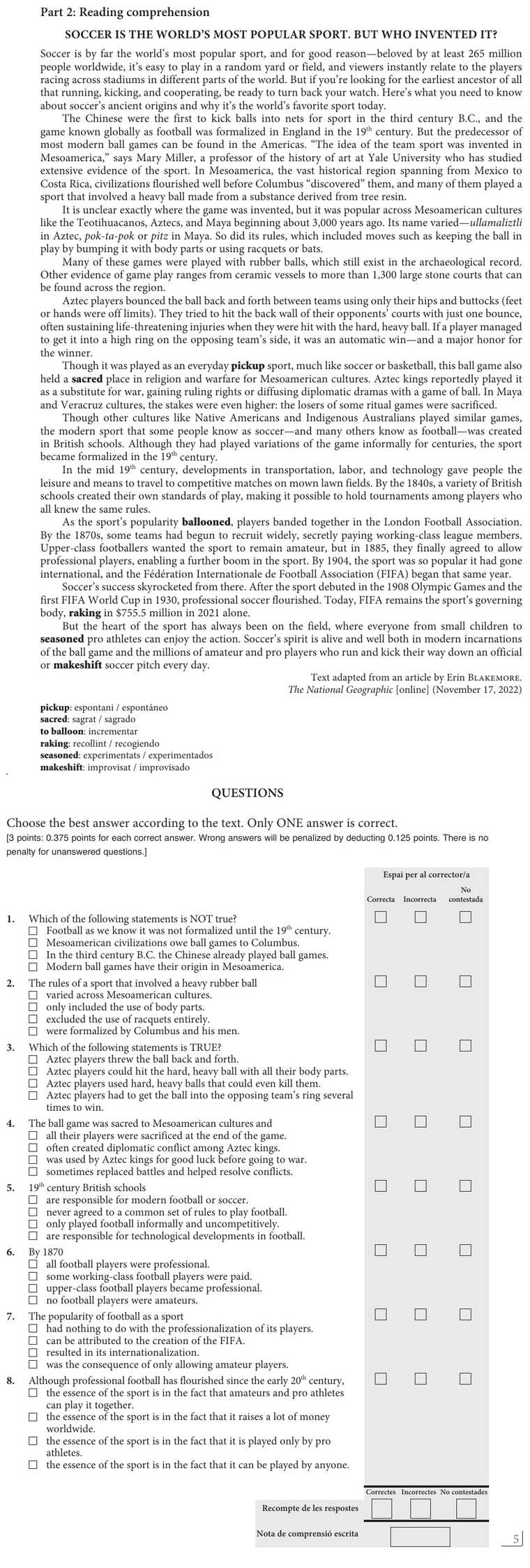
SOCCER IS THE WORLD’S MOST POPULAR SPORT. BUT WHO INVENTED IT? Soccer is by far the world’s most popular sport, and for good reason—beloved by at least 265 million people worldwide, it’s easy to play in a random yard or field, and viewers instantly relate to the players racing across stadiums in different parts of the world. But if you’re looking for the earliest ancestor of all that running, kicking, and cooperating, be ready to turn back your watch. Here’s what you need to know about soccer’s ancient origins and why it’s the world’s favorite sport today. The Chinese were the first to kick balls into nets for sport in the third century B.C., and the game known globally as football was formalized in England in the 19th century. But the predecessor of most modern ball games can be found in the Americas. “The idea of the team sport was invented in Mesoamerica,” says Mary Miller, a professor of the history of art at Yale University who has studied extensive evidence of the sport. In Mesoamerica, the vast historical region spanning from Mexico to Costa Rica, civilizations flourished well before Columbus “discovered” them, and many of them played a sport that involved a heavy ball made from a substance derived from tree resin. It is unclear exactly where the game was invented, but it was popular across Mesoamerican cultures like the Teotihuacanos, Aztecs, and Maya beginning about 3,000 years ago. Its name varied—ullamaliztli in Aztec, pok-ta-pok or pitz in Maya. So did its rules, which included moves such as keeping the ball in play by bumping it with body parts or using racquets or bats. Many of these games were played with rubber balls, which still exist in the archaeological record. Other evidence of game play ranges from ceramic vessels to more than 1,300 large stone courts that can be found across the region. Aztec players bounced the ball back and forth between teams using only their hips and buttocks (feet or hands were off limits). They tried to hit the back wall of their opponents’ courts with just one bounce, often sustaining life-threatening injuries when they were hit with the hard, heavy ball. If a player managed to get it into a high ring on the opposing team’s side, it was an automatic win—and a major honor for the winner. Though it was played as an everyday pickup sport, much like soccer or basketball, this ball game also held a sacred place in religion and warfare for Mesoamerican cultures. Aztec kings reportedly played it as a substitute for war, gaining ruling rights or diffusing diplomatic dramas with a game of ball. In Maya and Veracruz cultures, the stakes were even higher: the losers of some ritual games were sacrificed. Though other cultures like Native Americans and Indigenous Australians played similar games, the modern sport that some people know as soccer—and many others know as football—was created in British schools. Although they had played variations of the game informally for centuries, the sport became formalized in the 19th century. In the mid 19th century, developments in transportation, labor, and technology gave people the leisure and means to travel to competitive matches on mown lawn fields. By the 1840s, a variety of British schools created their own standards of play, making it possible to hold tournaments among players who all knew the same rules. As the sport’s popularity ballooned, players banded together in the London Football Association. By the 1870s, some teams had begun to recruit widely, secretly paying working-class league members. Upper-class footballers wanted the sport to remain amateur, but in 1885, they finally agreed to allow professional players, enabling a further boom in the sport. By 1904, the sport was so popular it had gone international, and the Fédération Internationale de Football Association (FIFA) began that same year. Soccer’s success skyrocketed from there. After the sport debuted in the 1908 Olympic Games and the first FIFA World Cup in 1930, professional soccer flourished. Today, FIFA remains the sport’s governing body, raking in $755.5 million in 2021 alone. But the heart of the sport has always been on the field, where everyone from small children to seasoned pro athletes can enjoy the action. Soccer’s spirit is alive and well both in modern incarnations of the ball game and the millions of amateur and pro players who run and kick their way down an official or makeshift soccer pitch every day. Text adapted from an article by Erin Blakemore. The National Geographic [online] (November 17, 2022) pickup: espontani / espontáneo sacred: sagrat / sagrado to balloon: incrementar raking: recollint / recogiendo seasoned: experimentats / experimentados makeshift: improvisat / improvisado
See the shared reading text and glossary in Part 2, question 1 (item 2.1).
Which of the following statements is NOT true?
Football as we know it was not formalized until the 19th century.
Mesoamerican civilizations owe ball games to Columbus.
In the third century B.C. the Chinese already played ball games.
Modern ball games have their origin in Mesoamerica.
The rules of a sport that involved a heavy rubber ball
varied across Mesoamerican cultures.
only included the use of body parts.
excluded the use of racquets entirely.
were formalized by Columbus and his men.
Which of the following statements is TRUE?
Aztec players threw the ball back and forth.
Aztec players could hit the hard, heavy ball with all their body parts.
Aztec players used hard, heavy balls that could even kill them.
Aztec players had to get the ball into the opposing team’s ring several
times to win.
The ball game was sacred to Mesoamerican cultures and
all their players were sacrificed at the end of the game.
often created diplomatic conflict among Aztec kings.
was used by Aztec kings for good luck before going to war.
sometimes replaced battles and helped resolve conflicts.
19th century British schools
are responsible for modern football or soccer.
never agreed to a common set of rules to play football.
only played football informally and uncompetitively.
are responsible for technological developments in football.
By 1870
all football players were professional.
some working-class football players were paid.
upper-class football players became professional.
no football players were amateurs.
The popularity of football as a sport
had nothing to do with the professionalization of its players.
can be attributed to the creation of the FIFA.
resulted in its internationalization.
was the consequence of only allowing amateur players.
Although professional football has flourished since the early 20th century,
the essence of the sport is in the fact that amateurs and pro athletes
can play it together.
the essence of the sport is in the fact that it raises a lot of money
worldwide.
the essence of the sport is in the fact that it is played only by pro
athletes.
the essence of the sport is in the fact that it can be played by anyone.
La pregunta demana l’afirmació falsa. Comprova si les dates del text encaixen amb cada opció.
Les cultures mesoamericanes ja practicaven jocs de pilota molt abans de l’arribada de Colom. Atribuir-li aquests jocs contradiu la cronologia del text.
Mesoamerican civilizations owe ball games to Columbus.
+0,375criteri 1 de la pauta
 Toca per ampliar
- 0,375 pSeleccionar la resposta de la clau oficial: Mesoamerican civilizations owe ball games to Columbus.Penalització: Resposta incorrecta: −0.125 punts; pregunta no contestada: sense penalització.
Busca què diu el text sobre les regles en les diferents cultures mesoamericanes.
Després d’explicar que el nom del joc canviava, el text afegeix *So did its rules*. Segons la variant, es podia colpejar la pilota amb parts del cos o fer servir raquetes o bats.
varied across Mesoamerican cultures.
+0,375criteri 1 de la pauta
Toca per ampliar- 0,375 pSeleccionar la resposta de la clau oficial: varied across Mesoamerican cultures.Penalització: Resposta incorrecta: −0.125 punts; pregunta no contestada: sense penalització.
Comprova quina afirmació coincideix amb el paràgraf sobre els jugadors asteques.
El text diu que els impactes de la pilota dura i pesada podien causar lesions *life-threatening*, és a dir, que posaven en perill la vida.
Aztec players used hard, heavy balls that could even kill them.
+0,375criteri 1 de la pauta
Toca per ampliar- 0,375 pSeleccionar la resposta de la clau oficial: Aztec players used hard, heavy balls that could even kill them.Penalització: Resposta incorrecta: −0.125 punts; pregunta no contestada: sense penalització.
Localitza com els reis asteques feien servir el joc per tractar els conflictes.
El text diu que jugaven *as a substitute for war*. Una partida podia evitar un enfrontament i ajudar a resoldre disputes diplomàtiques.
sometimes replaced battles and helped resolve conflicts.
+0,375criteri 1 de la pauta
Toca per ampliar- 0,375 pSeleccionar la resposta de la clau oficial: sometimes replaced battles and helped resolve conflicts.Penalització: Resposta incorrecta: −0.125 punts; pregunta no contestada: sense penalització.
Localitza on va néixer el futbol modern i quan se’n van formalitzar les regles.
El text situa l’origen del futbol modern a les escoles britàniques. A la dècada de 1840, diverses escoles ja havien establert regles de joc que permetien organitzar tornejos.
are responsible for modern football or soccer.
+0,375criteri 1 de la pauta
Toca per ampliar- 0,375 pSeleccionar la resposta de la clau oficial: are responsible for modern football or soccer.Penalització: Resposta incorrecta: −0.125 punts; pregunta no contestada: sense penalització.
Fixa’t en qui cobrava durant els primers anys de professionalització.
A la dècada de 1870, alguns equips ja pagaven en secret un sou a jugadors de classe treballadora. El text situa l’acord per admetre professionals el 1885.
some working-class football players were paid.
+0,375criteri 1 de la pauta- Nota d’OriginalL’enunciat diu «By 1870» i el text diu «By the 1870s». La segona expressió situa els pagaments a la dècada de 1870 i deixa oberta la data exacta en què van començar.
Toca per ampliar- 0,375 pSeleccionar la resposta de la clau oficial: some working-class football players were paid.Penalització: Resposta incorrecta: −0.125 punts; pregunta no contestada: sense penalització.
Segueix l’ordre de causa i conseqüència en el fragment sobre l’expansió del futbol.
El text diu que, cap al 1904, el futbol ja s’havia estès a altres països gràcies a la seva popularitat. També situa la fundació de la FIFA aquell any.
resulted in its internationalization.
+0,375criteri 1 de la pauta
Toca per ampliar- 0,375 pSeleccionar la resposta de la clau oficial: resulted in its internationalization.Penalització: Resposta incorrecta: −0.125 punts; pregunta no contestada: sense penalització.
Busca al darrer paràgraf quina idea resumeix el cor del futbol.
El text inclou des dels infants fins als professionals amb experiència. Aquesta expressió indica que qualsevol persona pot jugar-hi, sigui quin sigui el seu nivell.
the essence of the sport is in the fact that it can be played by anyone.
+0,375criteri 1 de la pauta
Toca per ampliar- 0,375 pSeleccionar la resposta de la clau oficial: the essence of the sport is in the fact that it can be played by anyone.Penalització: Resposta incorrecta: −0.125 punts; pregunta no contestada: sense penalització.