PAU 2024
 Toca per ampliar
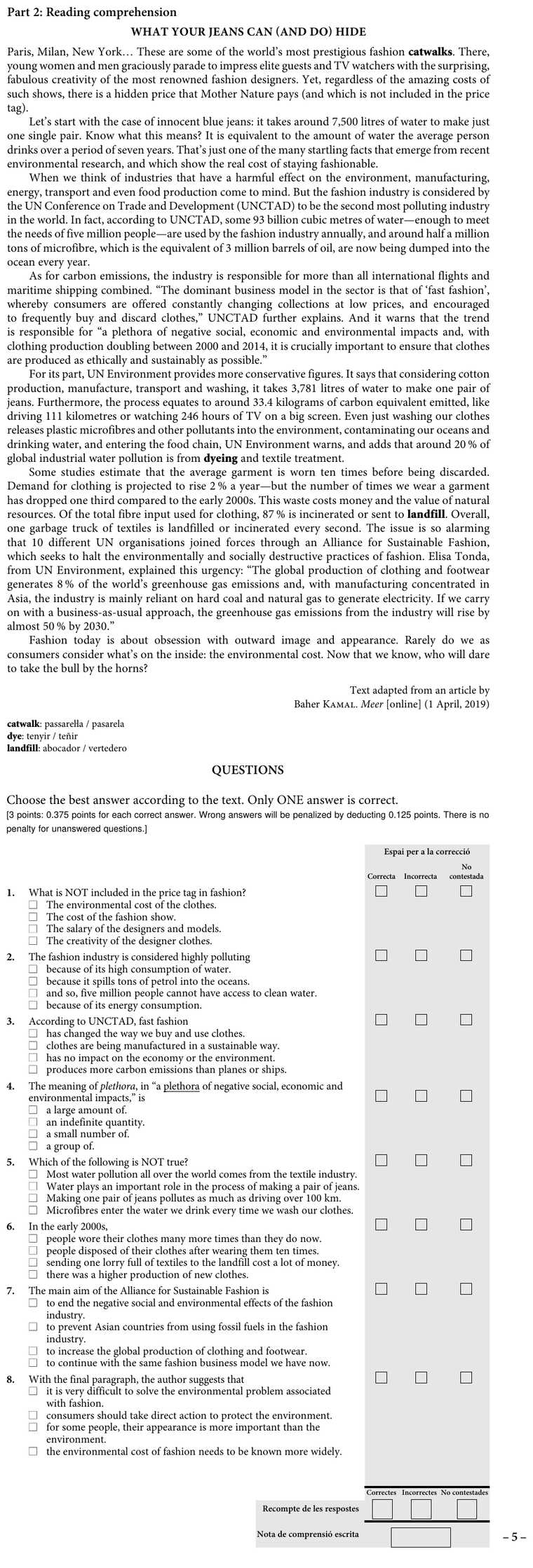
WHAT YOUR JEANS CAN (AND DO) HIDE Paris, Milan, New York… These are some of the world’s most prestigious fashion catwalks. There, young women and men graciously parade to impress elite guests and TV watchers with the surprising, fabulous creativity of the most renowned fashion designers. Yet, regardless of the amazing costs of such shows, there is a hidden price that Mother Nature pays (and which is not included in the price tag). Let’s start with the case of innocent blue jeans: it takes around 7,500 litres of water to make just one single pair. Know what this means? It is equivalent to the amount of water the average person drinks over a period of seven years. That’s just one of the many startling facts that emerge from recent environmental research, and which show the real cost of staying fashionable. When we think of industries that have a harmful effect on the environment, manufacturing, energy, transport and even food production come to mind. But the fashion industry is considered by the UN Conference on Trade and Development (UNCTAD) to be the second most polluting industry in the world. In fact, according to UNCTAD, some 93 billion cubic metres of water—enough to meet the needs of five million people—are used by the fashion industry annually, and around half a million tons of microfibre, which is the equivalent of 3 million barrels of oil, are now being dumped into the ocean every year. As for carbon emissions, the industry is responsible for more than all international flights and maritime shipping combined. “The dominant business model in the sector is that of ‘fast fashion’, whereby consumers are offered constantly changing collections at low prices, and encouraged to frequently buy and discard clothes,” UNCTAD further explains. And it warns that the trend is responsible for “a plethora of negative social, economic and environmental impacts and, with clothing production doubling between 2000 and 2014, it is crucially important to ensure that clothes are produced as ethically and sustainably as possible.” For its part, UN Environment provides more conservative figures. It says that considering cotton production, manufacture, transport and washing, it takes 3,781 litres of water to make one pair of jeans. Furthermore, the process equates to around 33.4 kilograms of carbon equivalent emitted, like driving 111 kilometres or watching 246 hours of TV on a big screen. Even just washing our clothes releases plastic microfibres and other pollutants into the environment, contaminating our oceans and drinking water, and entering the food chain, UN Environment warns, and adds that around 20 % of global industrial water pollution is from dyeing and textile treatment. Some studies estimate that the average garment is worn ten times before being discarded. Demand for clothing is projected to rise 2 % a year—but the number of times we wear a garment has dropped one third compared to the early 2000s. This waste costs money and the value of natural resources. Of the total fibre input used for clothing, 87 % is incinerated or sent to landfill. Overall, one garbage truck of textiles is landfilled or incinerated every second. The issue is so alarming that 10 different UN organisations joined forces through an Alliance for Sustainable Fashion, which seeks to halt the environmentally and socially destructive practices of fashion. Elisa Tonda, from UN Environment, explained this urgency: “The global production of clothing and footwear generates 8 % of the world’s greenhouse gas emissions and, with manufacturing concentrated in Asia, the industry is mainly reliant on hard coal and natural gas to generate electricity. If we carry on with a business-as-usual approach, the greenhouse gas emissions from the industry will rise by almost 50 % by 2030.” Fashion today is about obsession with outward image and appearance. Rarely do we as consumers consider what’s on the inside: the environmental cost. Now that we know, who will dare to take the bull by the horns? Text adapted from an article by Baher Kamal. Meer [online] (1 April, 2019) catwalk: passareŀla / pasarela dye: tenyir / teñir landfill: abocador / vertedero
See the shared reading text and glossary in Part 2, question 1 (item 2.1).
What is NOT included in the price tag in fashion?
■ The environmental cost of the clothes.
■ The cost of the fashion show.
■ The salary of the designers and models.
■ The creativity of the designer clothes.
The fashion industry is considered highly polluting
■ because of its high consumption of water.
■ because it spills tons of petrol into the oceans.
■ and so, five million people cannot have access to clean water.
■ because of its energy consumption.
According to UNCTAD, fast fashion
■ has changed the way we buy and use clothes.
■ clothes are being manufactured in a sustainable way.
■ has no impact on the economy or the environment.
■ produces more carbon emissions than planes or ships.
The meaning of plethora, in “a plethora of negative social, economic and
environmental impacts,” is
■ a large amount of.
■ an indefinite quantity.
■ a small number of.
■ a group of.
Which of the following is NOT true?
■ Most water pollution all over the world comes from the textile industry.
■ Water plays an important role in the process of making a pair of jeans.
■ Making one pair of jeans pollutes as much as driving over 100 km.
■ Microfibres enter the water we drink every time we wash our clothes.
In the early 2000s,
■ people wore their clothes many more times than they do now.
■ people disposed of their clothes after wearing them ten times.
■ sending one lorry full of textiles to the landfill cost a lot of money.
■ there was a higher production of new clothes.
The main aim of the Alliance for Sustainable Fashion is
■ to end the negative social and environmental effects of the fashion
industry.
■ to prevent Asian countries from using fossil fuels in the fashion
industry.
■ to increase the global production of clothing and footwear.
■ to continue with the same fashion business model we have now.
With the final paragraph, the author suggests that
■ it is very difficult to solve the environmental problem associated
with fashion.
■ consumers should take direct action to protect the environment.
■ for some people, their appearance is more important than the
environment.
■ the environmental cost of fashion needs to be known more widely.
Al primer paràgraf, identifica el preu ocult que paga la natura. L’exemple de l’aigua que cal per fabricar uns texans concreta aquest cost.
The environmental cost of the clothes.
+0,375criteri 1 de la pauta
 Toca per ampliar
- 0,375 pSeleccionar la resposta de la clau oficial: The environmental cost of the clothes.Penalització: Resposta incorrecta: −0.125 punts; pregunta no contestada: sense penalització.
Busca la dada que el text dona just després de presentar la moda com una indústria molt contaminant. Segons el text, el sector consumeix uns 93 mil milions de metres cúbics d’aigua l’any.
because of its high consumption of water.
+0,375criteri 1 de la pauta- Nota d’OriginalLa clau oficial només accepta l’opció sobre el consum d’aigua. L’opció because of its energy consumption també es pot defensar perquè el text relaciona les emissions del sector amb l’ús de carbó i gas natural per generar electricitat.
Toca per ampliar- 0,375 pSeleccionar la resposta de la clau oficial: because of its high consumption of water.Penalització: Resposta incorrecta: −0.125 punts; pregunta no contestada: sense penalització.
Localitza la definició de fast fashion que dona la UNCTAD. Les col·leccions canvien sovint i els preus baixos animen a comprar roba i a descartar-la més de pressa.
has changed the way we buy and use clothes.
+0,375criteri 1 de la pauta
Toca per ampliar- 0,375 pSeleccionar la resposta de la clau oficial: has changed the way we buy and use clothes.Penalització: Resposta incorrecta: −0.125 punts; pregunta no contestada: sense penalització.
Dedueix el significat de plethora a partir de la frase. Les conseqüències negatives s’estenen a diversos àmbits i el text en subratlla l’abundància.
a large amount of.
+0,375criteri 1 de la pauta
Toca per ampliar- 0,375 pSeleccionar la resposta de la clau oficial: a large amount of.Penalització: Resposta incorrecta: −0.125 punts; pregunta no contestada: sense penalització.
Comprova l’abast de la xifra abans de marcar l’afirmació falsa. El text atribueix al tenyit i al tractament tèxtil aproximadament el 20 % de la contaminació industrial de l’aigua, i l’opció parla de la major part de tota la contaminació de l’aigua.
Most water pollution all over the world comes from the textile industry.
+0,375criteri 1 de la pauta
Toca per ampliar- 0,375 pSeleccionar la resposta de la clau oficial: Most water pollution all over the world comes from the textile industry.Penalització: Resposta incorrecta: −0.125 punts; pregunta no contestada: sense penalització.
Compara les vegades que es porta una peça ara i a principis dels anys 2000. El text diu que el nombre d’usos ha baixat un terç des d’aleshores.
people wore their clothes many more times than they do now.
+0,375criteri 1 de la pauta
Toca per ampliar- 0,375 pSeleccionar la resposta de la clau oficial: people wore their clothes many more times than they do now.Penalització: Resposta incorrecta: −0.125 punts; pregunta no contestada: sense penalització.
Localitza la frase que diu per què es va crear l’Aliança per a la Moda Sostenible. L’objectiu és aturar les pràctiques del sector que perjudiquen les persones i el medi ambient.
to end the negative social and environmental effects of the fashion industry.
+0,375criteri 1 de la pauta
Toca per ampliar- 0,375 pSeleccionar la resposta de la clau oficial: to end the negative social and environmental effects of the fashion industry.Penalització: Resposta incorrecta: −0.125 punts; pregunta no contestada: sense penalització.
Toca per ampliar- 0,375 pSeleccionar la resposta de la clau oficial: it is very difficult to solve the environmental problem associated with fashion.Penalització: Resposta incorrecta: −0.125 punts; pregunta no contestada: sense penalització.